
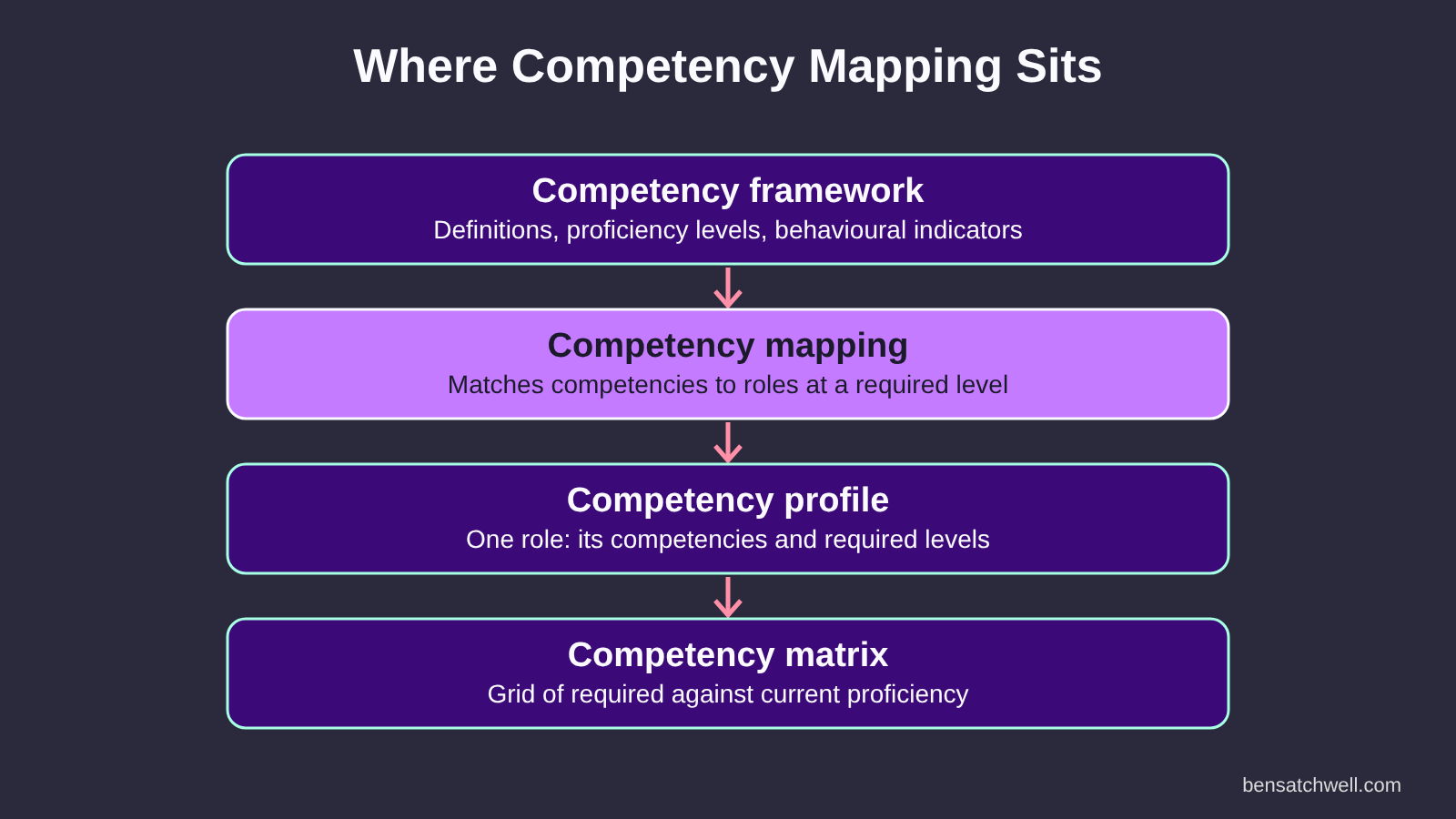
Competency mapping is the work of recording which competencies each role requires, at what proficiency level, and sometimes which of those competencies each person currently holds. It is not a framework and it is not a gap report. It sits between them. If you do not yet have a standard to map against, start with the competency framework, because a map is only as consistent as the framework behind it.
Most mapping projects stall because nobody agrees what the output is. One team produces a spreadsheet of job duties, another a list of personal traits, and a third a heat map. All three get called competency mapping. I separate the activity, the input and the output so the work can be checked.
What is competency mapping?
Competency mapping is the process of matching the competencies in a competency framework to roles, and optionally to people, at a defined proficiency level for each. The input is the framework: competency definitions, proficiency levels and behavioural indicators. The output is a record of required levels per role, and where people are assessed, current levels per person.
The US Office of Personnel Management defines a competency as "a measurable pattern of knowledge, skills, abilities, behaviors, and other characteristics" that a person needs to do work successfully. Its competency guidance lists the uses a map supports: selecting candidates, managing performance, workforce planning and employee development. Those uses decide how detailed the map needs to be.
Why does competency mapping exist?
A framework describes the whole organisation. A decision about one person or one role needs something narrower. Mapping is the step that turns the general standard into a specific expectation: this role needs this competency at level three, not level five.
Without that step, the same competency means different things in different teams. A manager in finance and a manager in operations both write "strong communicator" on a position description and mean different standards. Mapping forces the choice of level, and the level is defined by the framework, not by the author of the role.
A note on terminology. A competency framework is also called a competency model, especially in the United States. I use competency profile for the competencies and required levels for one role, and competency matrix for the grid of required against current proficiency. Usage varies by region, and I explain the differences in this competency model definition.
How does competency mapping work in practice?
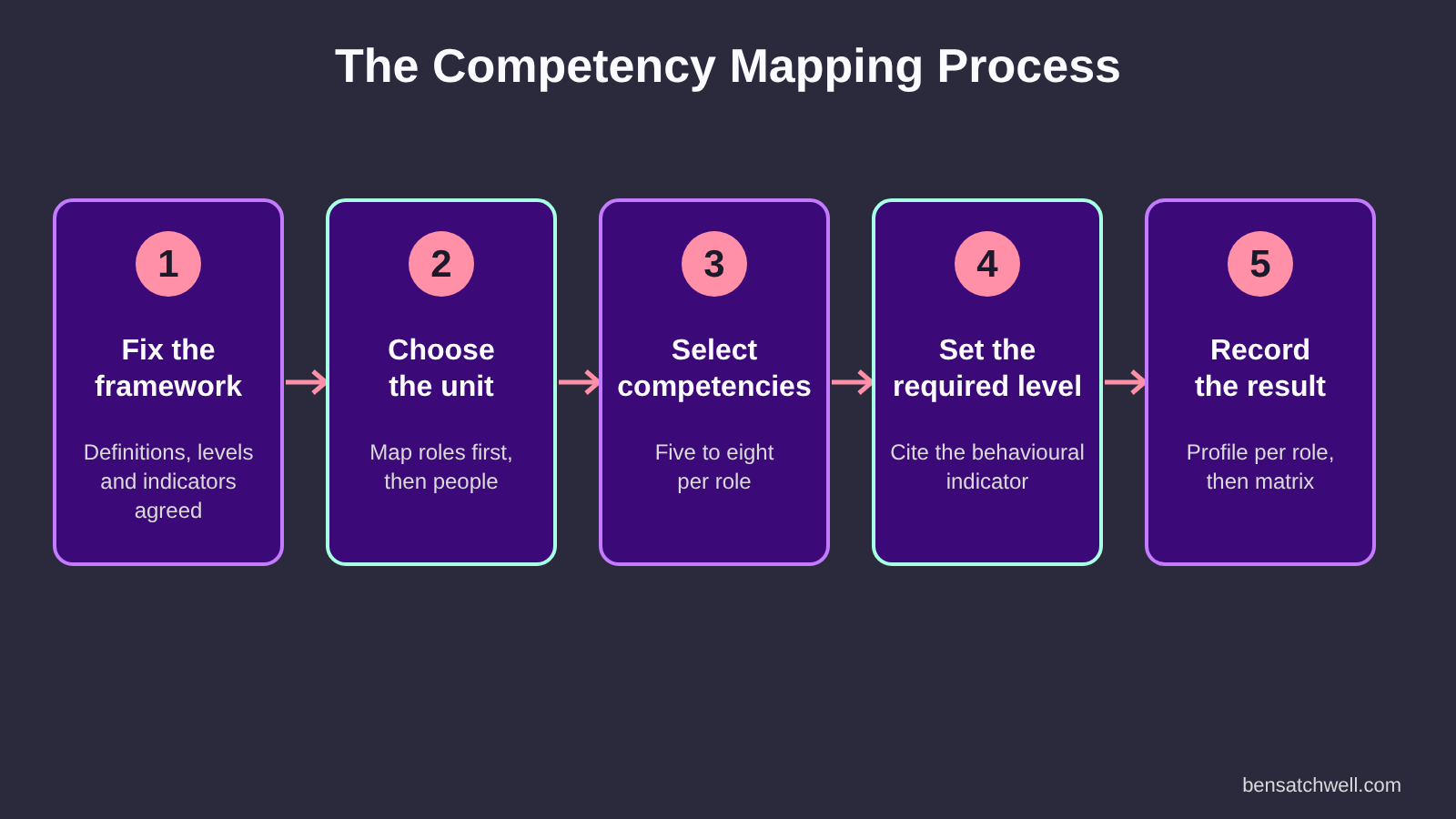
The process has five steps. Each produces something you can review.
1. Fix the framework first
Confirm that every competency has a definition, a set number of proficiency levels and behavioural indicators at each level. If the levels are vague, the map will be vague. The competency framework levels article covers how scope, autonomy and impact separate one level from the next.
2. Choose the unit you are mapping
Map roles, not individuals, in the first pass. A role is a stable unit. People move, and a map built around the person is out of date within a year. Group roles into job families so that similar roles share a base profile.
3. Select competencies for each role
Choose the few competencies that separate good from average performance in the role. Five to eight is a workable range. A role with twenty competencies is a list of tasks. Use evidence: job analysis, performance data, and interviews with people who do the work well.
4. Set the required level
For each selected competency, assign a proficiency level and cite the behavioural indicator that justifies it. This is the part that matters most. Level is set by the complexity of the work, the autonomy given and the impact of the decisions, not by seniority or tenure. The SFIA Foundation uses the same logic: its seven levels of responsibility describe, for example, level 4 as working "autonomously under general direction" and level 6 as having "significant organisational influence".
5. Record the result in a usable form
The result for one role is a competency profile. Many profiles side by side, or profiles against assessed people, become a matrix. The competency matrix article shows how to build that grid, and the job competency matrix article explains where it breaks.
A short worked example
Take a payroll officer role in a framework with four proficiency levels. The map selects six competencies. Accuracy and attention to detail is required at level 3, because the officer works independently and checks the work of others. Stakeholder communication is required at level 2, because the officer handles routine queries but escalates complex ones. Each entry cites the behavioural indicator that justifies the level, such as "reconciles payroll exceptions without supervision". When a payroll supervisor role is mapped next, it reuses the same competencies at higher levels, and the difference between the two roles becomes visible and defensible.
What is competency mapping not?
Four confusions come up repeatedly.
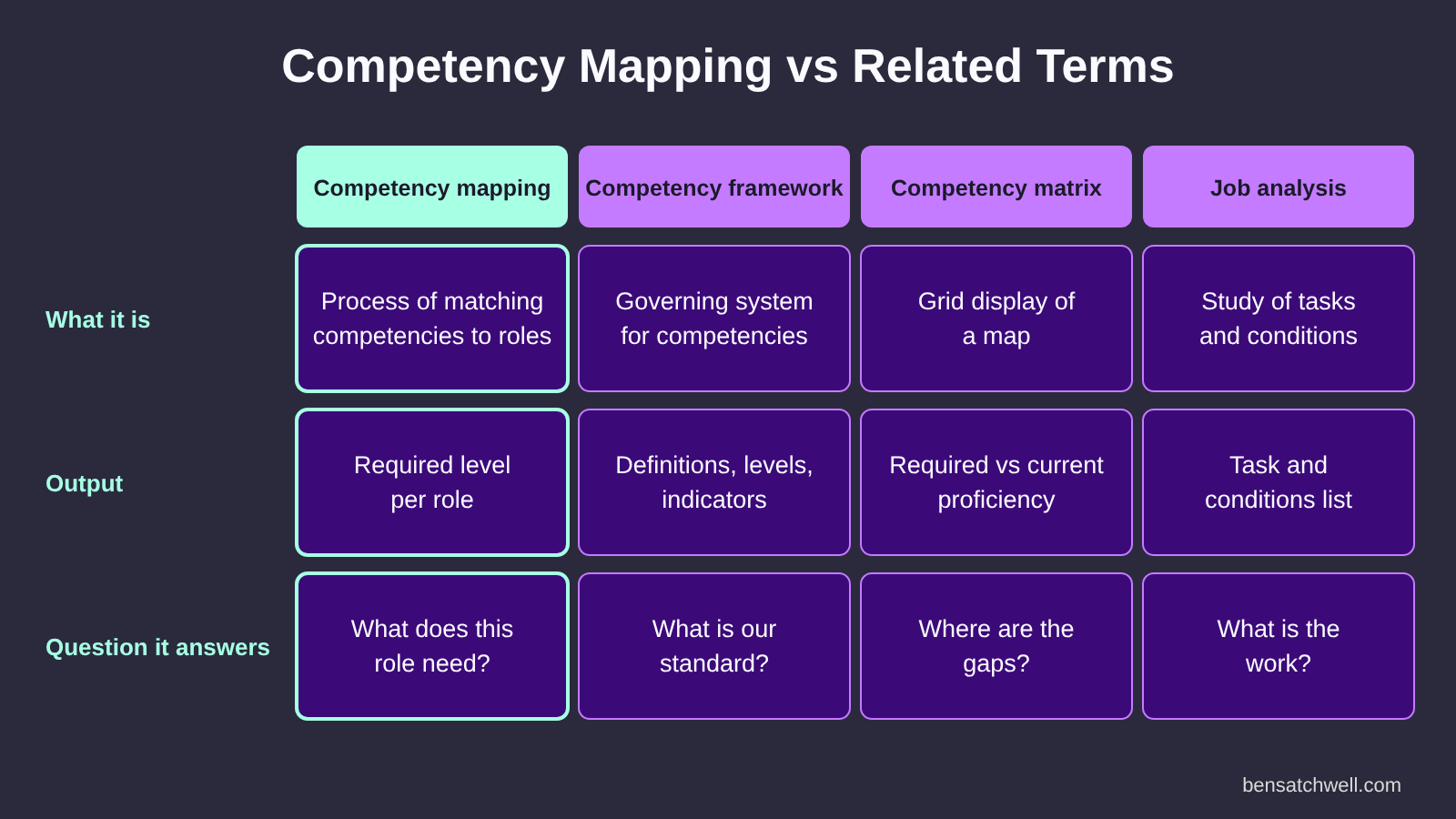
- Not a competency framework. The framework is the governing system. Mapping applies it.
- Not a competency matrix. The matrix is one way of displaying a map. You can map without drawing a grid.
- Not job analysis. Job analysis describes tasks and conditions. Mapping describes the competencies needed to perform them.
- Not skills mapping. A skill is a discrete learned ability. A competency integrates skills, knowledge, judgement and behaviour in the context of a role. Mapping skills produces a longer, shorter-lived list.
It is also not a performance rating. A map states what the role requires. Assessment, covered in the competency assessment framework article, states what a person demonstrates against it.
Which standards use competency mapping?
The structure is not new. The US Department of Labor's O*NET programme rates each occupation's knowledge, skills and abilities on an importance scale from 1 to 5 and a level scale from 0 to 7. That is a role-to-descriptor map at national scale. OPM's MOSAIC studies, which identified critical competencies and tasks for nearly 200 federal occupations, are another.
Both examples show the same pattern: a fixed descriptor set, a rating scale, and a record for each occupation. A map inside one organisation follows that pattern at a smaller scale, with the competency framework playing the part of the descriptor set and the proficiency levels playing the part of the rating scale.
What are the common failure modes of competency mapping?
- Mapping before the framework is stable. Every change to a definition forces the map to be redone.
- Too many competencies per role. The map becomes a task list and nobody uses it.
- Levels set by seniority. Senior roles get high levels by default, which hides real differences in complexity.
- Self-rated current levels. People rate themselves generously, so the gap analysis shows nothing. Use evidence against the behavioural indicators.
- Mapping people before roles. The data goes stale as soon as someone changes position.
- No owner. Without someone accountable for updates, the map becomes a one-off document.
What are the trade-offs of competency mapping?
Mapping gives consistency and comparability, and it costs effort to build and maintain. It suits organisations with enough roles that inconsistency causes real problems: grading disputes, uneven selection standards, unclear development paths. For a team of twenty with a few distinct roles, a short competency profile for each role is enough and a full map is overbuilt.
There is a second trade-off between precision and durability. Detailed required levels per competency are precise but need updating as work changes. Broader bands last longer but give less guidance. Choose based on how fast the roles change.
Frequently asked questions about competency mapping
What is competency mapping in HR?
It is the process of assigning competencies from a framework to roles at a required proficiency level, and optionally recording each person's assessed level against them.
What is the difference between competency mapping and a competency matrix?
Mapping is the activity and the matrix is a display of the result. A matrix shows required against current proficiency in a grid.
How many competencies should I map to a role?
Five to eight is a workable range. Beyond that, the profile starts to describe tasks rather than the competencies that separate strong performance.
Do I need a competency framework before I start mapping?
Yes. Mapping selects from the framework's competencies and levels. Without a framework, each map invents its own definitions and the results cannot be compared.
Is competency mapping the same as skills mapping?
No. Skills mapping lists discrete abilities. Competency mapping records integrated performance at a defined level in a role, so it is broader and lasts longer as tools change.
How often should a competency map be updated?
Review role maps when the role changes materially and at least once a year. Update the framework less often, because every framework change flows into every map.