
Most organisations that say they are assessing competencies are actually just filling in a competency matrix and calling it assessment. A competency assessment framework is a different thing. It is the governing system that defines how competence is measured, against what evidence, using which methods, and with what decision rules, applied consistently across roles and assessors. Without it, "competency assessment" means whatever the person holding the pen that day decides it means.
What Is a Competency Assessment Framework
A competency assessment framework is the structured system an organisation uses to determine whether a person demonstrates a competency to the proficiency level required, based on defined evidence, consistent methods, and clear decision rules applied the same way across assessors.
It sits downstream of the competency framework, the organisation-wide system that defines, groups and standardises competencies in the first place. The competency framework tells you what good looks like at each proficiency level, stated as behavioural indicators. The assessment framework tells you how you find out whether a real person, in a real role, actually meets that standard.
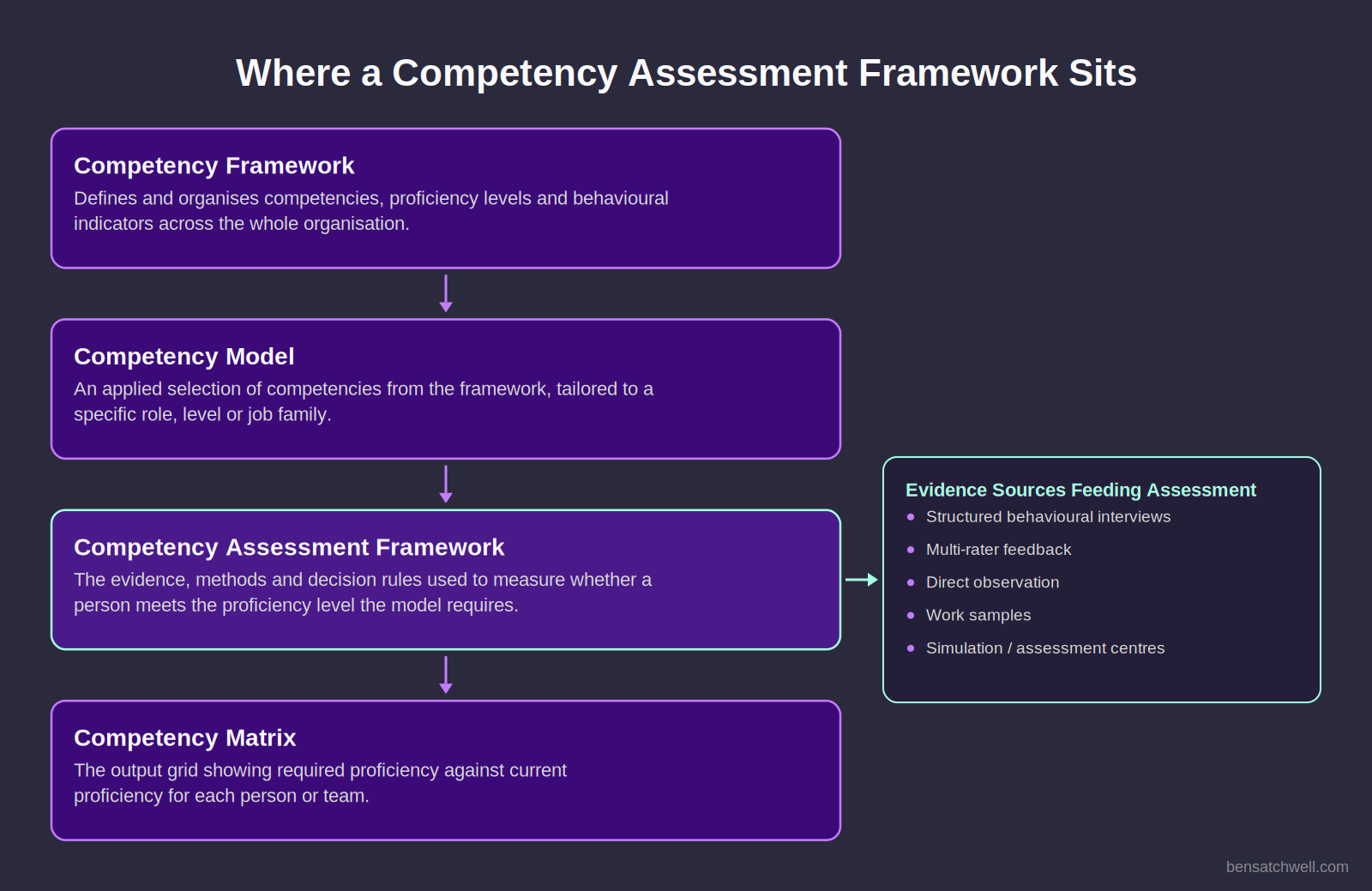
Where a competency assessment framework sits relative to the competency framework, competency profile and competency matrix.
A note on terminology. A competency framework is also called a competency model, especially in the United States. I use competency profile for the competencies and required levels for one role, and competency matrix for the grid of required against current proficiency. Usage varies by region, and I explain the differences in this competency model definition.
Why a Competency Assessment Framework Exists
Behavioural indicators are only useful if someone can judge against them consistently. Left to individual managers, that judgement drifts. One manager rates generously because they like the person. Another anchors every rating to "meets expectations" regardless of evidence. A third confuses recent performance with sustained competence.
A competency assessment framework exists to close that gap. It converts a set of written indicators into a repeatable decision process: what evidence counts, who provides it, how disagreement between raters is resolved, and what threshold separates "developing" from "proficient." Without that process, the organisation is left with competence in name only, what Lester calls fitness for purpose, asserted rather than demonstrated.
There is also a fairness dimension. Promotion, pay progression and access to senior roles are frequently tied to assessed competence. If the assessment method is inconsistent, those decisions are inconsistent too, and the organisation is exposed to exactly the kind of bias a competency framework was meant to remove. A defined assessment framework is what makes a competency framework usable as a basis for decisions rather than a reference document that sits on a shared drive.
How a Competency Assessment Framework Works in Practice
Evidence Sources
A workable assessment framework specifies where evidence comes from before anyone is assessed. Common sources include structured behavioural interviews, multi-rater feedback, direct observation, work samples, and simulation exercises such as assessment centres. The framework should state which sources apply to which competency domain, since a technical competency is usually better evidenced by a work sample than by a colleague's general impression.
Assessment Matrices in Vocational Education (RTO Contexts)
In Australian vocational education and training, an assessment matrix for a unit of competency is a specific compliance document. Registered Training Organisations map each unit of competency to the assessment methods, evidence types and performance criteria used to determine competent or not yet competent outcomes, as required under the national VET Quality Framework. This is a narrower, more prescriptive use of "competency assessment" than the organisational frameworks covered here, built for regulatory compliance rather than internal talent decisions, but it draws on the same underlying logic of tying evidence explicitly to defined competency standards.
The OECD's own competency framework is a useful public example. It defines behavioural indicators at each proficiency level for every core competency, and pairs them with guidance on how interview panels and assessors should weigh evidence against those indicators rather than against general impressions of the candidate.
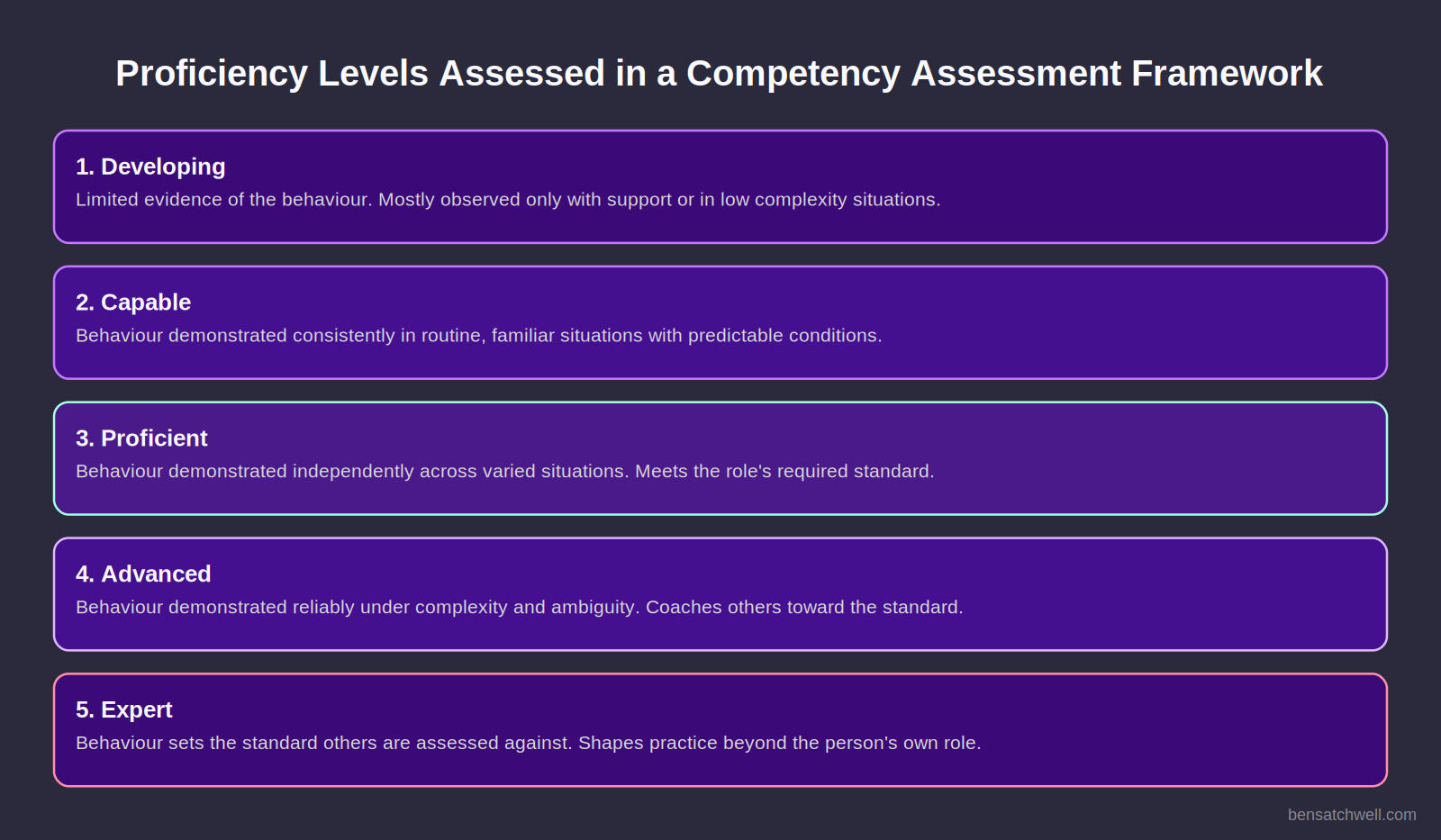
The proficiency levels a competency assessment framework typically measures against, from developing to expert.
Decision Rules and Calibration
A proficiency level is meaningless if two assessors looking at the same evidence reach different conclusions. Calibration sessions, where assessors compare ratings and evidence before scores are finalised, are what keep a framework defensible. Without calibration, ratings reflect the assessor more than the person being assessed.
The CIPD's factsheet on competence and competency frameworks is a useful general reference on applying frameworks consistently, including how people who use them are prepared to apply them.
Where Assessment Sits Against the Profile
The assessment framework is applied against a competency profile, the competencies and required levels for a specific role or job family, rather than against the full competency framework directly. This keeps the assessment focused on what the role actually requires, not every competency the organisation has ever defined. For a worked example, see how to assess an HR business partner.
What a Competency Assessment Framework Is Not
It is not the competency framework itself. The framework defines and organises competencies; the assessment framework measures people against them. Conflating the two is why so many organisations build an excellent framework document and then have no consistent way to actually use it.
It is not a competency matrix. A matrix is the grid that displays the result, required proficiency against current proficiency, for a person or team. It is an output of assessment, not the assessment process itself.
It is not a performance review. Performance review typically blends competency, output against targets, and conduct into a single rating cycle. A competency assessment framework is narrower and more precise: it measures demonstrated competence against defined indicators, independent of whether targets were hit in a given period.
It is not a certification exam. Certification tests knowledge or technical skill against a fixed pass mark at a point in time. Competency assessment is concerned with sustained, contextual performance, which is why it typically draws on evidence gathered over a period rather than a single test event.
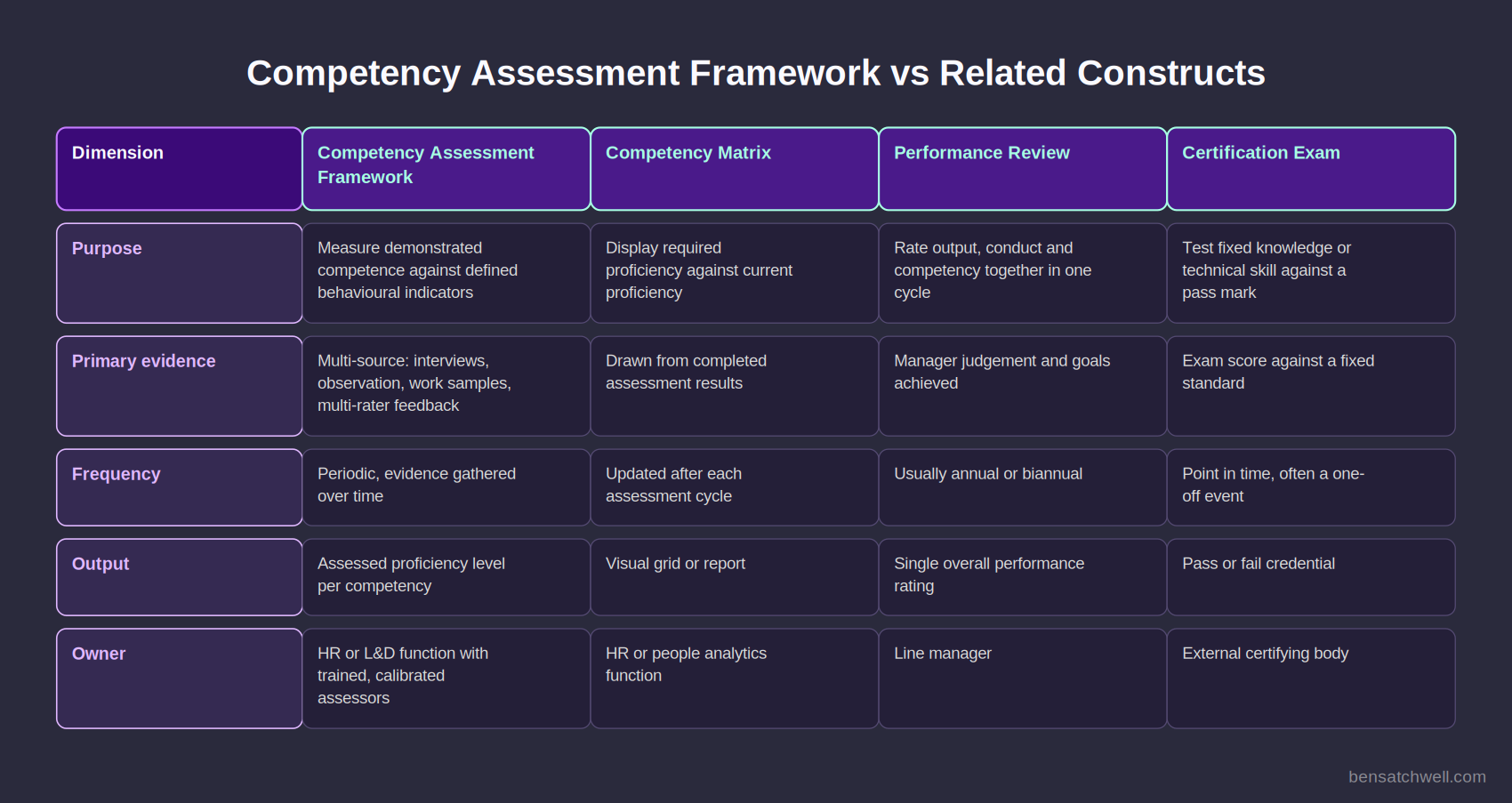
How a competency assessment framework compares with a competency matrix, performance review and certification exam.
Named Frameworks and Standards
Several established frameworks build assessment logic directly into their structure rather than leaving it as an afterthought. SFIA defines skills with levels of responsibility and expects evidence of application, not just familiarity. Korn Ferry and Lominger libraries are frequently paired with assessment centre methodology for leadership pipelines. The OECD framework cited above does the same for public sector recruitment and promotion decisions.
Assessment also has to account for the difference between assessing competency and assessing capability. A capability and competency framework typically needs two distinct assessment approaches, since capability is broad and transferable across roles, while competency is role-specific and contextual. Using a single assessment instrument for both tends to produce shallow results for one or the other.
Common Failure Modes
The most common failure is relying on self-assessment alone. People are poor judges of their own competence, particularly at the lower end of proficiency, where the gaps in their knowledge are also the gaps in their ability to recognise those gaps. A framework that stops at self-rating is collecting opinion, not evidence.
A second failure is writing indicators in evaluative rather than descriptive language. "Communicates effectively" tells an assessor nothing about what to look for. A usable indicator describes an observable behaviour at a specific level, so two assessors looking at the same evidence reach the same conclusion.
A third failure is treating assessment as a single event rather than a programme of evidence gathered over time. Research into programmatic assessment in competency-based education, summarised in a peer-reviewed analysis of validity evidence, found that a single assessment point produces weaker validity than multiple data points triangulated across methods and assessors. The same logic applies outside education: one interview is not assessment, it is a snapshot.
A fourth failure is skipping calibration entirely, which lets rating inflation set in within a year or two as managers learn that generous ratings cause less friction than accurate ones.
A fifth failure is running the assessment framework once and never revisiting it. Roles change, behavioural indicators that were precise three years ago drift out of date, and the assessors who were calibrated at launch move on without anyone calibrating their replacements. An assessment framework needs the same governance as the competency framework underneath it, not a one-off rollout treated as finished.
Trade-offs and Constraints
A full competency assessment framework, with multiple evidence sources, calibration sessions and trained assessors, is resource intensive. It is justified where the cost of getting it wrong is high: regulated professions, safety-critical roles, and senior leadership pipelines where a poor promotion decision is expensive to reverse.
For lower-stakes roles, a lighter self-and-manager rating process against a competency matrix is often proportionate, provided the organisation is honest that it is a lighter process and does not present matrix scores with the same confidence as evidence-based assessment.
Either way, the assessment framework only works if the underlying competency framework is sound first. Creating a competency framework with clear, levelled, behavioural indicators is the precondition for assessment, not a parallel exercise. An assessment process built against vague or inflated indicators will produce vague or inflated results no matter how rigorous the method.
Competency Assessment Framework FAQ
What is the difference between a competency framework and a competency assessment framework?
A competency framework defines and organises competencies, proficiency levels and indicators. A competency assessment framework defines how people are measured against that framework, including evidence sources, methods and decision rules.
How do you assess competency objectively?
Use multiple evidence sources rather than self-rating alone, write indicators as observable behaviours rather than evaluative statements, and run calibration sessions so assessors reach consistent conclusions from the same evidence.
Is a competency matrix the same as a competency assessment framework?
No. A competency matrix is the grid that displays assessment results, required proficiency against current proficiency. It is an output of the assessment process, not the process itself.
How many proficiency levels should a competency assessment framework use?
Most workable frameworks use four to six levels, set by scope, autonomy, complexity and impact rather than seniority or years of service. More than six levels usually adds administrative load without improving the precision of the assessment.
What is the difference between competency assessment and a performance review?
A performance review typically blends competency, output against targets and conduct in one cycle. Competency assessment is narrower: it measures demonstrated competence against defined behavioural indicators, independent of whether targets were met in a given period.
Who should conduct competency assessment?
Trained assessors using calibrated, multi-source evidence produce more consistent results than a single manager working from memory. For higher-stakes roles, structured methods such as assessment centres or panel interviews reduce the influence of any one assessor's bias.