
Behavioral competencies (spelt behavioural competencies in Australia and the UK) are the part of a competency framework that describes how people work, not what they know. Most organisations list them as adjectives such as "collaborative" or "resilient" and call the job done. That list is not a competency. It has no definition, no levels and nothing an assessor can observe.
I treat behavioural competencies as one domain inside a competency framework, written as observable behaviour at defined proficiency levels. This page sets out what they are, how they are built and where they go wrong.
What are behavioral competencies?
A behavioural competency is a defined area of performance, expressed as observable behaviour at stated proficiency levels, that describes how work is done in a role.
The key phrase is observable behaviour. A behaviour is an act a person performs in a specific situation, which means it can be witnessed and recorded. Knowledge, skills and attitudes sit underneath it, but only the behaviour is visible, so only the behaviour can be assessed.
Behavioural competencies are usually contrasted with technical (or functional) competencies, which cover the specialist knowledge and skills a role requires. Behavioural competencies are broader and are usually shared across roles, for example communication, collaboration, decision making and accountability.
The US Office of Personnel Management defines a competency as a measurable pattern of knowledge, skills, abilities, behaviors and other characteristics needed to perform work successfully. Behaviour is one of the named components, which is why behavioural competencies belong inside the competency construct and not beside it.
Why do behavioural competencies exist?
Two roles with identical technical requirements can produce very different results because people differ in how they work with others, handle ambiguity and make decisions. Technical competencies cannot explain that gap. Behavioural competencies exist to make it describable, comparable and open to development.
They also give an organisation a shared language. Without one, a manager's "not a team player" and another manager's "too independent" describe the same person, and neither can be tested. A behavioural competency with levelled indicators replaces opinion with a stated standard.
A note on terminology. A competency framework is also called a competency model, especially in the United States. I use competency profile for the competencies and required levels for one role, and competency matrix for the grid of required against current proficiency. Usage varies by region, and I explain the differences in this competency model definition.
How do behavioural competencies work in practice?
A usable behavioural competency has four parts: a name, a one or two sentence definition, a set of proficiency levels and behavioural indicators at each level. The levels are set by scope, autonomy, complexity and impact, not by seniority or years of service. Four to six levels is workable. More than that and the differences become too fine to assess.
An example: collaboration across four levels
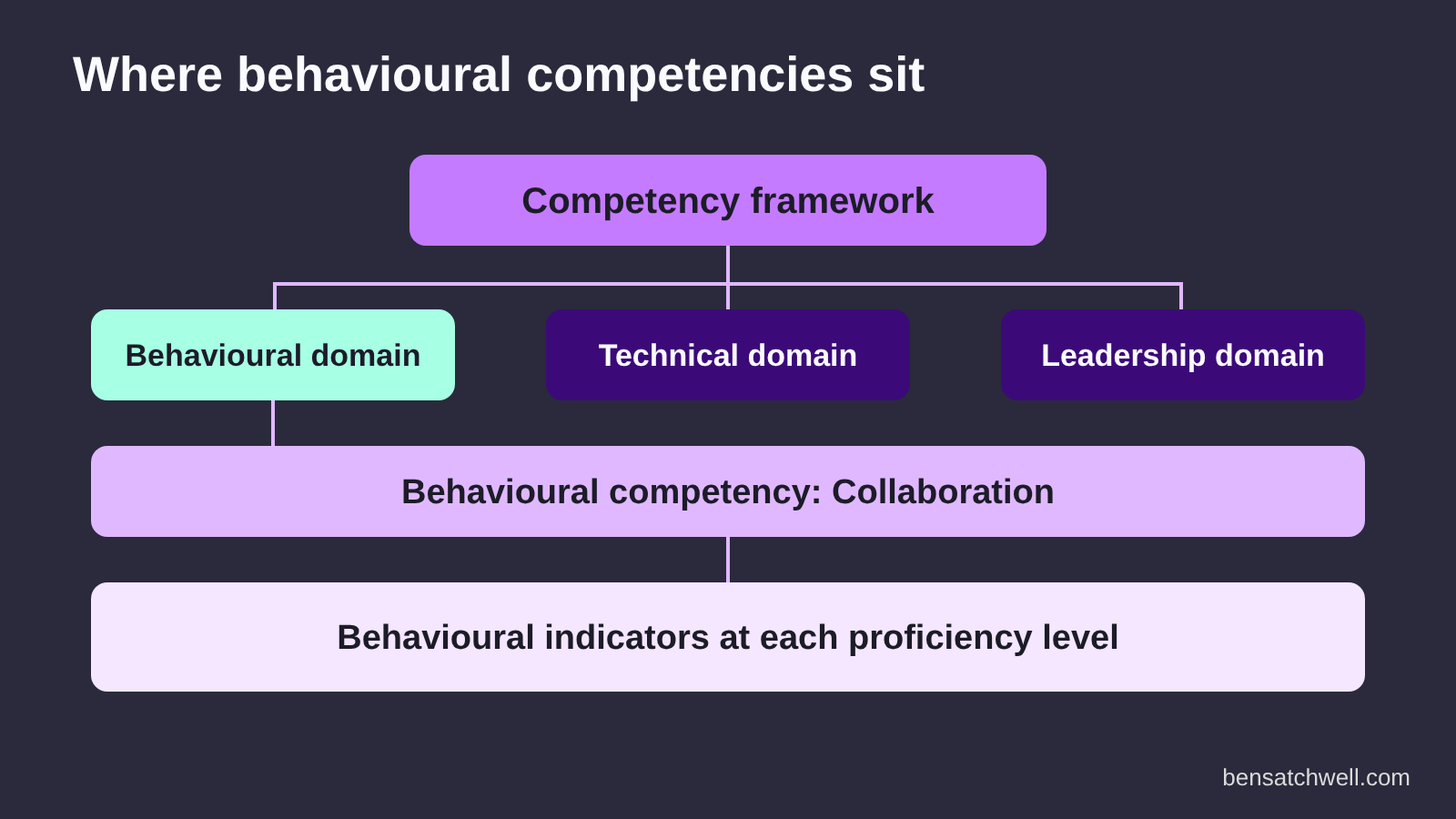
Where behavioural competencies sit inside a competency framework.
| Level | Scope | Behavioural indicator |
|---|---|---|
| 1. Contributes | Own tasks | Shares information with the team and responds to requests on time. |
| 2. Coordinates | Team | Aligns own work with colleagues' priorities and raises conflicts early. |
| 3. Connects | Across teams | Builds working agreements between teams with competing priorities. |
| 4. Shapes | Organisation | Sets the conditions that let separate functions deliver shared outcomes. |
Each indicator is a statement about what a person does, in a situation, at a scope. None describes a trait. I cover the levelling logic in more detail in competency framework levels.
How are behavioural competencies assessed?
Assessment collects evidence of behaviour and compares it with the indicators. Typical evidence is structured interview examples, manager observation and feedback from peers. The standard is the indicator text, so two assessors reading the same evidence should reach the same level. The method is covered in competency assessment framework.
How do you choose which behavioural competencies to include?
Start from the work, not from a generic list. Identify the behaviours that separate strong from average performance in the role, then group similar ones under a single name. Test each draft competency with one question: could two managers watch the same person and agree on whether the indicator was met? If not, rewrite the indicator until they could. Keep the final set small enough that each competency can be assessed with real evidence.
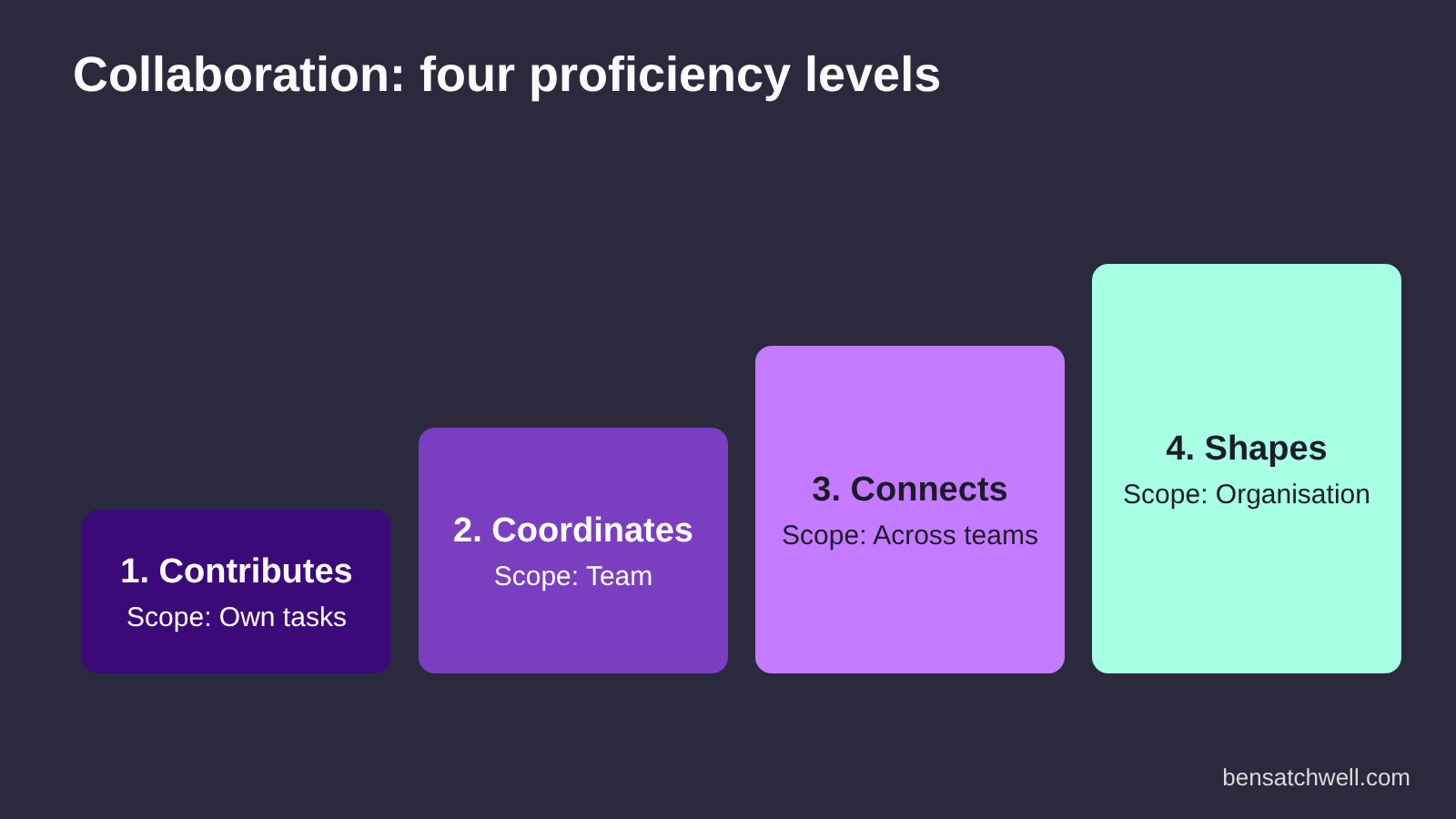
Four proficiency levels for a behavioural competency, from individual to organisational scope.
What are behavioural competencies not?
- Not personality traits. Traits are stable attributes inferred from behaviour. A competency describes behaviour a person can demonstrate and develop at a stated level.
- Not values. Values state what an organisation believes. Behavioural competencies state what performance looks like. A competency and values framework can hold both, but the two are separate constructs.
- Not soft skills. The popular label suggests something easy to acquire. Most of what the market calls soft skills are broad, durable capabilities, and behavioural competencies are how a role expresses them as observable performance.
- Not technical competencies. These cover role-specific expertise. Behavioural competencies describe how that expertise is applied.
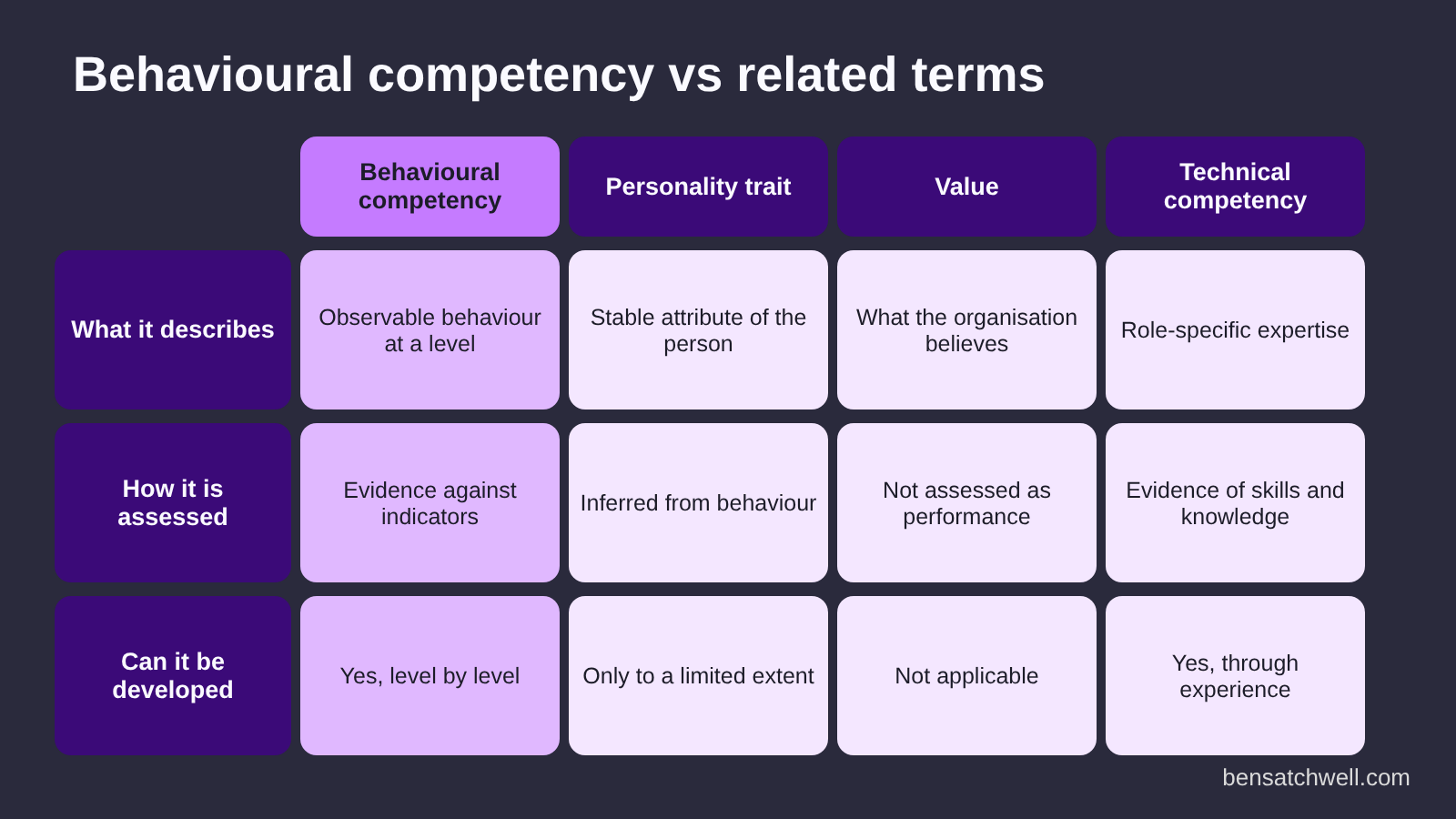
Behavioural competencies compared with traits, values and technical competencies.
Which standards define behavioural competencies?
Three public references show the construct in use. The UK Civil Service Success Profiles name behaviours as one of five elements, defined as the actions and activities that people do which result in effective performance in a job. The behaviours are written at grade level, so the same behaviour reads differently at different grades.
The CIPD Profession Map lists core behaviours as one of its three types of standard, and sets out behaviours that apply regardless of career level or specialism. OPM publishes leadership proficiency levels with examples of work behaviour at each level, which is the structure shown above.
All three separate the behaviour from the technical requirement, and all three tie behaviour to a level or grade. A behaviour with no level is a label.
Where do behavioural competencies fail?
- Adjective lists. The competency is a single word with no definition or indicators, so every assessor reads it differently.
- One description for every level. If a graduate and an executive share the same indicator, the framework cannot show progression.
- Too many competencies. Twenty behavioural competencies cannot be assessed in one conversation. Most roles need five to eight.
- Evaluative indicators. Words such as "excellent" or "strong" judge the person. They do not describe what was done.
- Ratings with no evidence. A score without a recorded example cannot be defended or calibrated.
These failures share a cause. The framework was written as a list to approve, not as a standard to assess against. The same pattern sits behind the questions in character and competency frameworks, where character traits are mixed with performance standards.
What are the trade-offs and constraints?
Behavioural competencies suit roles where how the work is done changes the outcome, such as management, client work and project delivery. They add little for roles where the output is fully specified by task and technical standard.
Shared behavioural competencies create consistency but can read as generic. The usual fix is to keep a small common set for everyone and add role-specific indicators where the context changes what the behaviour looks like. The cost is maintenance. Every added indicator needs an owner and a review date.
Behaviour is also context dependent. An indicator that holds in one culture or country may read differently in another, so test the wording with the people who will be assessed against it.
Frequently asked questions
What is the difference between behavioral and technical competencies?
Technical competencies cover the specialist knowledge and skills a role needs. Behavioural competencies describe how a person applies them: how they communicate, decide and work with others. Both are written as observable performance at levels.
What are examples of behavioral competencies?
Common examples are communication, collaboration, decision making, accountability, adaptability and customer focus. Each only becomes a competency when it has a definition, levels and behavioural indicators.
Are behavioral competencies the same as soft skills?
No. Soft skills is a popular label for interpersonal attributes. A behavioural competency is a defined, levelled standard that can be assessed. Many soft skills are better understood as capabilities that a behavioural competency makes observable.
How many behavioural competencies should a framework have?
Most roles need five to eight. A framework as a whole may hold more, grouped into domains, but any one role profile should stay short enough to assess properly.
How do you measure behavioral competencies?
Compare recorded evidence of behaviour, such as interview examples and observed work, with the indicators at each level. The indicator text is the standard, not the assessor's impression.
Do I write behavioral or behavioural competencies?
Use behavioral in the United States and behavioural in Australia, the UK and most of the Commonwealth. The construct is identical.