

Competency Model in HRM
In human resource management, "competency model" gets used to mean whatever the speaker needs it to mean that day. A competency model in HRM is sometimes treated as shorthand for the whole competency framework, sometimes as a job description with better formatting, and sometimes as the entire performance system, competencies, ratings, pay bands and all. None of these are correct, and the conflation is not harmless. It is the reason HR teams build a competency model, watch it sit unused in a folder, and conclude that "competencies don't work" when the actual problem was that nobody built the thing the term describes.
What Is a Competency Model in HRM?
A competency model in HRM is an applied, role-specific selection of competencies drawn from the organisation's competency model framework, set against a defined job, level or job family, and used as the working reference for a specific HR decision. If the framework is the governing system that defines and standardises competencies across the whole organisation, the model is a single instance of it, built for one purpose.
A competency model for a finance manager role, for example, draws its behavioural and technical competencies from the framework, but only the subset relevant to that role, levelled for that seniority. It is not the framework itself, and it is not a job description. A job description states what a person is accountable for. A competency model states what good performance in that role actually looks like, described as observable behaviour.
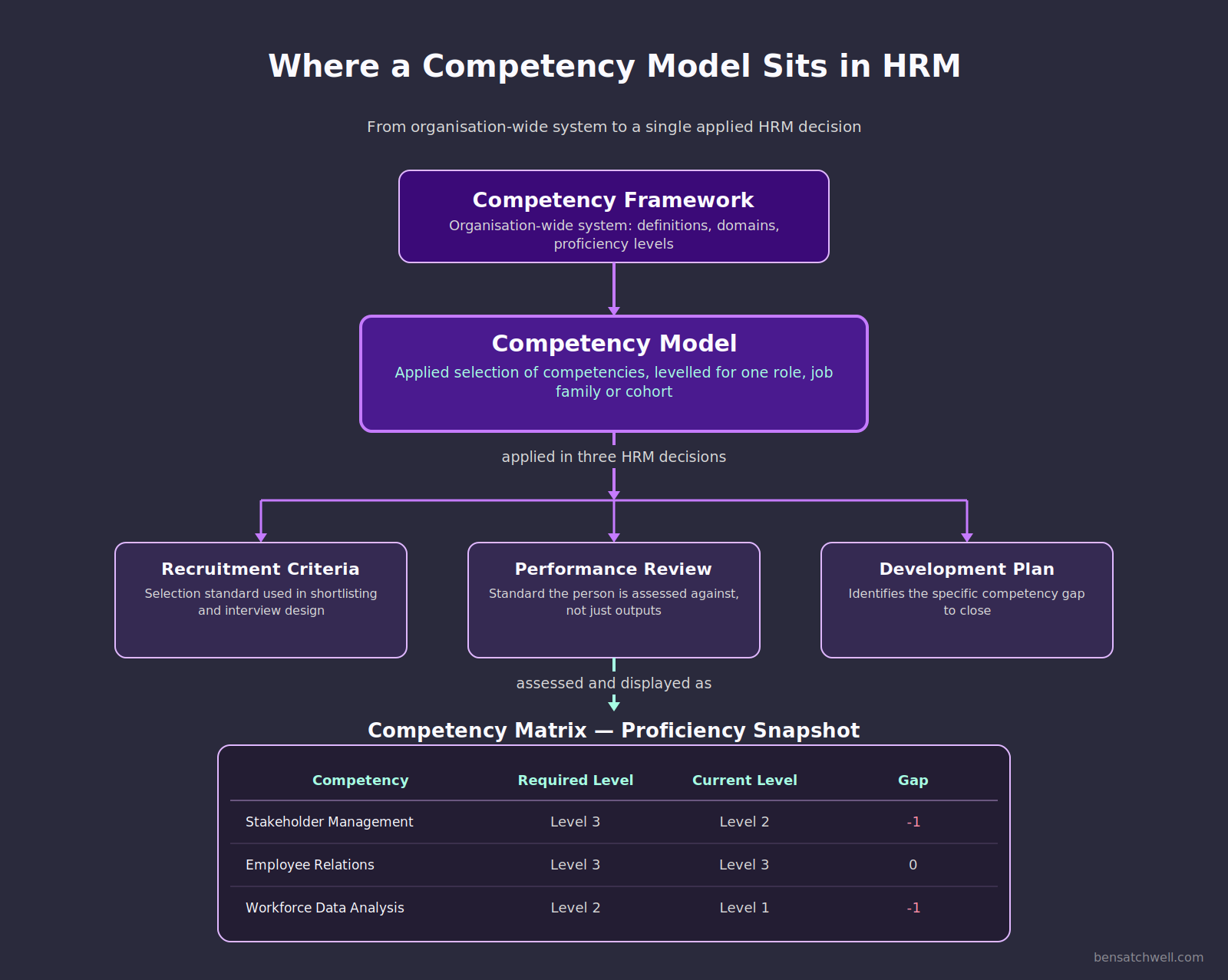
Where a competency model in HRM sits between the organisation-wide framework and everyday HR decisions.
Why It Exists
HRM needs a consistent, defensible basis for decisions that are otherwise made on gut feel: who to hire, who is ready for promotion, what a development plan should focus on, and what "good" means in a given role. Without a competency model, each of those decisions gets made against a different, unwritten standard, and the standard usually varies by manager.
The functional reason competency models exist in HRM is comparability. A framework on its own is too abstract to apply directly to a recruitment shortlist or a performance review. It needs to be translated into something specific enough to assess a real person against. That translation, from organisation-wide framework to role-specific application, is what a competency model does. It is the layer where strategy becomes an actual hiring criterion or a real development conversation.
How It Works in Practice
Once built, the model gets used across several distinct HRM processes: it shapes selection criteria and interview structure in recruitment, it provides the standard a performance review is measured against, and it identifies the specific gap a development plan should close. My earlier piece on the competency model sets out this build sequence in more depth, including where organisations typically go wrong on level-setting.
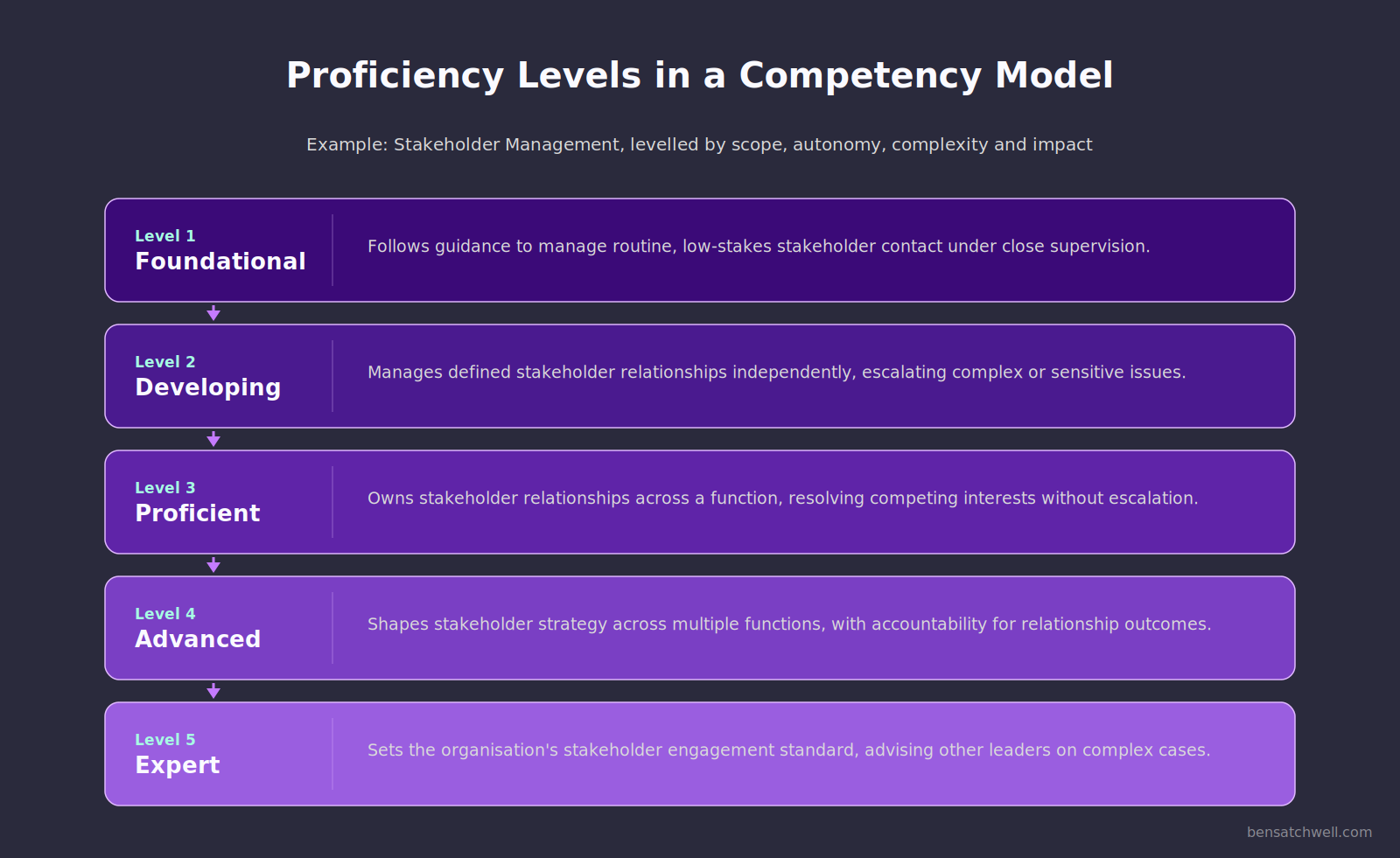
Proficiency levels in a competency model in HRM, shown against a single competency.
Competency Model vs Related HRM Constructs
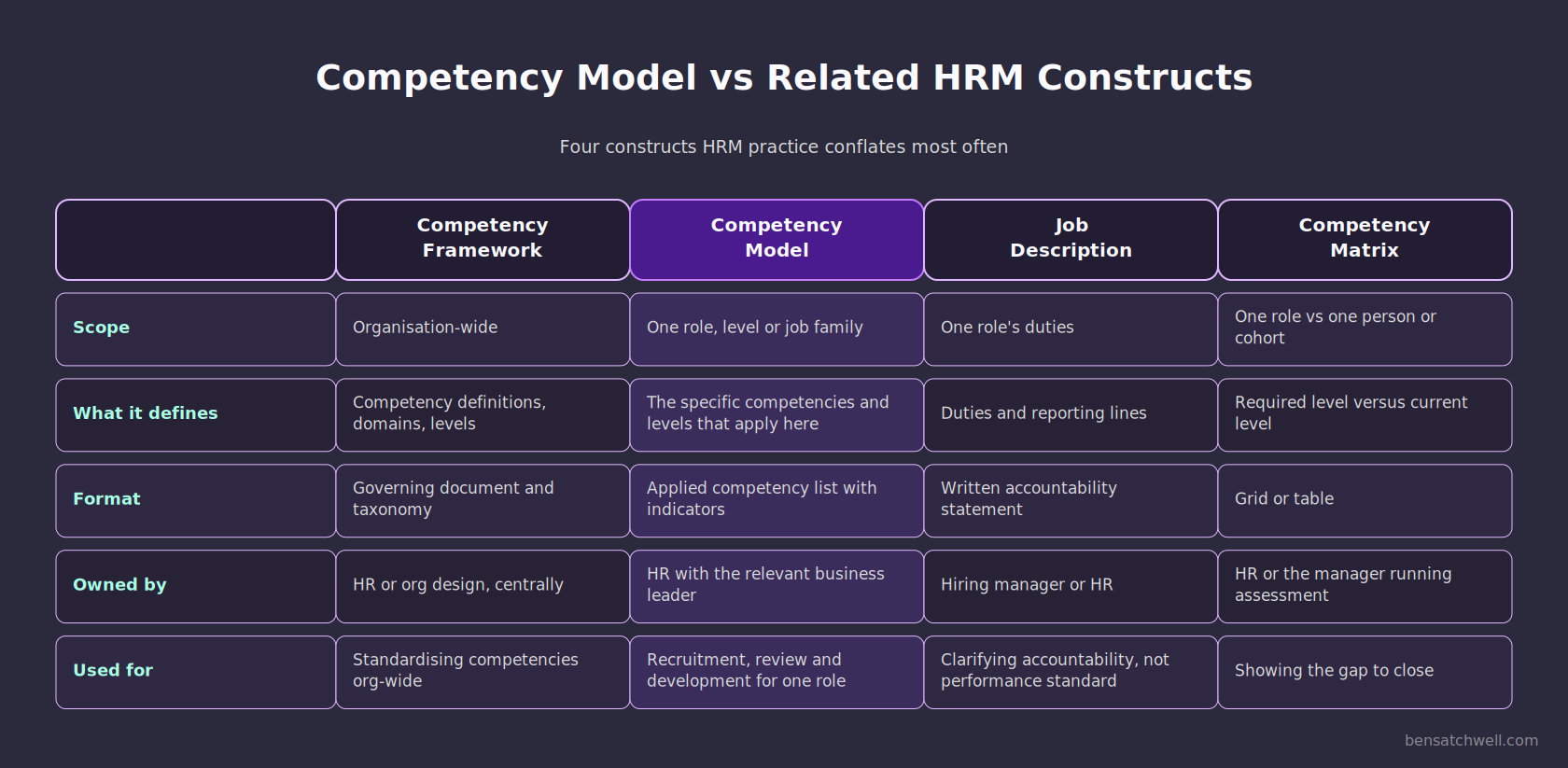
How a competency model in HRM compares with the framework, job description and matrix it is most often confused with.
Named Frameworks and Standards in HRM
The two most visible competency models in the HRM discipline itself are worth knowing, because they are frequently cited as if they were generic best practice rather than specific, bounded instruments.
The SHRM Body of Applied Skills and Knowledge, formerly the SHRM Competency Model, defines eight behavioural competencies (in its 2026 edition) plus a technical knowledge domain for HR professionals specifically. It is a competency model for people who work in HRM, not a template for building competency models for other functions.
CIPD's Profession Map takes a different structure again, organising core knowledge and core behaviours around being "an expert in people, an expert in work, and an expert in change." Korn Ferry and Lominger's competency libraries, by contrast, are built to be applied across any function, not just HR, which is closer to what most organisations need when building competency models for their broader workforce. My piece on HR competency models walks through how SHRM's and CIPD's approaches compare in more detail, and where each is actually the right reference point.
Common Failure Modes
The most common failure is building a competency model without a framework underneath it. HRM teams under time pressure often jump straight to writing competencies for a priority role, skipping the organisation-wide definitions and levelling logic. The result looks credible in isolation but cannot be compared against any other role, and the next model built the same way uses slightly different language for the same underlying competency.
A second failure is writing indicators as evaluative statements rather than observable behaviour. "Demonstrates strong leadership" is not a behavioural indicator, it is a conclusion. A usable indicator describes what that looks like in action, specific enough that two different assessors would reach the same rating.
A third is building the model once and never revisiting it. Roles change as work changes, and a competency model that hasn't been reviewed in several years is usually still being used to assess people against a version of the job that no longer exists.
The OECD's framework for HR management indicators in public administration makes a related point at system level: competency-based HR practices only function when there is alignment between the model, the line managers applying it, and the employees being assessed against it. A well-written model with no manager buy-in produces the same outcome as no model at all.
Trade-offs and Constraints
A competency model is worth building when a role is stable enough to define, high-volume enough to justify the investment, or critical enough that inconsistent assessment carries real risk. Leadership roles, technical specialisations, and any role with a formal career pathway attached are typical candidates.
It is not worth building a full model for every role in a small organisation, or for roles that are genuinely transient and likely to be redesigned within a year. In those cases, a lighter capability-based approach, focused on transferable strengths rather than role-specific competencies, usually serves HRM better. My article on human resources competencies covers how to decide which approach fits which situation, including where a matrix alone is enough without a full model behind it.
The other constraint is governance capacity. A competency model needs an owner who keeps it current as the role evolves. An HRM function that cannot commit to that maintenance is usually better served by fewer, broader models than by a large library of role-specific ones that will drift out of date at different rates.
Frequently Asked Questions
What is the difference between a competency model and a competency framework in HRM?
The framework is the organisation-wide system that defines and standardises competencies, proficiency levels and indicators. The model is one applied instance of that framework, built for a specific role, level or job family.
Is a competency model the same as a job description?
No. A job description lists duties and accountabilities. A competency model describes the standard of performance expected in the role, expressed as observable behaviour at defined proficiency levels.
Who owns competency models in an HRM function?
Typically HR or organisational design owns the framework and governance, while the model for a specific role is usually built or reviewed jointly with the relevant business leader, since they understand what good performance in that role actually requires.
How often should a competency model be reviewed?
Most organisations review models every two to three years, or sooner if the role's scope, technology or accountabilities change materially. A model built against a role that has since been redesigned is actively misleading if left unreviewed.
Can a small organisation use competency models without a full framework?
It is possible but risky. Without a framework underneath it, each model uses its own definitions and levels, which makes comparison across roles unreliable. A lightweight, shared framework is worth building even at small scale if more than a handful of models are planned.
Does SHRM's competency model apply outside the HR function?
No. The SHRM Body of Applied Skills and Knowledge is built specifically for HR professionals. It is a useful reference for how a professional body structures its own competency model, but it is not a template for competency models in other functions.