

Competency Framework Levels
Most competency frameworks I review have levels attached to them, and most of those levels are wrong. Not wrong in the sense of being badly written, wrong in the sense that nobody in the business can explain what actually separates level two from level three beyond a vague feeling that level three sounds more senior. Competency framework levels exist to solve a specific measurement problem. When organisations skip the discipline of setting them properly, the whole framework collapses into a list of nice-sounding statements with numbers next to them.
What Are Competency Framework Levels?
Competency framework levels are the defined stages of proficiency at which a given competency can be held or required, set inside the governance of a competency framework. Each level marks a genuine difference in scope, autonomy, complexity and impact, not a difference in job title, tenure or personality.
A competency framework level is the point on a defined proficiency scale, usually four to six stages, at which a specific competency is expected to be demonstrated to a defined standard of scope, autonomy, complexity and impact.
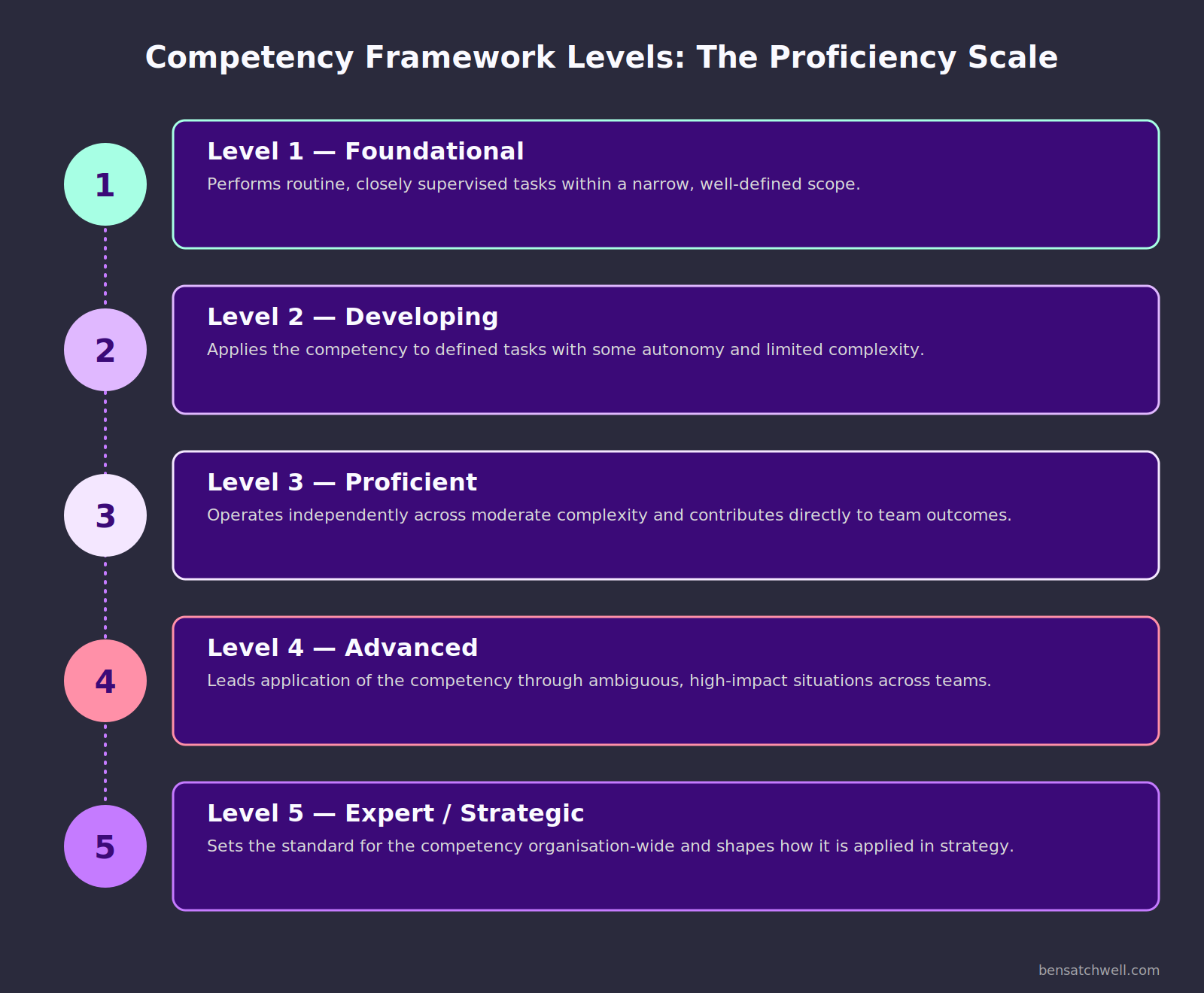
A workable framework typically runs to four or six levels. Fewer than that and the scale cannot capture a meaningful gradient of performance. More than that and the distinctions become indistinguishable in practice, and assessors start guessing which line to tick rather than recognising real differences in behaviour.
Why Competency Framework Levels Exist
A competency stripped of levels is a static description of good behaviour. "Communicates clearly" does not tell you whether that means clear communication in a one-on-one feedback conversation, or clear communication chairing a board update on a failing project. Levels are the mechanism that turns a competency from a flat description into something that can flex across a career, get assessed consistently, and support real decisions about hiring, promotion and development.
CIPD's own guidance on competency and competency frameworks makes a related point: frameworks work best when they are grounded in actual job analysis rather than theoretical ideals of what a role should look like. The same discipline applies to levels specifically. A level that is written from an abstract sense of seniority, rather than from what the work at that level actually demands, will not survive contact with a real assessment conversation.
How Competency Framework Levels Work in Practice
Each level in a well-built framework carries its own behavioural indicators, the written, observable statements describing what that competency looks like in action at that stage. A level three indicator should genuinely describe more autonomous, more complex or higher-impact behaviour than a level two indicator for the same competency, not just busier or more senior-sounding language.
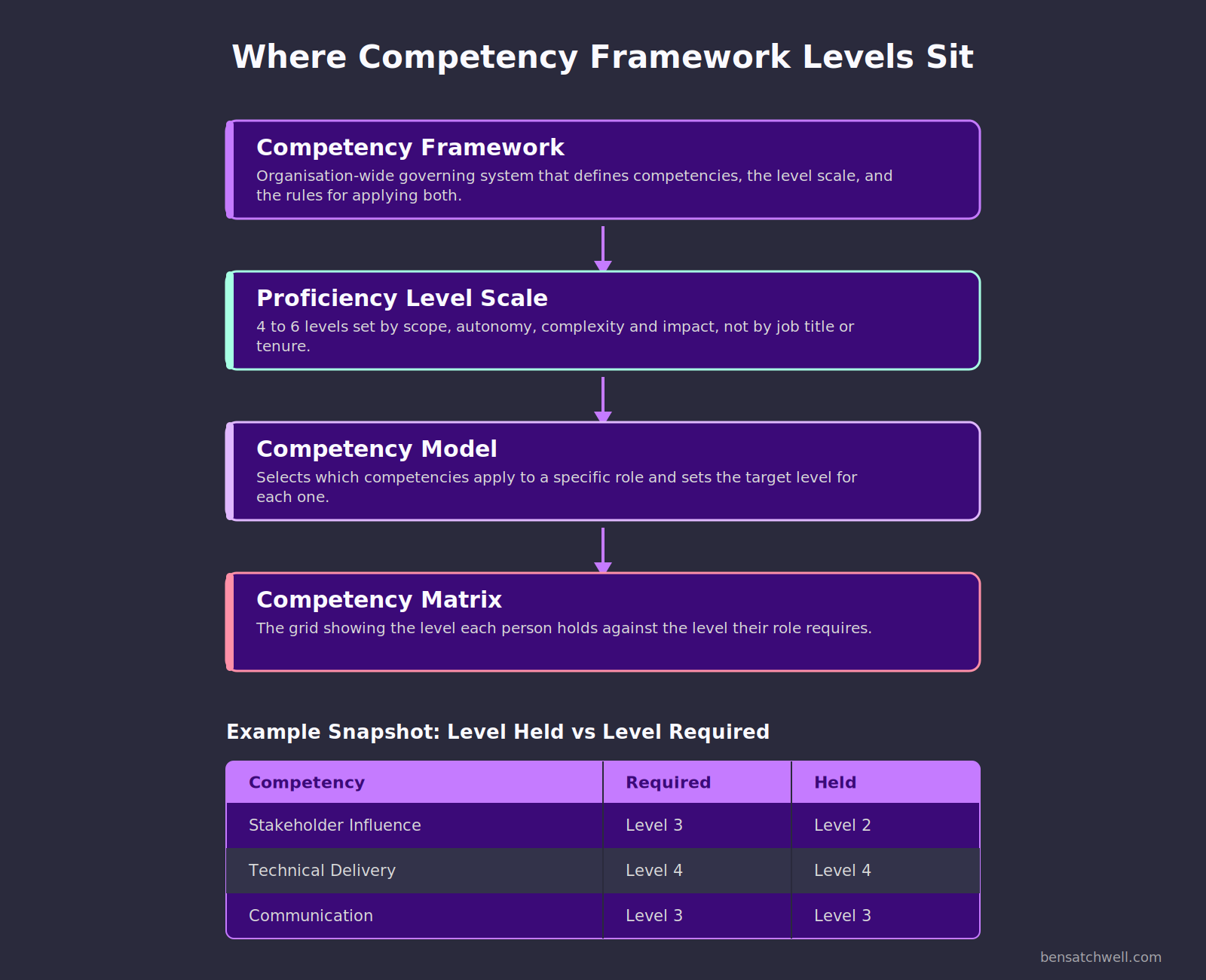
It helps to be precise about where levels actually sit in the structure. The framework defines the level scale itself, once, for the whole organisation. A competency model then selects which competencies apply to a given role and sets the target level for each one in that context. The competency matrix is the grid built from that model, showing who currently holds what against what the role requires. Levels live in the framework, targets live in the model, and gaps show up in the matrix.
SFIA is a useful named example of levelling done at scale. The SFIA framework defines seven generic levels of responsibility, from routine, closely supervised work at level one through to setting strategy and policy at level seven, and those levels apply consistently across every skill in the framework rather than being redefined for each one. SFIA's own documentation on its levels of responsibility sets out autonomy, influence, complexity, business skills and knowledge as the generic attributes that distinguish one level from the next, which is the same logic a competency framework applies at a smaller, organisation-specific scale.
What Competency Framework Levels Are Not
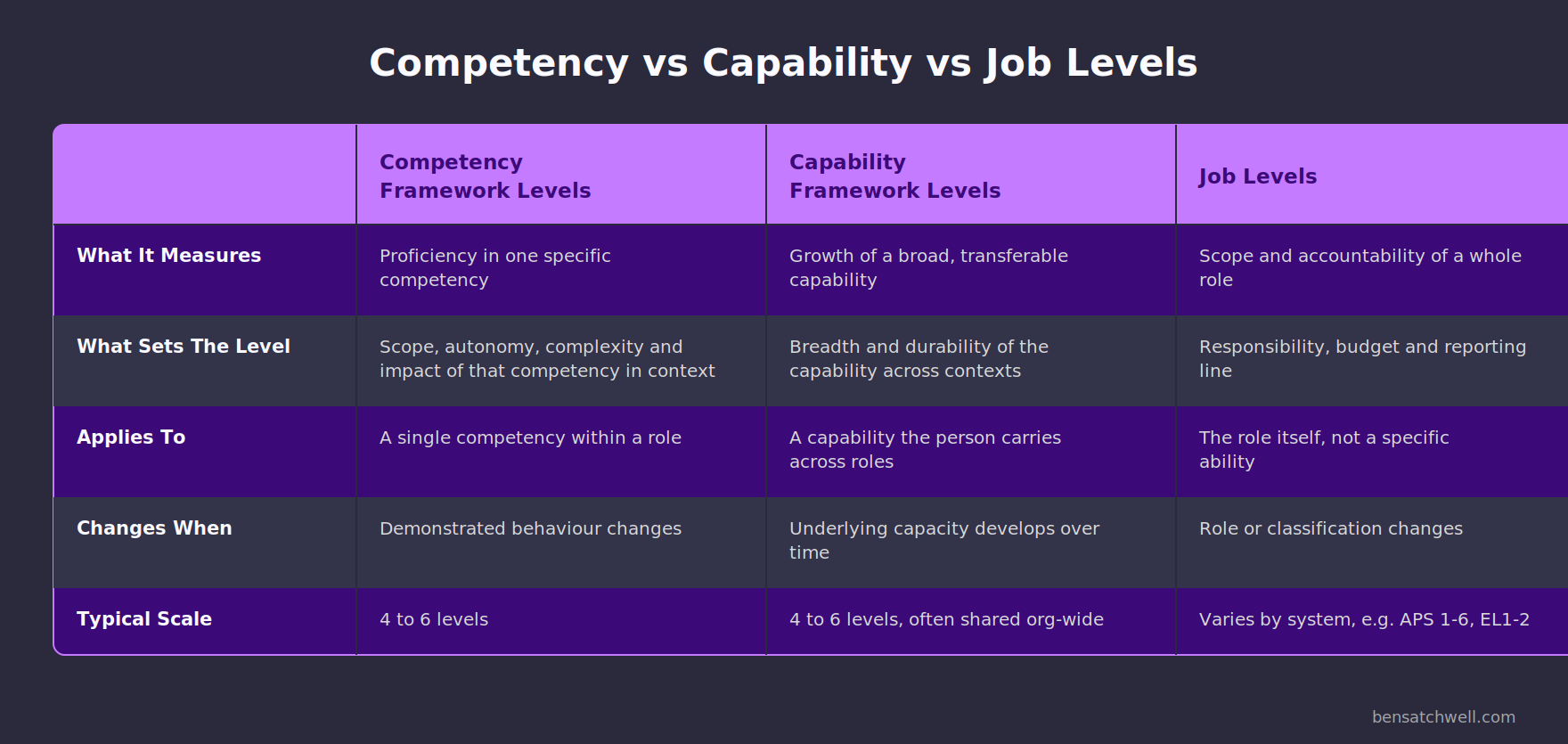
The most common conflation is with capability framework levels, and it is worth being exact about why they differ. A competency is role-specific or behavioural, integrated skill and judgement applied to a defined context, so its levels describe how well someone performs that specific competency against a fixed standard. A capability is broader and more durable, an area of ability a person carries across roles and contexts as work changes, so its levels describe how far that broader capacity has developed, not performance against one fixed task. The two ladders look similar on a page. They are not measuring the same thing.
Named Examples of Levelled Competency Structures
Beyond SFIA, Korn Ferry and Lominger competency libraries typically use a five-point behavioural proficiency scale running from a foundational level through to a mastery level, with each competency's indicators rewritten at every point on that scale rather than reused. CIPD's Profession Map takes a related but distinct approach, describing core behaviours as bands of "thinking performer" maturity rather than a single numbered scale, which suits a professional body assessing practice across very different HR roles.
Government classification systems offer a useful adjacent example, even though they are levelling whole roles rather than individual competencies. The Australian Public Service Commission's work level standards define APS Level and Executive Level classifications by the complexity, autonomy and impact of the work itself, not by title or tenure, which is precisely the discipline a competency framework needs to apply when it sets levels for a single competency rather than a whole job.
Where Competency Framework Levels Go Wrong
The most common failure is levels defined by title rather than behaviour. A framework that quietly equates "manager" with level three and "senior manager" with level four has stopped describing competency and started restating the org chart. The second most common failure is too many levels. Beyond six or seven, assessors cannot reliably distinguish adjacent levels, and calibration meetings turn into negotiation rather than assessment.
A third failure sits inside the framework itself: inconsistent level logic across competencies. If level three in "stakeholder influence" means something structurally different from level three in "technical delivery", the framework has lost the one thing that makes levels useful, a shared scale people can compare against. The fourth is governance drift. Levels written well at launch degrade over eighteen months of managers interpreting them slightly differently with no calibration process to pull them back into line.
Trade-offs and Constraints
Levels earn their complexity in organisations that need comparability across many roles, functions or business units, where career pathing, succession and pay decisions depend on a consistent read of proficiency. A small organisation with a handful of roles and no formal promotion process gains little from a six-level scale applied to every competency. It adds governance overhead without a decision the levels are actually informing.
The constraint most frameworks underestimate is ongoing ownership. Setting levels once at launch is the easy part. Keeping them consistent as new competencies get added, as roles change and as different assessors apply them, requires someone accountable for calibration on an ongoing basis. Without that, the levels degrade regardless of how well they were designed on day one.
FAQ
How many levels should a competency framework have?
Most workable frameworks use between four and six levels. Fewer cannot capture a meaningful gradient of performance, and more than six or seven becomes difficult for assessors to distinguish consistently.
What is the difference between competency framework levels and job levels?
Job levels classify whole roles by scope and accountability. Competency framework levels describe proficiency in one specific competency, and a single role can sit at different levels across different competencies at the same time.
What is the difference between competency framework levels and capability framework levels?
Competency levels measure performance in a role-specific or behavioural competency against a fixed standard. Capability levels measure how far a broader, more durable and transferable capability has developed across roles and contexts. They look similar but describe different constructs.
Who decides what each competency framework level means?
The framework owner, typically HR or organisational design, sets the level definitions and generic attributes such as scope, autonomy, complexity and impact. Subject matter experts then write the behavioural indicators for each competency at each level, and a calibration process keeps interpretation consistent across assessors over time.
Do all competencies in a framework need the same number of levels?
Not necessarily, but the underlying logic, such as scope, autonomy, complexity and impact, should stay consistent across competencies even where the number of applicable levels differs, so a given level number means a comparable thing wherever it appears.
How are competency framework levels assessed?
Assessors compare observed behaviour against the behavioural indicators written for each level, using evidence from real work rather than self-reported confidence or job title, and calibration sessions across assessors keep that judgement consistent.