


I get asked to explain "competency based framework" almost as often as "competency framework", and most people using the two terms interchangeably do not realise they are describing different things. A competency framework is an artefact, the structure itself. A competency based framework is a design logic, an approach that uses competencies as the organising unit for something else, whether that something else is a hiring process, a pay structure, a learning programme, or an assessment. Confuse the two and you end up building the wrong thing, or worse, buying a system that promises one and delivers the other.
What Is a Competency Based Framework
A competency based framework is any system, process, or structure that is designed around competencies rather than tasks, job titles, or outputs. It uses defined competencies, proficiency levels, and behavioural indicators as the reference points for decisions about capability, performance, learning, or reward.
The distinction matters because "competency-based" is a design philosophy that gets applied well beyond the competency framework itself. You will see it attached to hiring (competency-based interviewing), training design (competency-based curricula), pay (competency-based pay), and assessment (competency-based assessment). In every one of these, the underlying reference point is the same: a defined competency, described by knowledge, skill, judgement, and behaviour integrated at a stated level of proficiency, rather than a role title, a qualification, or time served.
The framework itself, the governing structure that defines and organises competencies, proficiency levels and indicators for reuse across an organisation, is a separate and prior artefact. A competency based framework depends on having that structure in place. It cannot exist without it.

A competency based framework applies the same competency framework consistently across hiring, learning, performance and pay.
Why It Exists
Organisations built decision systems on job titles, tenure, and qualifications for decades. All three are poor proxies for what someone can actually do. A ten-year veteran is not automatically more capable than someone in year three. A qualification tells you what was studied, not what can be applied under pressure.
Competency-based design exists to replace those weak proxies with something observable and defendable: demonstrated behaviour against a defined standard. It moves the basis for hiring, promotion, pay progression, and learning investment away from credentials and seniority and onto evidence of what a person can actually do, at what level, in what context.
This matters most where the cost of getting it wrong is high: professional registration, safety-critical roles, regulated industries, and leadership appointments, because a competency-based approach forces the standard to be written down and applied consistently rather than left to manager judgement.
How It Works in Practice
A competency based framework is applied by taking the competencies, proficiency levels and behavioural indicators defined in the framework and using them as the criteria inside a specific process.
- Hiring: interview questions and assessment exercises are built to elicit evidence against named competencies and their behavioural indicators, not general impressions.
- Learning and development: programmes are designed to close a specific, identified gap between current and required proficiency on a named competency, not generic skill-building.
- Performance management: reviews are structured against the same competency language used in hiring and development, so feedback is consistent across the employee lifecycle.
- Pay and progression: movement through pay bands or levels is tied to demonstrated proficiency against defined competencies rather than tenure alone.
Applied properly, every one of these processes draws on the same competency model for the relevant role, so the language a candidate hears in an interview is the same language they hear in their first performance review eighteen months later. Research on framework implementation backs this up: the practical value of a competency-based design comes from consistent, criteria-referenced application across processes, not from the elegance of the competency list itself, a point examined in detail in recent implementation research on competency-based framework development.
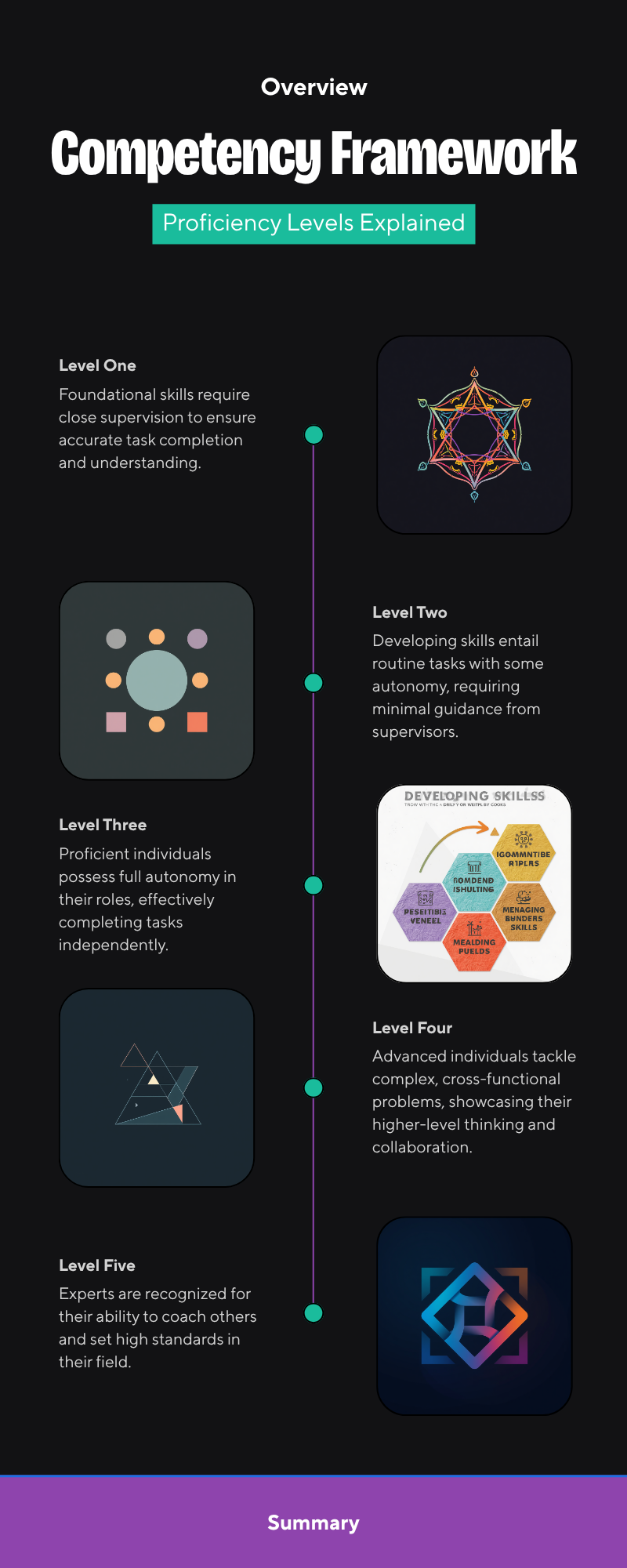
Proficiency levels inside a competency based framework are set by scope, autonomy, complexity and impact, not tenure.
What a Competency Based Framework Is Not
It is not the same as a capability-based approach. A capability framework organises broad, durable, person-owned abilities that transfer across roles and time. A competency-based approach is narrower and more contextual: competencies are defined against a specific role or job family, and they shift as that role's requirements change. If your organisation needs a system that helps people move into roles that do not exist yet, competency-based design alone will not get you there. That is capability territory.
It is also not a skills-based approach. Skills are discrete, granular, and transient, the specific things a person can do with a tool or method. A competency based framework integrates skills into something broader and behaviourally observable, not a flat inventory of individual skills.
Finally, it is not simply "the competency framework document". The framework is the governing structure. Competency-based is what you call the approach when that structure is actually being used to make hiring, pay, learning, or promotion decisions. A framework can sit unused on a shared drive. A competency-based process is the framework doing its job.
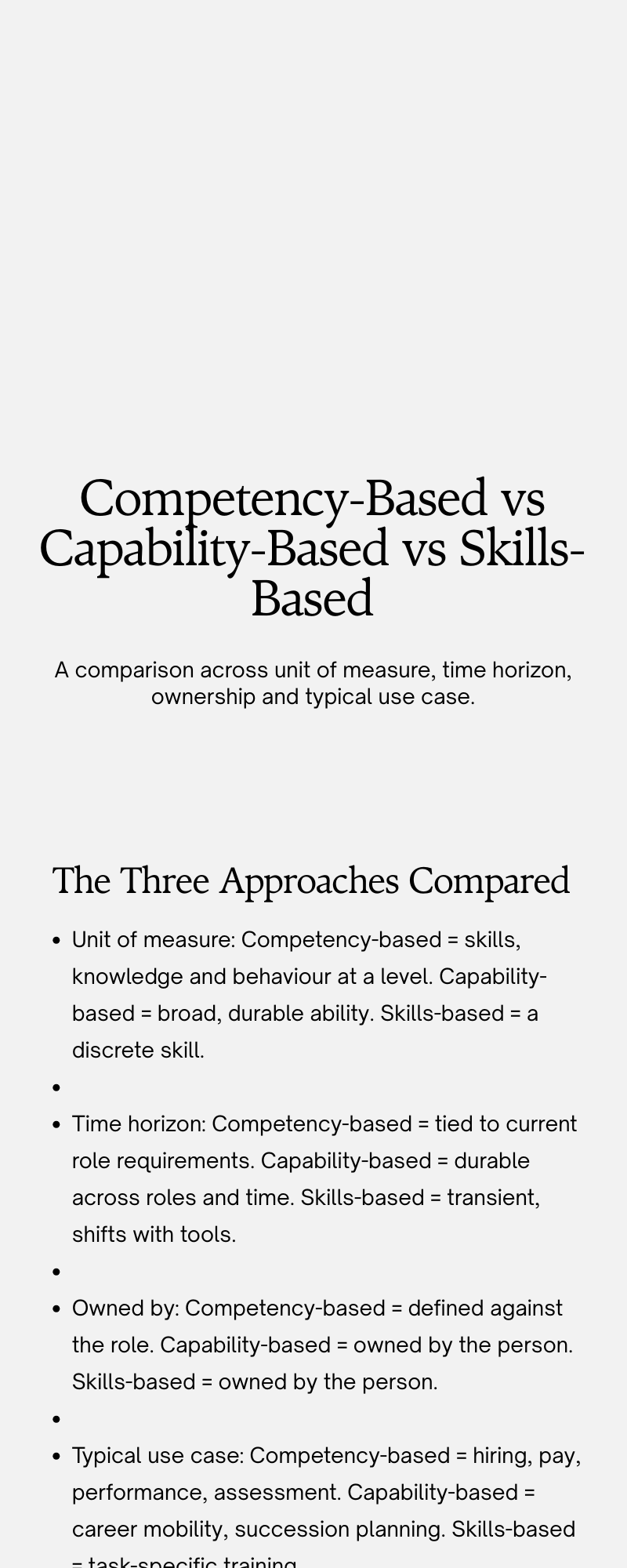
A competency based framework is narrower and more role-specific than a capability-based or skills-based approach.
Named Frameworks and Standards
Several established bodies have published competency-based standards worth knowing. The CIPD's competency factsheet recommends limiting any single role to around twelve competencies, clearly defined with examples and clustered into groups, advice aimed squarely at organisations trying to build a competency-based process without collapsing under its own complexity.
SHRM's own model has evolved along the same lines. What began as the SHRM Competency Model, eight behavioural competencies plus one technical competency, has since been expanded into the SHRM Body of Applied Skills and Knowledge (BASK), which layers knowledge areas onto the behavioural competencies and is now used to define the content of SHRM's own certification exams. That is a competency-based framework operating exactly as intended: the same standard driving certification, professional development, and role expectations.
DDI, Korn Ferry, and Lominger have each published their own competency libraries built for the same purpose, giving organisations a starting point rather than requiring competencies to be written from nothing.
Common Failure Modes
The most common failure is treating the competency list as the finished product. Publishing twenty competencies with generic descriptions and no behavioural indicators produces a document, not a competency-based process. Nobody can interview, assess, or pay against a competency that says "communicates effectively" with no defined levels or observable evidence, which is exactly the gap a properly built competency assessment framework is meant to close.
The second failure is inconsistency across processes. If hiring uses one competency language, performance reviews use another, and learning programmes use a third, the organisation has three separate lists, not one competency-based approach. The entire value of the design collapses when the same competency means something different depending on which team wrote the document.
The third is over-engineering the number of competencies per role. Frameworks with thirty or more competencies per role are unusable in practice. Managers cannot hold that many criteria in mind during an assessment conversation, so they default back to gut feel, exactly what the competency-based approach was meant to replace.
Trade-offs and Constraints
Competency-based design is strongest where roles are relatively stable and the behaviours that predict success can be observed and agreed on. It is weakest where roles are changing quickly, where the organisation needs people to move into work that does not exist yet, or where the cost of maintaining detailed behavioural indicators across every role outweighs the benefit.
It also requires ongoing governance. Competencies drift out of date as work changes, and a competency-based process built on stale definitions produces decisions that look objective but are quietly wrong. Treat the underlying framework as something that needs review, not something you finish once and leave alone.
FAQ
What is the difference between a competency based framework and a competency framework?
A competency framework is the governing structure that defines and organises competencies, proficiency levels, and indicators. A competency based framework is the application of that structure to a specific process, such as hiring, pay, or learning design.
Is competency-based the same as skills-based?
No. Skills are discrete and specific to a tool or method. Competencies integrate skills, knowledge, judgement, and behaviour into a broader, role-contextual standard.
Is competency-based the same as capability-based?
No. Capabilities are broad, durable, and person-owned, and they transfer across roles. Competencies are defined against a specific role or job family and are narrower in scope.
How many competencies should a competency based framework include per role?
Guidance from the CIPD suggests around twelve per role as a practical ceiling. Beyond that, frameworks become too complex to apply consistently in real assessment and hiring conversations.
Can a small organisation use a competency based approach?
Yes, but it needs to be scaled down. A handful of well-defined core competencies applied consistently across hiring, performance, and development will outperform a large, generic list that nobody actually uses.
Does a competency based framework replace job descriptions?
No. Job descriptions describe accountabilities and scope. A competency based framework describes the standard of behaviour and skill required to meet those accountabilities at a given level.