

A competency framework is one of the most widely used tools in HR, learning and workforce design, and one of the most often misunderstood. I see the phrase used for a list of soft skills, a set of values, a performance rubric or a bundle of role descriptions. When the construct is unclear, organisations end up with documents that cannot be assessed, cannot be reused and cannot be governed. This article sets out what a competency framework is as a system: what sits inside it, how it is governed and where it breaks.
What Is a Competency Framework?
A competency framework is an organisation-wide system that defines, groups and standardises the competencies required for effective performance, so they can be reused across roles, levels and job families. It holds the competency definitions, the proficiency levels and the observable indicators, plus the rules for how they are applied.
Put simply, it is the governing structure that gives an organisation one language for expectations. Everything built on it, from role profiles to interview guides to career paths, draws on the same definitions instead of inventing new ones team by team.
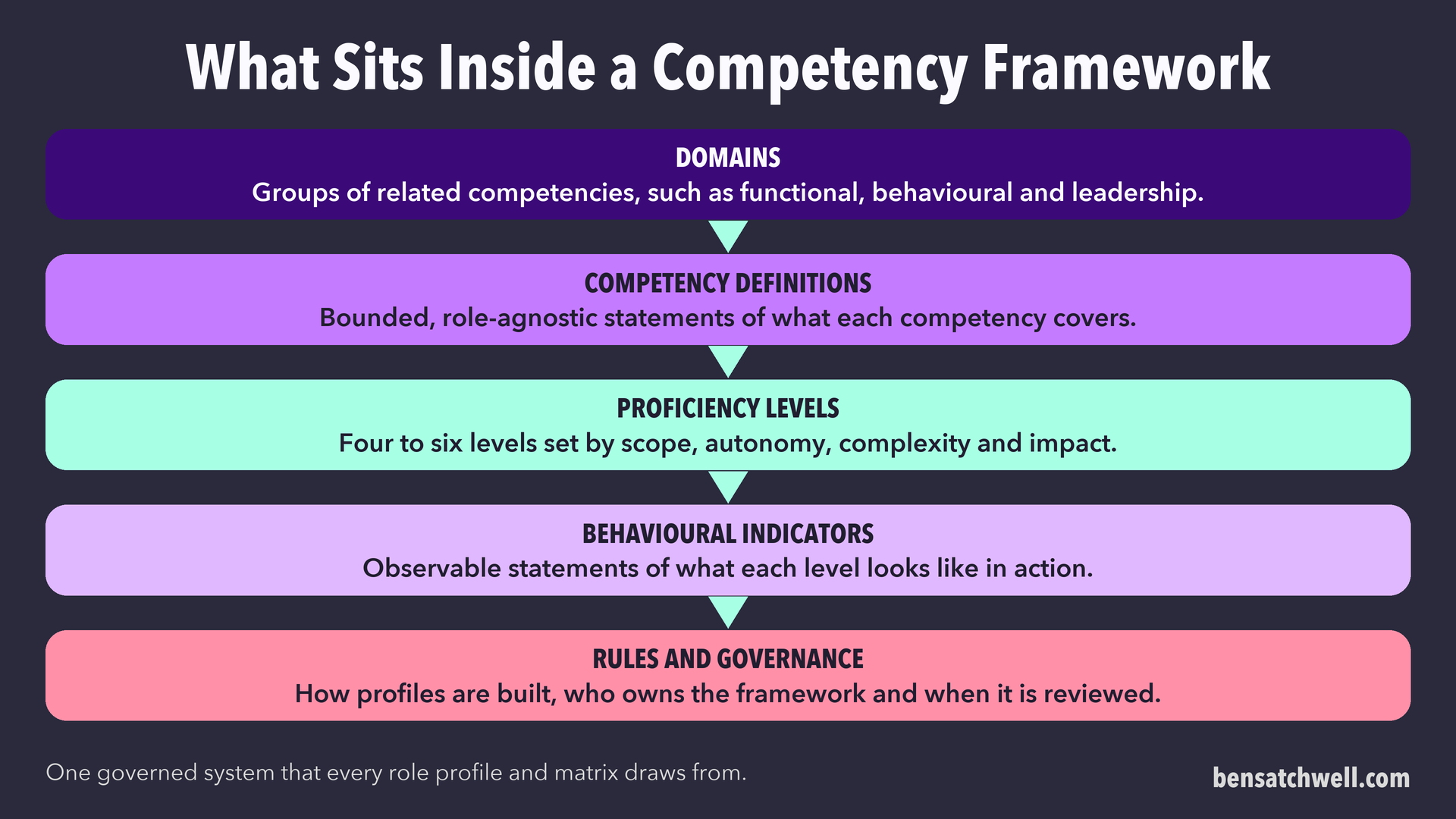
The five parts of a competency framework, from domains through to governance.
A note on terminology. A competency framework is also called a competency model, especially in the United States. I use competency profile for the competencies and required levels for one role, and competency matrix for the grid of required against current proficiency. Usage varies by region, and I explain the differences in this competency model definition.
Why Organisations Build a Competency Framework
A framework exists to solve a coordination problem. As an organisation grows, every team writes its own expectations in its own words. Hiring criteria differ between managers, performance conversations rest on private benchmarks, and nobody can compare two roles without arguing about vocabulary.
A framework removes that argument. It lets an organisation:
- align hiring criteria across teams
- set consistent performance expectations
- design learning pathways against real work demands
- describe progression and mobility in the same terms everywhere
- compare roles and levels without reinventing language
If you cannot describe progression clearly, build role profiles consistently or assess people fairly across teams, you do not have a people problem. You have a system design problem, and a framework is one way to solve it.
The Six Components Inside a Competency Framework
There is no single universal template, but frameworks that survive contact with real use share the same components.
1. Domains
Domains group related competencies, prevent sprawl and make gaps and overlaps visible. Common sets are functional or technical competencies, behavioural competencies, leadership competencies, and professional or ethical competencies. The labels matter less than a consistent internal logic.
2. Competency definitions
Each definition should be bounded (what it includes and excludes), usable across roles, not circular and not an outcome. Definitions that read like values statements sound positive and measure nothing. A good one says what the competency is, what it enables a person to do and what kind of judgement or behaviour it involves.
3. Proficiency levels
Levels express growth. They are not seniority, years of service or a judgement of someone as good or bad. They describe scope (how broad the work context is), autonomy, complexity and impact. Four to six levels is workable. Beyond that the distinctions become theatre.
4. Behavioural indicators
Indicators describe what a competency looks like in action at each level. They must be observable, tied to work scenarios and descriptive rather than evaluative. "Is a strong leader" is a judgement. "Summarises stakeholder needs and confirms shared understanding before committing to deliverables" is an indicator.
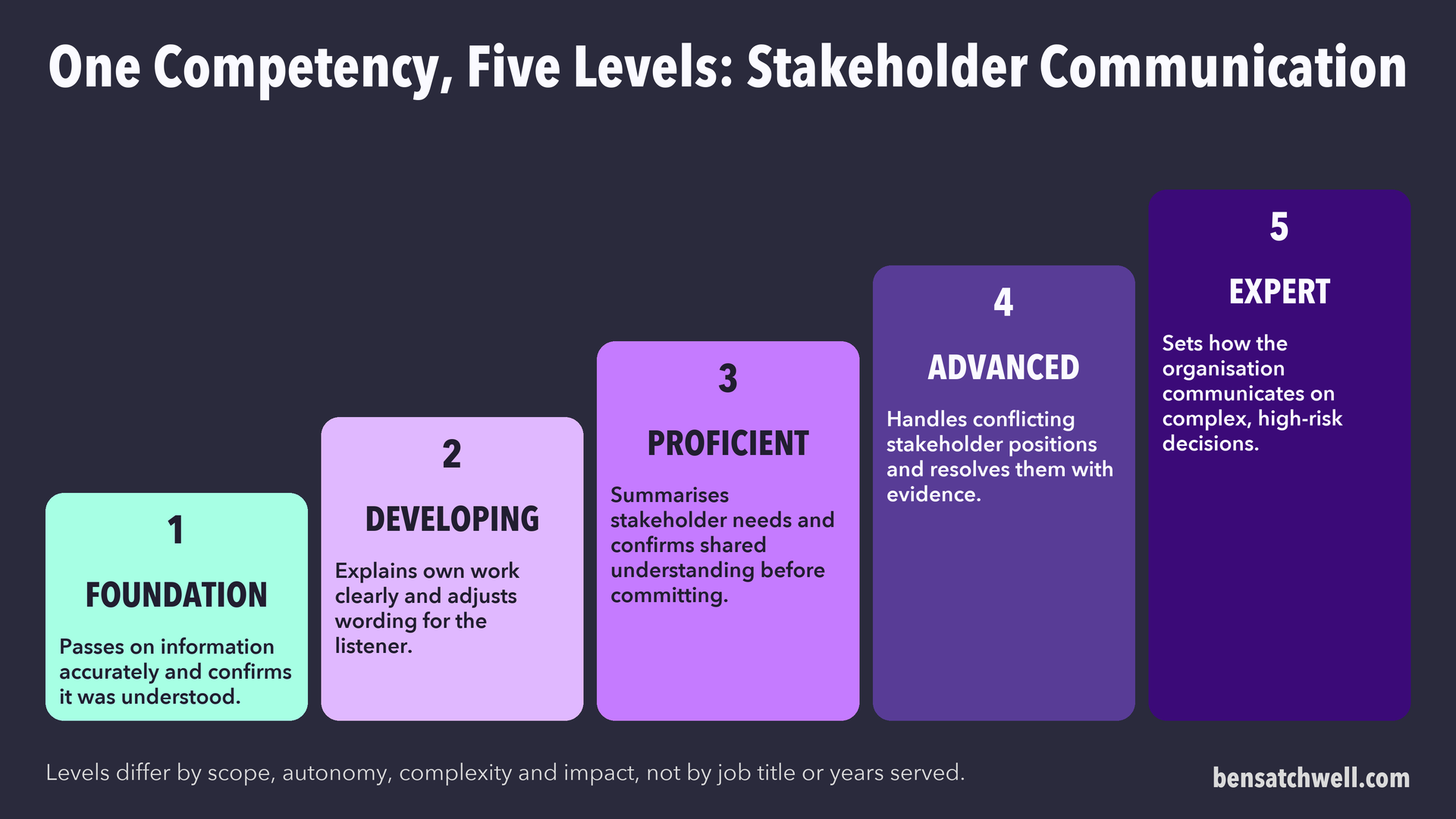
One competency described across five levels. The step between levels is scope and complexity, not tenure.
5. Rules for use
Frameworks fail when people do not know how to apply them. The rules should state how many competencies a role profile includes, whether competencies are weighted, how target levels are set, what evidence counts in an assessment and how specialist roles are handled.
6. Governance
If nobody owns the framework, it decays. Governance covers who approves new competencies, how duplicates are handled, how definitions are maintained, version control and a review cadence, typically annual. Without it a framework becomes a cemetery of old language, because everyone adds one more competency until it collapses under its own weight.
How a Competency Framework Relates to Profiles and Matrices
The framework is the system. A competency profile is one role's selection from it, with a required level for each competency chosen. A competency matrix is the grid that sets required against current proficiency for roles or people. Both are drawn from the framework, which is why the framework has to be stable and the profiles and matrices can change as roles and people change.
For the content view of this, how a single role's profile is assembled and what goes into it, see the guide to the competency model. This page stays with the system that sits above it.
What a Competency Framework Is Not
A framework connects to many systems but should not be confused with them.
- Not a performance management system. It informs one.
- Not a values statement. It may align with values, but values are not levelled or observed in the same way.
- Not a learning curriculum. It can map to learning content, but it does not contain it.
- Not a skills taxonomy. Skills are discrete abilities. Competencies integrate skills, knowledge, judgement and application in context. The skills and competency framework guide covers how the two fit together.
- Not a job architecture. It can support one but does not replace it.
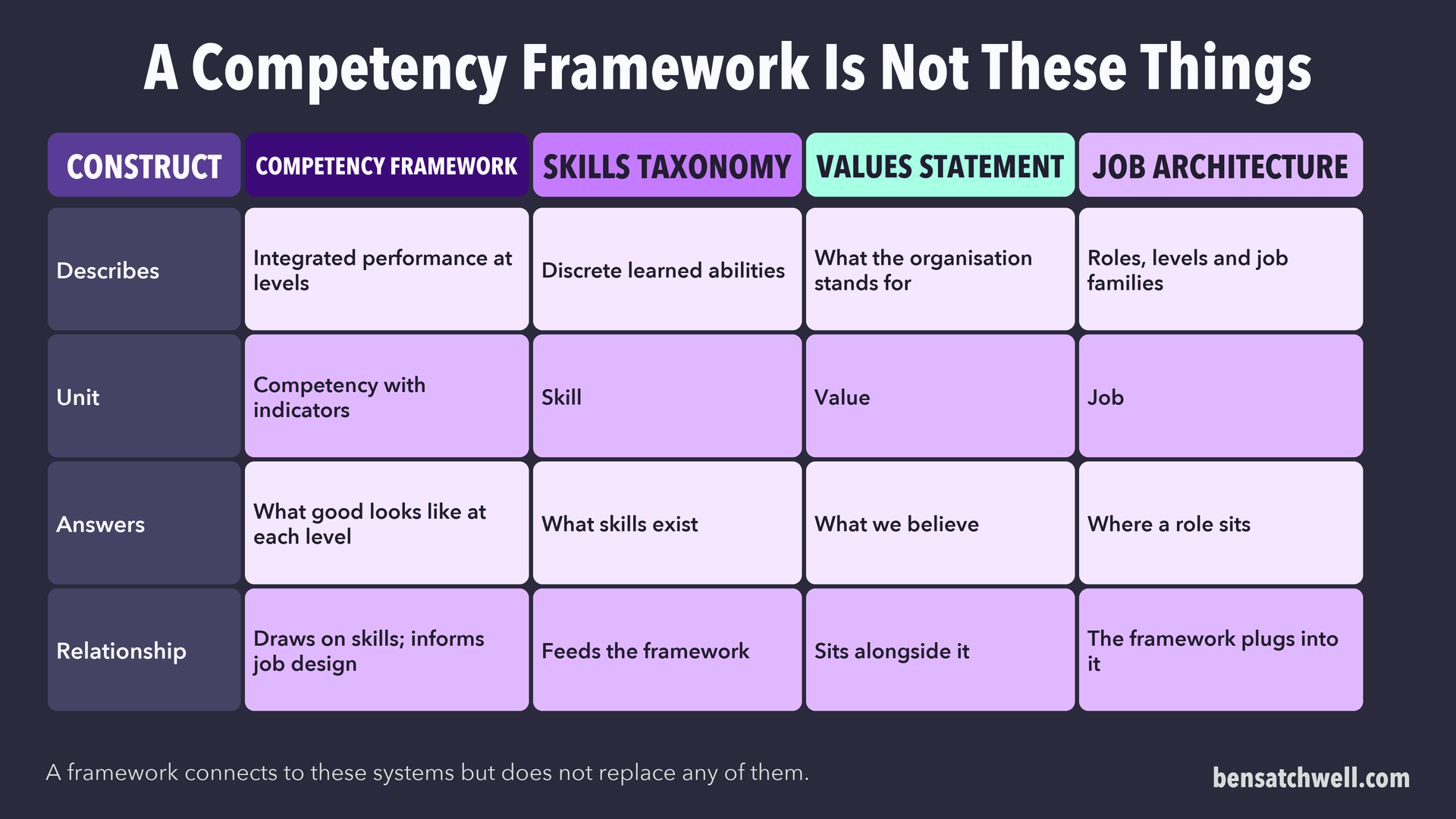
A framework connects to these systems without replacing any of them.
When an organisation asks one framework to do everything, it becomes incoherent.
Where a Competency Framework Is Used
A competency framework is most valuable when it is treated as infrastructure that several workflows share:
- Hiring and selection: structured interview rubrics and consistent criteria.
- Role profiles: the same expectations across job families and levels.
- Performance conversations: shared language for expectations and growth.
- Learning pathways: development aimed at real competency gaps.
- Career progression and mobility: comparing roles and readiness without guesswork.
In practice, the best frameworks are used consistently in two or three core workflows. The worst are launched with fanfare and then ignored.
Patterns That Appear in Competency Frameworks
Examples are most useful when read for structure, not copied. Three patterns recur.
- Enterprise-wide, multi-domain. Functional, behavioural and leadership domains share one set of proficiency levels, and role profiles select from the framework and set targets.
- Job family framework with a shared core. Core competencies apply to everyone and job families add specialist competencies, such as those in a sales competency framework.
- Leadership framework as a layered section. A leadership domain with its own progression, as in a leadership competency framework, linked to strategy and the operating structure.
What they share is stable definitions, explicit progression and governed reuse.
Common Mistakes That Break Competency Frameworks
- Treating a list as a framework. A framework has structure, progression logic and governance. A list has none of them.
- Mixing competencies and outcomes. Competencies describe capability. Outcomes describe results. Written as KPIs, competencies stop separating development from performance.
- Virtue-based language. Words such as collaborative or strategic work only when defined precisely and backed by indicators.
- Levels that are adjectives. Basic, intermediate and advanced mean nothing without differences in scope, autonomy and complexity.
- No application rules. If every team picks a different number of competencies and reads indicators differently, consistency is an illusion.
- No governance. Frameworks need owners.
- Forcing it into every workflow. Choose the workflows where it improves decisions, build adoption there and expand later.
Competency Frameworks and Skills
Skills are discrete abilities, the things you can do. Competencies integrate skills, knowledge, judgement and application in context. Many organisations use both, a skills taxonomy for granular matching and workforce analytics and a competency framework for performance, development and progression. Problems start when the two words are used as interchangeable labels, which usually signals weak definitions.
How Many Competencies Should a Framework Include?
There is no perfect number, but frameworks that grow too large stop being used. Keep the core tight enough to navigate, remove near-duplicates and prefer clearer definitions over more items. If finding the right competency takes a working session, the framework is too big.
How to Assess Against a Competency Framework
Assessment goes wrong when people believe they are scoring personality. A defensible approach defines observable indicators per level, names acceptable evidence such as work outputs, examples and stakeholder feedback, separates the role's required level from the person's current level, and calibrates using example cases. The goal is consistency and usefulness, not perfect measurement.
FAQ
What is a competency framework?
A competency framework is an organisation-wide structure that defines and organises competencies, with proficiency levels, behavioural indicators and rules for use, so they can be applied consistently across roles.
Is a competency framework the same as a competency model?
Yes. They name the same structure, and the name depends on the region. Competency model is the common US term and competency framework is more common in the UK and Australia. A competency profile is the narrower selection for one role.
Should a competency framework include behaviours?
It should include behavioural indicators, but they must be observable and tied to levels. Vague virtue statements do not belong.
How often should a competency framework be updated?
Infrequently but deliberately. An annual review with controlled versioning and a change log suits most organisations.
How many levels does a framework need?
Four to six. Each level must differ from the next in scope, autonomy, complexity or impact.