

Most competency framework development process failures are not content failures. They are sequencing failures. Someone starts drafting competency statements in week one, skips stakeholder validation because it feels slow, and ships a document in week eight that nobody in the business recognises as describing their actual work. The process matters as much as the content it produces, and most guidance on competency frameworks skips straight past it to talk about domains and proficiency levels instead.
This article is about the process itself: the sequence of steps that takes a competency framework from a blank page to a governed, trusted system people actually use.
What Is the Competency Framework Development Process
The competency framework development process is the sequence of stages an organisation follows to scope, research, draft, validate, and govern a competency framework, from initial commissioning through to ongoing maintenance.
It is not the framework itself. A competency framework is the finished organisation-wide system: the definitions, domains, proficiency levels, and behavioural indicators that get reused across roles. The development process is the method that produces and sustains that system. Skip stages in the process and the resulting framework, however well-written, tends to fail on adoption rather than on content.
A workable process moves through five stages: scoping and governance, research and data collection, structuring and drafting, validation and calibration, and ongoing governance. Each stage produces something the next stage depends on, which is why sequencing errors are so costly. You cannot calibrate proficiency levels you have not yet validated with the people who will be assessed against them.
Why a Defined Development Process Matters
Frameworks built without a defined process tend to go one of two ways. Either HR imports a generic competency list from a vendor or a previous employer and relabels it, or a small internal team writes the framework in isolation and presents it to the business as finished. Both produce a document. Neither produces something people trust.
The CIPD's guidance on competency frameworks is explicit that credible frameworks need to be designed in close collaboration with the people who will use them, and that time spent on co-creation early pays off at implementation through stronger credibility and advocacy. Skip that collaboration and you get a framework that looks complete on paper and gets ignored in performance conversations, because nobody outside HR had a hand in writing it.
A defined process also protects against the opposite failure: endless consultation with no structure, where the framework never ships because every stakeholder group wants another round of input. Clear stages with clear exit criteria prevent both failure modes at once.
How the Competency Framework Development Process Works in Practice
Five stages, run in sequence and then governed as a cycle rather than closed off as a finished project:
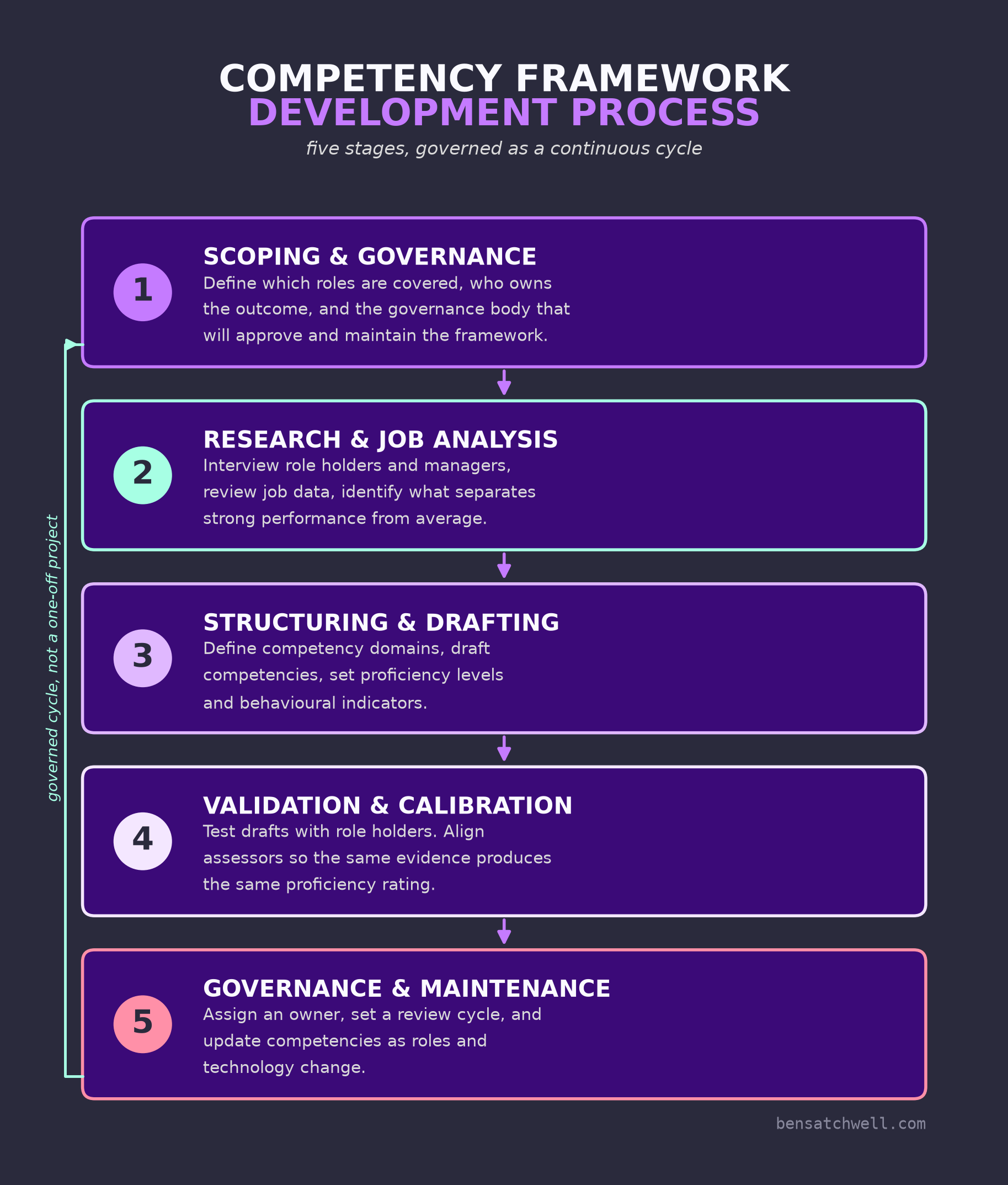
The competency framework development process runs as a governed cycle, not a one-off project.
Scoping and Governance
The first stage sets boundaries before any content gets written: which roles or job families the framework will cover, who owns the outcome, and what governance body will approve and maintain it once it is live. This stage also decides scale, whether the organisation is building one framework covering everyone or a smaller pilot to prove the approach first.
Skipping this stage is the single most common cause of scope creep later. Without an agreed boundary, a framework commissioned for one division quietly expands to cover the whole organisation mid-project.
Research and Job Analysis
This stage gathers the raw material: interviews with role holders and their managers, review of existing job descriptions, and analysis of what actually distinguishes strong performance from average performance in the roles being covered. This is where the framework earns its credibility or loses it. A framework drafted from templates rather than real job data reads as generic because it is generic.
I've written before about what happens when organisations skip this step and go straight to building a competency framework from a downloaded template: the resulting document has the right shape but says nothing specific about the actual work being done.
Structuring and Drafting
With research complete, the team defines competency domains, drafts individual competency definitions, and sets proficiency levels with behavioural indicators for each. This is also where the decision gets made about core competencies, held by everyone, versus technical or functional competencies specific to a domain.
Academic research on competency framework development found that most published development processes used literature review and group techniques for this stage, but flagged there is no single agreed methodology, with significant variation in how rigorously different organisations approach it, according to a scoping review in Advances in Health Sciences Education. That variation is normal. What matters more is that drafting stays grounded in the research from the previous stage rather than being written in isolation.
Validation and Calibration
Draft competencies get tested against real people and real performance. Validation checks whether role holders and managers recognise the definitions as accurate. Calibration checks whether different assessors, looking at the same evidence, land on the same proficiency rating. Without calibration, a framework can look precise on paper while producing wildly inconsistent ratings once different managers start using it.
This is also the stage where the framework gets connected to how it will actually be used, most commonly through a competency assessment framework that defines the evidence and decision rules for rating people against the competencies just drafted.
Governance and Maintenance
A competency framework is not a document you finish and file away. It needs an owner, a review cycle, and a defined process for updating competencies as roles and technology change. SFIA, the skills framework for the information age, is a useful reference point: it is maintained through a global open consultation process and updated roughly every three years to stay aligned with how the underlying work changes, as described by the SFIA Foundation. Most organisational frameworks will never need governance at that scale, but the principle, that maintenance is a designed stage rather than an afterthought, holds regardless of size.
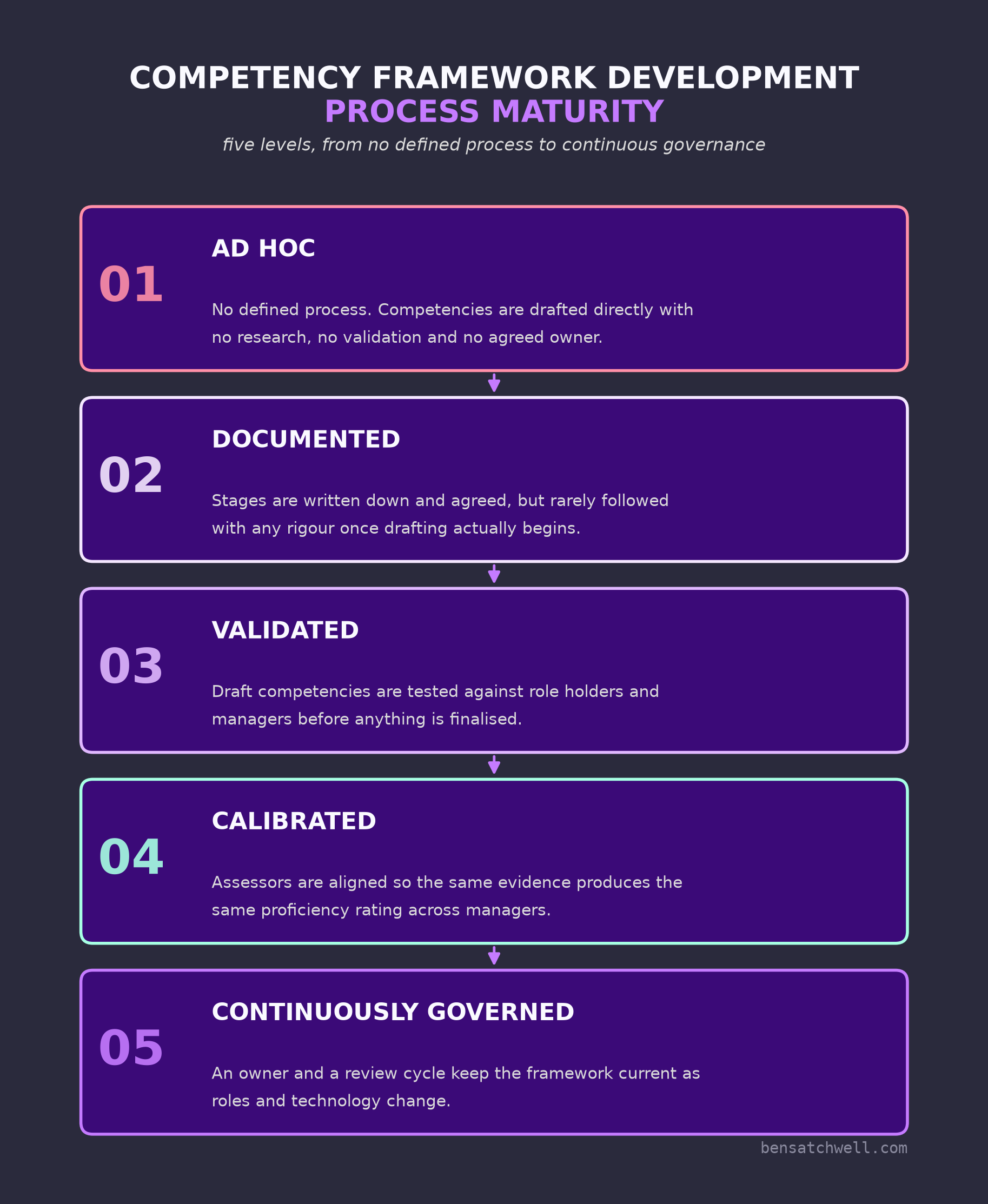
Process maturity in the competency framework development process runs from ad hoc drafting through to continuous governance.
What the Competency Framework Development Process Is Not
It is not the same thing as a competency model. The development process produces the framework; a competency model is a later, separate exercise that selects and tailors competencies from that framework for a specific role, level, or job family.
It is not a competency matrix either. A matrix is a display and assessment artefact, a grid mapping competencies against people or roles, built from a completed framework. Producing a matrix is not a stage of framework development. It is something you do after development is finished, using the framework as the source.
It is also not a one-off project with a defined end date. Treating it that way is one of the most common reasons frameworks decay within two or three years of launch. The process includes governance and maintenance as ongoing stages, not a wrap-up task.
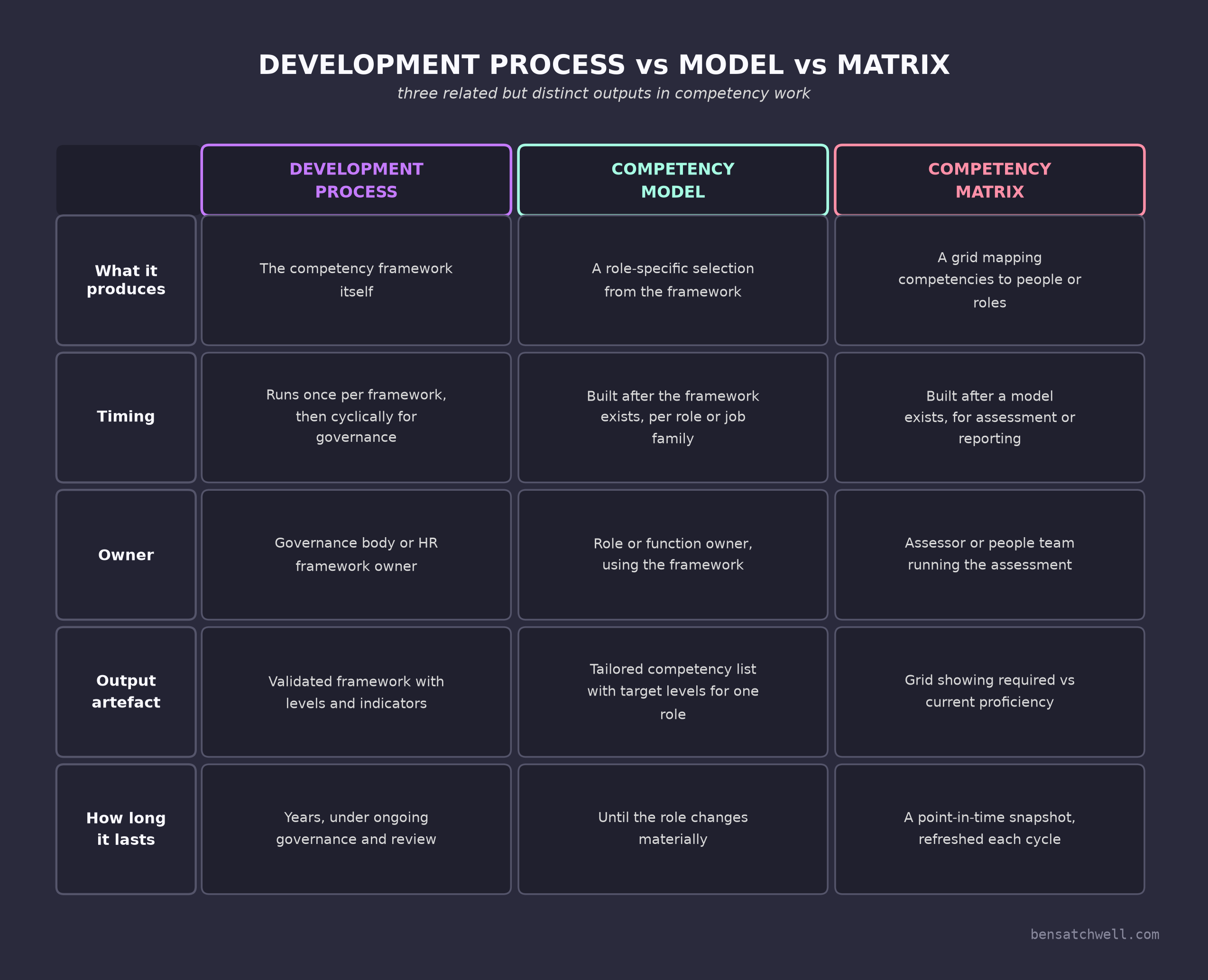
The development process, the competency model, and the competency matrix are related but distinct outputs
Trade-offs and Constraints
Speed and credibility trade off directly. A framework can be drafted quickly by a small central team, but speed costs the stakeholder buy-in that validation provides. Organisations under time pressure sometimes accept this trade-off deliberately, launching with lighter validation and a planned review cycle to catch what was missed. That is a legitimate choice as long as it is made consciously rather than by default.
Breadth and usability also trade off. The CIPD's guidance notes that a framework which is too broad fails to provide adequate guidance, while one that is too detailed becomes bureaucratic and loses credibility with the people using it. The scoping stage is where this balance gets set, and it is worth revisiting explicitly before drafting begins rather than discovering the framework is unusable after it ships.
Finally, central versus local ownership is a constraint every process has to resolve. A centrally governed process produces more consistency across the organisation. A process with more local input into drafting produces more relevance to specific roles but weaker comparability across job families. Most organisations land somewhere between the two, with core competencies governed centrally and technical competencies drafted with heavier input from the functions that own them.