


A competency framework template is a fill-in structure for the parts every competency framework needs: domains, competencies, definitions, proficiency levels and behavioural indicators. Most templates give you an empty grid with column headings and no guidance on what belongs in each cell, so organisations fill it with adjectives and call the result a framework. This page sets out the structure I use, a worked example for one competency and the checks to run before anyone relies on it.
It sits inside my guide to the competency framework, which covers the system the template feeds into. If you need the build process first, read Creating a Competency Framework: A Step-by-Step Guide.
What is a competency framework template?
A competency framework template is a blank structure that fixes the fields every competency must have, so each one is written to the same standard.
It does not decide which competencies your organisation needs. It decides what each entry must contain. The US Office of Personnel Management defines a competency as "a measurable pattern of knowledge, skills, abilities, behaviors, and other characteristics" that a person needs to perform work roles or occupational functions successfully (US Office of Personnel Management, competencies). A template turns that definition into fields you can complete and check.
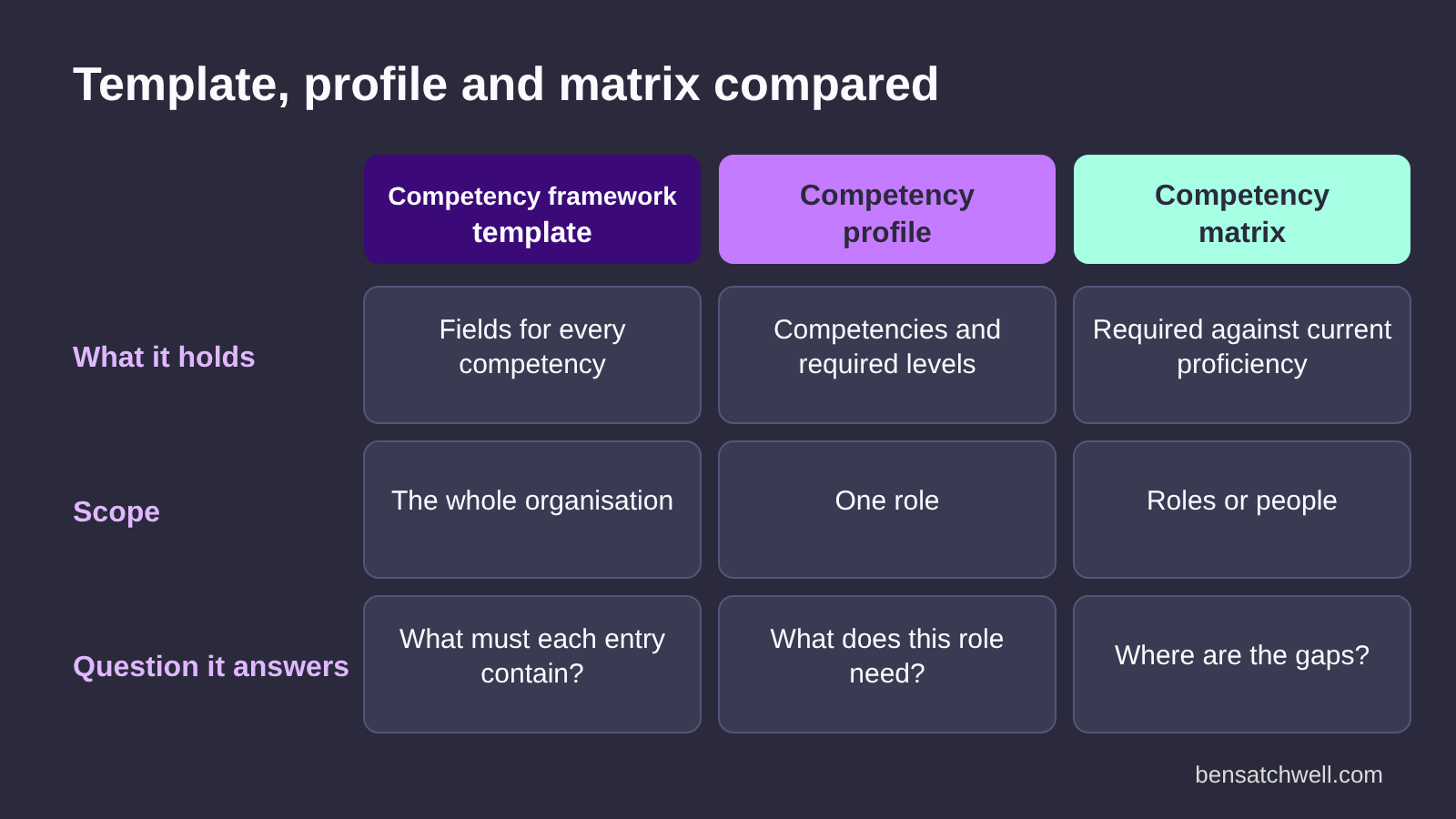
A note on terminology. A competency framework is also called a competency model, especially in the United States. I use competency profile for the competencies and required levels for one role, and competency matrix for the grid of required against current proficiency. Usage varies by region, and I explain the differences in this competency model definition.
What does a competency framework template contain?
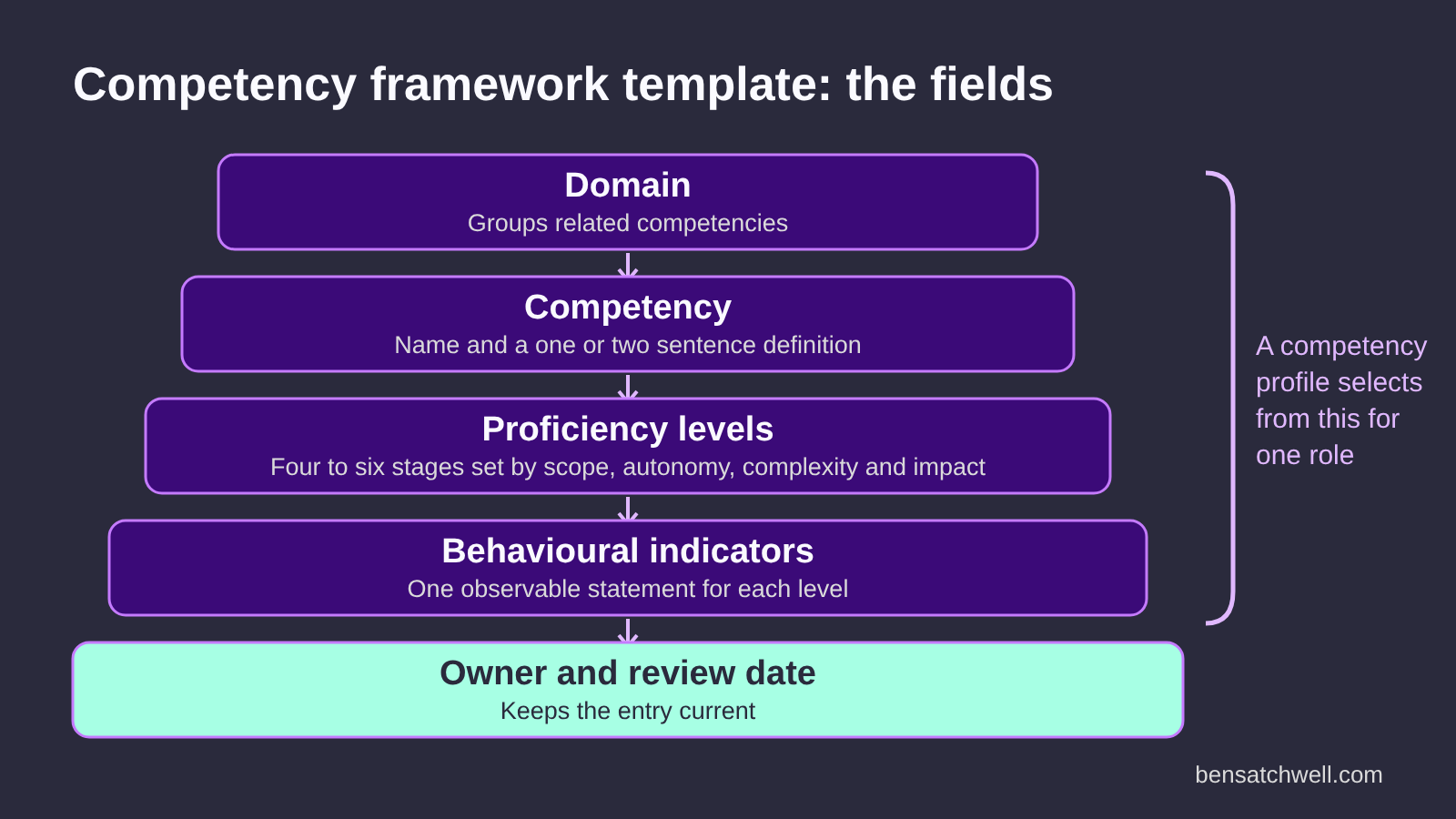
Seven fields are enough. Each has a test, and an entry that fails its test is not finished.
| Field | What goes in it | Test it should pass |
|---|---|---|
| Domain | A grouping of related competencies, such as behavioural, functional or leadership | Each competency sits in one domain only. |
| Competency name | Two to four words | A reader can tell it apart from its neighbours. |
| Definition | One or two sentences on what good performance looks like in a role | It describes performance, not a personality trait. |
| Applies to | Everyone (a core competency) or a role, job family or function (a technical competency) | Core and technical competencies are marked differently. |
| Proficiency levels | Four to six stages set by scope, autonomy, complexity and impact | No level depends on seniority or years of service. |
| Behavioural indicators | One observable statement for each level | An assessor can say whether the behaviour was seen. |
| Owner and review date | The person who approves changes and when the entry is next reviewed | Every entry has both. |
What does a completed competency framework template look like?
The example below is one entry, "Stakeholder communication", written as a core competency in a behavioural domain. The definition is: Shares information and positions with the people affected by a decision, in a form they can act on. The four levels are defined by scope and autonomy, and each indicator describes something an assessor could observe.
| Level | Scope and autonomy | Behavioural indicator |
|---|---|---|
| 1. Foundation | Routine work under direction | Explains routine information to colleagues in plain language and checks it has been understood. |
| 2. Practitioner | Independent work within one team | Adapts the message and format to different stakeholders and keeps them updated without being asked. |
| 3. Advanced | Complex work that crosses teams | Negotiates competing stakeholder needs and records the agreed position so decisions are not reopened. |
| 4. Expert | Direction for the whole organisation | Presents the organisation's position to senior external stakeholders and shapes how others communicate it. |
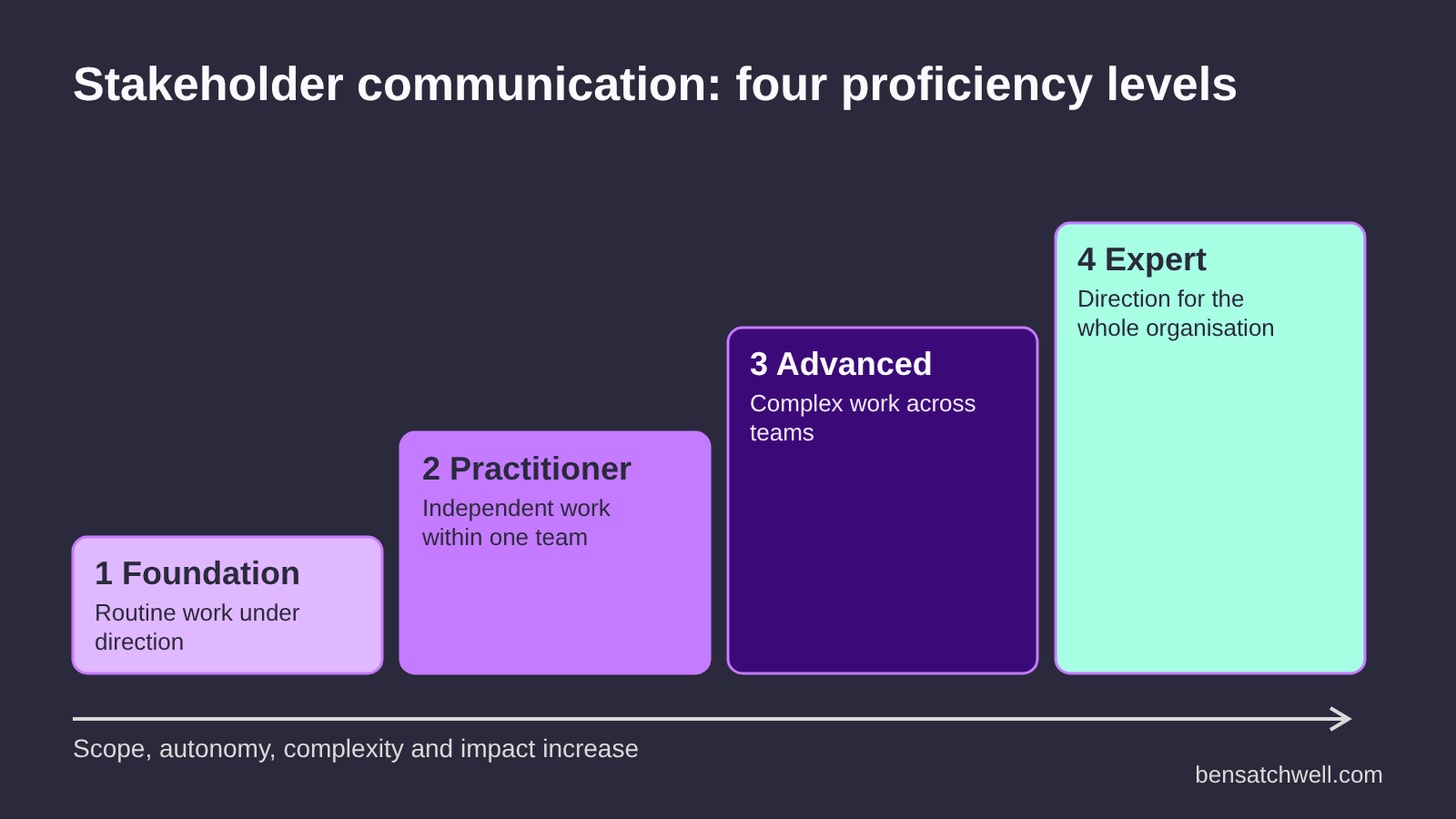
Four levels suit most organisations, and I keep to four to six. The SFIA Foundation uses seven levels of responsibility for the digital field, which shows the range in use (SFIA Foundation, the SFIA framework). More levels are harder to describe and harder to assess consistently. I cover the design of the scale in Competency Framework Levels: Scope, Autonomy and Impact.
How do you fill in a competency framework template?
1. Start with the domains
Name three or four domains before writing any competency. Common choices are behavioural, functional or technical, leadership, and professional or ethical.
2. Define each competency in one or two sentences
State what good performance looks like. If you cannot separate a competency from a neighbouring one, merge them.
3. Set the levels once, then reuse them
Write the scale in terms of scope, autonomy, complexity and impact, and apply the same scale to every competency. Writing a new scale for each entry makes levels incomparable.
4. Write one behavioural indicator per level
Use the present tense and describe what a person does, with a context from the work. Words such as "good", "strong" and "excellent" cannot be assessed.
5. Build the profile for each role
Select five to eight competencies for the role and state the required level of each. The government approach is the same in principle: the NSW Government tells role description writers to choose capabilities from the NSW Public Sector Capability Framework and to use its Capability Comparison Guide to choose the right level (NSW Government, creating a role description).
6. Show required against current
Once profiles exist, a competency matrix lays out required against current proficiency so the gaps are visible.
What a competency framework template is not
- Not a list of competencies. A list names things. A template fixes what each entry must contain, including levels and indicators.
- Not a competency profile. The template holds the framework. A profile selects from it for one role.
- Not an assessment form. Indicators are what assessment tests against, but the rating process is separate. See Competency Assessment Framework: Evidence, Methods, Rules.
- Not finished once it is filled in. A framework needs an owner and a review cycle, or the entries drift from the work.
Where do competency framework templates commonly fail?
- Adjectives in the indicator column. "Strong communicator" at level 3 tells an assessor nothing to look for.
- Levels tied to seniority. Level 4 becomes "manager", and the scale measures status instead of performance.
- Too many competencies. A framework nobody can remember is a framework nobody applies. Keep each role profile to five to eight entries.
- Copied entries. Wording lifted from another organisation's framework describes their work, and the examples in Competency Framework Examples From Major Organisations are best used as a reference for structure, not as text to paste.
- No owner. Entries with no owner and no review date are the first to go out of date.
FAQ
What should a competency framework template include?
A domain, a competency name, a definition, who it applies to, four to six proficiency levels, one behavioural indicator for each level, and an owner with a review date.
How many proficiency levels should a competency framework template have?
Four to six is a workable range. Fewer levels cannot separate real differences in performance, and more than six are hard to describe and assess consistently. SFIA uses seven levels of responsibility, but it serves a large specialist field.
Is a competency framework template the same as a competency model template?
In practice, yes. A competency framework is also called a competency model, especially in the United States, so a competency model template has the same structure. The competency model definition page explains how I use the terms.
How many competencies should a role profile include?
As a guide, five to eight. That is enough to describe what the role needs and few enough for a manager to assess. The framework itself can hold more competencies than any one profile uses.