

Competency Model Job Analysis
Most competency models on my desk started life as a job analysis that never got translated. Someone ran interviews, built a task inventory, wrote up the knowledge and skills required, called the output a "competency model" and stopped. What they actually produced is a job analysis with a new label. The two are related, but they are not the same exercise, and conflating them is why so many competency models read like duty statements rather than something that predicts performance.
This article is about where job analysis sits inside competency model construction, what it contributes, and where the translation from one to the other has to happen.
What Is Competency Model Job Analysis
Competency model job analysis is the systematic study of a role, using job analysis methods, as the evidence base for building a competency model. It borrows the data-gathering discipline of traditional job analysis, tasks, duties, working conditions, incumbent and supervisor input, and uses that evidence to identify and validate the competencies that belong in a competency model for a role, level or job family.
It is not a synonym for job analysis. Traditional job analysis is task-oriented: it documents what a job holder does, in what conditions, to what standard, and is built for compliance purposes such as job classification, pay grading and legally defensible selection criteria. Competency modelling is behaviour-oriented: it asks what a person needs to demonstrate, across changing tasks, to perform effectively now and as the role evolves. Competency model job analysis is the bridge between the two, using job analysis rigour to ground a competency model in evidence rather than assumption.
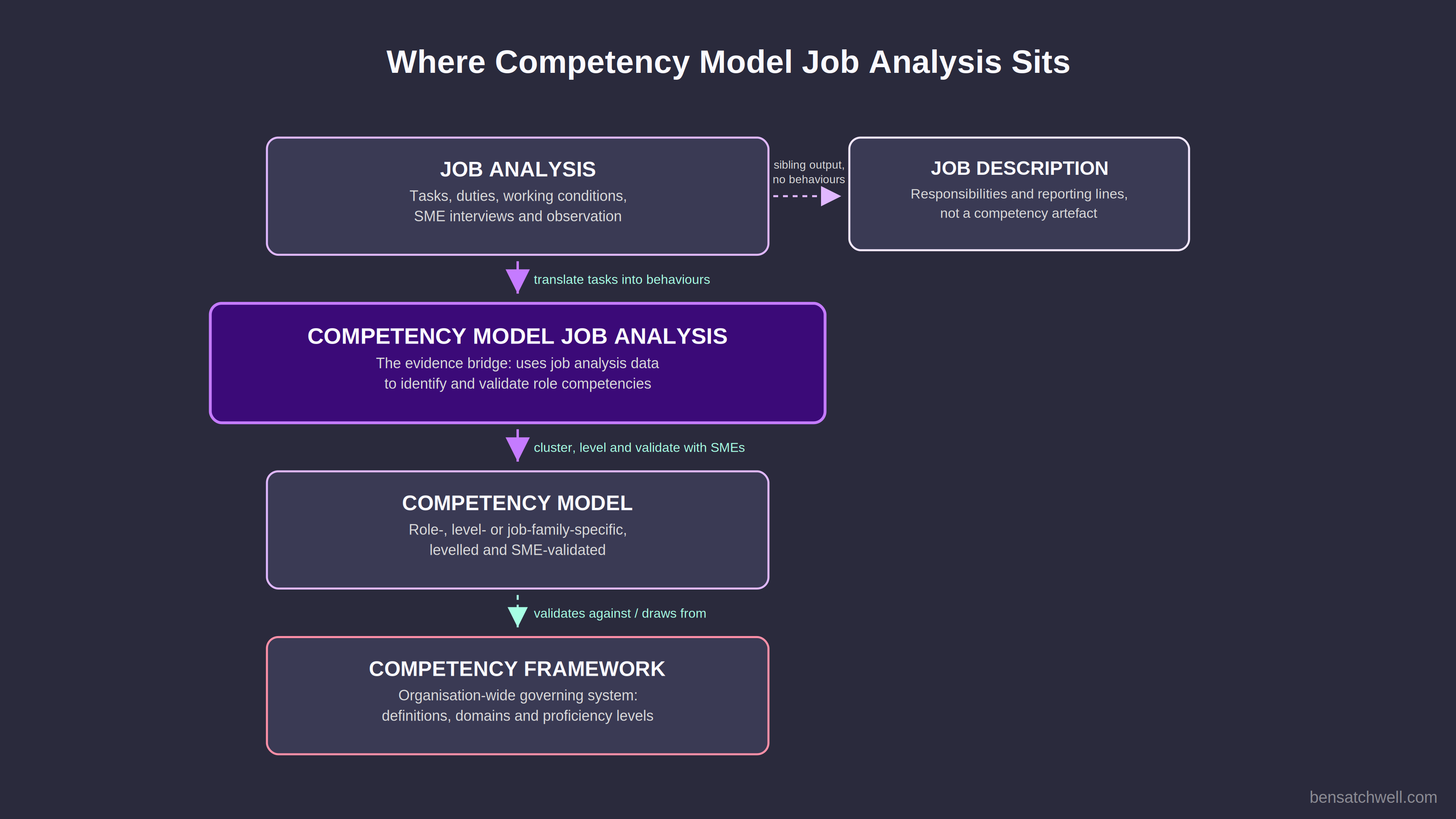
Where competency model job analysis sits between raw job analysis evidence and the organisation's competency framework.
Why It Exists
A competency model built without job analysis is guesswork dressed as strategy. Consultants and HR teams under time pressure often lift competencies from a generic library, add the organisation's logo, and call it done. It looks credible and holds up in a leadership meeting. It falls apart the moment a manager asks why "strategic thinking" appears in a frontline supervisor role, because nobody checked what the role actually requires.
Job analysis exists to answer that question with evidence rather than opinion. It exists in competency modelling specifically because a model that is not traceable back to real task and behaviour data will not survive contact with the people who do the job. Employees and line managers can tell the difference between a competency that was derived from watching the work and one that was copied from a template. The former gets used. The latter gets filed.
How It Works in Practice
Competency model job analysis follows a sequence, and skipping steps is where most of the failures start.
1. Identify subject matter experts
High-performing incumbents and their supervisors are the primary data source. A panel of four to eight SMEs per role is typical, large enough to triangulate, small enough to manage.
2. Gather job analysis data
This stage uses established job analysis techniques: structured interviews, critical incident technique, behavioural event interviews, task inventories, and direct observation where the role allows it. The goal is a documented set of tasks, critical incidents and the knowledge, skills, abilities and other characteristics (KSAOs) associated with strong versus average performance.
3. Translate tasks into behaviours
This is the step that separates job analysis from competency modelling. Tasks describe what is done. Competencies describe how effective performance looks, expressed as observable behaviour. A task such as "prepares budget variance reports" gets translated into a behavioural competency such as financial analysis and judgement, defined by what distinguishes a strong report from a mediocre one.
4. Cluster and validate against the framework
The translated behaviours are grouped into competency clusters and checked against the organisation's existing competency framework, so the new model reuses shared definitions rather than inventing parallel language for the same thing. This is also where competency model development proper begins: selecting, defining and levelling the validated competencies for the specific role or job family the analysis covered.
5. Set proficiency levels and confirm with SMEs
Each competency is levelled against observable indicators, then taken back to the SME panel for a validation pass. If the panel does not recognise the model as a description of their actual work, the analysis was incomplete.
The U.S. Department of Labor's Competency Model Clearinghouse documents this translation explicitly through its tiered building-block model, separating foundational competencies from industry-specific and occupation-specific ones built on job analysis data, which is a useful reference for how the layers are meant to stack.
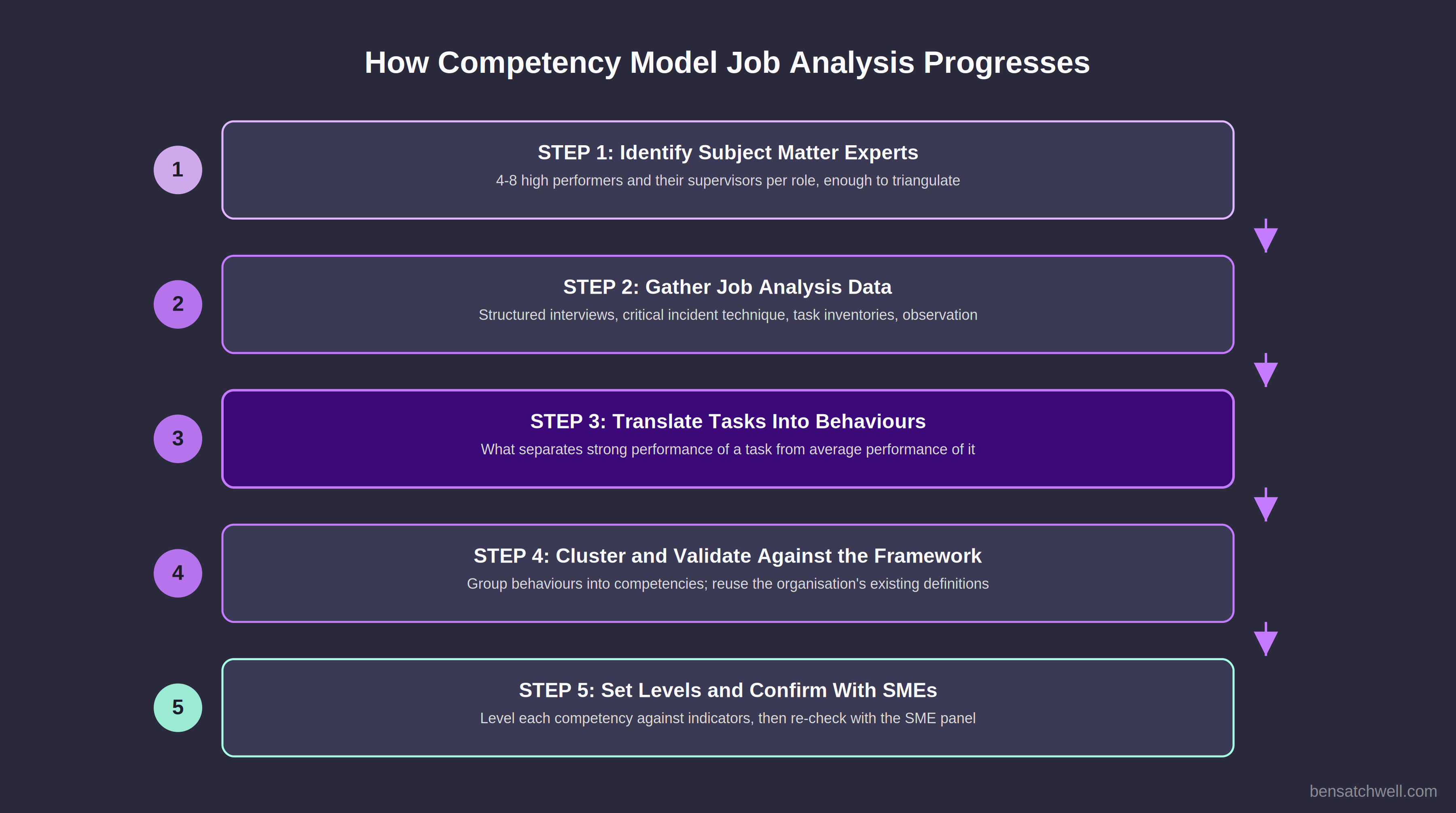
The five-step sequence competency model job analysis follows, from identifying subject matter experts through to SME-confirmed proficiency levels.
What It Is NOT
Competency model job analysis is not traditional job analysis on its own. Traditional job analysis stops at the task and duty level and is oriented towards classification, grading and legal defensibility. It does not, by itself, produce levelled behavioural competencies.
It is not a competency framework. A framework is the organisation-wide governing system, the definitions, domains and levelling logic that apply across the whole workforce. Competency model job analysis produces the evidence for one model, built for one role, level or job family, that draws on and feeds back into that framework.
It is not a job description. A job description documents responsibilities and reporting lines. It rarely says anything about the proficiency level required or what distinguishes strong performance from average performance, which is the entire point of the competency layer.
It is not a shortcut to skip job analysis and start with a generic competency library. Borrowing competencies is a legitimate starting point when speed matters more than precision, but it stops being competency model job analysis the moment the evidence-gathering step is removed. At that point it is competency labelling, not modelling.
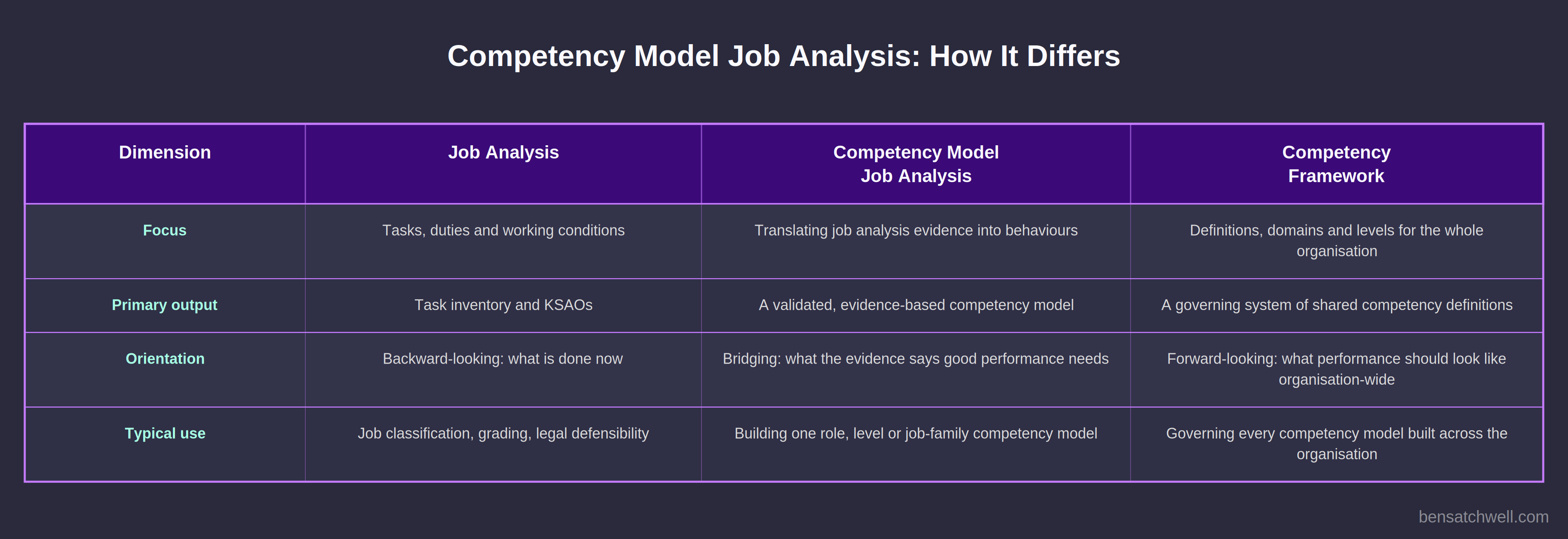
How competency model job analysis differs from job analysis and the competency framework across focus, output, orientation and typical use.
Named Approaches Worth Knowing
A few methodologies show up repeatedly in how organisations run this work. McClelland's behavioural event interview technique, later commercialised through Korn Ferry and Lominger's competency libraries, uses critical incidents from top and average performers to isolate the behaviours that actually differentiate performance, rather than the tasks everyone performs regardless of skill.
The O*NET Content Model, maintained by the U.S. Department of Labor, structures this differently again: it organises job-oriented data (tasks, work activities) and worker-oriented data (skills, abilities, knowledge) into a shared taxonomy, which is one of the clearest public illustrations of how task-level job analysis output maps onto competency-style constructs at scale.
In government contexts, the U.S. Office of Personnel Management runs its own governmentwide occupational studies using the MOSAIC methodology, collecting structured input from incumbents and supervisors to build the competency models used across federal selection and assessment. It is a large-scale, standardised version of the same SME-driven process a single organisation runs at a smaller scale.
Common Failure Modes
The most common failure is stopping at step two. Organisations run interviews and build a task inventory, then present that inventory as the competency model without ever translating tasks into behaviours. The result reads like a job description with a proficiency scale bolted on, and nobody can explain what "level 3" looks like in practice.
The second is the opposite problem: skipping job analysis entirely and adapting a purchased competency library. This produces polished, well-worded competencies that do not describe the actual role, which line managers spot immediately and quietly stop using.
The third is under-sampling. Interviewing one or two incumbents and calling it job analysis produces a model shaped by one person's idiosyncrasies rather than what the role genuinely requires. A defensible model needs enough SME input to separate the role from the individual currently doing it.
The fourth is skipping validation. A model that has not been checked back with the SME panel, or against an existing competency assessment framework, is a hypothesis, not a finished artefact, and it usually gets treated as one the first time it is used for a real decision.
Trade-offs and Constraints
Full competency model job analysis is resource-intensive. SME panels, structured interviews and validation rounds take weeks, not days, and that cost is only justified when the model will carry real weight: selection decisions, regulated occupations, high-volume roles, or anything likely to face legal or industrial scrutiny. For those contexts, the rigour is not optional. Job analysis-grounded models are what make competency-based selection defensible under equal employment and merit-based hiring obligations.
Where the stakes are lower, a lighter approach is defensible: adapting existing framework competencies with a short SME sense-check rather than running full job analysis from scratch. The judgement call is matching the depth of the analysis to what the model will actually be used for, not applying maximum rigour everywhere by default or skipping it everywhere to save time.
Frequently Asked Questions
Is job analysis the same as competency modelling?
No. Job analysis documents tasks, duties and working conditions. Competency modelling translates that evidence into behavioural competencies with proficiency levels. Job analysis is an input; the competency model is the output after translation.
Do you always need job analysis to build a competency model?
Not always. Adapting existing framework competencies is a reasonable starting point for low-stakes or fast-turnaround needs. Full job analysis is warranted when the model will drive selection, regulated roles, or other high-stakes decisions.
Who should be involved in the job analysis stage?
High-performing incumbents and their direct supervisors, typically four to eight per role, gathered through structured interviews, critical incident technique or behavioural event interviews.
What is the difference between a task and a competency?
A task describes what gets done. A competency describes the behaviour, skill and judgement that distinguishes strong performance of that task from average performance. Job analysis identifies tasks; competency modelling identifies what separates good from average within them.
How many people need to be involved for the analysis to be valid?
There is no fixed number, but a single incumbent's input reflects that person, not the role. Most practitioners triangulate across four or more SMEs per role before treating the output as representative.
Does competency model job analysis replace the organisation's competency framework?
No. It produces the evidence for one model within one role or job family. That model should draw on, and stay consistent with, the definitions and levelling already established in the organisation's competency framework.