

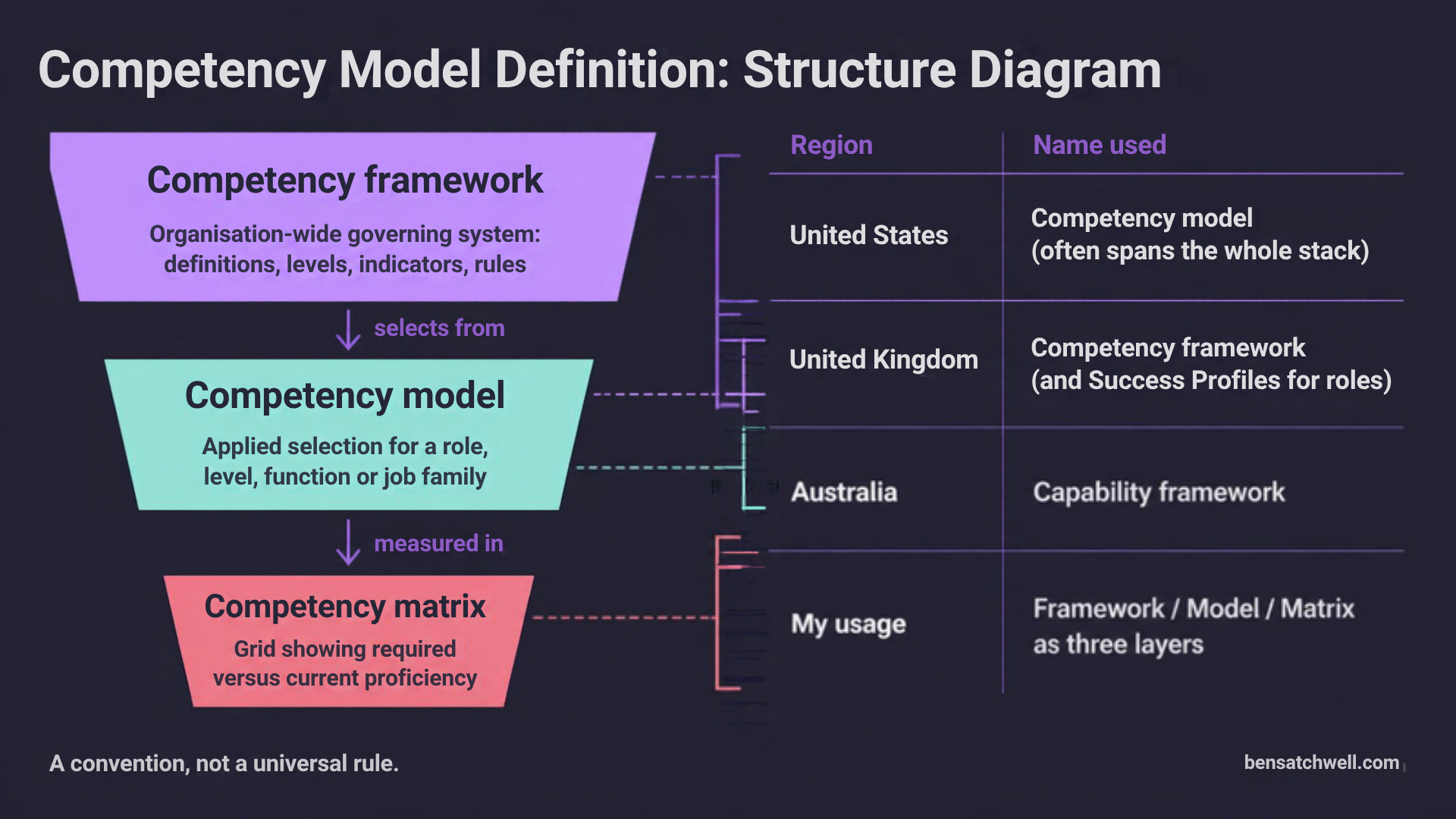
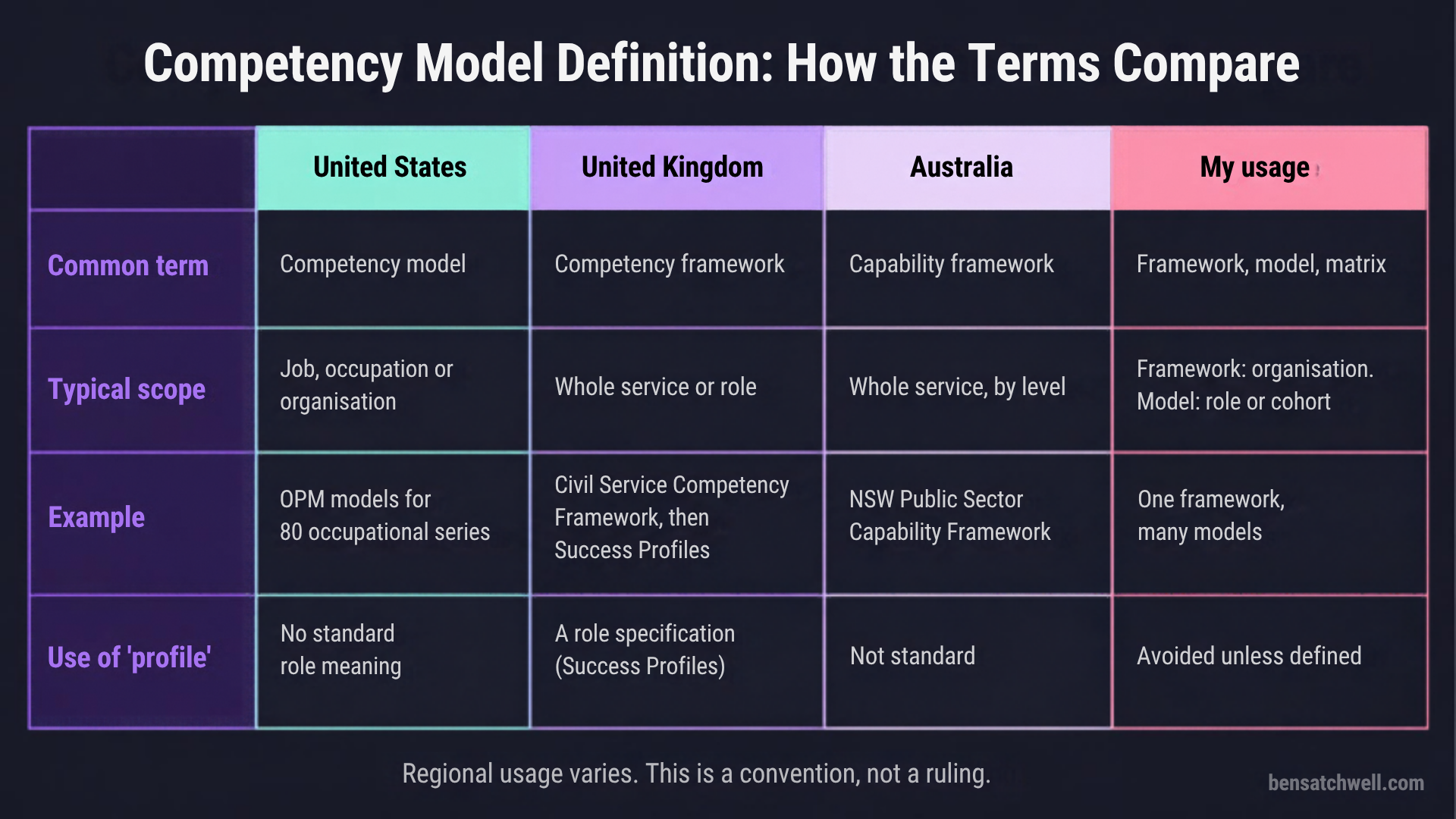
The competency model definition you were taught depends on where you were taught it. In the United States, a competency model is usually the whole structure. In the UK and Australia, that same structure is more often called a framework. I use a third arrangement, where framework and model are separate layers.
None of these is wrong, and I am not trying to replace any of them. I am not the authority on this definition and I do not plan to be. My aim is clarity and alignment, because implementations fail quietly when two people use the same word for different structures.
What Is a Competency Model Definition in the US?
In the US, "competency model" is the primary term. The most useful short version is this:
A competency model is a collection of competencies that together define successful performance in a defined work setting, such as a job, occupation or industry.
That is how the US Department of Labor describes it on its CareerOneStop Competency Model Clearinghouse. The academic version comes from industrial and organisational psychology. Campion and colleagues (2011) describe competency models as collections of knowledge, skills, abilities and other characteristics needed for effective job performance. The SHRM-SIOP white paper on competency modelling documentation repeats that view and adds that the concept is "somewhat ambiguous".
US usage also reaches down to the job. In 2023 the US Office of Personnel Management published competency models for 80 occupational series. So the American term covers an organisation, an occupation and a single role, all under one name.
What Do the UK and Australia Call a Competency Model?
Both countries lean towards "framework", and Australia leans towards "capability" as well.
- UK: the Civil Service used a Civil Service Competency Framework from 2012 to 2017. From 2019 it moved to Success Profiles, which describe a role through behaviours, strengths, ability, experience and technical skills. The CIPD also speaks of competency frameworks rather than models.
- Australia: public sector practice favours capability frameworks. The NSW Public Sector Capability Framework, managed by the Office of the Public Service Commissioner, is built to help agencies attract, recruit, develop and keep skilled staff. The Australian Public Service uses the Integrated Leadership System, and Queensland has its own Capability and Leadership Framework.
I would say "commonly" rather than "always". The UK Civil Service has changed its own language, and the pattern is stronger in government than in private practice.
Where does the word "profile" fit?
"Profile" has no settled meaning. In UK Civil Service recruitment it describes a role. In some practitioner writing it describes a person's actual competencies, set against a model. I could not find a standard US usage for a role-level competency profile, since US sources use "competency model" at job level too. I would not assume either reading without asking.
How Do I Define Competency Framework, Competency Model and Competency Matrix?
This is my convention, and I offer it as how I use the terms, not as universal fact.
- Competency framework: the organisation-wide system that defines, groups and standardises competencies, with proficiency levels, observable indicators and the rules for how they are applied.
- Competency model: an applied selection of competencies from the framework, tailored to a role, level, function or job family.
- Competency matrix: a grid that maps competencies against roles or people to show required proficiency against current proficiency.
If the framework is the system, the model is an instance of it, and the matrix is how you see the gaps. A US reader will often use "competency model" for what I split into framework and model. A UK or Australian reader will often use "framework" for the same combined thing.
Why Does a Competency Model Exist?
A competency model exists to state what good performance looks like in observable terms, so that hiring, development, performance review and succession all draw on one set of attributes. Campion and colleagues note that models are often used to align HR systems into a single approach. Without that shared reference, each process invents its own idea of good.
The terms differ because they grew in different settings. US usage sits close to job analysis, where the unit is a job. UK and Australian public sector usage sits close to workforce policy across a whole service, where the unit is a level or classification. That is my reading, not a documented history.
How Does a Competency Model Work in Practice?
The mechanics are the same in every region, whatever it is called.
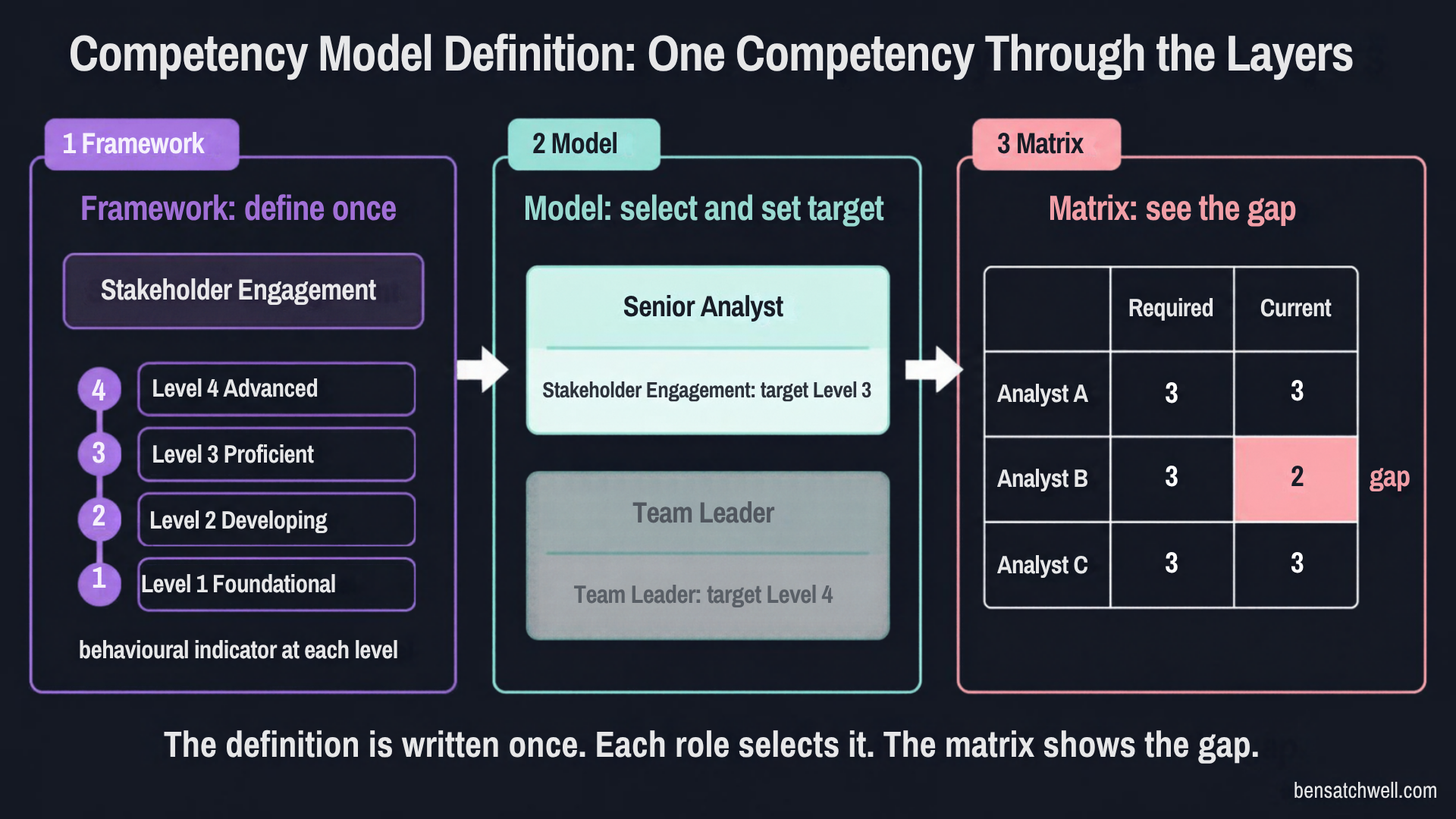
- Competencies are defined once, with levels and behavioural indicators.
- A model selects the competencies a role needs and sets a target level for each.
- A matrix compares those targets with what people currently demonstrate.
For example, "Stakeholder Engagement" is defined once with four levels. A senior analyst role selects it at level three. A matrix then shows which analysts sit at level two. The definition is not rewritten for each role, which is what keeps comparison consistent.
What Is a Competency Model Not?
This is where most confusion lives, so I will be specific.
- Not a replacement for US terminology. If a US colleague says competency model, they mean something legitimate and well established. My split is an addition for projects that need to separate governance from application.
- Not a job description. A job description lists accountabilities and tasks. A model describes the behaviours that show those accountabilities being met well.
- Not a skills taxonomy. A taxonomy classifies skills. A model integrates skills, knowledge, judgement and behaviour as applied in a role.
- Not a capability model. I treat capability as broad, durable human ability that travels across roles. A competency is applied in the context of a role.
- Not a person's profile. A model is the standard. A profile, where the word is used that way, is the measurement against it.
Which Named Standards Use These Terms?
Named standards show how loose the vocabulary is. The SHRM-SIOP paper and OPM both use "competency model". The CIPD and the UK and Australian public service examples above use "framework". SFIA, which originated in the UK, calls itself a skills framework and defines skills with levels, which is a different construct again. I treat these as usage, not errors. Each reflects its own audience.
What Goes Wrong When Teams Use Different Words for the Same Structure?
The failure is rarely the model itself. It is the mismatch of expectations before the model is built.
- Scope mismatch. A US supplier proposes a competency model for one role. The client expects an organisation-wide system.
- Duplicate builds. Two teams each build a model, with different definitions of the same competency.
- No governance. A model is built with no framework above it, so it cannot be reused or kept consistent.
- Treated as a launch. The work is delivered once and never run. I cover that pattern in why most capability frameworks fail.
Wording problems are often a symptom of a deeper one. As I argue in the problem is assembly, not capability, organisations usually hold the parts but lack the assembly that derives them from strategy. Agreeing the vocabulary is the cheapest first step. How the layers connect is set out in the People Capability System.
When Should You Use Each Term?
Use the local term in the room, and define it on the first page of any document.
- Use "competency model" when you are describing one role, level or occupation. It reads the same in every region.
- Use "framework" when you mean the organisation-wide system, or say "organisation-wide competency model" with US audiences.
- Use "matrix" only for the grid.
The trade-off is real. My split adds a layer that some US readers will see as unnecessary. The benefit is that governance and application are named separately, which matters once more than a handful of roles are involved. For a single role in a small team, the extra term is not worth the cost.
Frequently Asked Questions About the Competency Model Definition
What is the definition of a competency model?
A competency model is a collection of competencies that together define successful performance in a defined work setting, such as a job, occupation or industry. It usually includes proficiency levels and observable behaviours.
Is a competency model the same as a competency framework?
Often, in common usage, yes. In my own usage, no. I use framework for the organisation-wide governing system and model for an applied selection from it for a role, level or job family.
What do the UK and Australia call a competency model?
Commonly a framework. The UK Civil Service used a Competency Framework before moving to Success Profiles, and Australian public sector bodies such as NSW use capability frameworks.
What is the difference between a competency model and a competency profile?
There is no settled difference. Profile can mean a role specification, as in UK Success Profiles, or a person's actual competencies measured against a model. Check which one is meant.
Which term should I use with a US client?
Use competency model, and state whether you mean one role or the whole organisation. Then define any extra terms you use, such as framework or matrix, before you rely on them.
What is the difference between a competency model and a capability model?
A competency model describes role-applied performance. A capability model, in my usage, applies selected human capabilities, which are broad and durable, to a role, level or cohort with target levels for that context.