
Most organisations confuse the artefact with the architecture. A job competency matrix is not a competency framework. It is not a competency profile. It is a grid, and treating it as the governing system is one of the most common reasons competency work collapses under its own weight.
I see this in practice constantly. Organisations build elaborate matrices, circulate them to managers, and then wonder why nothing changes in how people are hired, developed or assessed. The matrix was never the problem. The confusion about what it is for, and what it is not, was.
What Is a Job Competency Matrix?
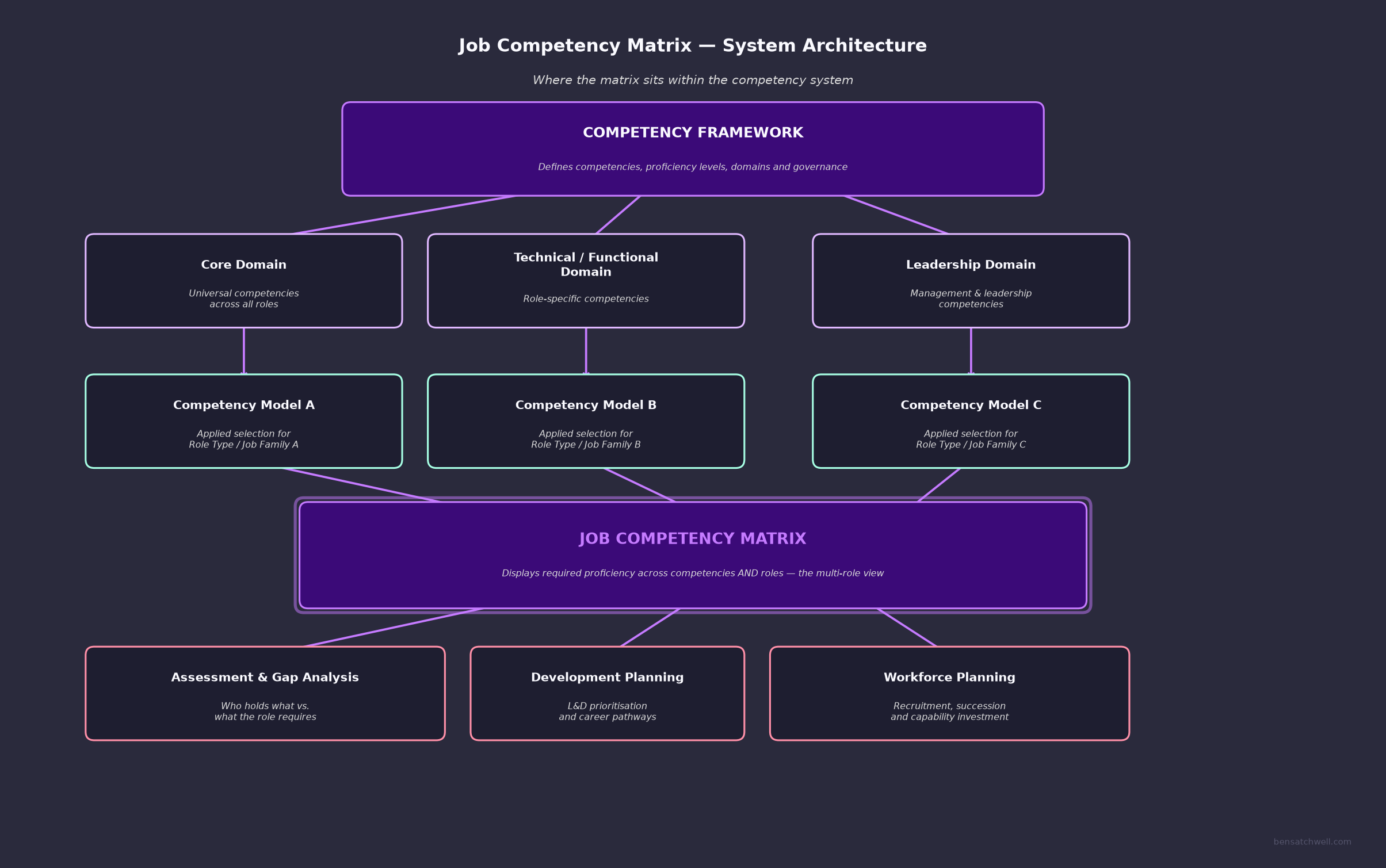
A job competency matrix is a grid that maps competencies against roles or job profiles to show, for each combination, the required proficiency level. It is a display and assessment artefact, a tool for making visible the competency expectations embedded in the organisation's competency framework and its profiles. The matrix does not define what the competencies mean. That is the framework's job. It does not define the proficiency levels. That is also the framework's job. It takes those definitions and maps them to specific roles so the expectations are visible in one place.
A second variant adds current proficiency alongside required proficiency. This is the assessment-oriented version, used in talent reviews, skills audits and development planning. Both variants are matrices: display and reference tools, not governing structures.
A note on terminology. A competency framework is also called a competency model, especially in the United States. I use competency profile for the competencies and required levels for one role, and competency matrix for the grid of required against current proficiency. Usage varies by region, and I explain the differences in this competency model definition.
Why a Job Competency Matrix Exists
Organisations face a persistent problem: competencies are defined centrally but no one can see, at a glance, what is required where. Managers cannot compare expectations across levels. People cannot see what is required to progress. L&D cannot identify where gaps are most pronounced across a function.
A competency framework defines the competencies and proficiency levels. A competency profile selects a subset for a specific role or cohort. The job competency matrix displays those requirements across multiple roles simultaneously, making comparison and prioritisation possible.
Without the matrix, the framework sits in a policy document. With it, the framework becomes navigable.
How a Job Competency Matrix Works in Practice
A job competency matrix cannot be built credibly without an underlying framework and profiles already in place. The competencies and proficiency levels must come from a defined system, not invented ad hoc for each role.
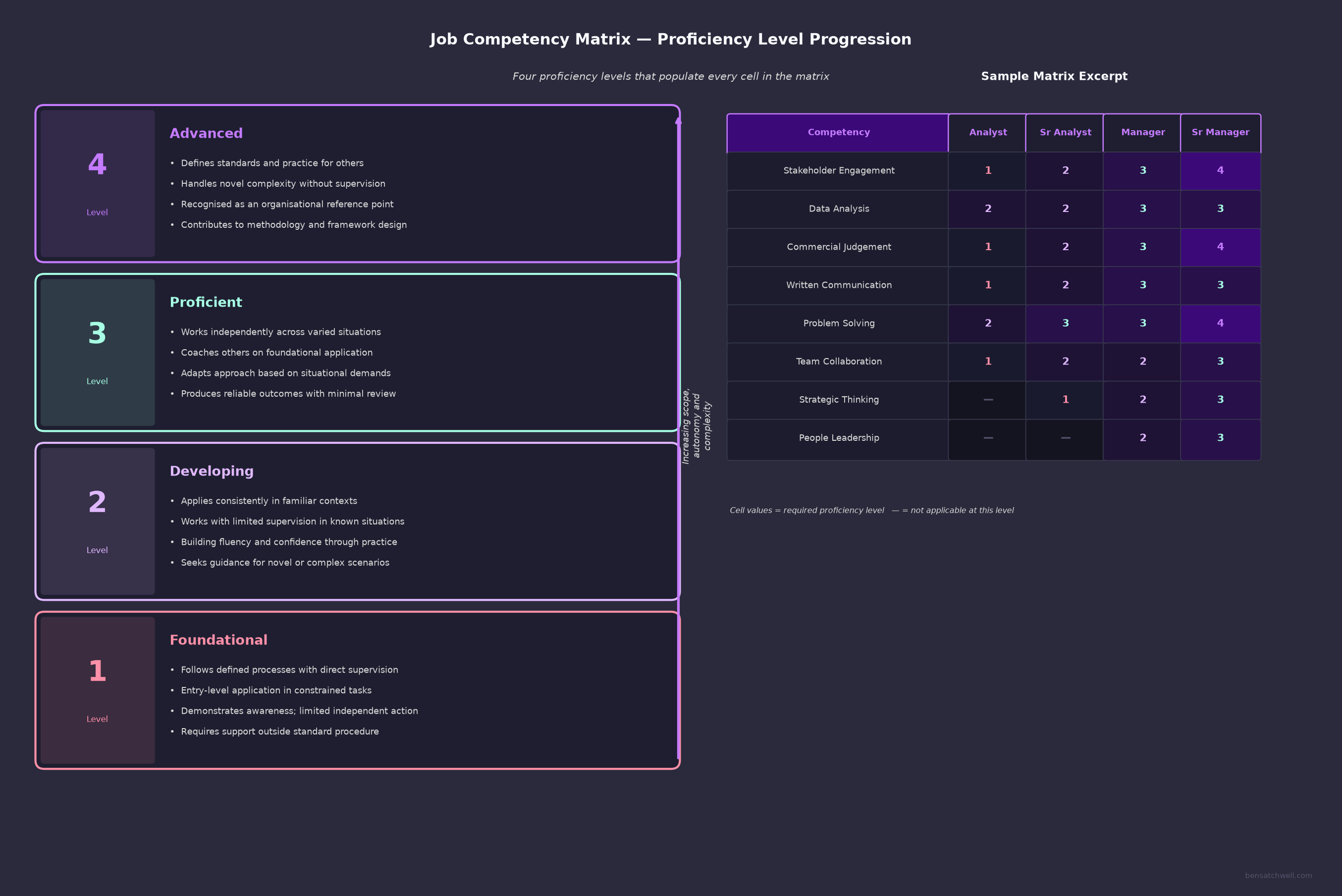
The process works roughly as follows:
The SHRM Body of Applied Skills and Knowledge distinguishes between proficiency indicators for standard HR professionals and those at advanced levels, with the gap between them mapped explicitly. That is exactly the kind of tiered, role-differentiated requirement that a well-structured job competency matrix makes visible and operational.
For technology and digital roles, SFIA (Skills Framework for the Information Age) provides seven defined responsibility levels, from Level 1 (follow) through Level 7 (set strategy), that organisations frequently use as the proficiency spine of their matrices rather than building custom levels from scratch.
What a Job Competency Matrix Is NOT
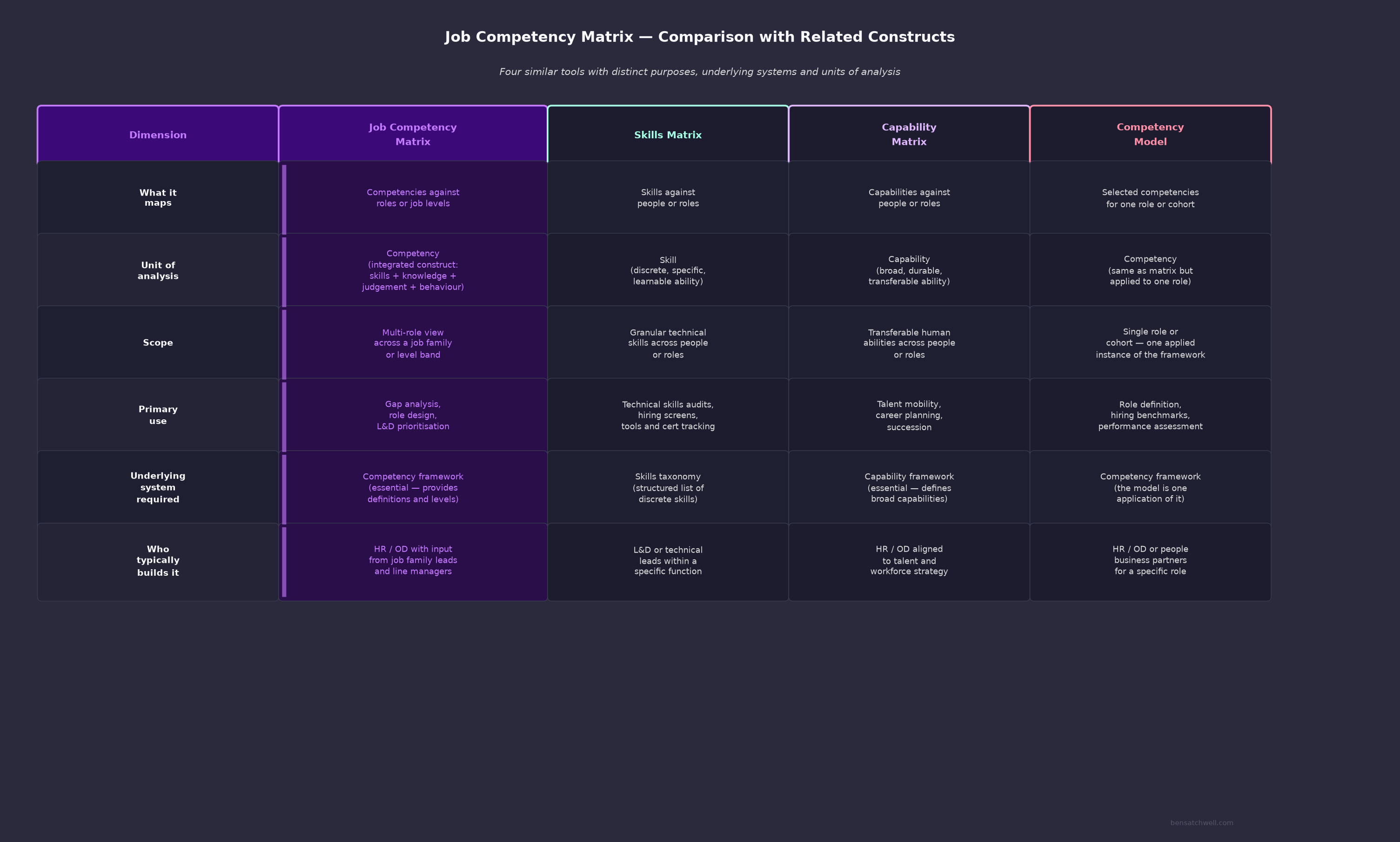
It is not a competency framework. The framework defines, organises and governs competencies across the organisation. The matrix uses the framework's output. An organisation that builds a matrix without a framework has built a display tool with nothing authoritative underneath it.
It is not a skills matrix. A skills and competency matrix maps discrete, granular skills, specific tools, techniques or tasks, against people or roles. A job competency matrix maps competencies, which integrate skills, knowledge, judgement and behaviour into a higher-order construct. The two artefacts are built on different underlying constructs and answer different questions.
It is not a competency profile. The competency profile is the selection of competencies and required levels for a role or cohort. The job competency matrix shows those selections and requirements across multiple profiles and roles side by side. The profile is the role-level selection; the matrix is the multi-role view.
It is not an assessment tool by itself. The matrix shows requirements. Evaluating whether a person meets those requirements takes a separate process: evidence gathering, manager observation, calibration conversations. The matrix is the benchmark. The assessment is what you do with it.
Named Framework and Standards References
SFIA defines skills and proficiency levels for technology and digital roles across seven levels of responsibility. Organisations in the ICT sector frequently use SFIA's skill and proficiency definitions directly as the row and level content in their matrices, avoiding the overhead of designing custom proficiency scales.
Lominger and Korn Ferry competencies are widely used in leadership and general management matrices. Their competency library, organised by career stage, appears regularly as the row labels in manager and executive-level matrices.
ISO 9001, ISO 14001 and ISO 45001 all require organisations to determine, document and evidence the competence needed by persons performing work that affects conformance. A job competency matrix is a natural vehicle for meeting this documentation requirement. ISO defines competency as observable and measurable performance indicators aligned to organisational objectives, a definition that maps directly to how a well-constructed matrix uses behavioural indicators at each proficiency level.
Common Failure Modes
The most common failure is building the matrix before the framework exists. Organisations create a grid, populate it with competency names they have borrowed or invented without formal definitions, and consider the job done. The matrix then sits unused because no one knows what the proficiency levels mean or how to assess against them.
The second failure is scale without purpose. A matrix listing 40 competencies across 30 job titles feels thorough but is unmaintainable. Matrices that stay in active use tend to cover 8 to 12 competencies within a clearly scoped job family or level band. Scope creep kills usability before the tool is ever tested.
The third failure is mistaking the matrix for the process. The matrix defines requirements. It does not conduct performance reviews or run development conversations. Placing the full burden of those processes onto a grid that was never designed to carry them is a reliable way to generate compliance without outcome.
The fourth failure is building centrally without business validation. Required proficiency levels that line managers do not recognise or believe in will be quietly disregarded. The matrix must survive scrutiny from people who actually do the work.
Trade-offs and Constraints
A job competency matrix is most useful in two situations: when you need to compare expectations across roles within a job family, and when you need a defined benchmark for assessment and development conversations.
It is less useful when roles are highly diverse or when the work resists fixed expectations. Emergent or research-oriented roles often have requirements that shift faster than a matrix can be updated. The matrix imposes structure, and in some contexts that structure constrains rather than enables.
Both the HR competency matrix and the team capability matrix are specialised variants applying the same logic within a specific function or team context. They inherit the same constraints: they work when the underlying definitions are solid and the required levels have been validated with the people closest to the work.
A matrix is not a substitute for manager judgement. The proficiency requirements in the cells are reference points for conversation, not automated verdicts. The best use of a job competency matrix opens developmental dialogue: here is what the role requires, here is what the evidence suggests you hold, here is the conversation we need to have.
FAQ
What is a job competency matrix?
A job competency matrix is a grid mapping competencies against job roles or levels to show the proficiency expected at each intersection. It is a display and assessment artefact built from a competency framework and its profiles, used to make role requirements visible and comparable across multiple positions.
What is the difference between a job competency matrix and a skills matrix?
A skills matrix maps discrete, granular skills against roles or people. A job competency matrix maps competencies, which integrate skills, knowledge, judgement and behaviour into a higher-order construct. The two overlap but serve different purposes and require different underlying systems.
How many competencies should a job competency matrix include?
Eight to twelve competencies per scoped job family is the workable range. More than fifteen across many roles tends to become administratively heavy and difficult to maintain. Scope by job family or level band rather than attempting to cover the whole organisation at once.
Can you build a job competency matrix without a competency framework?
You can, but it is not advisable. Without a framework providing authoritative definitions and proficiency levels, the matrix lacks consistency and credibility. The matrix is a use of the framework's outputs, not a substitute for the framework itself.
What is the difference between a job competency matrix and a competency profile?
A competency profile is the selection of competencies and required levels for a specific role, level or function. A job competency matrix shows those selections and required levels across multiple profiles and roles side by side. The profile is the role-level selection; the matrix is the multi-role view.
How does a job competency matrix support workforce planning?
By making required proficiency levels explicit across roles, the matrix enables gap analysis at scale: which roles have the most significant shortfalls, across which competencies, and at what level. This feeds directly into recruitment targeting, succession planning and L&D investment decisions.