

A competency matrix is a grid that shows, for each competency, the proficiency a role requires and the proficiency a person currently holds. Most of the matrices I see are skills checklists with a coloured cell for each person. They show who is good at what and say nothing about what the role needs, so nobody can tell a gap from a strength. A matrix only works when it sits on a competency framework, which supplies the competencies, the levels and the behavioural indicators that every cell refers to.
This guide sets out what a competency matrix is, how it is laid out, a competency matrix template you can copy, how to build one in Excel, and where matrices go wrong.
What is a competency matrix?
A competency matrix is a grid that maps competencies against roles or people to show required proficiency against current proficiency.
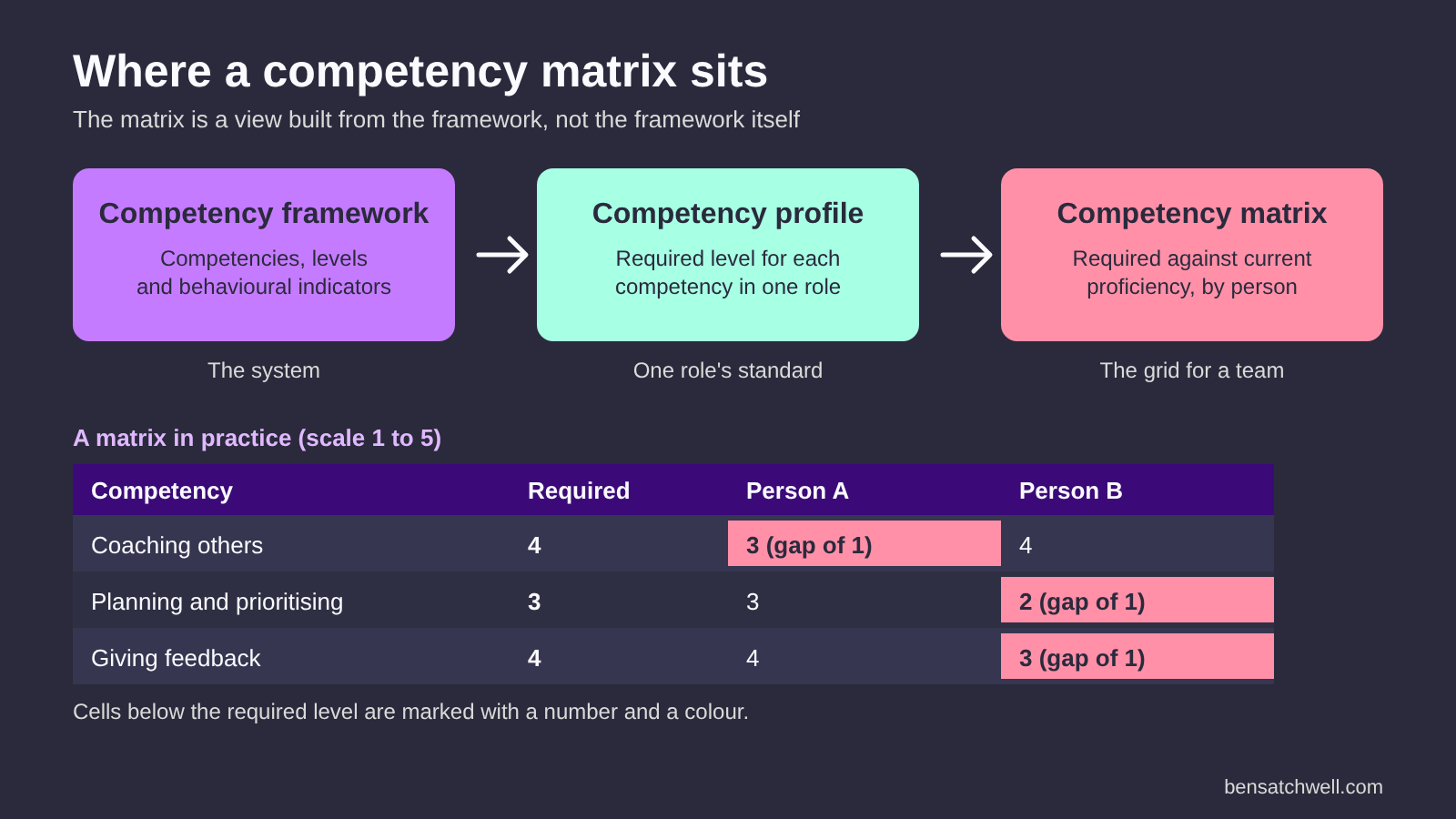
It is a display and assessment artefact. It is built from a competency framework and shows the result of applying it, rather than governing it. Rows are normally competencies. Columns are either roles, when the matrix states what each role requires, or people, when it states what each person currently holds. Each cell holds a proficiency level from the framework's scale.
Reading across a row shows how one competency is spread across a team or how its required level changes between roles. Reading down a column shows the profile of one role or one person.
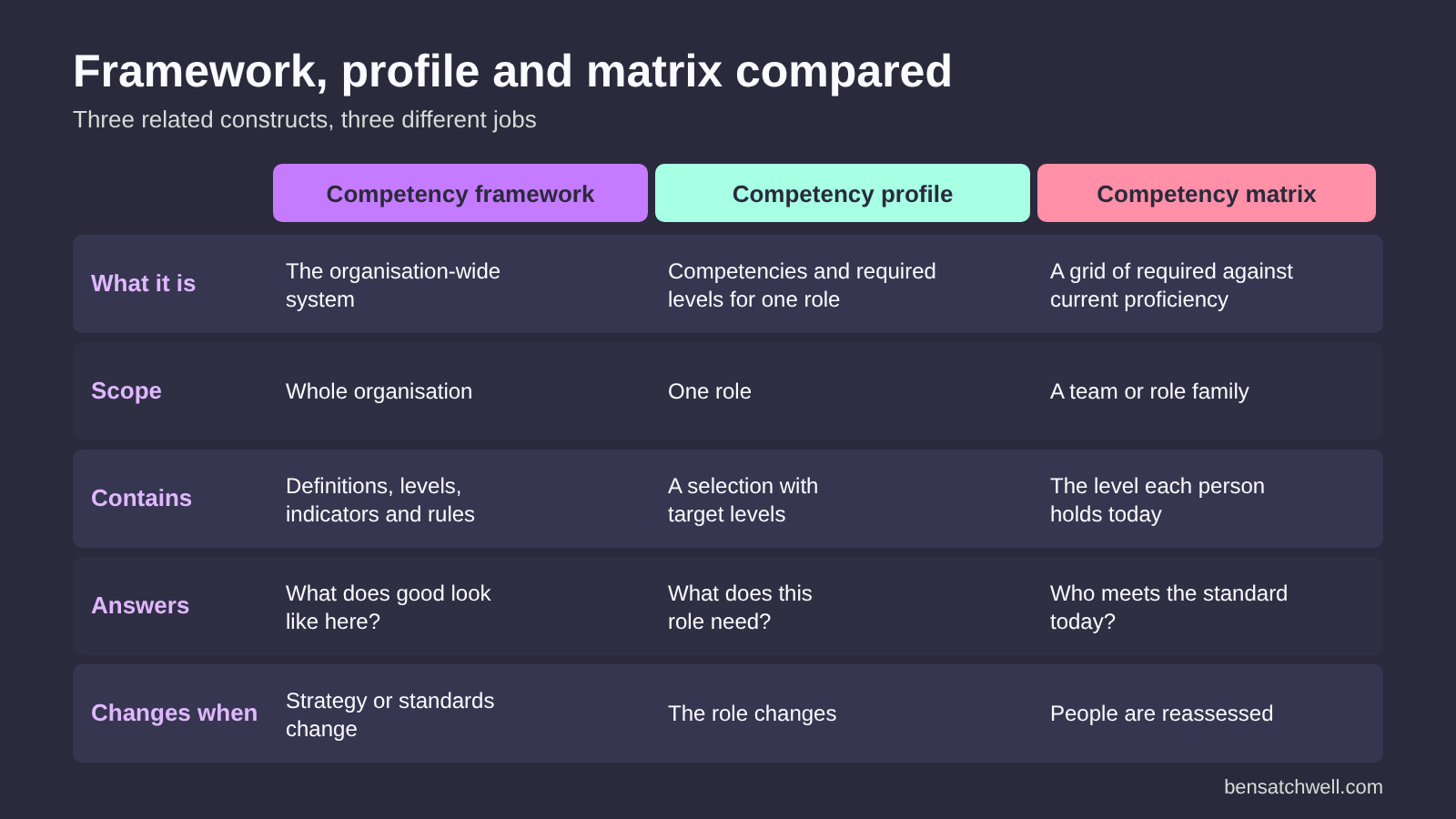
A note on terminology. A competency framework is also called a competency model, especially in the United States. I use competency profile for the competencies and required levels for one role, and competency matrix for the grid of required against current proficiency. Usage varies by region, and I explain the differences in this competency model definition.
Why does a competency matrix exist?
A competency framework is a system for the whole organisation. A manager has a smaller question: who on this team can do what, to the standard the work needs? Without a matrix the answer sits in opinion and memory. The matrix puts the required level and the current level side by side, so the gap is visible and can be discussed.
The US Department of Labor's Competency Model Clearinghouse describes a competency model as a collection of competencies that together define successful performance in a particular work setting, and says competency models are the foundation for recruitment and hiring, learning and development, and performance management. The matrix is how those uses reach a team. It supports three decisions: who is placed on which work, where development effort goes, and which competencies to hire for.
How does a competency matrix work?
What goes on the rows and columns?
The competencies come from the framework. I keep to between six and twelve for one role family, because a grid with forty rows is not read. In a job competency matrix the columns are roles and each cell shows the level the role requires. In a team matrix the columns are people and each cell shows the level the person currently holds. The HR competency matrix is a worked example for one function.
What proficiency scale does a competency matrix use?
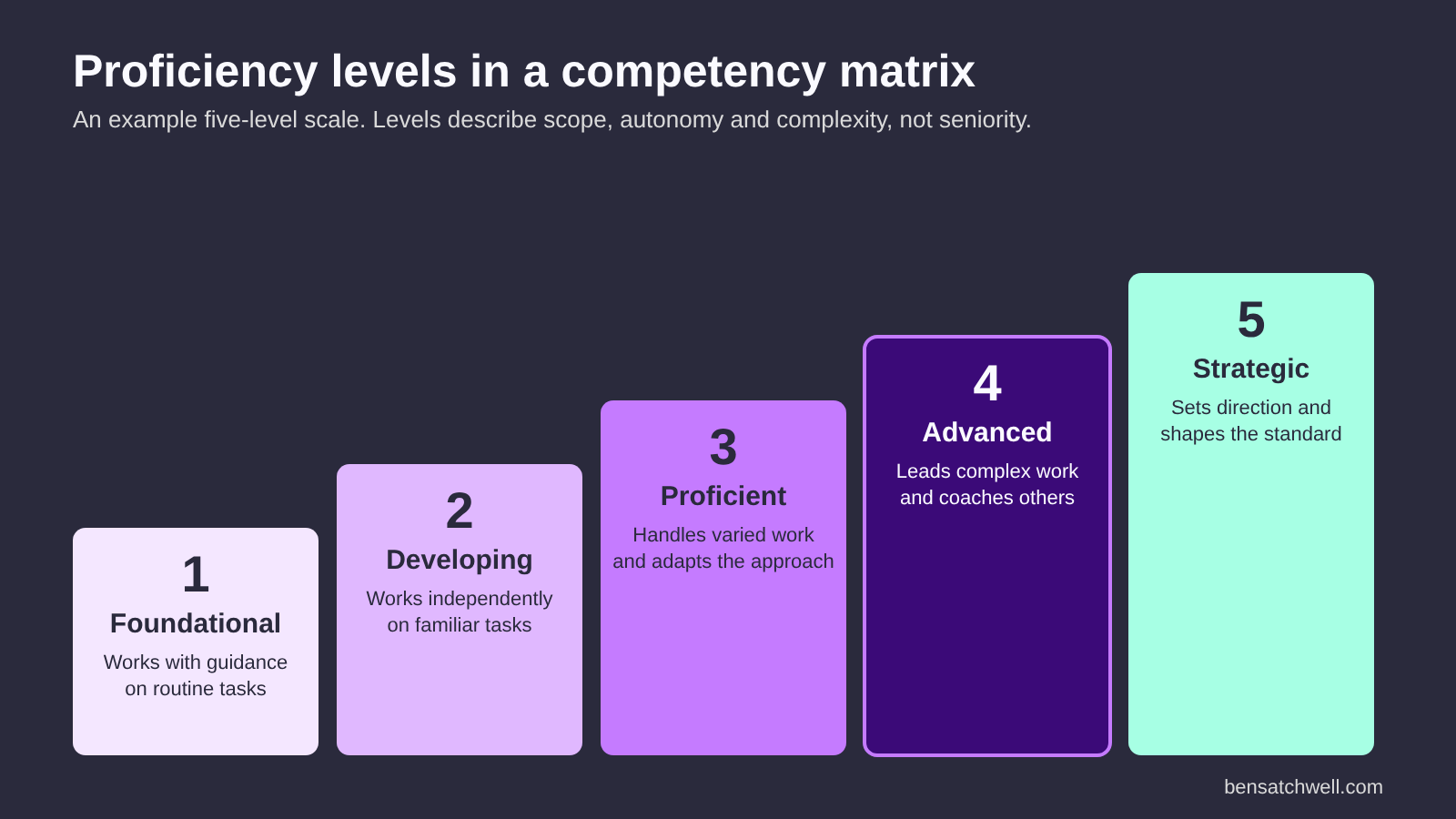
The scale comes from the framework. Levels are set by scope, autonomy, complexity and impact, not by seniority or years of service, and a workable scale has four to six of them. The SFIA Foundation defines seven levels of responsibility. The NSW Government capability framework keeps five capability levels, Foundational, Intermediate, Adept, Advanced and Highly Advanced, showing a progressive increase in complexity and skill. The example here uses five generic levels. Use the levels and behavioural indicators in your own framework, because a number only means something when it points to written behaviours. The competency framework levels guide explains how to set them.
How is the gap calculated?
The gap is the current level minus the required level. A negative number means the person is below the standard, zero means they meet it and a positive number means they exceed it. Show the number as well as a colour, because colour alone fails readers who cannot distinguish it. The gap describes observed behaviour against an indicator at one point in time. It is not a judgement of the person.
Competency matrix template
The template below shows a team of three people against one role profile on a five-level scale. Copy it into Excel or Google Sheets and replace the competencies and levels with those from your own framework.
| Competency | Required level | Person A | Person B | Person C |
|---|---|---|---|---|
| Coaching others | 4 | 3 | 4 | 2 |
| Planning and prioritising | 3 | 3 | 2 | 4 |
| Giving feedback | 4 | 4 | 3 | 3 |
| Stakeholder communication | 3 | 4 | 3 | 2 |
| Decision making | 4 | 3 | 4 | 4 |
Read the table against the required column. Person A is one level short on coaching others and on decision making, meets planning and giving feedback, and exceeds the standard on stakeholder communication. Person B is one level short on planning and on giving feedback. Person C has the most gaps, three: two levels short on coaching others, and one short on giving feedback and on stakeholder communication, while exceeding the standard on planning. That pattern tells a manager where to direct development and who can coach whom.
Each cell should record four things, even if only the level is visible: the level, the evidence it rests on, who rated it and the date.
How do I build a competency matrix in Excel?
- Start with the framework. Select the competencies and the required level for each. This selection is the competency profile for the role.
- Set up the sheet. Put the competencies down column A, the required level in column B and one person per column from column C.
- Rate each person against the indicators. Use the behavioural indicators for each level and evidence such as observed work, work samples and feedback from more than one person.
- Add gap columns. For each person add a column with a formula such as =C2-$B2, copied down, so the gap is current minus required.
- Highlight the gaps. Use conditional formatting for values below zero, and keep the number visible in the cell.
- Count the gaps. A formula such as =COUNTIF(F2:F6,"<0") on a gap column gives the number of gaps for a person. Run it down the rows to see which competencies most people fall short on.
- Set an owner and a review date. A matrix is a snapshot, so someone must be responsible for updating it.
Google Sheets uses the same formulas.
What a competency matrix is not
- Not a competency framework. The framework is the governing system of definitions, levels, indicators and rules. The matrix is one output of it.
- Not a competency profile. A profile is the selection of competencies and required levels for one role. The matrix places profiles beside people.
- Not a skills matrix. A skills matrix records discrete learned abilities such as a tool or a method. A competency matrix records integrated competencies defined by behaviour. The skills and competency matrix guide sets out the difference.
- Not a capability matrix. The same grid works for capabilities, which are broad abilities a person carries across roles. I compare that version with a skills matrix in the team capability matrix guide.
- Not a performance rating. It records proficiency against defined behaviours at a point in time.
Where do competency matrices go wrong?
- No framework behind it. Levels with no written behaviours mean each rater applies a private standard.
- Skills listed as competencies. A row such as "Excel" is a skill. The competency is the integrated performance it supports.
- Too many rows. A grid nobody can read in one sitting will not be used.
- Self-rating only. People rate themselves high or low depending on context. Use evidence and a second rater.
- Colour without numbers. A traffic light hides the size of the gap.
- Never updated. A rating that is a year old describes someone who may have changed.
- Tied to pay without calibration. Once ratings carry money, they inflate.
When should you use a competency matrix, and when not?
Use one when a team has repeated role types, a framework already exists and the decision is about development, work allocation or hiring. A career path version reads the same grid across the levels of one role, as in the career path competency matrix guide.
Do not use one when no framework exists, because the levels will have no meaning, and the framework should be built first. Do not use one for a team of three, where a conversation does the same job. Where roles change every few months, capabilities fit better than role-specific competencies.
The cost is manager time. A matrix also gives a false sense of precision, because a number from one to five looks exact but rests on judgement. Calibrate raters against the same evidence before anyone relies on the result.
Frequently asked questions
What is a competency matrix?
A competency matrix is a grid that maps competencies against roles or people to show required proficiency against current proficiency. It is built from a competency framework.
What is the difference between a competency matrix and a skills matrix?
A skills matrix records discrete, learned abilities such as using a tool. A competency matrix records competencies, which integrate skills, knowledge, judgement and behaviour, at defined proficiency levels.
How many competencies should a competency matrix include?
I keep to six to twelve for one role family. More than that makes the grid hard to read and hard to rate with evidence.
How many proficiency levels should a competency matrix have?
Four to six. Use the levels in your framework, so that each number points to written behavioural indicators.
Can I build a competency matrix in Excel or Google Sheets?
Yes. List the competencies and required levels, add one column per person for the current level, and add gap columns that subtract the required level from the current level.
Who should rate people in a competency matrix?
The line manager, with at least one other rater, using the same behavioural indicators and recorded evidence. Compare ratings before finalising them.