

Competency model training is usually done backwards. An organisation buys or builds a library of learning content, then retrofits competency labels onto it so the catalogue looks aligned. A competency model is meant to run the other way. It states what good performance looks like in a role, and learning is designed to close the gap between that standard and what people currently do.
I see the backwards version constantly, and it is why so many competency models never change anything. This article sets out how competency model training should work, what it is not, and where it tends to fail.
What Is Competency Model Training?
Competency model training is the practice of designing, selecting and sequencing learning against the competencies and proficiency levels in a competency model, so that development effort is aimed at defined performance gaps rather than at general topics.
The unit of design is the competency, not the topic. A competency model is an applied selection of competencies from a framework, set for a role, level or job family. Each competency integrates skills, knowledge, judgement and behaviour as they are applied in the context of a role. That integration is why you cannot simply attach a single piece of content to a competency and call the job done.
In this approach, learning is one input. Experience, coaching, stretch assignments and feedback do as much work as formal learning, and often more.
Why Competency Model Training Exists
It exists because learning spend and job performance routinely drift apart. Content gets commissioned because it is popular, available or requested by a senior stakeholder. Nobody can say which performance gap it addresses.
A competency model fixes the reference point. It gives learning designers a written, levelled description of the behaviour the organisation needs, so they can ask a better question: what stops this person performing at the required level, and what would move them?
The European Centre for the Development of Vocational Training draws the same line in its typology of knowledge, skills and competences. Competence is the ability to apply learning outcomes adequately in a defined context. Learning produces knowledge and skills. Competence is what shows when they are applied at work. A model built on that distinction tells you to design for application, not for completion.
How Does Competency Model Training Work in Practice?
The mechanics are a sequence, and the order matters. Learning is designed last, not first.
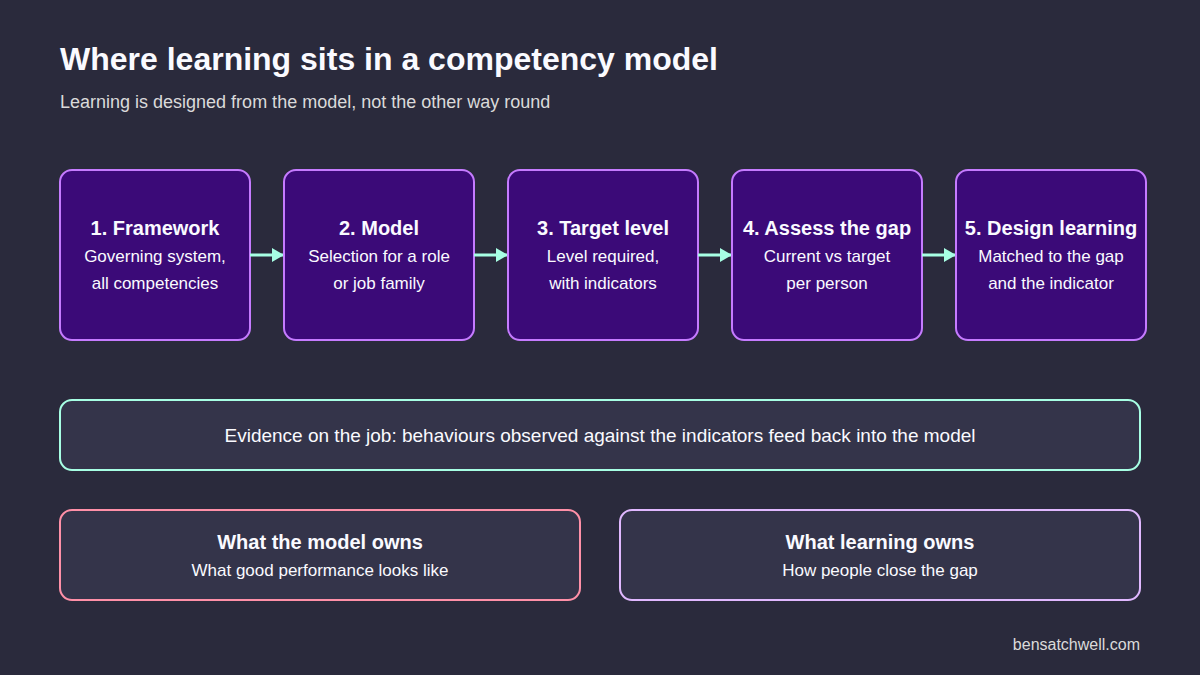
- Select the competencies for the role. Start from the model, not the catalogue. A good model is built from competency model job analysis, which establishes what the role actually requires.
- Set the target proficiency. Each competency needs a required level, with behavioural indicators written for that level.
- Assess the gap. Compare current proficiency with the target for each person or cohort. A matrix is the usual way to display it.
- Design learning against the gap. Match the learning method to the type of gap, whether knowledge, skill or behaviour.
- Gather evidence on the job. Observed behaviour against the indicators shows whether the gap has closed.
Matching Learning to Proficiency Levels
The same competency needs different development at different levels. A foundational level is usually built with guided practice and feedback. Advanced and expert levels are built through stretch work, mentoring others and influencing beyond the immediate team. This is why competency framework levels should be set by scope, autonomy, complexity and impact, not by seniority or years of service.
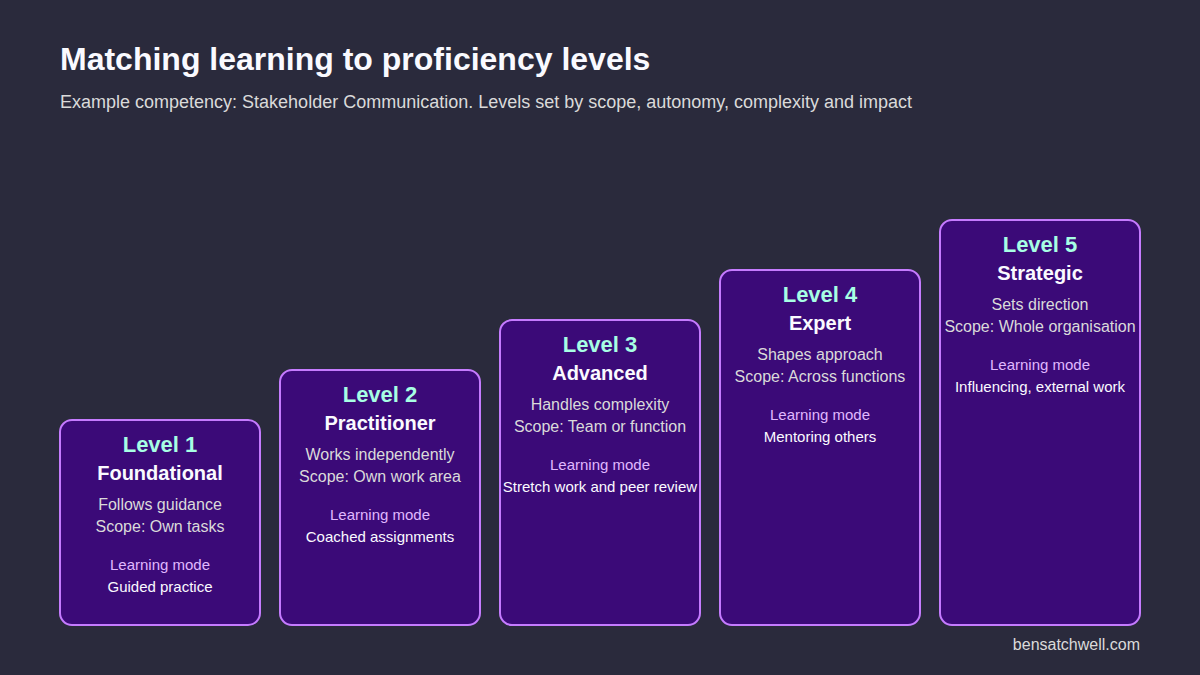
Notice that formal learning is the dominant mode only at the lower levels. By the upper levels, the development is in the work itself. A model that offers only formal learning at every level will stall people at the middle.
What Competency Model Training Is NOT
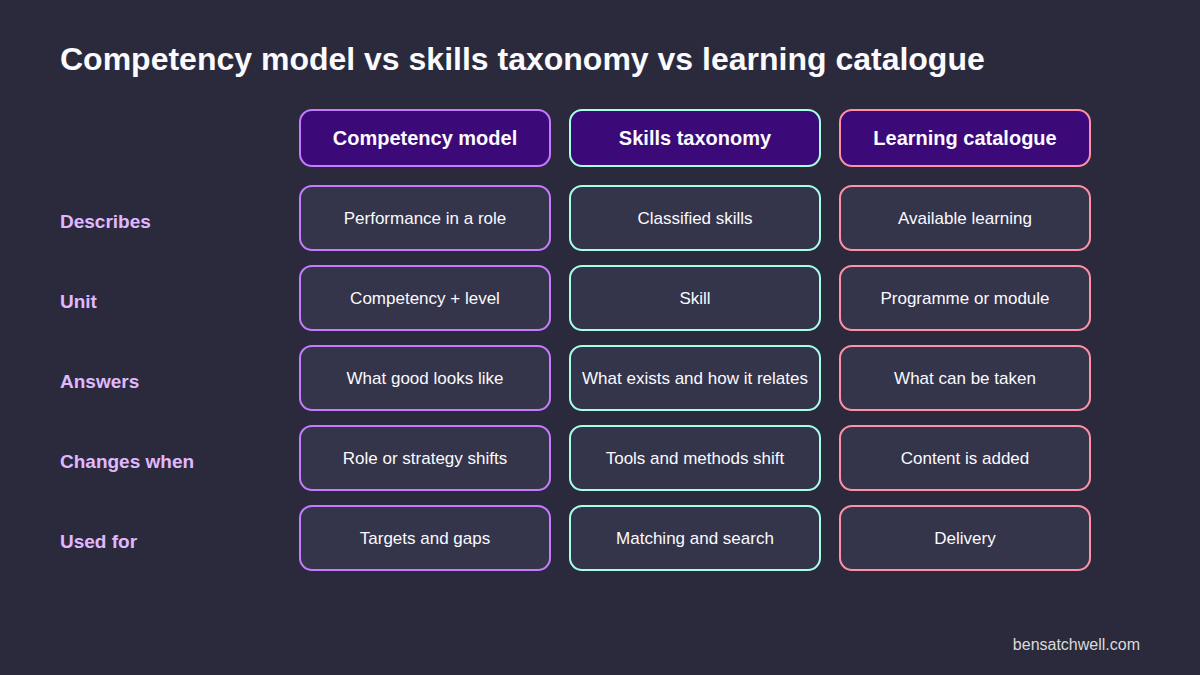
It is not the competency model itself. The model describes performance. Learning is one way of moving people toward it. Teams that conflate the two end up believing the model is finished when the learning catalogue is.
It is not a skills taxonomy. A skills taxonomy classifies skills so a skill means the same thing everywhere. It does not describe performance in a role. A competency draws on skills, but it is not a skill.
It is not task instruction. Teaching someone to complete a system task builds a skill. Competency development changes how they exercise judgement across many tasks.
It is not a compliance record. A completion record shows that content was consumed. A competency is shown by behaviour, and only observed behaviour counts as evidence.
Which Frameworks and Standards Inform Competency Model Training?
The clearest working example of competency-based design is the Australian national system. The Department of Employment and Workplace Relations describes national training package products in which units of competency specify the knowledge and skill, and the application of that knowledge and skill, to the standard of performance required in the workplace. Each unit sets out elements and performance criteria, which are close relatives of the behavioural indicators in a corporate model. The Australian Skills Quality Authority regulates the providers that deliver against them.
In technology, SFIA defines seven levels of responsibility with generic attributes such as autonomy, influence and complexity, which is a useful reference when you are writing level descriptors. Korn Ferry's Lominger library pairs each competency with development suggestions, an early example of linking a competency directly to development actions. CIPD and SHRM take the same approach for people professionals, with levelled behaviours that practitioners can be developed against.
I use these as references, not templates. Each was designed for a particular purpose, and the useful part to borrow is the structure: a defined competency, a defined level, and an observable indicator.
Common Failure Modes
- Mapping content to competencies after the fact. A catalogue tagged with competency names looks aligned and changes nothing.
- Indicators that cannot be observed. If a level descriptor cannot be seen in behaviour, nobody can tell whether learning worked.
- Assuming one intervention per competency. A competency integrates several skills and a body of knowledge. Closing a gap usually takes more than one kind of activity.
- Setting every role at the highest level. Inflated targets create gaps that no amount of learning can close and drain credibility from the model.
- Measuring completion instead of performance. Attendance and completion rates are easy to report and tell you almost nothing about proficiency.
Trade-Offs and Constraints
Use competency model training when roles are stable enough to define, the organisation can assess current proficiency honestly, and managers will observe and give feedback on behaviour. Do not use it as the only development approach for emerging work, where the competencies themselves are still being worked out. In that case, a broader capability approach serves better, because capabilities are durable and transferable across roles that do not yet exist.
There is also a cost. Defining levels, writing indicators and assessing gaps takes real effort, and a model that is not maintained decays. Smaller organisations are often better served by a short model for a handful of critical roles than by a full framework. For how learning and development teams apply this in their own work, see my guide to competency models in learning and development.
Frequently Asked Questions
What is a competency model in training and development?
A competency model is a defined set of competencies, each with proficiency levels and behavioural indicators, selected for a specific role or job family. In development work it acts as the standard that learning is designed against, so effort targets real performance gaps.
How do you use a competency model to plan learning?
Set the target proficiency for each competency in the role, assess current proficiency, then design learning and on-the-job activity to close the gap between the two. Gather behavioural evidence afterwards to confirm whether the gap has closed.
What is the difference between a competency and a skill?
A skill is a discrete, learned ability to do something specific. A competency integrates skills, knowledge, judgement and behaviour as applied in the context of a role. Skills are narrower and change faster with tools and methods.
How many proficiency levels should a competency model have?
Four to six is workable. Fewer than four gives too little distinction between people, and more than six becomes difficult to assess consistently. Levels should be defined by scope, autonomy, complexity and impact.
Can a competency model replace a learning catalogue?
No. They do different jobs. The model defines the performance standard and the catalogue holds the learning options. The model should direct which options are used, and for whom.
How do you measure whether competency-based development worked?
Measure observed behaviour against the behavioural indicators for the target level, ideally through manager observation and structured assessment. Completion and satisfaction figures show participation, not proficiency.