

Competency Model of Mentoring
Most mentoring programs are built on a single unspoken assumption: that being senior is the same as being good at mentoring. It is not. Organisations pair a junior employee with someone who has been around longer, call it a mentoring program, and then wonder why half the pairs never meet twice and the other half produce wildly inconsistent results. The missing piece is almost always the same one: nobody defined what a mentor actually needs to do, at what level, before handing out the label.
A competency model of mentoring is how that gap gets closed. It is not a personality checklist and it is not a training curriculum. It is a defined, levelled set of behaviours that says exactly what effective mentoring looks like in this organisation, for this program, so mentor selection, matching and feedback have something concrete to point at.
What Is a Competency Model of Mentoring
A competency model of mentoring is an applied selection of competencies, drawn from an organisation's broader competency framework, that defines the specific behaviours, judgement and skills a mentor needs to demonstrate at each proficiency level within a particular mentoring role or program. It is a model, not a framework: the competency framework is the organisation-wide governing system that defines competencies once and reuses them consistently; the mentoring model is one applied instance of it, built for the mentor role specifically.
That distinction matters more here than in most competency work, because mentoring is one of the roles most commonly staffed on vibe rather than evidence. A competency model forces the question that seniority quietly avoids: what, specifically, does this person need to be able to do?
Why It Exists
Informal mentoring runs on goodwill and works, occasionally, when the pairing happens to be a good fit. It does not scale, and it gives an organisation nothing to manage. You cannot select mentors against a standard that does not exist. You cannot tell a struggling mentor what to improve without a definition of what "better" looks like. You cannot defend a mentor's inclusion in a formal program, or their exclusion from one, without a documented basis for the decision.
A competency model of mentoring exists to replace that guesswork with a defined standard. The Mentoring Competency Assessment developed by the Center for the Improvement of Mentored Experiences in Research (CIMER) at the University of Wisconsin–Madison is a useful reference point here: it was built specifically because research mentoring programs had no validated way to measure whether a mentor's skills were actually improving, only whether the relationship subjectively felt fine.
How It Works in Practice
Building a mentoring competency model follows the same discipline as any other applied model, adapted to what mentoring specifically requires.
1. Start from the existing framework, not a blank page
The model should draw its competency model structure and any relevant core competencies, such as communication or relationship management, directly from the organisation's existing competency framework, rather than inventing a parallel vocabulary specific to mentoring.
2. Define the mentoring-specific technical competencies
On top of the shared core, the model needs technical competencies specific to the mentor role: active listening and questioning, constructive feedback, psychological safety and boundary-setting, career and network sponsorship, and the judgement to know when to advise directly versus when to let the mentee work through a problem unassisted. These sit within the organisation's broader learning and development competency framework, since mentoring is one delivery mechanism within that function, not a standalone discipline.
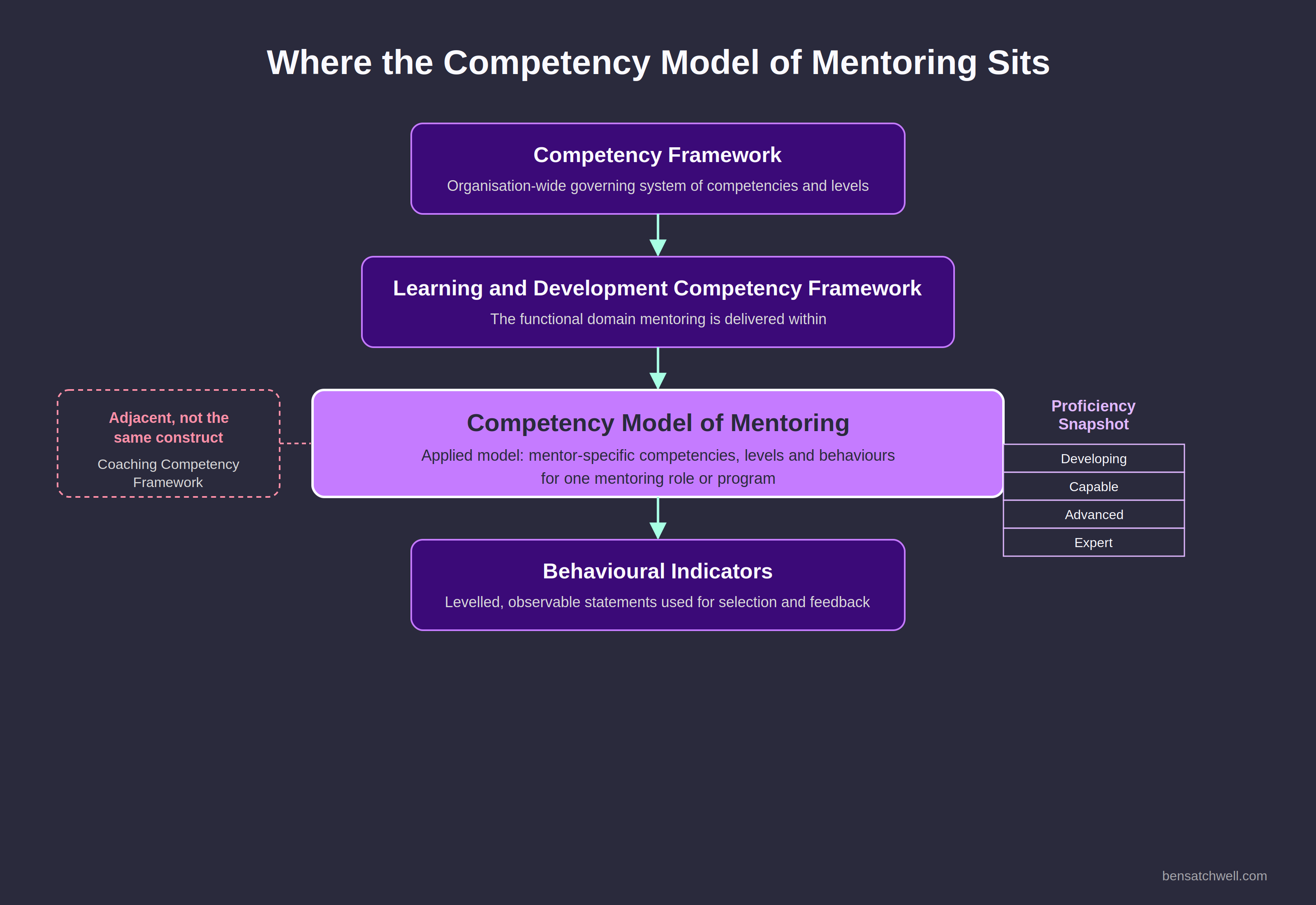
Where a competency model of mentoring sits between the organisation's competency framework and the mentor role it is built for.
3. Set proficiency levels with real behavioural distinctions
A mentoring competency without levels is close to useless for development purposes. Four levels is typically enough: a developing mentor who follows a structured process but needs support with difficult conversations, a capable mentor who manages the relationship independently, an advanced mentor who adapts their approach to different mentee needs and contexts, and an expert mentor who is trusted to coach other mentors and shape the program itself.
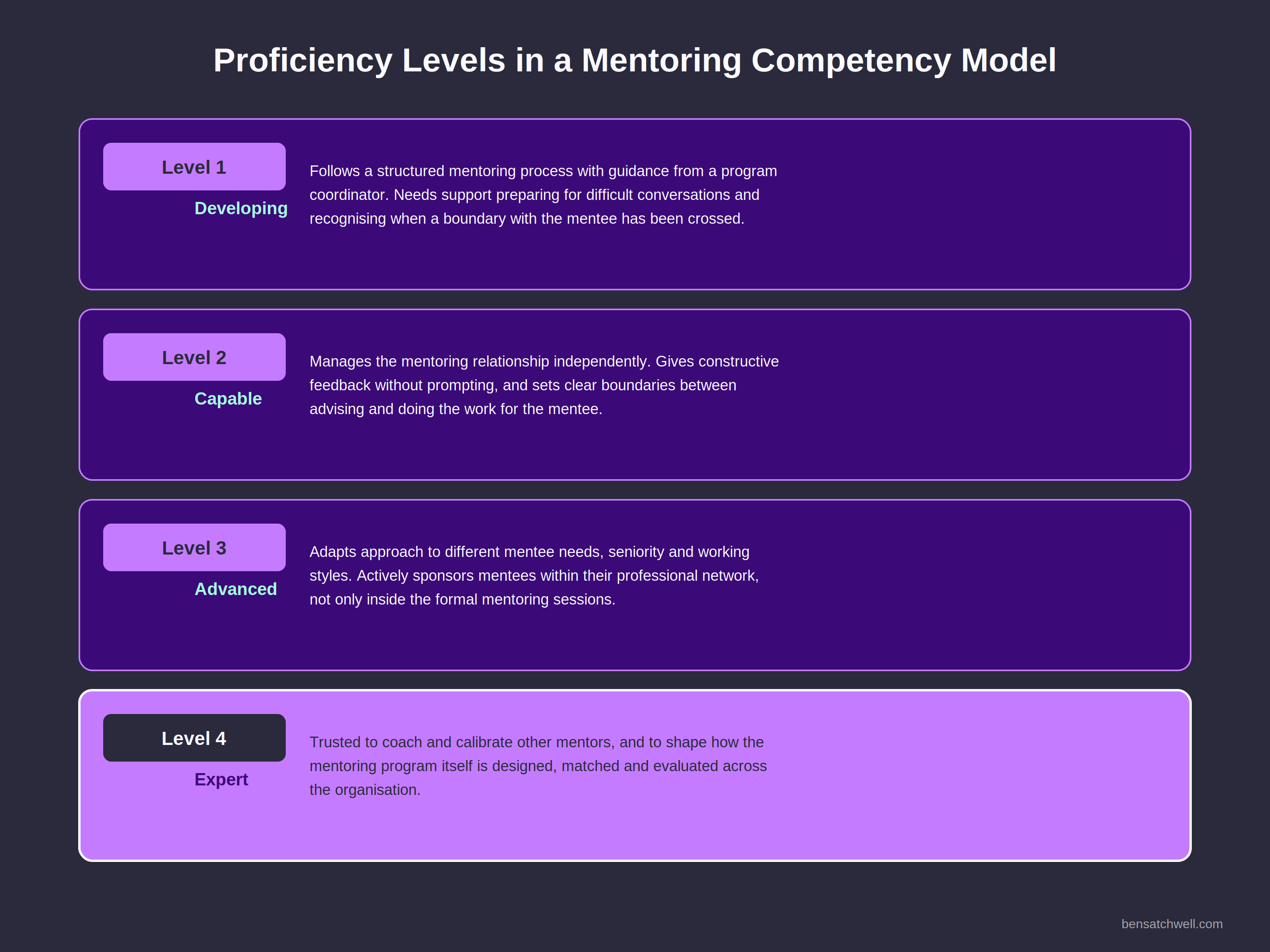
Proficiency levels in a competency model of mentoring, defined by behavioural distinction rather than years of experience.
4. Validate with practising mentors and mentees
The draft model is checked against people who are actually doing the work. If experienced mentors do not recognise the top proficiency level as a description of what they do, or mentees do not recognise the lower levels as what they have experienced, the model needs revision before it goes anywhere near mentor selection or evaluation.
5. Apply it to selection, matching and evaluation
Once validated, the model does the work an informal program cannot: it gives selection panels criteria to assess candidates against, gives program managers a basis for matching mentor proficiency to mentee need, and gives mentors specific, behavioural feedback rather than vague encouragement to "keep at it."
What It Is NOT
A competency model of mentoring is not a coaching competency framework, even though the two share underlying skills such as listening and questioning. CIPD draws the distinction on orientation and timeframe: mentoring is typically a longer-term relationship focused on career and organisational development, while coaching is more often shorter-term and focused on specific performance goals. A model built for one should not be silently repurposed for the other.
It is not a job description. A job description for a "mentor" role documents responsibilities and time commitment. It says nothing about what distinguishes an effective mentor from an ineffective one, which is the entire purpose of the competency layer.
It is not the organisation's competency framework itself. The framework is the governing system that defines competencies, levels and indicators once, for reuse across every role. The mentoring model is a single applied instance of that system, scoped to one role.
It is not a personality profile. Being naturally warm or approachable is not a competency; it is not observable, levelled or trainable in the way a defined behaviour is. A competency model describes what a mentor does, not what kind of person they are.
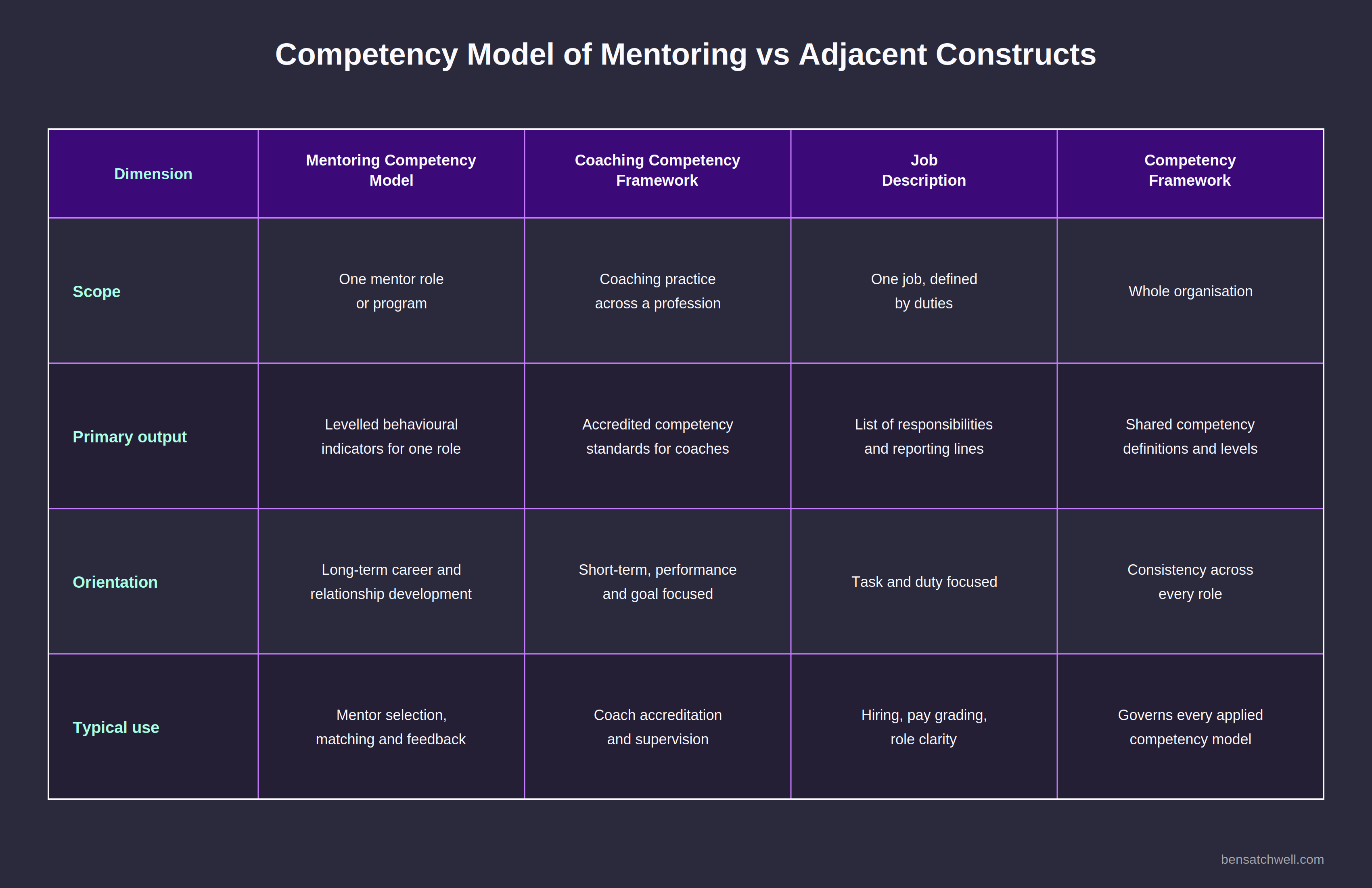
How a competency model of mentoring differs from adjacent constructs it is often confused with.
Named Standards Worth Knowing
A handful of external references are worth knowing when building a mentoring model rather than starting from nothing. EMCC Global's competence framework, developed for coaching and mentoring accreditation, sets out capability indicators across professional standards that scale from foundational to advanced practice, and is a reasonable structural reference for how a mentoring model's levels might be worded. Korn Ferry and Lominger's competency libraries include a "developing others" competency that overlaps meaningfully with mentoring, useful where an organisation wants to reuse an existing leadership competency rather than build a mentoring-specific one from scratch. Neither is a substitute for validating the model against your own mentors and mentees, but both save time on the first draft.
Common Failure Modes
The most common failure is treating tenure as a proxy for competency. Long service tells you someone knows the organisation. It tells you nothing about whether they can give difficult feedback well or resist the urge to solve a mentee's problem for them.
The second is borrowing a coaching competency framework wholesale and relabelling it mentoring. The overlap is real but partial, and the parts that do not transfer, particularly around sponsorship and long-term career guidance, are often the parts that matter most in a mentoring context specifically.
The third is skipping proficiency levels entirely and treating mentoring as binary: someone either is or is not "a mentor". This removes any basis for development, and it means every mentor is held to the same standard regardless of how much support they actually need.
The fourth is building the model and never validating it. A model that has not been checked against practising mentors is a set of assumptions with a proficiency scale attached, and it tends to fall apart the first time it is used for a real selection decision.
Trade-offs and Constraints
Building a dedicated mentoring competency model is worth the effort for formal, ongoing programs at scale: graduate programs, leadership succession pipelines, or structured mentoring tied to promotion pathways, where consistency and defensibility genuinely matter. The validation cycle and levelling work take real time, and that cost is only justified when the program will run repeatedly and carry real weight in people decisions.
For smaller or informal mentoring arrangements, a lighter approach is more sensible: extending the relevant domain of the existing competency model development process with a short mentoring-specific addendum, rather than running a full standalone build. The judgement call is matching the rigour of the model to how much the program actually relies on it, not applying maximum structure to a handful of informal pairings.
Frequently Asked Questions
What is a competency model of mentoring?
It is an applied set of competencies, levels and behavioural indicators that defines what effective mentoring looks like for a specific role or program, drawn from the organisation's broader competency framework rather than invented separately.
How is a mentoring competency model different from a coaching competency framework?
Mentoring is typically longer-term and oriented towards career and organisational development, while coaching is usually shorter-term and focused on specific performance goals. The two share some underlying skills but are not interchangeable models.
What competencies should a mentoring competency model include?
Core organisational competencies such as communication, plus mentoring-specific technical competencies including active listening, constructive feedback, boundary-setting, and career or network sponsorship.
Do you need a formal competency model for an informal mentoring program?
Not always. A full model is justified for formal, ongoing or high-stakes programs. Informal or small-scale mentoring can usually work from a lighter extension of an existing competency framework.
How do you assess mentor competency?
Against defined proficiency levels and behavioural indicators, validated with practising mentors and mentees, rather than through subjective impressions of whether the relationship felt successful.
Is mentoring a competency or a capability?
Mentoring is best modelled as a set of competencies, specific, role-bound behaviours applied within the mentor role, rather than as a single broad capability, since the model needs to specify observable, levelled behaviour to be usable for selection and feedback.