
Search "learning and development competency framework" and you will find two completely different things wearing the same name. Some results describe the competencies L&D professionals themselves need to do their job well. Others describe a generic curriculum map dressed up as a framework because "framework" sounds more credible than "list of programs". These are not the same construct, and treating them as interchangeable is why so many L&D teams cannot explain what their own framework actually governs.
What Is a Learning and Development Competency Framework
A learning and development competency framework is the organisation-wide system that defines, groups and levels the competencies required to perform the L&D function itself, from needs analysis and learning design through to delivery, evaluation and capability uplift. It is a competency framework applied to one functional domain: the people who design and deliver development, not the workforce they are developing.
That distinction matters because the same three words get used loosely to mean something else entirely: the competency data an L&D function draws on to decide what development activity the rest of the organisation needs. Both usages are legitimate. They are not the same artefact, and a framework built for one purpose will not serve the other.
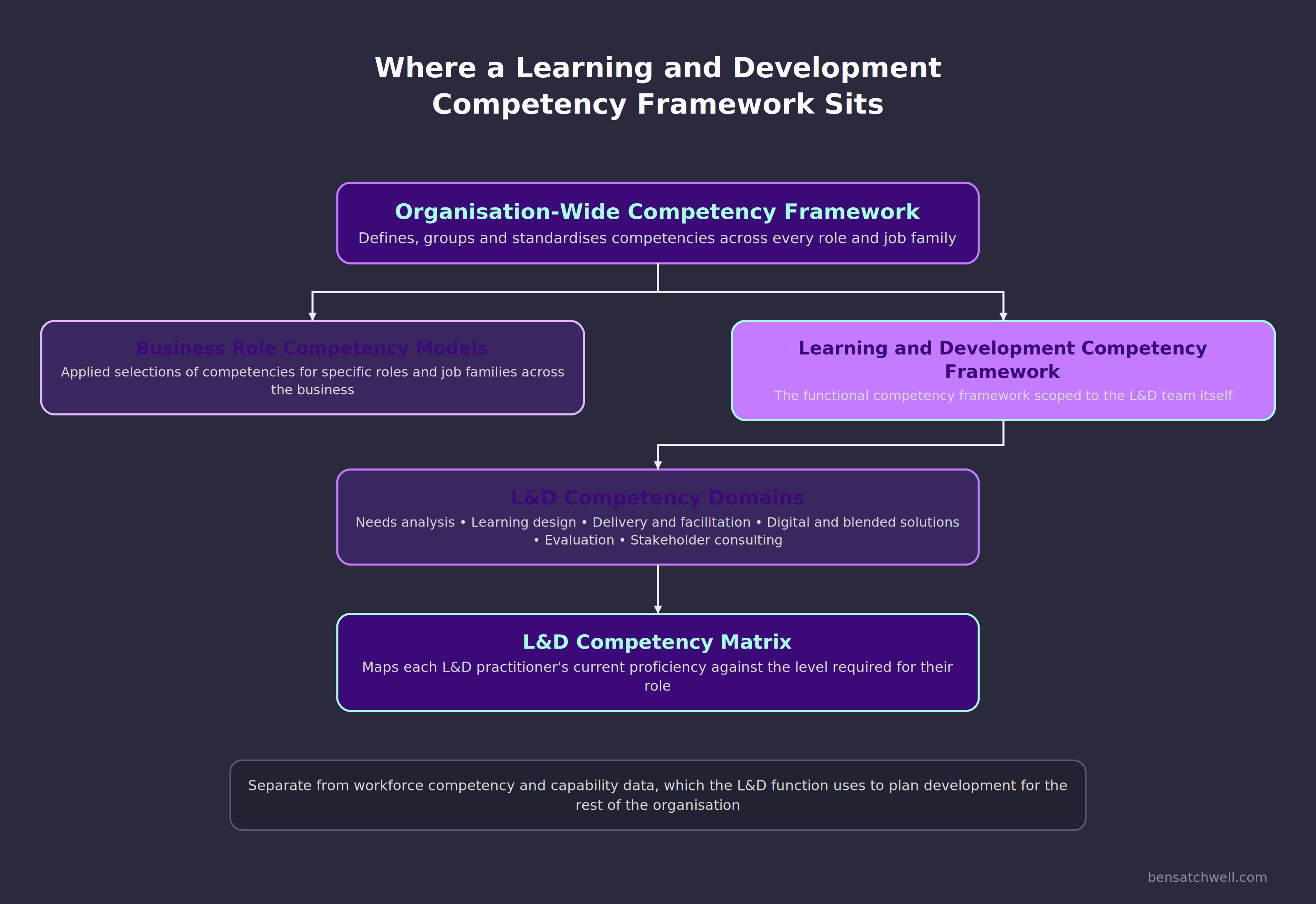
Where a learning and development competency framework sits relative to the organisation-wide competency framework.
A note on terminology. A competency framework is also called a competency model, especially in the United States. I use competency profile for the competencies and required levels for one role, and competency matrix for the grid of required against current proficiency. Usage varies by region, and I explain the differences in this competency model definition.
Why It Exists
L&D has historically been judged on activity, not capability. Programs delivered, completion rates, satisfaction scores. None of that tells you whether the people running L&D can actually diagnose a genuine capability gap, design an intervention that closes it, or prove the intervention worked.
A learning and development competency framework exists to fix that by naming what good L&D practice looks like as observable behaviour, at defined levels, so an L&D generalist can be assessed and developed against the same standard as an L&D specialist in a different part of the business. It also gives L&D a defensible answer when a stakeholder asks why they should trust the function's recommendations: because the recommendation is grounded in a competency, not a preference.
How It Works in Practice
A functional L&D competency framework is structured the same way any competency framework is structured, just scoped to one domain.
Competency domains. The technical domain covers the core areas of L&D practice: needs analysis, learning design, delivery, digital solutions, evaluation and stakeholder consulting. Each domain groups related competencies the same way a technical domain would in a broader competency framework.
Proficiency levels. Four to six levels, set by scope, autonomy, complexity and impact rather than job title. A graduate L&D coordinator and a head of capability sit on the same competency (say, learning design) at very different levels of the same scale.
Behavioural indicators. Written statements describing what each level looks like in observable behaviour. "Designs a single-session intervention from a supplied brief" reads very differently to "diagnoses ambiguous capability gaps across a business unit and designs a multi-modal development response", and both belong to the same competency at different levels.
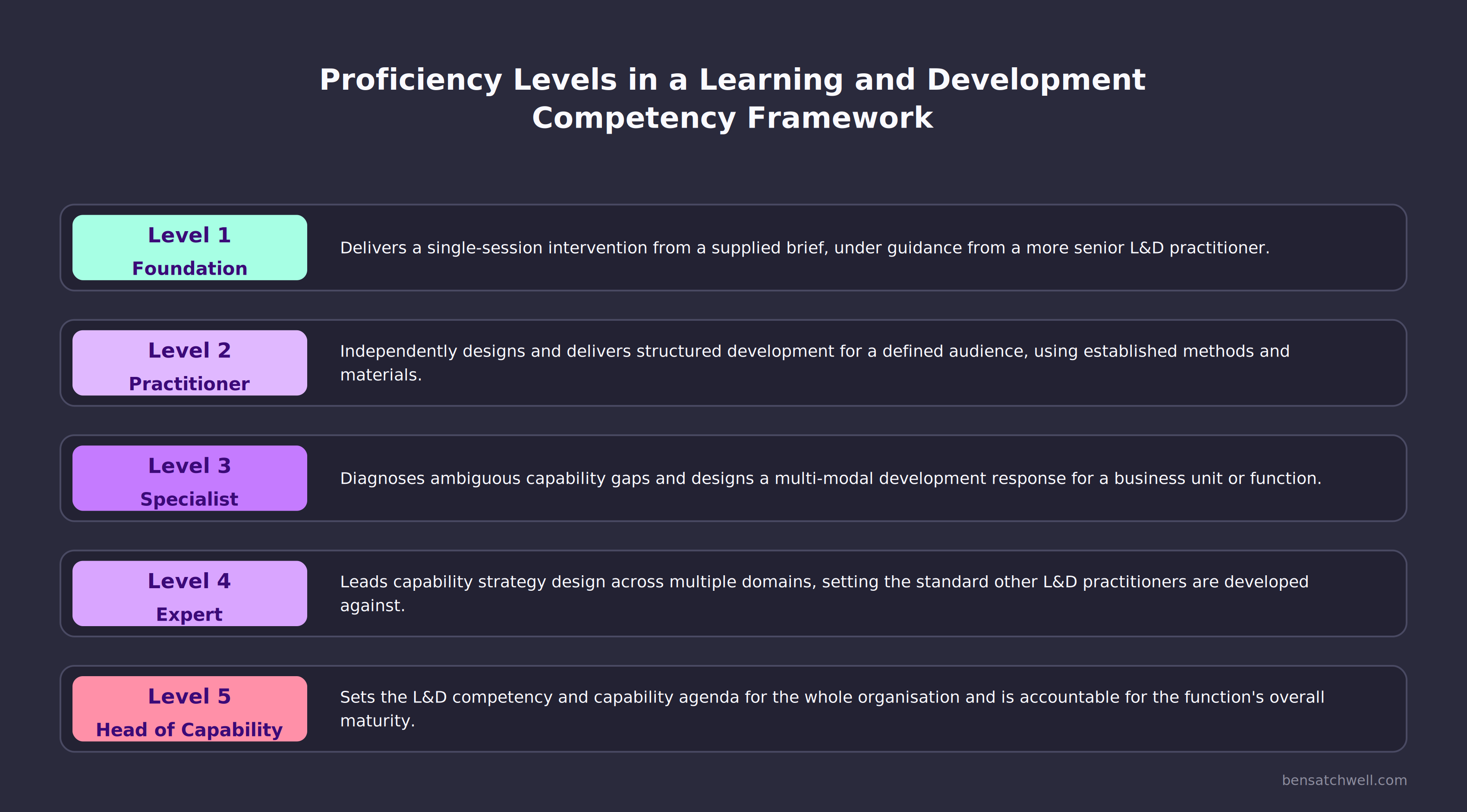
Proficiency levels in a learning and development competency framework, from Foundation to Head of Capability.
Once the domains, levels and indicators exist, the framework does two jobs. It becomes the basis for developing L&D practitioners themselves, closing gaps in exactly the way a competency development framework is built to do. And it becomes the credible foundation L&D stands on when it uses competency and capability data from elsewhere in the business to recommend what development the workforce needs.
What It Is NOT
It is not a curriculum catalogue. A list of programs, modules or learning paths is an inventory of interventions, not a definition of the competence required to design or run them. You can build the most comprehensive curriculum library in the business and still have no framework for whether the people building it are any good at the job.
It is not the same as the competency framework it services. An L&D competency framework governs the L&D function. The organisation-wide competency framework the business uses to define roles elsewhere is a separate artefact, even though L&D is usually the custodian of both.
It is not a performance management tool. Competency data gets pulled into ratings and reviews constantly, and the performance management competency framework conflation is well documented: a rating scale is not a competency framework, and an L&D competency framework is not a performance instrument either. It defines development standards for the L&D function, not a scoring mechanism for anyone's annual review.
It is not a skills taxonomy. A skills taxonomy classifies discrete, learned abilities in a hierarchy. A competency framework describes integrated performance, skill plus knowledge plus judgement plus behaviour, applied in context. L&D functions often need both, and they solve different problems.
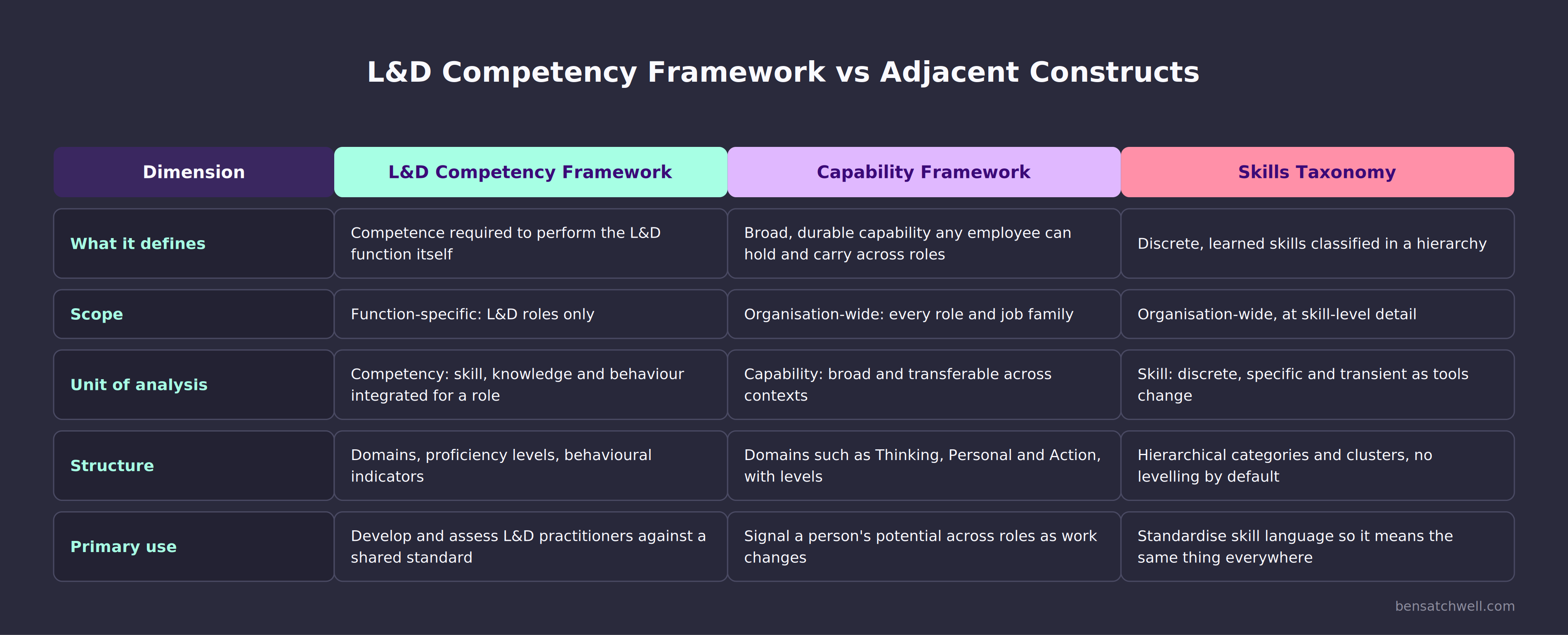
How a learning and development competency framework compares with a capability framework and a skills taxonomy.
Named Frameworks and Standards Worth Knowing
CIPD's Profession Map is the clearest public example of an L&D-specific competency structure. It defines specialist knowledge and behaviours for learning and development practice across four impact levels, built with input from around 20,000 people professionals, so the levelling logic is the same scope-autonomy-complexity-impact test any well-built framework should apply.
SHRM's approach illustrates the domain split well too. Its Body of Applied Skills and Knowledge separates behavioural competencies from technical, HR-specific expertise, the same core-versus-technical-competency split that belongs in a properly designed L&D framework: shared behaviours like consultation and communication sitting alongside the technical domain specific to designing and delivering development.
SFIA takes a different route worth understanding by contrast. It defines skills with levels attached specifically to support professional development and assessment, which looks similar to a competency framework on the surface but is properly a skills framework: it classifies and levels discrete skills rather than integrating skill, knowledge and behaviour into a single competency statement. Useful to know the difference exists, particularly if your L&D function also supports a technology or digital function that already uses SFIA.
Common Failure Modes
The most common failure is building the framework backwards from existing programs rather than from evidence of what good performance actually looks like. If the framework was reverse-engineered from a delivery calendar, it will describe activity, not competence, and it will not survive contact with a role that does not fit the calendar.
The second is treating every L&D role as identical. Needs analysis and stakeholder consulting are genuinely different competencies from facilitation and delivery. Collapsing them into one generic "learning professional" competency produces indicators too vague to assess anyone against.
The third is building the framework and never using it. A framework that only exists as a document nobody references when hiring, developing or promoting L&D staff has failed at the one thing it was built to do, regardless of how well designed it is on paper. The steps in creating a competency framework apply directly here: ground it in evidence, then build it into the processes that actually govern how people are hired, developed and promoted, or it will not last.
Trade-Offs and Constraints
A dedicated L&D competency framework is worth building when the function is large enough, or specialised enough, that "L&D professional" no longer describes one job. If a business has one generalist doing everything from needs analysis to delivery, a full framework is disproportionate. A simpler capability profile, or borrowing the relevant domain from CIPD's Profession Map, will do the job without the governance overhead of maintaining a bespoke structure.
It is also worth being honest about maintenance cost. Learning design practice changes as fast as any discipline in the people space, digital and blended delivery models shift constantly, and a framework left unreviewed for several years will describe how L&D used to work rather than how it works now. Build a review cycle into the framework from the start, not as an afterthought once it is already stale.
Frequently Asked Questions
Is a learning and development competency framework the same as a learning needs analysis?
No. A needs analysis diagnoses a gap in the workforce being developed. A learning and development competency framework defines the competence required to run that diagnosis and everything that follows it, held by the L&D function itself.
Who owns a learning and development competency framework?
Usually the L&D or capability function owns it, though it should be built with input from the wider HR or people function, since L&D competencies interact directly with performance, talent and workforce planning data owned elsewhere.
How many competencies should an L&D competency framework include?
Most functional frameworks work best with somewhere between six and twelve competencies across domains like needs analysis, learning design, delivery, digital solutions, evaluation and stakeholder consulting. More than that and the framework becomes too granular to use consistently.
Does an L&D competency framework replace a capability framework?
No. A capability framework describes broad, durable, transferable capability held across roles. An L&D competency framework describes role-specific competence within one function. Organisations often need both, applied to different questions.
How is this different from the competency framework the rest of the organisation uses?
The organisation-wide framework defines competencies for every role or job family in the business. A learning and development competency framework is scoped to one function, the people responsible for designing and delivering development, and is usually built using the same methodology as the broader framework.
How often should an L&D competency framework be reviewed?
Every eighteen to twenty-four months at minimum, and sooner if delivery models, digital tools or the structure of the L&D function itself change materially in the interim.