
The term competency model is used constantly in HR, learning and workforce design, and it is often confused with job descriptions, values statements, performance scorecards and curriculum catalogues. The result is unclear role expectations, inconsistent assessment and endless debate about what good looks like. This article looks at the content of a competency model: what goes inside one, a worked example, and the steps for building one for a role.
What Is a Competency Model?
A competency model is the structure that sets out the competencies required for effective performance, with the proficiency level expected for each. In the United States the term covers the whole system. When it is built for one role, level, job family or cohort, I call that selection a competency profile. Either way it answers one question: what competencies, at what level, are required for success here?
A model does not invent competencies. It selects, applies and contextualises competencies drawn from a governed system. The system view of that sits on the competency framework page. This page is the content view: what the role-level model holds and how it is assembled.
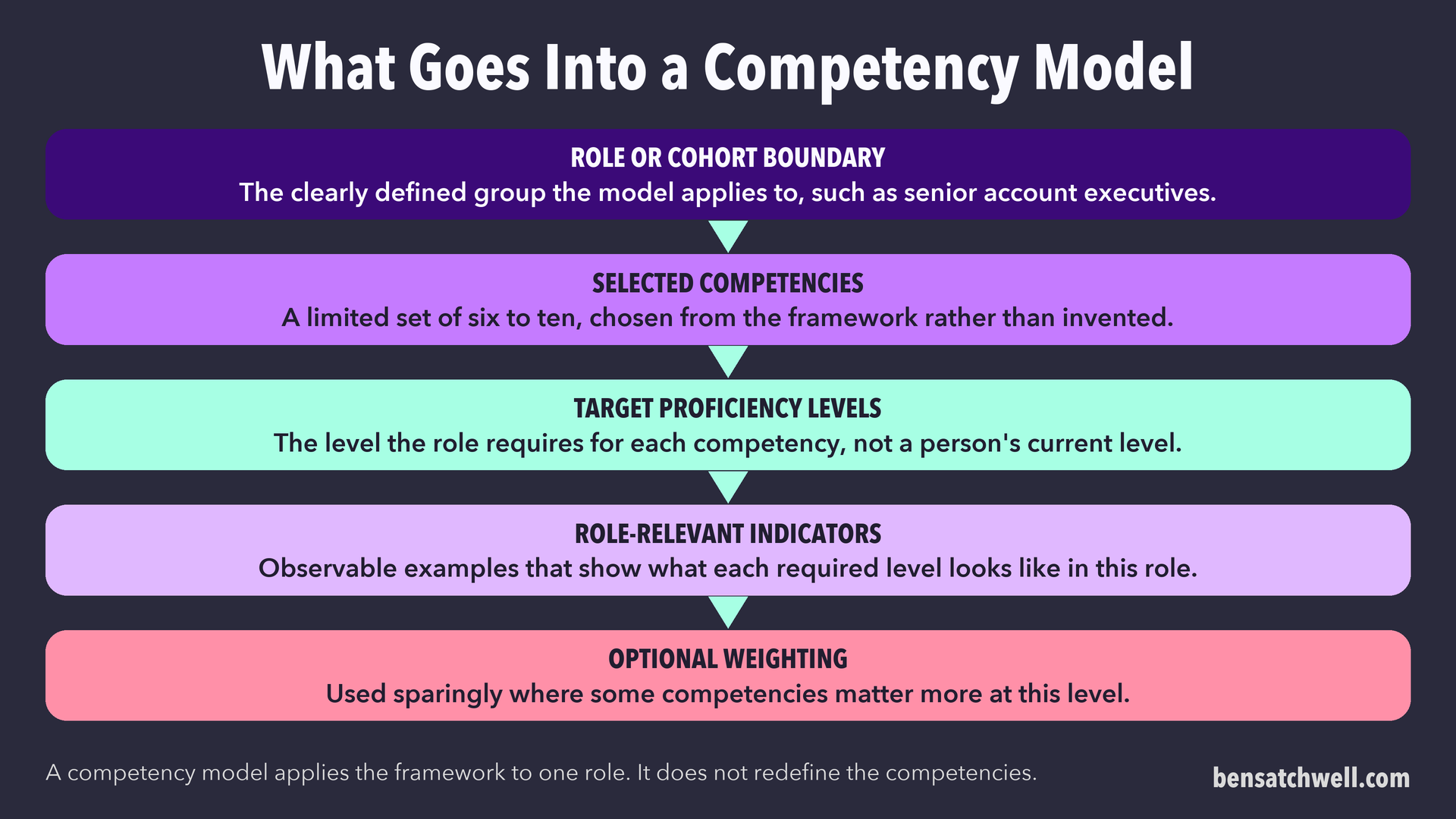
A competency model applies the framework to one role. It does not redefine the competencies.
A note on terminology. A competency framework is also called a competency model, especially in the United States. I use competency profile for the competencies and required levels for one role, and competency matrix for the grid of required against current proficiency. Usage varies by region, and I explain the differences in this competency model definition.
Why Organisations Use a Competency Model
A shared structure gives consistency. A role-level model gives relevance. Used properly, it clarifies role expectations, supports structured hiring, gives performance conversations a stable reference, informs targeted development and enables fair assessment between people in the same role. Without role-level models a framework stays abstract. Without a framework, role models become idiosyncratic, because every manager writes their own.
What Goes Inside a Competency Model
A well-built model needs five things, and no more.
- A clear role or cohort boundary. The group it applies to must be defined: frontline people leaders, senior account executives, graduate engineers. A vague boundary produces a vague model.
- Selected competencies. Selection is the point. Choose a limited number, six to ten is typical, avoid overlaps and cover the role without overload.
- Target proficiency levels. For each competency, the level the role requires. This is not the person's current capability and not an aspirational future state.
- Role-relevant indicators or examples. Definitions and level logic come from the framework. The model can add observable examples that show what the required level looks like in this role, without redefining the competency.
- Optional weighting. Technical depth may outweigh leadership in early-career roles, and influence may dominate in senior roles. Use weighting sparingly. Too much turns an expectations guide into a scoring system.
A Worked Example: Senior Account Executive
Role boundary: an enterprise B2B sales role responsible for complex deal cycles and long-term account growth. The table shows the model.
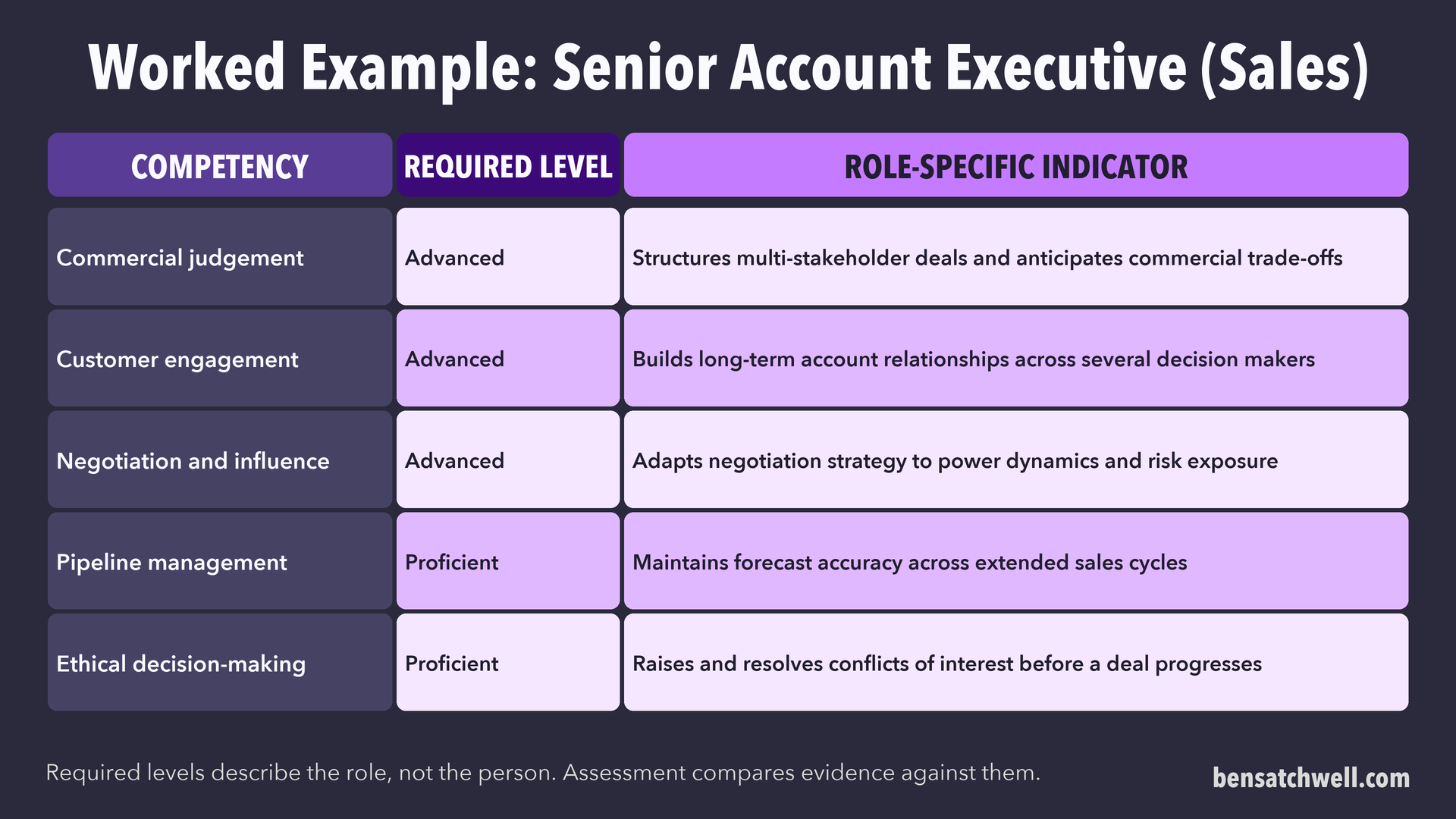
Required levels describe the role, not the person.
Notice what the model leaves out: quotas and KPIs, curriculum lists, values statements and personality traits. Its only job is to say what competency the role requires. For named published examples, see these competency framework examples, and for the sales function in full see the sales competency model.
How to Build a Competency Model for a Role
Research on competency modelling treats it as a repeatable process. Skipping steps is the fastest way to lose credibility.
- Define the boundary. Name the role or cohort and what falls outside it.
- Select from the framework. Pull the relevant competencies. If a competency you need is missing, change the framework through its governance, not the model.
- Set target levels. Decide the level the role requires, using scope, autonomy, complexity and impact.
- Add role context. Write examples that clarify expectations and improve consistency, but stay inside the framework's definitions.
- Test and apply. Check with the people who do the role and with the managers who assess it, then use the model in hiring and appraisal.
What Does Not Belong in a Competency Model
Models fail when they absorb unrelated constructs. Leave out values and culture statements, personality traits, KPIs and performance targets, learning activities, tenure expectations and subjective adjectives such as strong or excellent. They may connect to the model. They are not the model.
Competency Model, Job Description and Skills Profile
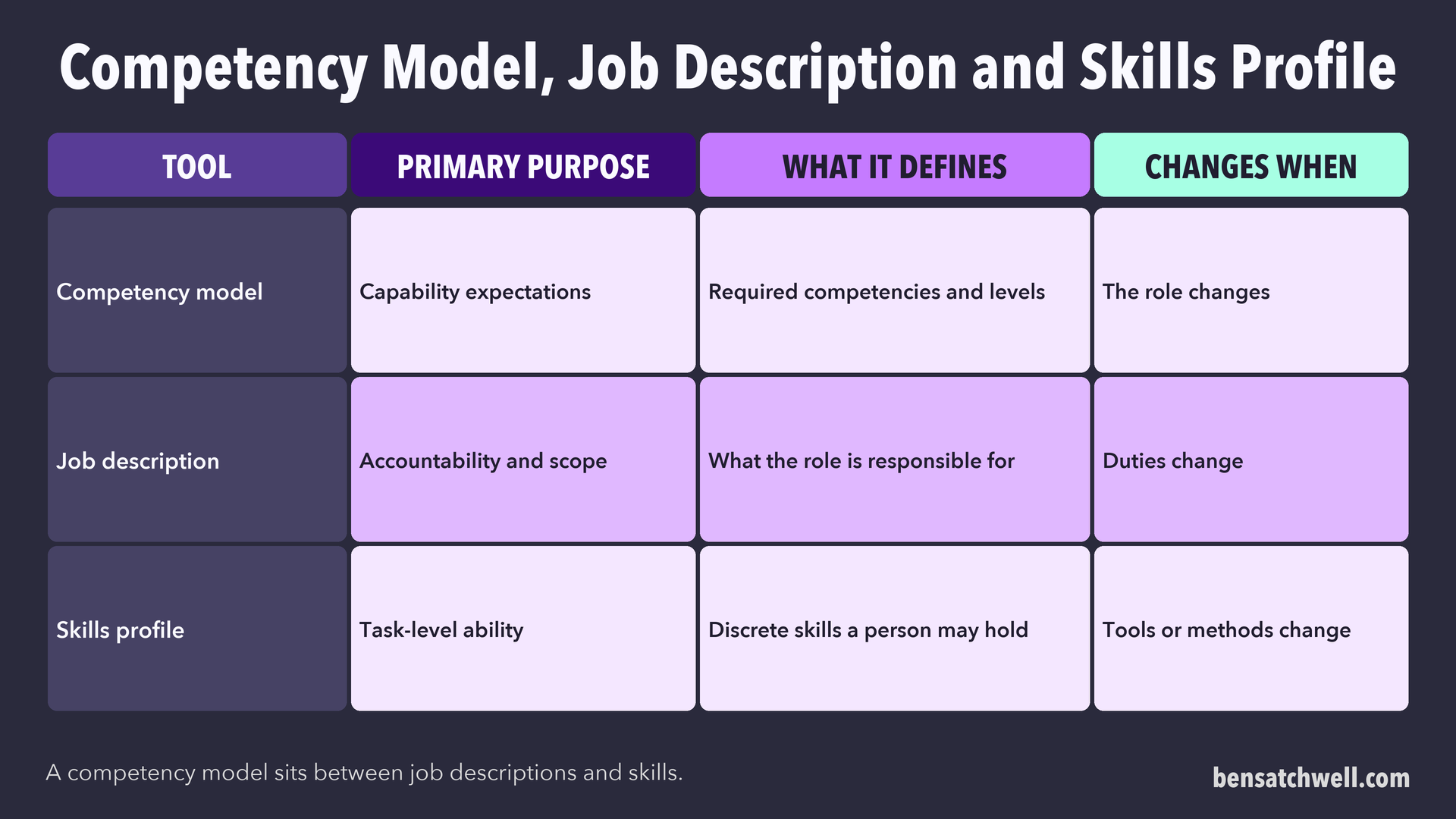
A competency model sits between job descriptions and skills.
A model is broader than individual skills and narrower than a full role description. Collapse the three into one document and clarity is lost, and assessment becomes subjective.
Assessing Against a Competency Model
Keep the role requirement apart from the person. The model states what the role needs. Assessment compares observed evidence against that requirement. The separation reduces bias, improves consistency and keeps performance conversations grounded in evidence instead of impressions.
Reuse Before You Duplicate
The hidden design decision is whether models are reused or endlessly copied. Healthy patterns are one model shared across similar roles, small contextual notes instead of rewrites and central governance of changes. Failure patterns are one model per role just in case, identical competencies reworded, and local tailoring without approval. If two roles need the same competency at the same level, they should share a model. Duplication is not flexibility. It is entropy.
Common Mistakes With Competency Models
- Treating a model as a framework. If every role has bespoke definitions, consistency is already lost.
- Overloading it. Values, KPIs, behaviours and learning plans together make it unusable.
- Confusing the role with the person. A model sets expectations. It is not a performance rating.
- Too many competencies. If a manager cannot remember the model, they will not use it.
- Uncontrolled local tailoring. It destroys comparability faster than any design flaw.
When Not to Build One
Avoid formal models where roles are experimental or short-lived, teams are deliberately fluid or outcomes matter more than consistency. A lightweight role charter or a skills-based approach often works better there. Keep the number of models small too. If an organisation has hundreds, governance has already failed, and designing around levels and competency bands is the better route.
FAQ
What is a competency model?
A competency model sets out the competencies and proficiency levels required for success. At role level it is a selection from the organisation's competency framework, also called a competency profile.
Is a competency model the same as a competency framework?
They name the same structure, and the name varies by region. Competency model is the usual US term, and competency framework is more common in the UK and Australia.
How many competencies should be in a competency model?
Typically six to ten. More than that reduces clarity and usability.
Can a competency model change over time?
Yes. Role-level selections should change as roles change, while the underlying definitions and levels stay relatively stable.
What is the difference between a competency model and a job description?
A job description defines accountabilities and scope. A competency model defines the competencies and levels needed to carry them out.