

Competency model performance management is the practice of using a role-based set of competencies, each with defined proficiency levels, to inform how performance conversations are structured. I want to be precise about that from the first line, because most organisations that say they do it are doing something narrower. They attach competency labels to a rating scale and call the result a model. That is a rating form, not a competency model.
What Is Competency Model Performance Management?
Competency model performance management is the use of a competency model, an applied selection of competencies from a competency framework tailored to a role, level or job family, as the reference point for how performance is discussed, assessed and developed.
Two constructs sit inside that definition and they must stay distinct. A competency is the integration of skills, knowledge, judgement and behaviour applied effectively in the context of a role. A competency model is the selection of those competencies, with target proficiency levels, for one role or cohort. Performance management is the cycle of expectations, observation, feedback and review that an organisation runs around its people.
The model supplies the language for how work is done. The performance cycle supplies the rhythm and the decisions. Competency model performance management is the deliberate connection between the two.
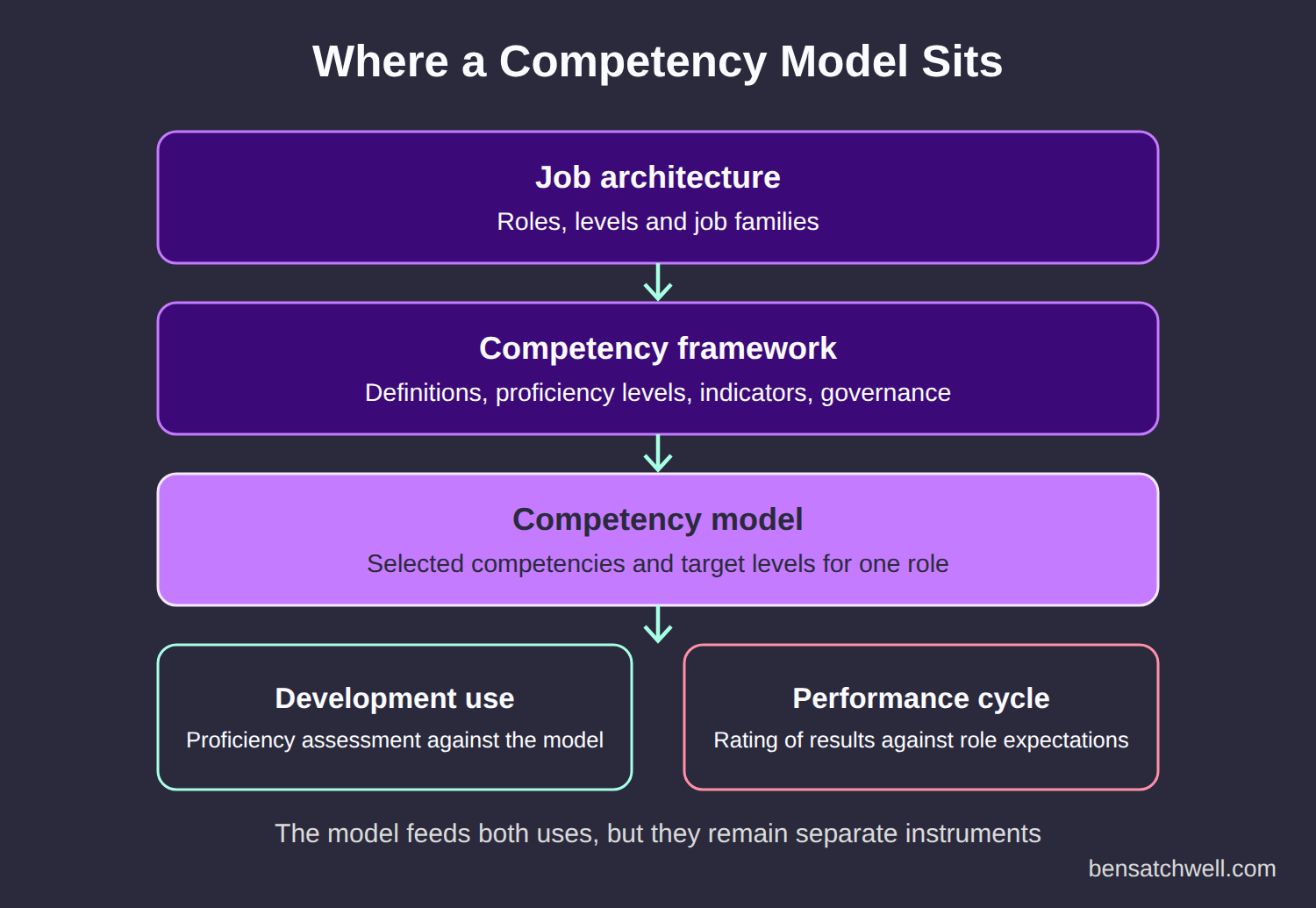
A note on terminology. I use competency framework for the organisation-wide governing system and competency model for an applied selection from it, for a role, level or job family. That is my convention, not a universal rule. In the United States, competency model is often used for the whole structure, and in the UK and Australia it is more often called a framework. I am not trying to replace any of those usages. My aim is clarity and alignment, so the people building this together mean the same thing. I set out the regional differences in this competency model definition.
Why Does Competency Model Performance Management Exist?
Results alone are an incomplete account of performance. Two people can hit the same target, one through sound judgement and the other through luck or shortcuts. Managers need a shared description of how good work is done, and employees need to know what that description is before the review, not during it.
A competency model solves that problem. It names the behaviours that matter for a role and describes them at observable levels. Research on competency-based performance management and organisational effectiveness reports a positive relationship between competency-based performance and organisational effectiveness, which is the practical case for linking the two.
How Does Competency Model Performance Management Work in Practice?
The mechanics are straightforward when the structure is right. The organisation maintains a competency framework, which defines competencies, proficiency levels and behavioural indicators once and governs how they are reused. For each role, a model selects the competencies that matter and sets a target level for each. Those targets are informed by the job analysis behind the model, so they describe what the work actually demands rather than what is fashionable.
Proficiency levels carry the weight
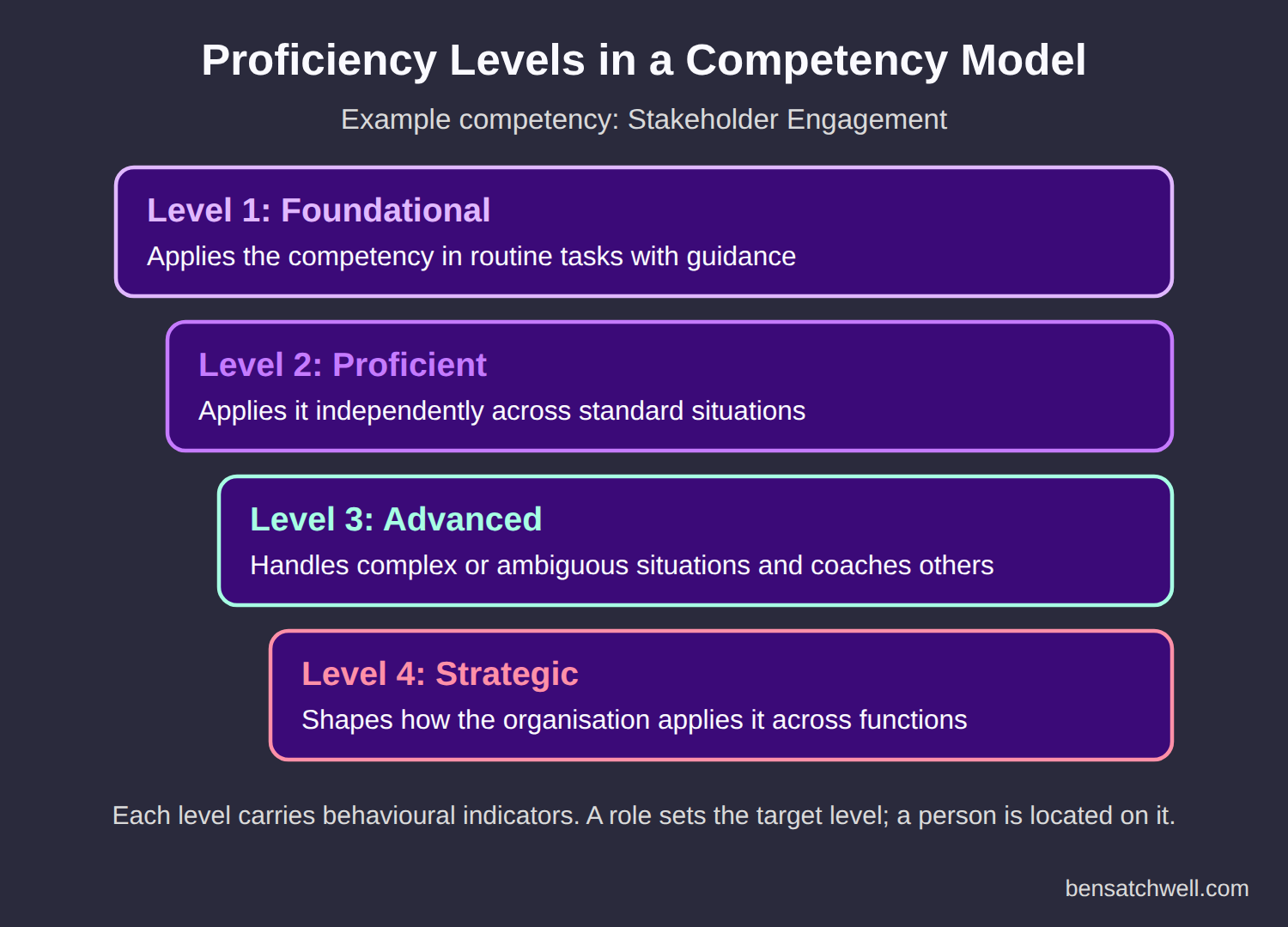
A proficiency level is the defined stage of growth at which a competency is held or required. Levels are set by scope, autonomy, complexity and impact, not by seniority or years of service. A workable model uses four to six of them. The detail of how to write them is covered in my article on competency framework levels.
Behavioural indicators make it observable
A behavioural indicator is the written, levelled statement describing the behaviour expected at a given proficiency level. Indicators are observable, contextual and descriptive rather than evaluative. A manager can point to a specific piece of work and say which indicator it matches. Without indicators, the model collapses into adjectives such as strong, solid or developing, which tell nobody anything.
Three uses of the model in the cycle
- At the start of the cycle: the model sets expectations by stating the target level for each competency in the role.
- During the cycle: managers collect evidence against the indicators and give feedback in the model's language.
- At the review: the conversation locates the person on each competency and identifies the next level, separately from any overall rating.
What Competency Model Performance Management Is Not
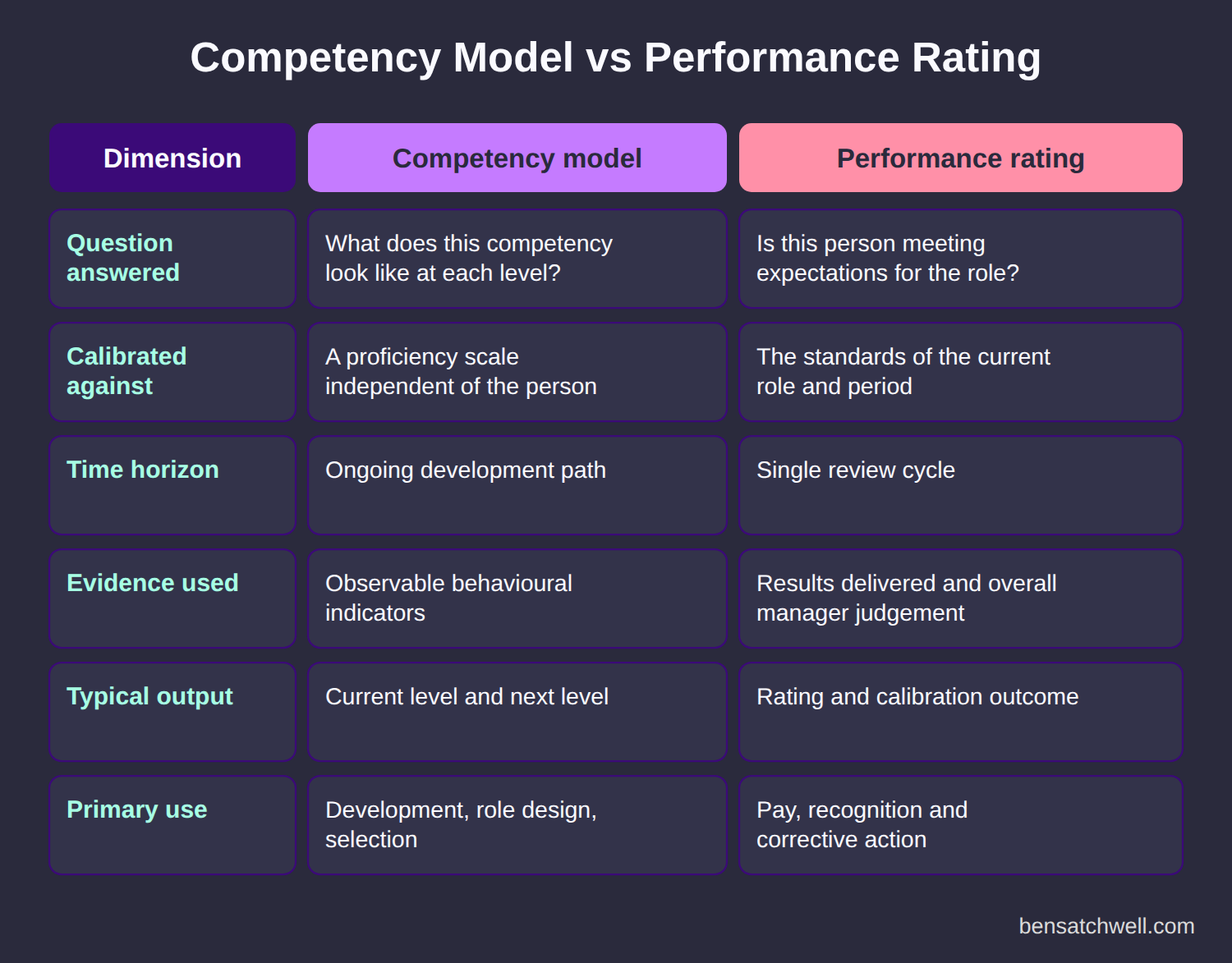
It is not a performance rating. A rating answers whether a person is meeting expectations for the role in this period. A proficiency assessment answers where a person sits on a defined scale, whatever the period. I have written about that conflation in detail in performance management competency framework, and it is the most common failure I see.
It is not a competency framework. The framework is the organisation-wide governing system. The model is an instance of it for a role. It is also not a competency matrix, which is the grid that shows required versus current proficiency across people or roles. The matrix is a display artefact built from the models.
It is not a skills list. A skill is a discrete, learned ability, and skills are transient as tools and methods change. A competency integrates skills with knowledge, judgement and behaviour, which is why a model built from skill names alone ages quickly.
Which Frameworks and Standards Inform It?
No single standard prescribes how to connect a model to a performance cycle, but several give useful structure. The OECD core competency framework sets out fifteen core competencies in three clusters, delivery-related, interpersonal and strategic, with five levels tied to the type of role. It is a clear example of competencies defined once and applied by level.
SFIA does the same job for technology roles, pairing skills with seven levels of responsibility. Korn Ferry and Lominger offer widely used leadership competency libraries, and SHRM publishes a competency model for HR practitioners. Treat each as a source to select from, not a model to adopt whole. A model is an applied selection, and the selection should reflect your roles.
On the performance side, the CIPD performance management guidance is a sound reference for designing the cycle itself. Its consistent message is that a process works best when it is designed for the purpose it serves, which supports keeping development and evaluation as separate instruments.
What Are the Common Failure Modes?
- Ratings dressed as levels. The scale reads meets, exceeds or does not meet. That is a performance judgement, and it tells the person nothing about the next level.
- Too many competencies. A model with fifteen competencies per role cannot be assessed with any care. Most roles need between five and eight.
- Indicators written as outcomes. If an indicator describes a result rather than a behaviour, the competency is really a goal.
- Levels tied to job grade. When level 3 simply means a grade 3 role, the model repeats the job architecture and adds no information.
- One-off assessment. Evidence gathered in the final week before the review is recall, not observation.
Calibration is the quieter failure. Without agreed indicators, two managers will place the same behaviour at different levels. A well-built competency assessment framework addresses that with defined evidence standards and moderation, and it is worth the effort.
What Are the Trade-offs and Constraints?
Use a competency model in performance management when the roles have stable, describable behaviours, when managers are able to observe the work, and when the organisation wants development conversations that go beyond results. It suits professional, technical and leadership roles well.
Be cautious where work is highly transactional and measured almost entirely by output, or where the organisation lacks the capacity to maintain the models. A stale model is worse than none, because it gives managers a false sense of rigour. There is also an administrative cost. Running a proficiency assessment alongside a separate rating means two conversations rather than one. In my view the better information from both is worth that cost, but it is a real decision and should be made deliberately.
Finally, do not use proficiency levels directly to set pay. The moment a level becomes a pay lever, managers inflate it, and the developmental value disappears.
Frequently Asked Questions
What is competency model performance management?
It is the use of a role-based competency model, with defined proficiency levels and behavioural indicators, as the reference point for setting expectations, observing work and holding development conversations within the performance cycle.
What is the difference between a competency model and a performance rating?
A competency model describes what a competency looks like at each proficiency level. A performance rating judges whether a person is meeting the expectations of their role in a given period. They answer different questions and should be kept as separate instruments.
How many competencies should a role competency model include?
Most roles need between five and eight. Beyond that, managers cannot gather meaningful evidence against each competency, and the assessment becomes a general impression.
Should competency assessment be tied to pay?
I recommend against it. Linking proficiency levels directly to pay encourages inflated assessments and weakens the developmental purpose of the model. Keep pay decisions with the performance rating and role design.
How many proficiency levels should a competency model have?
Four to six is workable. Fewer than four gives too little differentiation for development planning, and more than six produces distinctions that two assessors are unlikely to apply consistently.
What is the difference between a competency framework and a competency model?
The competency framework is the organisation-wide system that defines and governs competencies, levels and indicators. A competency model is an applied selection from that framework for a specific role, level or job family.