

Competency Model in Training and Development
I keep meeting learning and development teams who ask for one thing and build three. They want a competency model in training and development, and what actually gets built is a competency framework (the organisation-wide governing system), a competency model (the role-specific instance of it), and a training curriculum (the delivery plan), all filed under one spreadsheet with a single name on the tab. That conflation is not a semantic quibble. It is why the resulting artefact satisfies nobody: too generic to design curriculum against, too narrow to govern the whole workforce, and disconnected from the actual behaviours anyone is meant to demonstrate afterwards.
A competency model in training and development is a specific, bounded artefact. It sits between the framework that defines competencies at the organisation level and the curriculum that teaches to them, and it only works if those boundaries stay intact.
What Is a Competency Model in Training and Development
A competency model in training and development is an applied selection of competencies, drawn from the organisation's competency framework, that defines what a role, job family or learning cohort must demonstrate at a given proficiency level, and is used as the reference point for designing and evaluating training and development activity.
That definition does three things most informal versions skip. It ties the model back to a governing framework, so proficiency levels and behavioural indicators are inherited rather than invented per project. It scopes the model to a defined population, a role, job family or cohort, rather than the whole workforce. And it names training and development as the model's purpose, meaning the model exists to inform curriculum design, learning needs analysis and post-training assessment, not to run performance reviews or set pay bands.
If a document does not do all three, it is something else: a training needs analysis, a skills matrix, or a competency framework wearing a training team's letterhead.
Why a Competency Model in Training and Development Exists
L&D budgets get spent on the wrong things when nobody has defined, precisely, what the spend is meant to produce. A programme calendar built from managers' anecdotes about what "seems to be missing" produces content that is popular, not necessary. A competency model exists to replace that guesswork with a defined target: a named set of behaviours, at a named proficiency level, that a learning intervention is meant to close the gap against.
This is also why L&D functions borrow a model rather than build their own framework from scratch. Framework governance, the definitions, the domains, the levelling logic, belongs to the organisation as a whole. What L&D actually needs is an instance of it, and my note on a competency framework for learning and development covers how that governance layer should be structured before any model is pulled from it.
Named frameworks earn their keep here. The CIPD's factsheet on competency and competency frameworks notes that, when done well, they increase clarity around performance expectations and establish a clear link between individual and organisational performance, while cautioning organisations to balance detail with flexibility rather than building something overly prescriptive. That clarity is exactly what a training curriculum needs before instructional designers start choosing content.
How a Competency Model in Training and Development Works in Practice
The competency model development process most organisations use follows something close to this sequence, and the United States Department of Labor's Employment and Training Administration reaches a similar structure from a different direction. Its Competency Model Clearinghouse, built with industrial and organisational psychology practitioners, organises competencies into a tiered "Building Blocks" model, where foundational and industry-wide competencies sit beneath role-specific ones, precisely so that training and credentialing can be built against a defined tier rather than the whole stack at once.
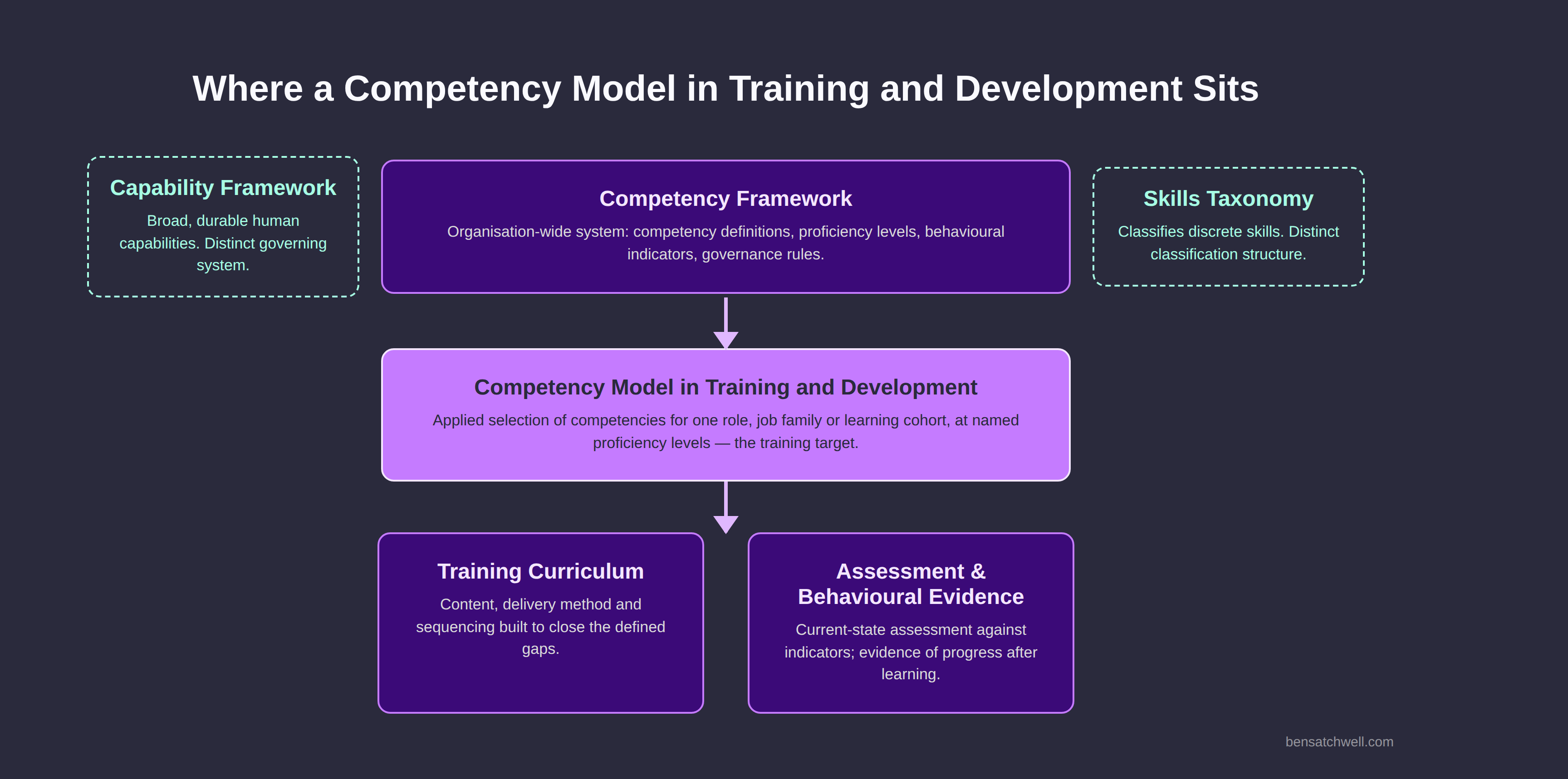
Where a competency model in training and development sits between the governing competency framework and the training curriculum.
Proficiency levels are where most models either become usable or collapse into vague seniority bands. A workable structure names four to six levels and describes what a person can actually do at each one, independent of job title.
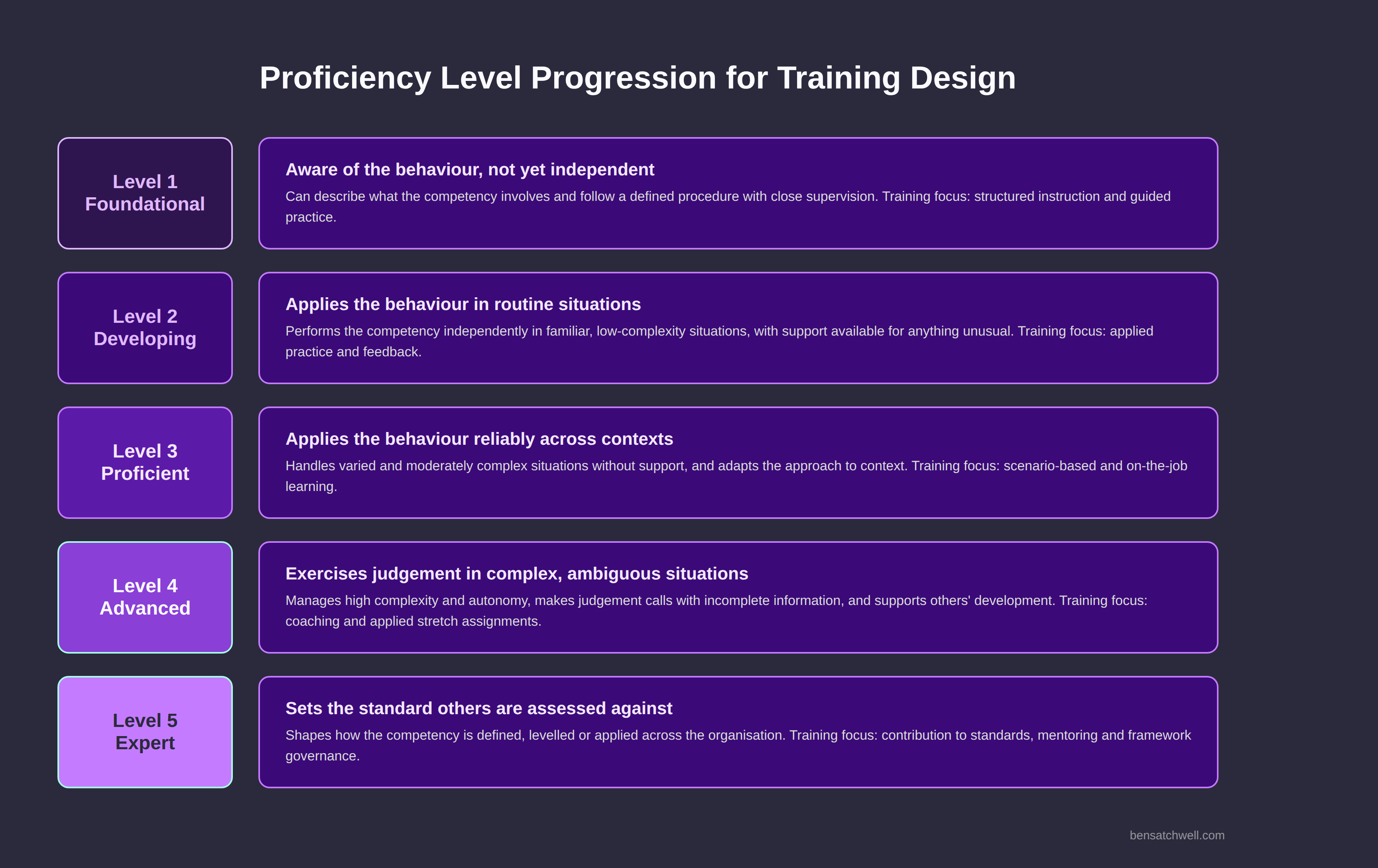
A typical proficiency level progression used to scope training design against a competency model in training and development.
What a Competency Model in Training and Development Is Not
It is not a competency framework. The framework is organisation-wide and governs every model built from it; the model is one applied instance, scoped to a role or cohort.
It is not a training needs analysis. A needs analysis identifies gaps for a specific group at a point in time; the model is the standing reference the needs analysis is measured against. Needs analyses expire. Models persist until the framework or the role changes materially.
It is not a curriculum or a delivery plan. The model defines the destination, behaviours at a proficiency level. The curriculum defines the route: content, delivery method and sequencing. Two very different curricula can legitimately target the same competency model.
It is not a competency-based training framework either, though the two are frequently used interchangeably. That term describes an entire training delivery and assessment methodology, common in vocational and regulated sectors, built around demonstrating competence to complete a qualification. A competency model in training and development can sit inside a competency-based training system, but the model is the target definition; the competency-based training framework is the methodology built around it.
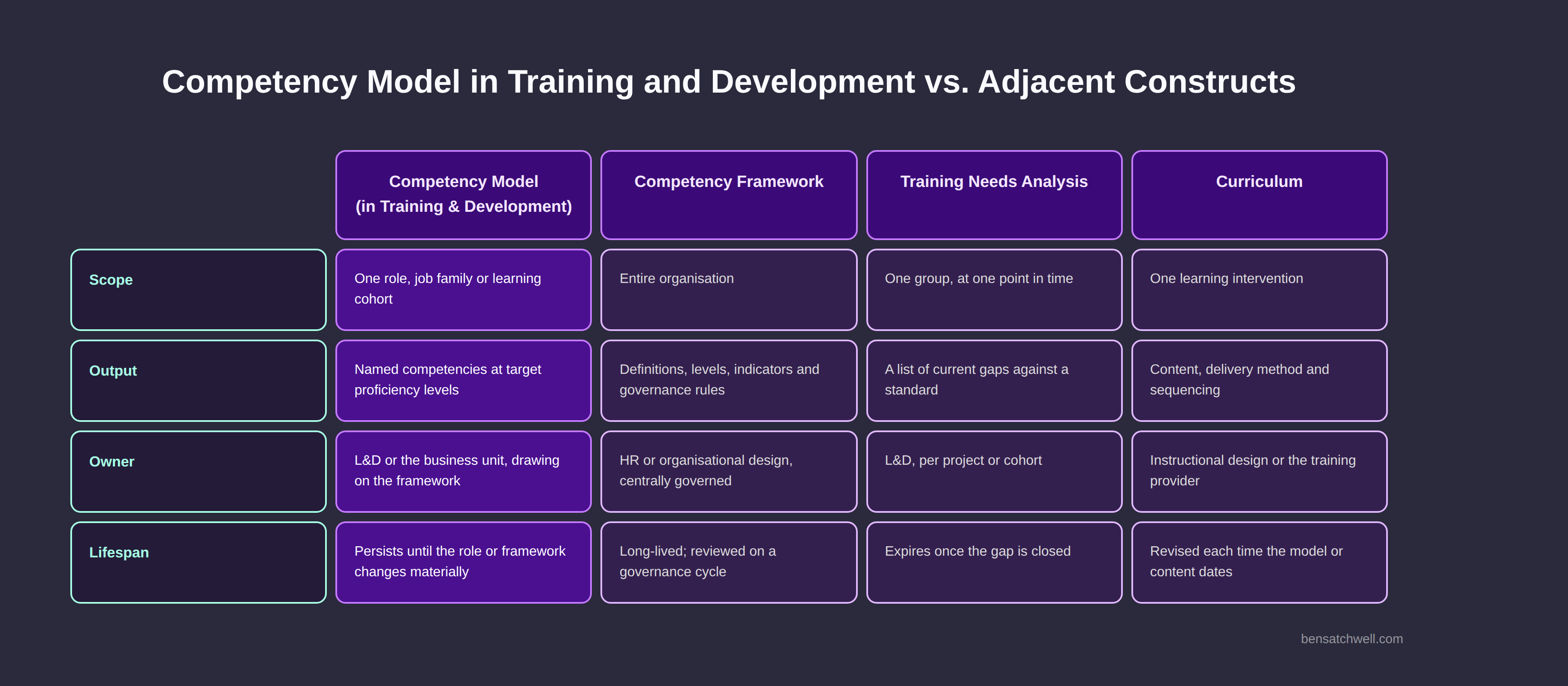
How a competency model in training and development differs from the adjacent constructs it is most often confused with.
Common Failure Modes
Three failure patterns show up repeatedly when I review these models after the fact.
The model is copied from a vendor library and never adapted. Korn Ferry, Lominger and SHRM's libraries are useful starting vocabularies, not finished models. Keeping every competency from a purchased library, unmodified, skips the step where someone decides what actually matters for this specific role.
Proficiency levels describe seniority, not behaviour. "Level 3: Manager" is not a proficiency level, it is a job title with a number attached. A usable level describes scope, autonomy, complexity and impact, independent of who currently holds the role.
The model and the curriculum are built by different teams who never reconcile them. L&D builds a programme catalogue against last year's skills gap survey while HR quietly updates the competency framework. Eighteen months later, nobody can explain why the flagship leadership programme does not map to a single named competency.
Trade-offs and Constraints
A competency model in training and development is worth building when a defined population, a role, job family or cohort, needs a stable target across multiple training cycles, and when the organisation already has, or is willing to build, a governing competency framework to draw from.
It is the wrong tool when the population is too small or short-lived to justify the governance overhead, when the underlying framework does not exist and there is no appetite to build it first, or when what is actually needed is a one-off training needs analysis rather than a standing reference.
The constraint most often ignored: a competency model only stays useful as long as someone owns its maintenance. A model built once and never revisited against a changing framework becomes a historical document, not a training target.
FAQ
What is the difference between a competency model and a competency framework in training and development?
The framework is the organisation-wide system that defines every competency, proficiency level and behavioural indicator. A competency model in training and development is one applied selection from that framework, scoped to a specific role, job family or learning cohort.
Is a competency model the same as a training needs analysis?
No. A training needs analysis measures gaps against a standard at a point in time. The competency model is the standard itself, the standing reference the needs analysis is measured against.
Does every training and development function need its own competency model?
No. A model is only worth the governance overhead when a defined population needs a stable target across multiple training cycles. Short-lived or very small cohorts are usually better served by a direct training needs analysis.
How many proficiency levels should a competency model use?
Most workable frameworks use four to six levels, set by scope, autonomy, complexity and impact rather than by seniority or years of experience.
Can a competency model be built without an existing competency framework?
It can, but it is fragile. Without a governing framework, each model risks inventing its own definitions and levelling logic, which breaks comparability the moment two models need to be compared or combined.
What is a competency-based training framework, and is it the same thing?
No. A competency-based training framework is a training delivery and assessment methodology, common in vocational and regulated sectors, built around demonstrating competence to complete a qualification. A competency model is the target definition that framework is built around, not the methodology itself.