
Most documents called an "HR capability framework" are actually competency frameworks wearing a different label, and that mislabelling is the reason so many of them get built, launched, and then quietly ignored. A capability framework and a competency framework solve different problems. If you build one when you need the other, the document will look complete and still fail to change how HR practitioners are developed, deployed, or assessed. A competency framework is also called a competency model, especially in the United States, and usage varies by region. I explain the differences in this competency model definition.
What Is an HR Capability Framework?
An HR capability framework is an organisation-wide structure that defines and organises the broad, durable human capabilities HR professionals need to do their work well, both now and as the function changes. It is scoped to the HR profession the way a competency framework might be scoped to sales or engineering, but it governs capabilities rather than competencies, and that distinction is not cosmetic.
A capability is a broad, durable area of ability that a person owns and carries across roles, tasks and contexts. Stakeholder influence, systems thinking, judgement under ambiguity and commercial reasoning are capabilities. They do not belong to a single HR role; an HR business partner, a reward specialist and a head of talent all draw on them, just at different depths. A competency, by contrast, is the integration of skills, knowledge, judgement and behaviour applied effectively in a specific role context, such as "designs job evaluation methodology" or "administers payroll within compliance requirements." The CIPD's factsheet on competence and competency frameworks makes a similar point: competency frameworks describe what good performance looks like in a defined role, which is precisely why they cannot do the job a capability framework is built for.
Why an HR Capability Framework Exists
HR competency frameworks are common. SHRM and CIPD both publish well-known examples, and most large organisations have built their own. What is missing in most HR functions is a structure that addresses a different question: not "what does good performance look like in this HR role today," but "what underlying human capability does this person carry that lets them move into a role that does not exist yet."
The HR function has changed shape repeatedly over the past decade, absorbing people analytics, workforce planning, organisational design and increasingly AI-enabled service delivery. A competency framework built around today's HR roles ages quickly because it is tied to the structure of those roles. A capability framework is built to survive that kind of restructuring, because it describes what the person can do, not what the job currently requires. That is the functional reason it exists: organisations need a way to develop and redeploy HR talent that does not have to be rewritten every time the operating model changes.
How an HR Capability Framework Works in Practice
A well-built HR capability framework groups capabilities into capability domains rather than HR sub-functions. Following Bowles' structure, these domains typically sit under Thinking, Personal and Action, covering things like analytical reasoning, self-management and stakeholder influence, rather than "recruitment," "reward" or "employee relations." This is a deliberate design choice. Grouping by domain of human functioning, instead of by job function, is what keeps the framework transferable across HR roles instead of locking it to the current org chart.
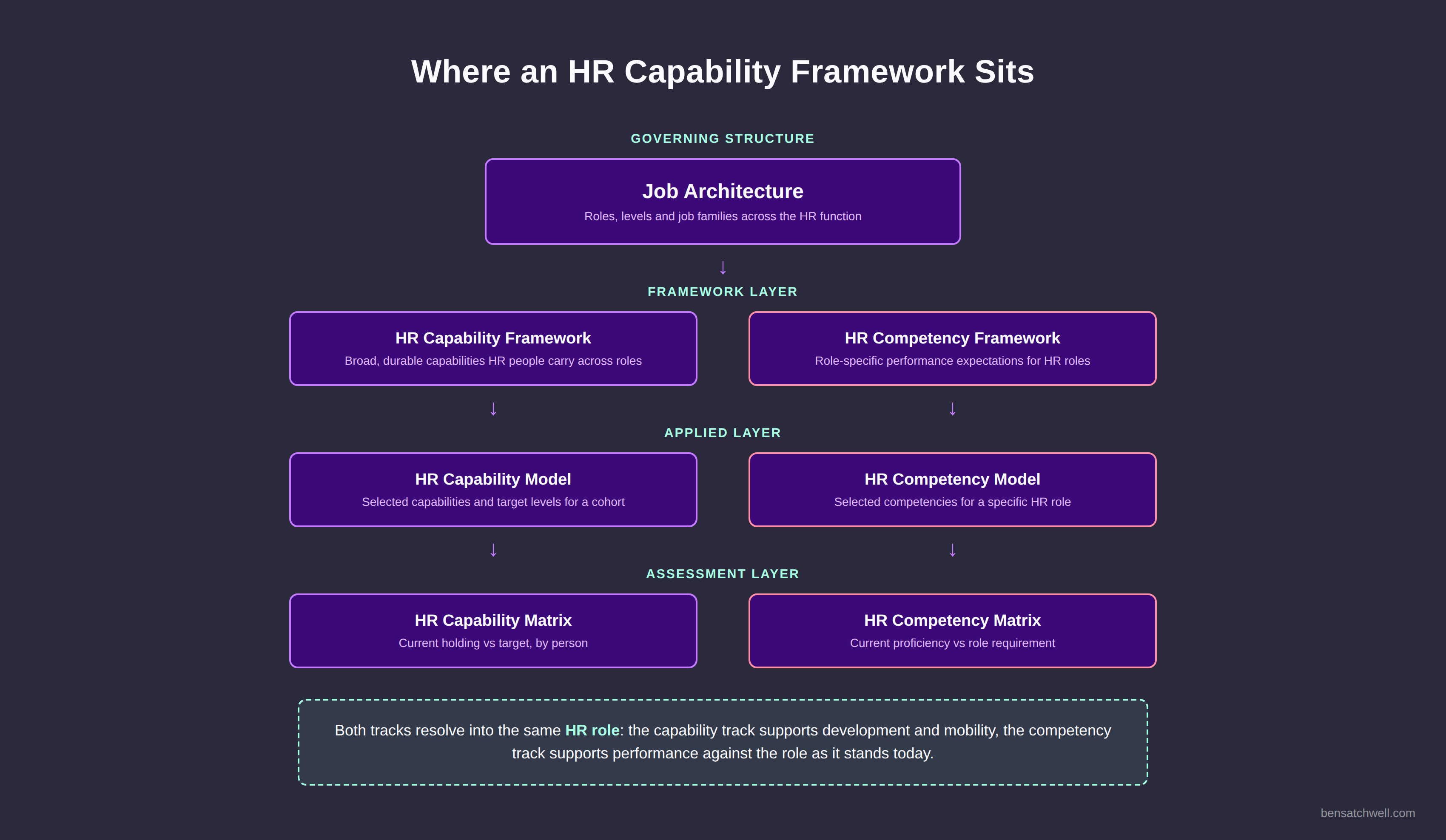
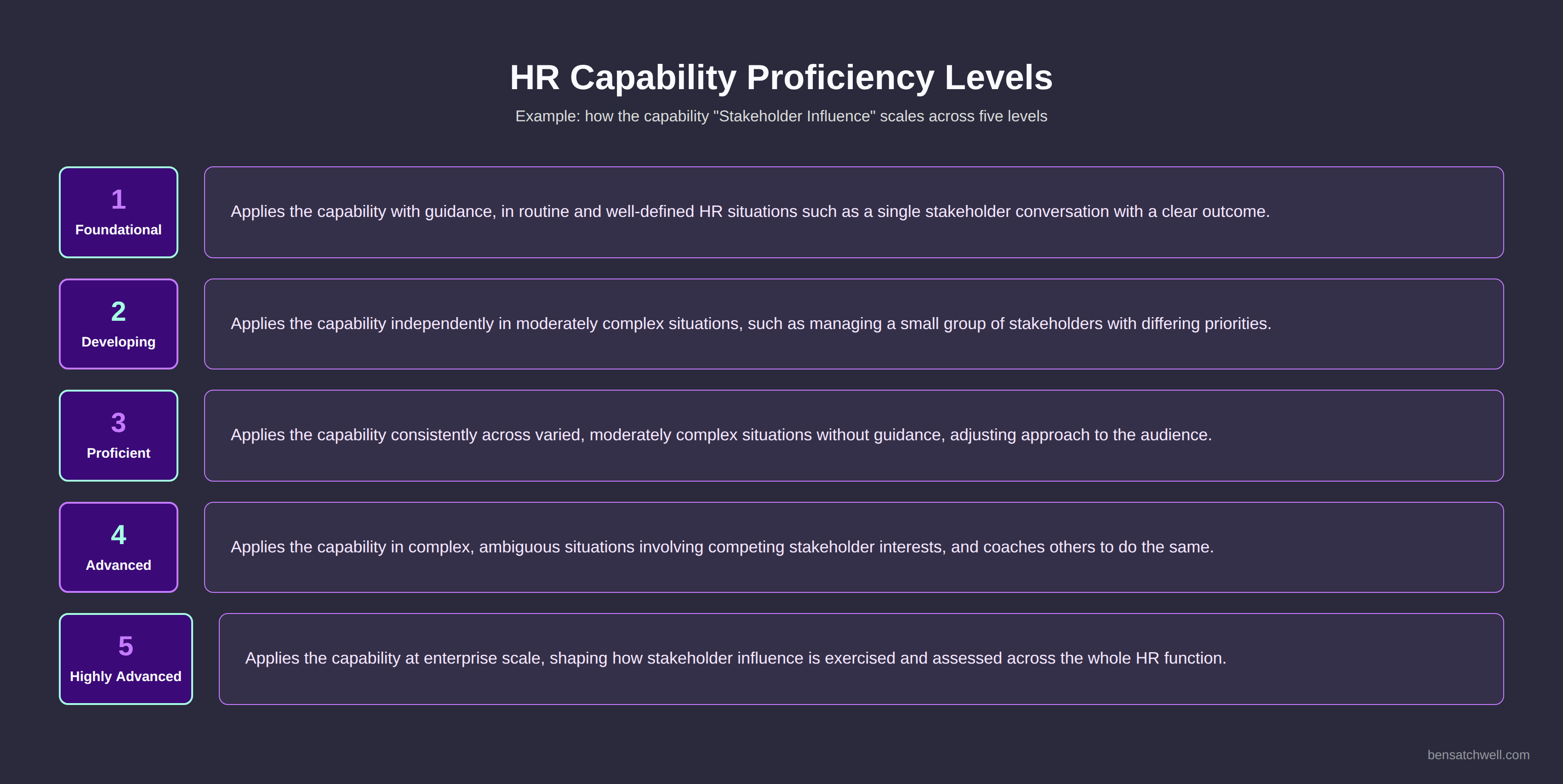
Each capability is then set against proficiency levels, typically four to six, defined by scope, autonomy, complexity and impact rather than by job title or years of service. Behavioural indicators are written at each level so the capability can be observed and assessed rather than guessed at. From there, organisations build a capability profile for a specific HR cohort or career band, selecting the relevant capabilities and target levels, and a capability matrix to show current holding against that target. Practical sequencing for this kind of build, including how to balance capability domains against assessment design, is covered in more depth in this guide to capability framework design.
What an HR Capability Framework Is Not
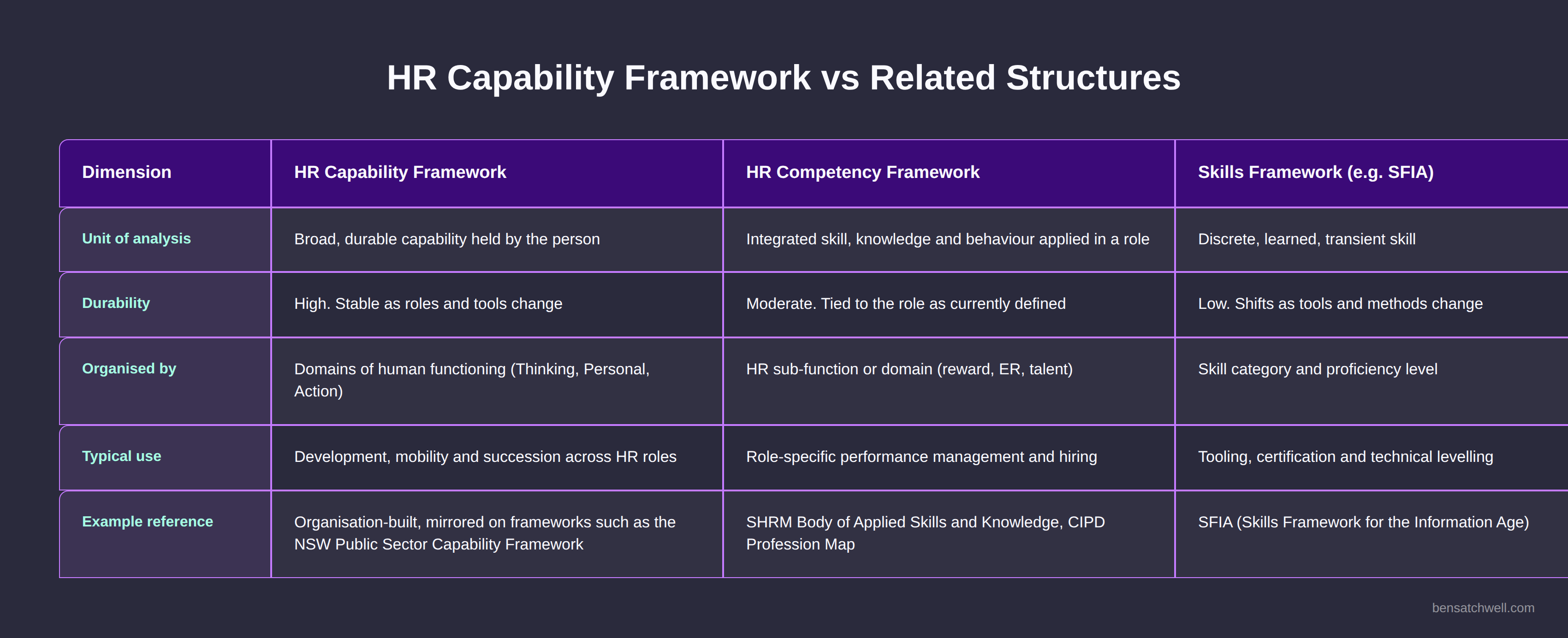
It is not an HR competency framework, even though the two are routinely used interchangeably in practice. A competency framework defines role-specific performance expectations; a capability framework defines the portable human ability underneath those roles. I have written previously about how a capability and competency framework work together as an integrated architecture rather than substitutes for one another, and that distinction matters more in HR than almost anywhere else, because HR is usually the function asked to design frameworks for everyone else first.
It is also not a skills taxonomy or a skills framework. A skills framework, of which SFIA is the clearest example, governs discrete, transient, learned abilities tied to tools and methods. HR capabilities such as judgement, influence and systems thinking are broader and more durable than the skills that sit underneath them. And it is not a job architecture. Job architecture organises roles, levels and job families; a capability framework describes what people need to carry to move through that architecture, not the architecture itself.
Finally, it is not the same as organisational capability. Organisational capability is what the HR function as a whole must be able to do to deliver the people strategy. An HR capability framework is about the individuals inside that function, not the function's collective capacity.
Named Frameworks and Standards Relevant to HR Capability
Few organisations publish a dedicated, public "HR capability framework" by that exact name, which is part of why the term gets conflated with the more visible HR competency frameworks. The SHRM Body of Applied Skills and Knowledge is the clearest large-scale reference point for HR competency, defining behavioural competencies and technical knowledge areas for the profession, and it is useful precisely as a contrast case: it is a competency structure, scoped to defined HR functional areas, not a capability structure scoped to the transferable person.
Government capability frameworks offer a closer structural parallel, even though they are not HR-specific. The NSW Public Sector Capability Framework defines twenty capabilities across five capability groups, including Personal Attributes, Relationships, Results, Business Enablers and People Management, each set against five proficiency levels from foundational to highly advanced. That is the architecture an HR-specific capability framework should mirror: domains of human functioning, not job functions, levelled by complexity and impact rather than title.
Common Failure Modes
The most common failure is building a competency framework and calling it a capability framework, then wondering why it cannot support workforce mobility or succession planning. If the content is written as role-specific performance statements, it is a competency structure no matter what the cover page says.
The second is collapsing capability domains into HR sub-functions, recreating "recruitment capability" or "reward capability" clusters. This defeats the purpose. If a capability is scoped to one HR job family, it has been redefined as a technical competency and the framework has lost the transferability that justified building it in the first place.
The third is skipping behavioural indicators. A capability framework without levelled, observable indicators cannot be assessed consistently, which means the resulting capability matrix is opinion dressed as data. The fourth, and most damaging long-term, is building the framework once and never revisiting the capability domains as the function's technology and strategy shift, which is the exact failure the construct exists to prevent.
Trade-Offs and Constraints
A capability framework is the right tool when the organisation needs to develop, assess or redeploy HR talent across a function that is actively changing shape, and when the goal is mobility and growth potential rather than role-specific performance management. It is the wrong tool, or at least an incomplete one, for managing day-to-day performance against a defined job description. That is what a competency profile is for, and most mature HR functions need both, with the capability framework sitting above the competency layer rather than replacing it. The process of building that competency layer is set out in detail in this walkthrough of creating a competency framework.
The constraint most organisations underestimate is governance load. A capability framework needs a defined owner, a review cycle tied to strategic and technology shifts, and calibration discipline so behavioural indicators are applied consistently across assessors. Without that governance, the framework decays into a static document within twelve months, regardless of how well it was designed.
FAQ
What is the difference between an HR capability framework and an HR competency framework?
A capability framework defines broad, durable, portable human abilities HR professionals carry across roles. A competency framework defines role-specific performance expectations tied to current HR job structures. Most mature HR functions use both, with capabilities sitting above role-specific competencies.
Does SHRM publish an HR capability framework?
No. SHRM's Body of Applied Skills and Knowledge is a competency structure, defining behavioural competencies and functional knowledge areas for HR certification. It is not built as a capability framework in the sense used here.
How many capabilities should an HR capability framework include?
There is no fixed number, but frameworks that work in practice tend to stay in the range of fifteen to twenty five capabilities grouped into a small number of domains. Beyond that, the framework becomes too granular to remain durable and starts behaving like a competency list.
Can a capability framework replace a competency framework in HR?
No. They answer different questions. A capability framework supports development and mobility; a competency framework supports role-specific performance management and assessment. Removing either leaves a gap the other was not designed to fill.
How often should an HR capability framework be reviewed?
It should be reviewed against strategic and technology shifts in the function, not on a fixed annual cycle alone. A useful practical trigger is any material change to the HR operating model, such as the introduction of AI-enabled service delivery or a shift in how the function is structured.
Who should own an HR capability framework?
Ownership typically sits with HR leadership or a dedicated capability or workforce planning role, with input from the broader HR function during design. Without a named owner and a review cycle, the framework has no mechanism to stay current.