

A competency framework for learning and development is easy to confuse with a learning and development competency framework, and the confusion is not trivial. One defines what L&D professionals need to be good at their own job. The other defines what everyone else in the organisation needs to become good at, and uses that definition to decide what gets built, delivered and measured. Mix the two up and you end up governing the wrong population with the wrong framework.
What Is a Competency Framework for Learning and Development
A competency framework for learning and development is a workforce-wide competency framework used as the primary input for deciding what development activity an organisation designs, prioritises and delivers. It does not describe the L&D function's own capability. It describes the competencies the rest of the workforce is expected to hold, at what proficiency level, in which roles, and it hands that definition to L&D as the basis for gap analysis, curriculum design and career pathway planning.
Used this way, the competency framework is not a document L&D consults occasionally. It is the specification L&D builds against.
That distinction separates a competency-driven L&D function from one that builds development activity on requests, trends or whatever content a vendor happens to be selling that quarter. Without a framework behind it, L&D ends up reacting to the loudest complaint rather than the largest capability gap.
A competency framework is an organisation-wide structure that defines, groups and standardises the competencies required for effective performance across roles and levels. Put to this specific use, it becomes the reference point every development decision is meant to trace back to.
Why Does Learning and Development Need a Competency Framework at All
L&D functions have historically built catalogues based on manager requests, industry trend lists, or generic leadership models bought off the shelf. That approach cannot answer the basic governance questions a competency-driven function needs to answer: which roles need this content, what proficiency does it target, and how do we know it worked. A competency framework fixes that by giving L&D a shared, levelled, assessable definition of what good looks like in each role, so development decisions trace back to a specific competency and proficiency gap rather than a hunch.
CIPD's most recent annual L&D survey found that six in ten organisations already run a competency framework for their workforce, with most of the remainder planning to introduce one within two years. That is not a niche practice. It is close to becoming the default way large L&D functions decide what to build.
How Does a Competency Framework Drive Learning and Development in Practice
Gap Analysis Comes First
Before any development activity gets built, the framework's proficiency levels and behavioural indicators are compared against a workforce's current and required standing, competency by competency, role by role. That comparison, not a survey of what people say they want to learn, is what generates the development priority list. It is also what lets L&D defend a budget decision with evidence rather than opinion.
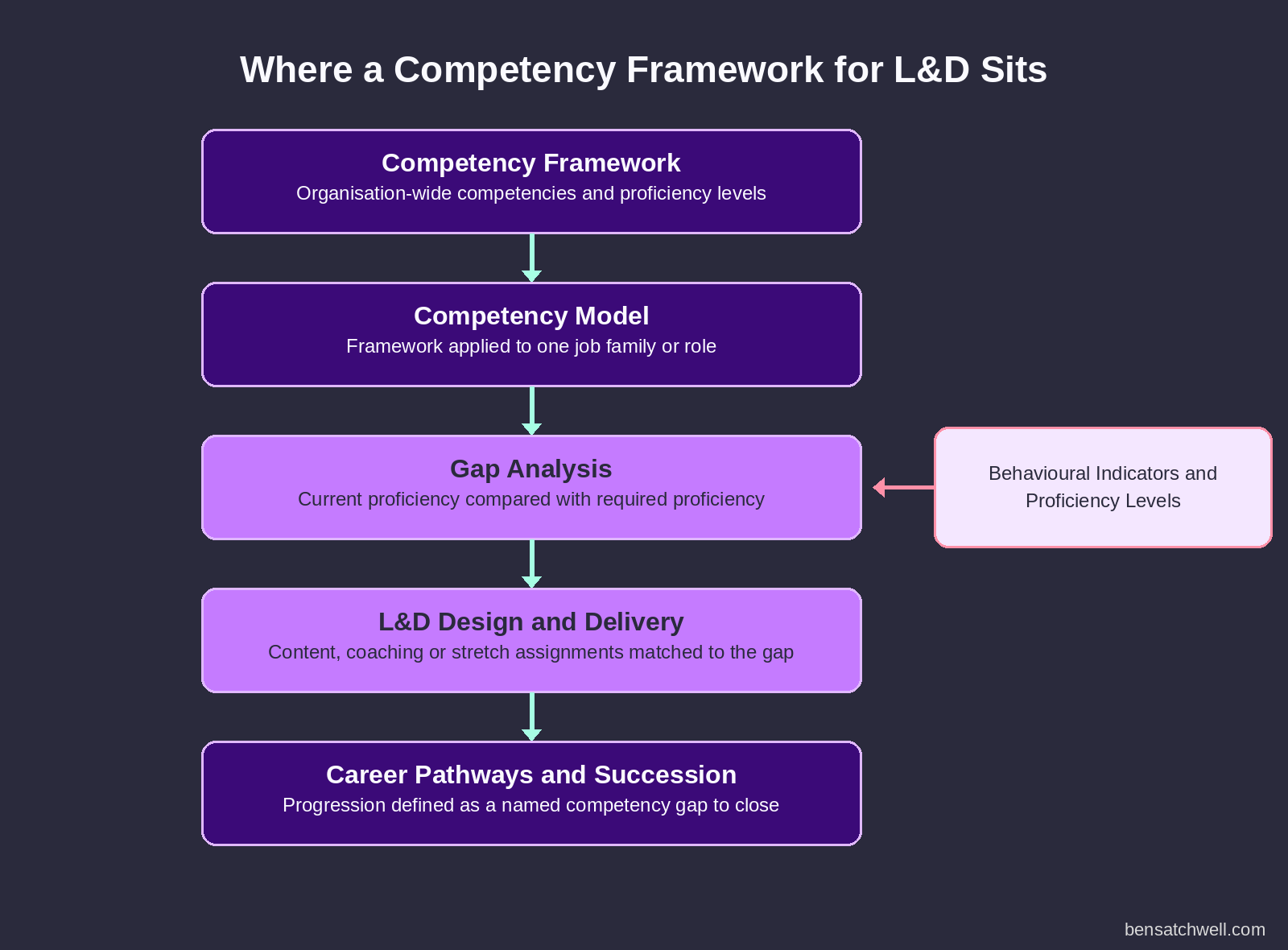
Where a competency framework for learning and development sits between the organisation-wide framework and the career pathways it eventually drives.
Levels Set the Development Response, Not the Other Way Around
Each proficiency level in the framework implies a different kind of development response. Closing a gap between a foundational and a developing level of proficiency usually calls for structured, sequenced content. Closing a gap between a proficient and an advanced level usually calls for stretch assignments, coaching or deliberate exposure, not more content at all. A framework with meaningful levels tells L&D which lever to pull, rather than defaulting to content for every gap regardless of what actually closes it.
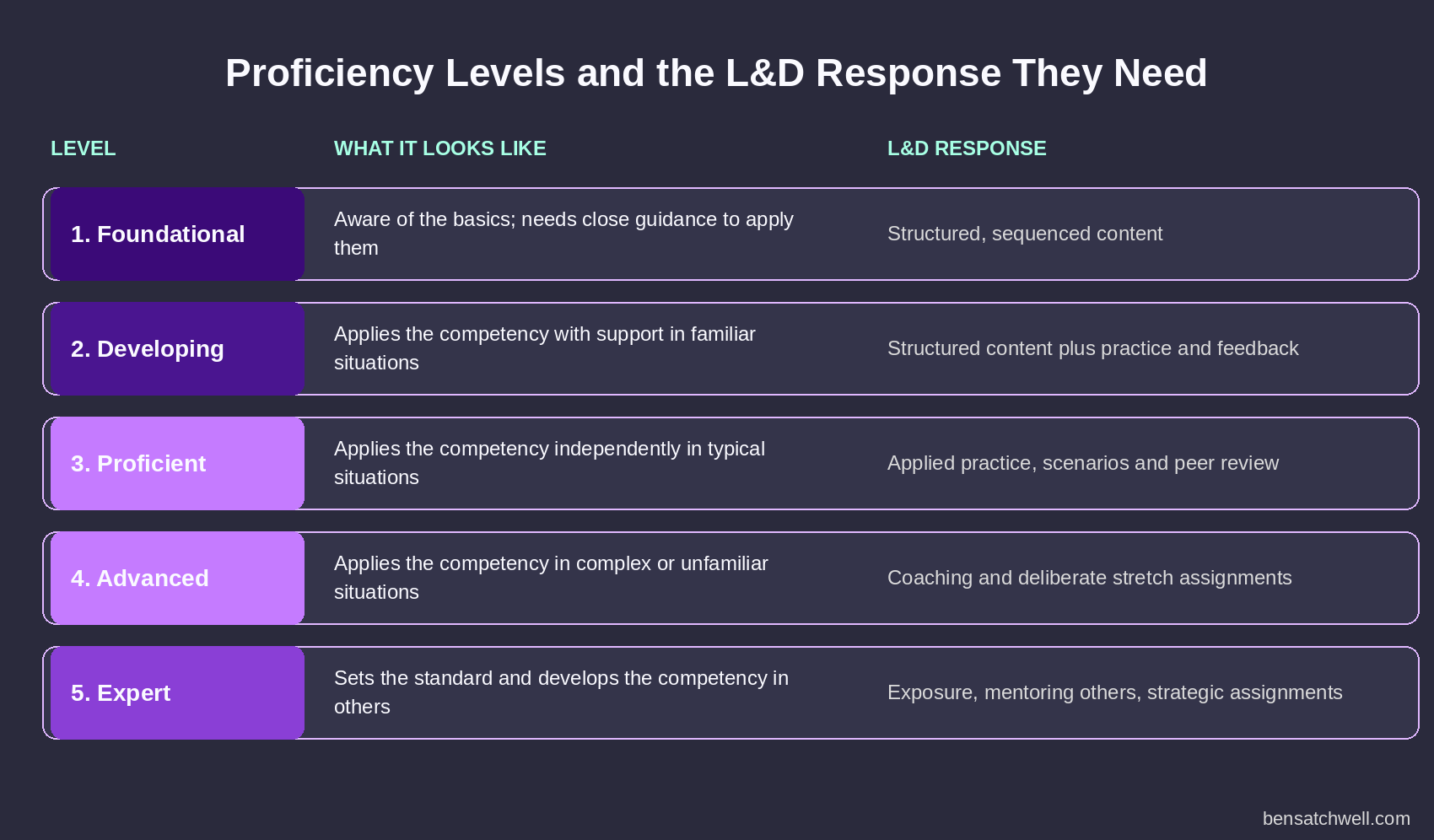
The proficiency level a competency framework for learning and development sets determines the kind of development response L&D should build, not just the content topic.
Career Pathways Inherit the Same Structure
Because the framework already defines what each level of each competency looks like, the same structure can drive career pathway design. Progression from one role or level to the next becomes a defined competency gap rather than a vague expectation of readiness. Korn Ferry's competency architecture is one of the most widely licensed examples of this approach, using shared proficiency scales to connect assessment, development and succession planning across roles in a single system.
Applying the framework to a specific job family produces a competency model, and it is the model, not the framework itself, that L&D typically builds development content against. The framework stays stable and organisation-wide. The model is what gets rebuilt as roles change.
What a Competency Framework for Learning and Development Is Not
It is not a curriculum catalogue with a competency label stuck on afterwards. A list of programmes mapped loosely to skill names is not a framework, because it has no proficiency logic and cannot tell you what good looks like at each level, only that a programme exists.
It is also not the same construct as a learning and development competency framework, which defines the competencies L&D practitioners themselves need, from needs analysis and instructional design through to delivery and evaluation. That framework governs the people building the development. This one governs the population the development is built for. Confusing the two is why so many L&D teams cannot say which framework their own content decisions actually run on.
It is not a competency matrix either. A matrix is the assessment artefact, a grid showing who currently holds what against what a role requires. The framework is the governing structure the matrix is built from, and a matrix without a framework behind it has no basis for its proficiency ratings.
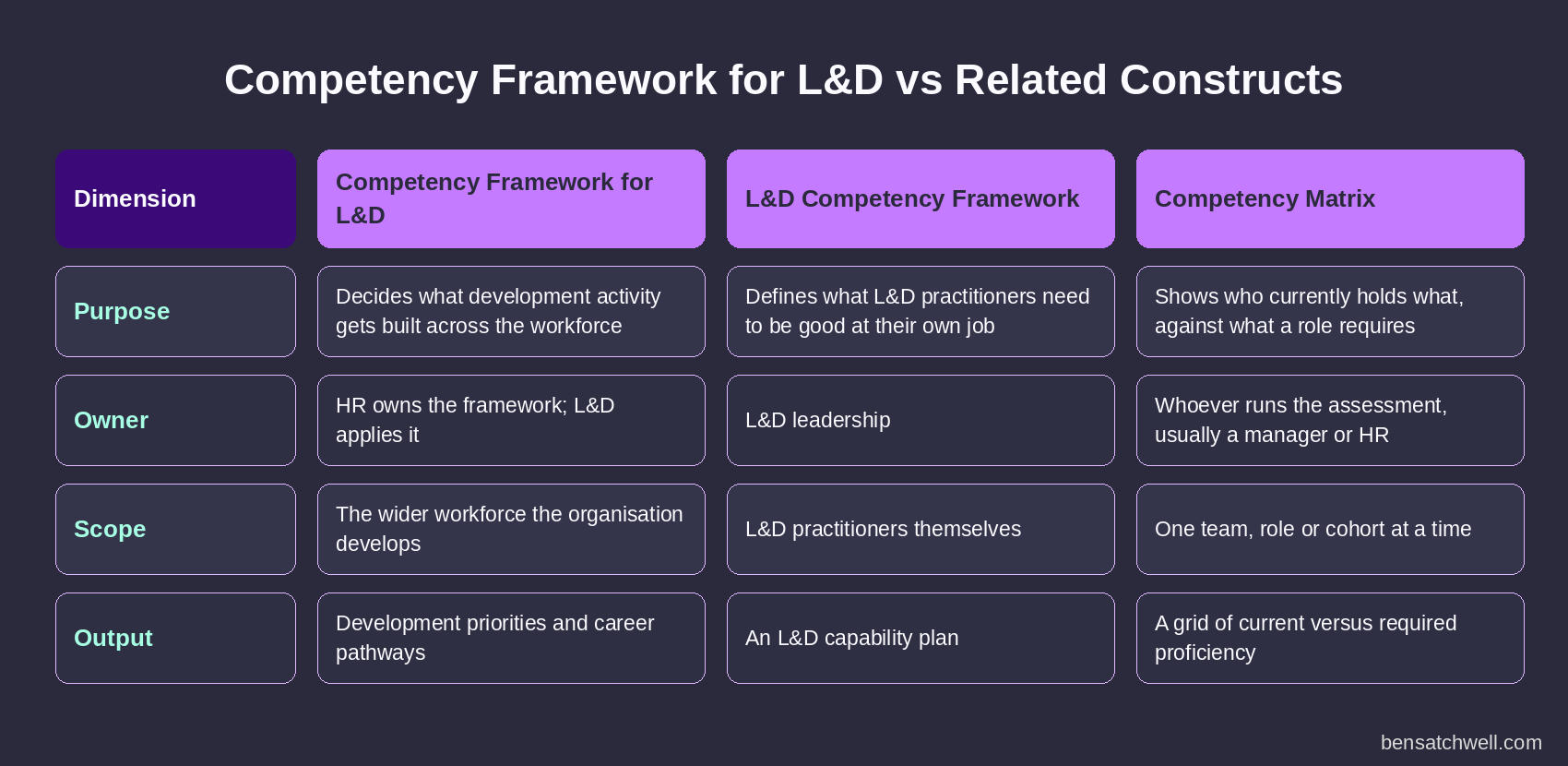
A competency framework for learning and development, a learning and development competency framework, and a competency matrix look similar but answer different questions.
Which Named Frameworks and Standards Apply Here
SFIA is the clearest worked example in the technology and digital space. Its skills and levels are already structured for exactly this purpose, letting an L&D function map content directly to a named skill at a named level rather than inventing its own scale from nothing. CIPD's Profession Map performs a similar function for HR and L&D roles specifically, though as noted above that framework describes the practitioners rather than the wider workforce. Korn Ferry and Lominger-derived competency libraries remain the most common commercial source organisations licence when building a workforce-wide framework rather than writing one from scratch. None of these replace the judgement involved in deciding which competencies matter for a specific workforce, but they save an L&D function from starting with a blank page.
Where Competency-Driven Learning and Development Goes Wrong
A few failure modes turn up repeatedly. The framework gets adopted by HR but is never handed to L&D in a form L&D can actually use, so old catalogue-building habits continue underneath a relabelled framework. Behavioural indicators are written vaguely enough that no one can tell whether development activity closed the gap it targeted, so evaluation quietly reverts to attendance figures and satisfaction scores. The framework covers every competency at the same depth, so L&D tries to build content for all of it at once instead of prioritising the highest-impact gaps. Proficiency levels get set by seniority rather than by scope, autonomy, complexity and impact, so senior staff are assumed competent by title rather than by evidence.
Some organisations solve part of this by building a dedicated competency development framework, a structure specifically for progression planning, though it still depends on the underlying competency framework being sound in the first place. Peer-reviewed research on competency-based framework implementation identifies exactly this pattern: frameworks fail less often because the model itself is wrong than because the organisation never operationalised it into standardised recruitment, assessment, development and evaluation practice.
When Is a Competency-Driven Approach Worth the Investment
Building or adapting a full competency framework is a heavier investment than commissioning a slate of content and calling it a plan. It pays off when L&D operates at organisational scale, across many roles, with a genuine need to prioritise and defend investment decisions. For a small team building a handful of programmes, a lighter needs analysis may do the job the framework would otherwise perform, without the governance overhead a full framework carries.
The OECD's Learning Compass work is a useful caution against treating competency too narrowly. It defines competency as a holistic combination of knowledge, skills, attitudes and values, not a single measurable task. A framework that reduces competency to a checklist of discrete tasks will underserve exactly the transferable capability that learning and development is meant to build over time.
Frequently Asked Questions
What is the difference between a competency framework for learning and development and a learning and development competency framework?
The first defines the competencies the wider workforce needs and uses that definition to decide what L&D builds. The second defines the competencies L&D practitioners themselves need to do their job. They serve different populations and are not interchangeable.
Does a competency framework replace a learning needs analysis?
No. The framework supplies the standard, the proficiency levels and the behavioural indicators. The needs analysis is the exercise that compares a specific workforce against that standard to find where the gaps actually sit.
How many proficiency levels should the framework use?
Most workable frameworks use four to six levels, set by scope, autonomy, complexity and impact rather than by seniority or years of service.
Can a skills framework do the same job as a competency framework?
Not on its own. A skills framework defines discrete, granular skills and their levels. A competency framework integrates skills with knowledge, judgement and behaviour into role-level performance, which is what L&D needs to design content against actual on-the-job effectiveness rather than a checklist of tasks.
Who should own the competency framework, HR or L&D?
HR typically owns the framework as an organisation-wide asset, since it also feeds recruitment, performance and career pathways. L&D should have a formal role in applying it, because the framework only earns its keep once it drives real development decisions.
Does every role need to be covered before L&D can use the framework?
No. Most organisations start with the roles or job families carrying the largest capability gap or the greatest strategic weight, then extend coverage over time rather than waiting for full coverage before using it.