

Most talent acquisition teams cannot tell you what good looks like in their function. They can tell you time-to-fill, offer acceptance rate, and cost-per-hire. What they cannot tell you is what competencies a senior recruiter should hold that a junior recruiter does not, how sourcing capability differs from stakeholder management capability, or how to assess whether someone is genuinely ready to step up. That gap is not a metrics problem. It is a framework problem.
A talent acquisition competency framework solves it directly. It is the structure that defines what TA professionals should be able to do, at what level, across the domains that matter in the function.
What Is a Talent Acquisition Competency Framework?
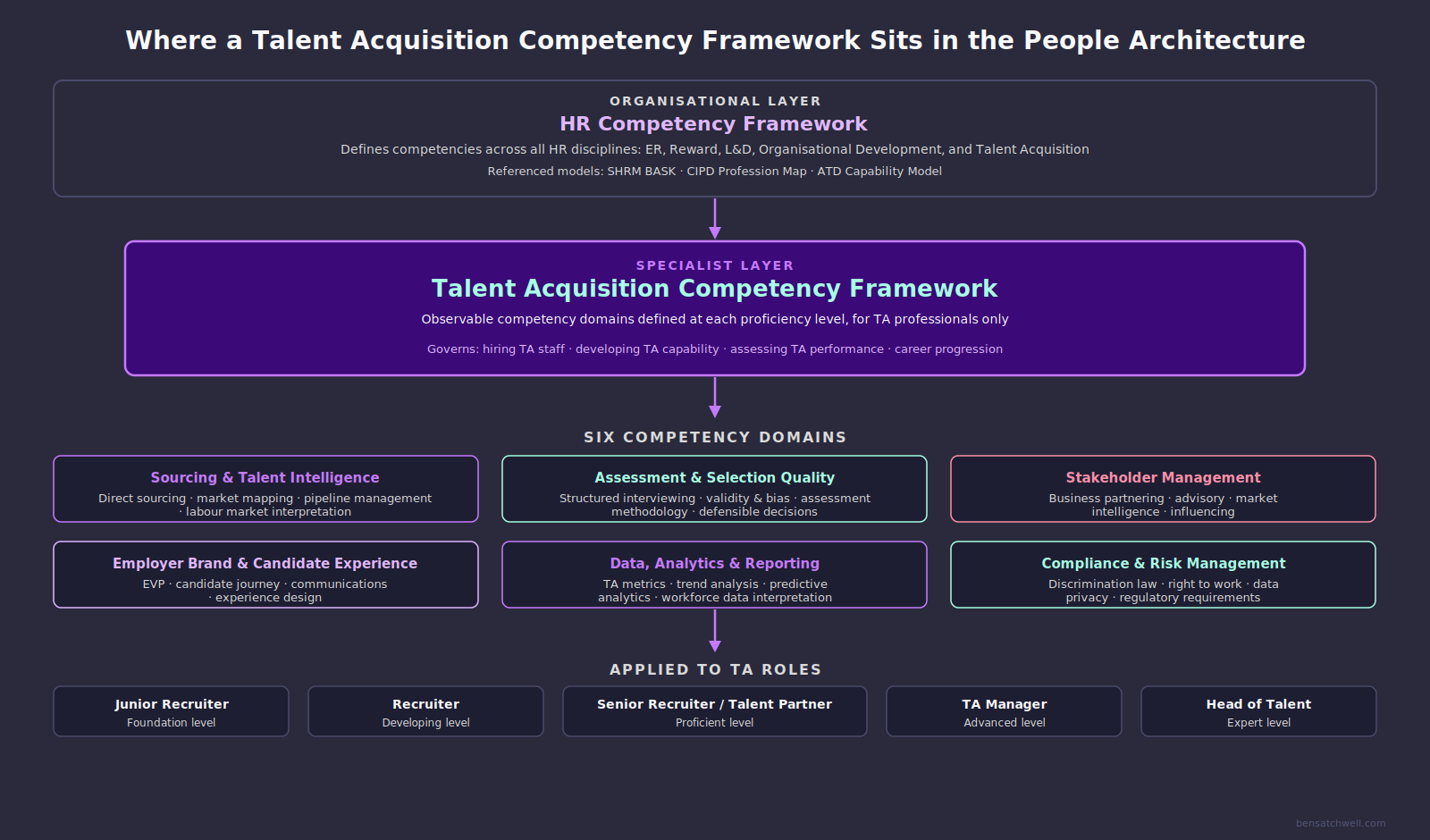
A talent acquisition competency framework is a structured system that defines the observable behaviours, skills and judgements TA professionals are expected to demonstrate at each level of proficiency. It organises those expectations into competency domains specific to the talent acquisition function, sourcing, assessment, stakeholder management, employer brand, analytics, and compliance, and sets clear proficiency levels from foundation through to expert.
The key word is observable. A talent acquisition competency framework does not describe personality traits or vague attributes. It describes what a recruiter at a given level actually does: how they approach a difficult brief, what they do when a hiring manager pushes back on a qualified candidate, and how they interpret a sourcing market that has dried up.
It is a specialist application of a competency framework, the broader governing structure used across an organisation, narrowed to the professional demands of TA specifically.
A note on terminology. A competency framework is also called a competency model, especially in the United States. I use competency profile for the competencies and required levels for one role, and competency matrix for the grid of required against current proficiency. Usage varies by region, and I explain the differences in this competency model definition.
Why a Talent Acquisition Competency Framework Needs to Exist
The challenge talent acquisition teams consistently face is that the function is treated as process-driven work rather than professional practice. Recruiters are evaluated against volume and speed. When performance falls short, the diagnosis is usually behavioural: they are not proactive enough, not commercially minded, not stakeholder-focused. But without a defined standard for what those things look like at each level, those observations cannot be acted on.
A talent acquisition competency framework creates that standard. It answers the questions a TA leader actually needs to answer:
- What should I look for when hiring a senior recruiter versus a talent partner?
- How do I develop someone who is technically strong at sourcing but weak at stakeholder advisory?
- What does a proficient-level assessment approach look like versus a developing-level one?
- Where in the competency domains do I have team-wide gaps?
Those questions require a competency framework to answer. They cannot be answered by a job description or a process manual.
How a Talent Acquisition Competency Framework Works in Practice
A talent acquisition competency framework is built around three design decisions: which competency domains to include, how many proficiency levels to define, and what the behavioural indicators look like at each intersection.
Competency Domains
The domains organise the framework into areas of professional practice. For talent acquisition, a workable set covers: sourcing and talent intelligence, assessment and selection quality, stakeholder management, employer brand and candidate experience, data and analytics, and compliance and risk management. These are the areas where competency actually differs between levels. They are not process steps and they are not job family specialisations.
Proficiency Levels
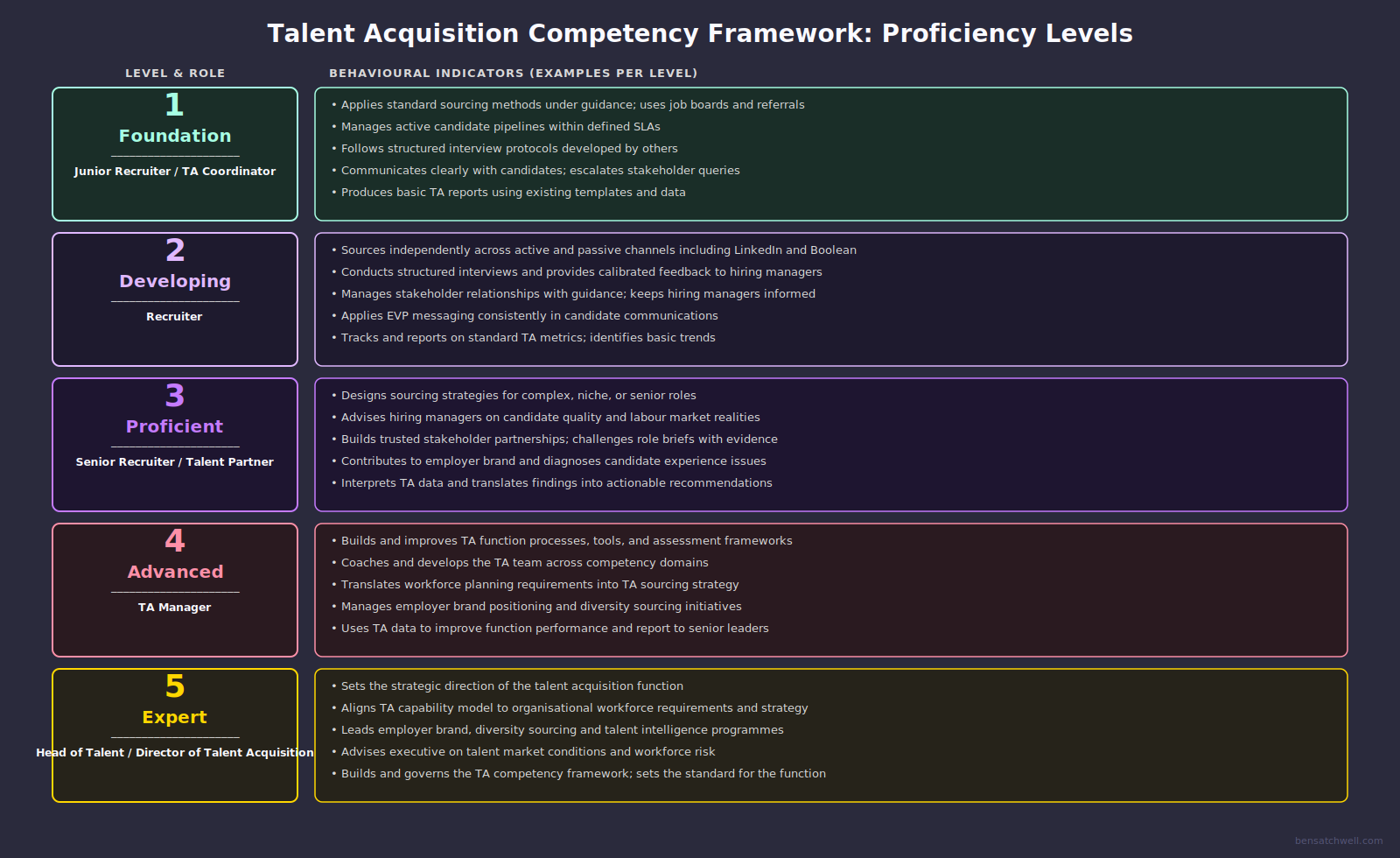
Levels define the standard expected at each stage of a TA career. Five levels cover the range from a junior recruiter operating under guidance through to a head of talent setting strategic direction and governing the framework itself. The distinction between levels is not seniority or time in role. It is scope, autonomy, and complexity. A level three practitioner does not simply do more than a level two. They do different things, at a different order of difficulty, and make judgements the level two is not expected to make.
Behavioural Indicators
Behavioural indicators are the observable statements that define what good performance looks like at a specific level in a specific domain. They are not aspirational. They are written at the standard expected, descriptively, so that assessment can be conducted against them. A behavioural indicator for level three stakeholder management might read: “Challenges role briefs with evidence; advises hiring managers on candidate quality and labour market realities without deferring to their preference.”
The process of creating a competency framework for talent acquisition follows the same design logic as any professional competency framework: define the domains, set the proficiency scale, write the indicators at each level, and validate against actual role performance in the function.
What a Talent Acquisition Competency Framework Is Not
Several constructs are frequently confused with a talent acquisition competency framework. The confusion matters because using the wrong tool for the wrong purpose produces poor outcomes.
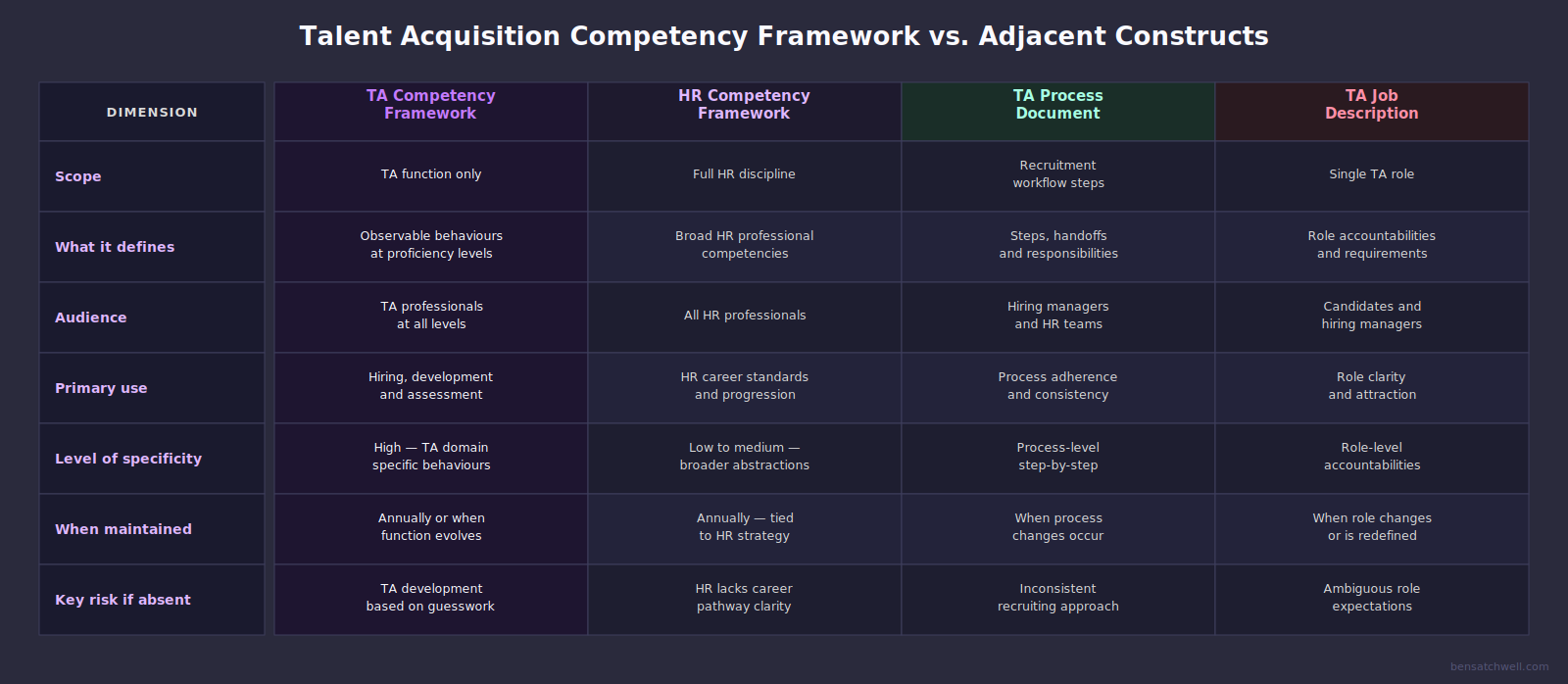
A talent acquisition job description defines what a role is responsible for. It describes accountabilities and requirements. It does not define how a practitioner should develop across a career or how to calibrate performance at each level. A job description answers “what is this role”. A competency framework answers “what does good look like, at each level, across the function.”
A TA process document or playbook defines the steps in a recruitment process: how a brief is taken, when assessments are scheduled, what approvals are needed. It governs process adherence, not professional capability. A recruiter can follow a perfect process and still be weak at sourcing intelligence or stakeholder advisory. Those are competency gaps, not process gaps.
A general HR competency framework covers all HR disciplines. Its competencies are necessarily broad because they have to apply across functions. A talent acquisition competency framework is more specific: it names the TA-domain behaviours that distinguish a capable sourcer, a strong assessment practitioner, and a genuine business partner. The broader capability and competency framework is the governing layer. TA competency frameworks sit within it as a specialist application.
Referenced Frameworks and Professional Standards
Several professional bodies have published competency frameworks that inform how talent acquisition is defined as a professional discipline.
The SHRM BASK (Body of Applied Skills and Knowledge) framework includes talent acquisition as a core HR functional area, defining competencies across sourcing, selection, and onboarding at a generalist HR level. The SHRM certification framework provides a useful reference for the professional expectations the function is held to internationally.
The CIPD Profession Map covers resourcing and talent planning as one of eight specialist knowledge areas for HR professionals. The CIPD positions talent acquisition within a broader people practice framework, with standards that apply across the UK and, to a significant degree, Australia and New Zealand. The CIPD Profession Map guidance is a grounding reference for what professional TA practice looks like at practitioner and strategic levels.
The ATD (Association for Talent Development) Talent Acquisition Competency Model offers a framework specifically designed for recruiters and TA professionals, covering sourcing, assessment, candidate experience, and data literacy. The ATD model distinguishes between foundational competency areas and specialist skill clusters in ways that directly inform how a practitioner-level framework should be designed.
None of these are intended to be used directly as an internal talent acquisition competency framework. They are reference structures, the governance and professional standards layer, that an organisation draws on when building its own.
Common Failure Modes
Most talent acquisition competency frameworks fail for one of three reasons.
The first is generic domain definition. Organisations list domains that sound right, communication, collaboration, commercial awareness, without defining what those mean in the context of talent acquisition specifically. Those labels could apply to anyone in the organisation. They give assessors nothing to calibrate against.
The second is conflating process compliance with competency. A recruiter who follows the right steps is not necessarily competent. Competency is visible in the judgements made within the process: what sourcing strategy is designed, how a difficult stakeholder is managed, what assessment methodology is recommended for a senior role. If the framework only measures whether the process was followed, it misses the professional practice it is supposed to develop.
The third is level collapse. Frameworks that define two or three vague levels, basic, intermediate, advanced, provide insufficient distinction to be useful. The difference between a foundation recruiter and a developing recruiter is specific and meaningful. A framework that collapses those into “basic” loses the diagnostic value entirely.
Trade-offs and Constraints
A talent acquisition competency framework requires ongoing maintenance. Domains and indicators that reflected the function five years ago may not reflect it today. The emergence of AI-assisted sourcing, skills-based hiring, and internal mobility have all shifted what technical competency in TA looks like. A framework that is not reviewed does not stay useful.
It also requires investment to use well. Assessment against a competency framework is only as good as the calibration of the people conducting the assessment. If TA leaders have not been trained to assess behavioural indicators consistently, the framework produces different standards across assessors and loses its value for career development and hiring decisions.
That said, the constraint of operating without one is significant. See competency framework examples across different functions for a sense of how this problem manifests across professional disciplines. TA is not unique in the challenge, but it is one of the functions that most consistently lacks a defined professional standard.
Frequently Asked Questions About Talent Acquisition Competency Frameworks
What is the difference between a talent acquisition competency framework and a job description for a recruiter?
A job description defines what a role is responsible for, its accountabilities and requirements. A talent acquisition competency framework defines how a practitioner should develop over time, what good looks like at each career stage, and how to assess and develop performance across the function. One is a hiring document. The other is a professional development system.
How many competency domains should a talent acquisition competency framework include?
Typically five to seven domains provide enough specificity to be useful without becoming unmanageable. Core domains for most TA functions include sourcing and talent intelligence, assessment and selection quality, stakeholder management, employer brand and candidate experience, data and analytics, and compliance and risk. Additional domains may be added for specialist functions, such as executive search or graduate recruitment.
How many proficiency levels does a talent acquisition competency framework need?
Four to five levels is the standard range. Fewer than four does not create enough distinction to be useful for development or assessment. More than six tends to produce level definitions that are artificially fine-grained and difficult to calibrate. Five levels, foundation, developing, proficient, advanced, expert, map cleanly to the common career stages in a TA function.
Do talent acquisition competency frameworks apply to TA leaders as well as practitioners?
Yes. The expert level in a talent acquisition competency framework covers the Head of Talent or Director of Talent Acquisition. At that level, the competencies shift toward strategic direction, governance of the framework itself, executive advisory, and organisational talent intelligence, rather than direct sourcing or individual assessment execution.
How often should a talent acquisition competency framework be reviewed?
Annual review is a reasonable baseline, with a more substantive review whenever the function changes significantly, new technology adoption, changes to hiring volume or scope, or shifts in the organisation's talent strategy. The indicators need to reflect current practice, not the practice of three years ago.
Is a talent acquisition competency framework the same as the SHRM or CIPD framework?
No. Frameworks published by bodies like SHRM or CIPD are reference frameworks for the profession broadly. They define what the discipline looks like at a professional standards level. An internal talent acquisition competency framework is built for a specific organisation's TA function, using those external references as a starting point and calibrating the domains and indicators to the organisation's context, size, and hiring profile.