

Competency Model Development
Most organisations that say they need a new competency model actually already have a competency framework sitting unused. Competency model development is not the same job as building a framework, and treating them as one task is why so many models end up as laminated posters nobody consults. If you are about to start this work, the first thing to fix is what you think you are building.
What Is Competency Model Development
Competency model development is the process of selecting, defining and levelling a specific set of competencies from a broader competency framework, and packaging them for one role, level, function or job family.
The output is a competency model: an applied instance of the framework, not the framework itself. If the framework is the governing system that defines every competency an organisation recognises, the model is the subset that applies to a defined group of people, with proficiency levels set for their context. Development is the work that turns the first into the second.
This distinction matters because the two are built differently. A framework is designed once, governed centrally, and changes rarely. A model is derived from it, built for a specific audience, and revisited whenever the role changes materially. It's the same layering what is the people capability system sets out more broadly: a governing structure at the top, applied instances underneath.
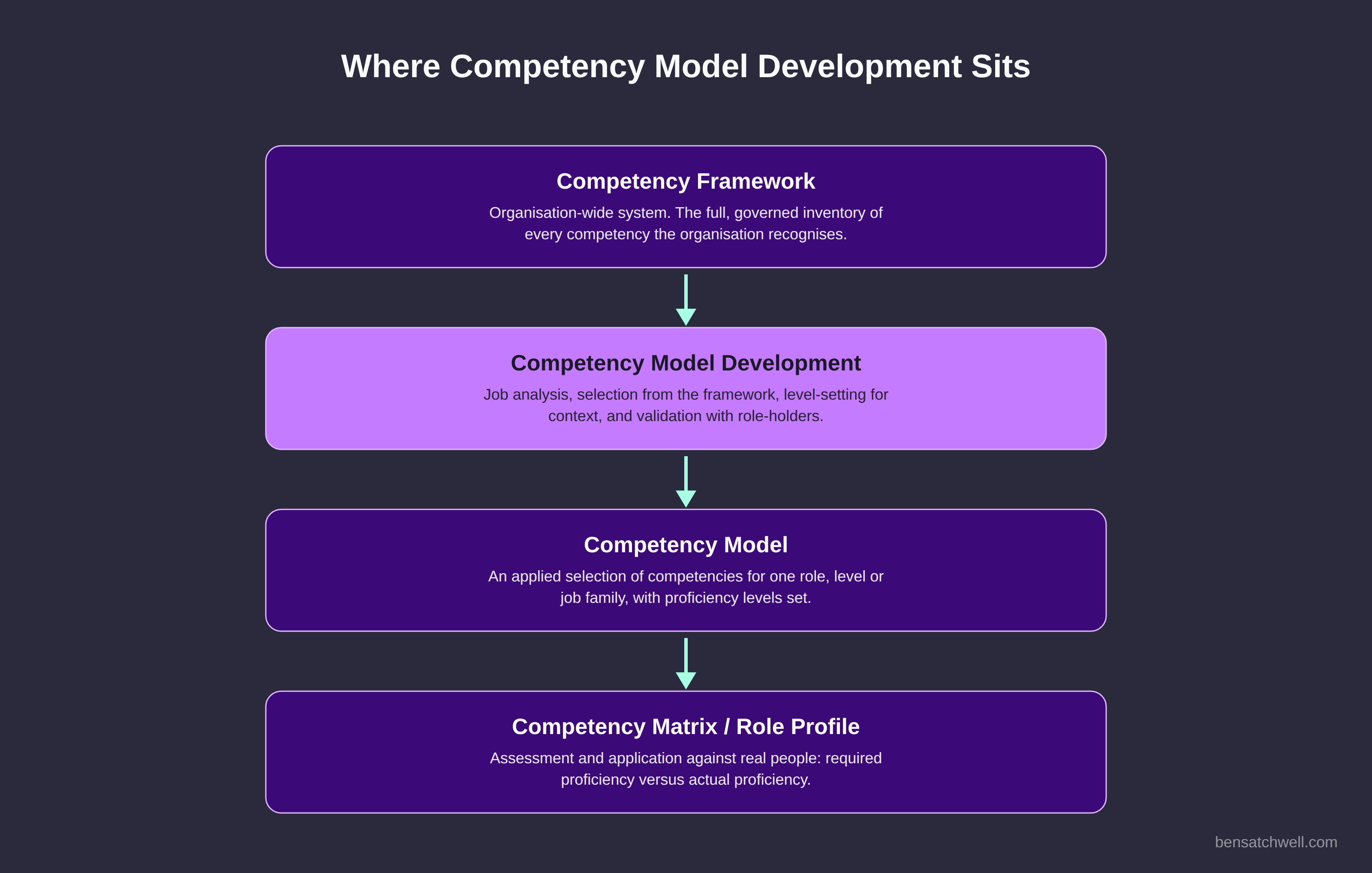
Competency model development sits between the framework and the matrix, translating a governed inventory into something a manager can actually use.
Why Competency Model Development Exists
A competency framework on its own is too broad to use for anything practical. It might define forty or fifty competencies across core, technical, and leadership domains, each written to apply across the whole organisation. No manager can run a performance conversation, a recruitment brief, or a development plan against fifty generic competencies.
Development exists to close that gap. It takes the framework's full inventory and answers a narrower question: which of these competencies actually matter for this role, at what level, and how would we recognise them in someone's day-to-day work? Without that translation step, the framework stays a reference document and the model never gets built at all.
This is the same problem why most capability frameworks fail: a well-designed structure that nobody translates into something usable at the point of application. Competency model development is the translation step for competency work specifically.
How Competency Model Development Works In Practice
The CIPD's own guidance on competency work makes a similar point from the practitioner side: a competency and competency frameworks factsheet stresses that competencies exist to give people a clear indication of the behaviours that will be valued and recognised, which only happens when the model is specific enough to act on.
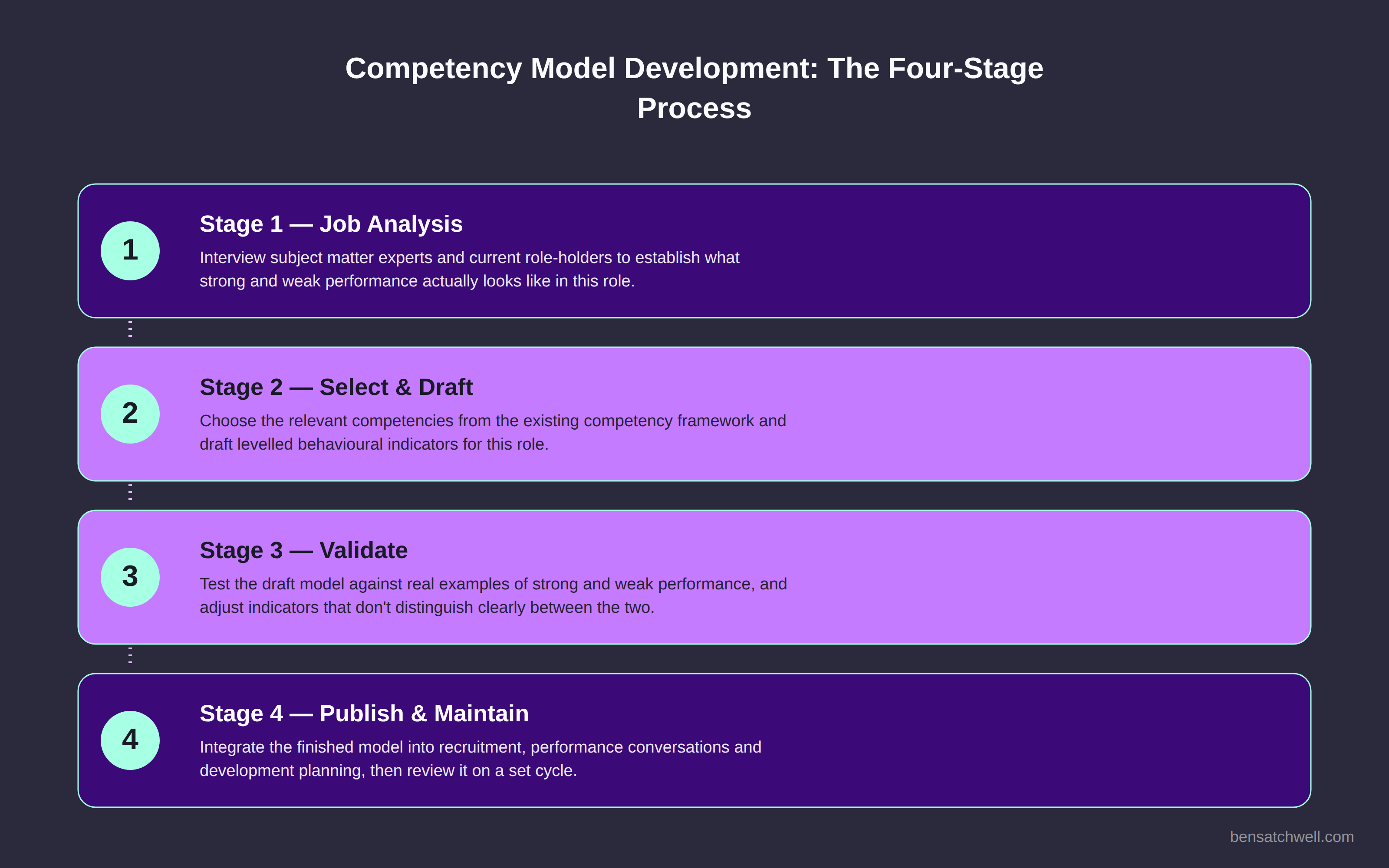
Competency model development follows the same four stages regardless of organisation size: job analysis, select and draft, validate, then publish and maintain.
Competency Model vs Framework vs Matrix vs JD
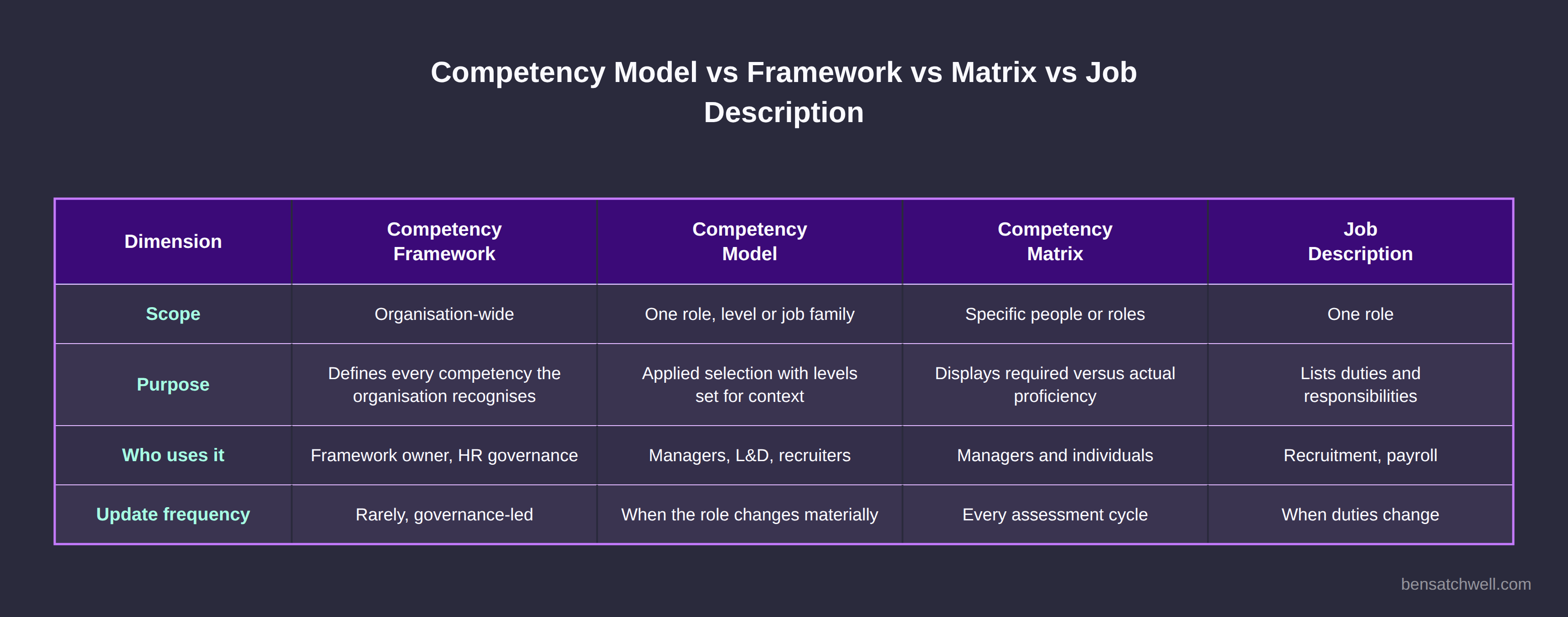
Four related artefacts, four different jobs: scope, purpose, audience and update frequency all differ between them.
Named Frameworks and Standards
Several named models illustrate how this plays out with real structure behind them.
SHRM's own competency work for HR professionals is a competency model in the strict sense: a defined set of behavioural and technical competencies, developed through structured research with practitioners, applied specifically to the HR profession rather than the whole workforce.
SFIA (the Skills Framework for the Information Age) takes a related but distinct approach for digital and technology roles. It defines professional skills against seven levels of responsibility, from Follow through to Set strategy, and SFIA's own documentation on how the framework works describes each level as progressive, distinct, and consistently defined across every skill. That level structure is exactly the kind of levelling decision that has to happen during model development, whether an organisation is using SFIA directly or building its own equivalent.
Korn Ferry and Lominger's competency libraries work differently again: a large bank of pre-written competencies that organisations select from and adapt, rather than building competency definitions from scratch. The selection and levelling decisions organisations make when using this library are, functionally, the model development step.
Trade-Offs and Constraints
Development is worth the investment when a role or job family is large enough, stable enough, or strategically important enough to justify a defined standard: dozens of people in structured career paths, a role critical to a regulated function, or a leadership population where consistency genuinely matters.
It's a poor use of effort for a role held by one or two people, a role likely to be restructured within twelve months, or a function still figuring out its own scope. A lighter role profile drawn loosely from the framework does the job without the maintenance overhead a full model creates.
The constraint most organisations underestimate is not the initial build, it's the ongoing governance. A model with no owner and no review cycle degrades faster than most other HR artefacts, precisely because it's specific enough to date quickly.