
Most organisations that ask for a human resources competency model want three things at once: a list of HR skills, a capability statement for the function and an assessment tool for performance reviews. These are different artefacts, and conflating them is why so many HR competency projects stall before they produce anything usable. A human resources competency model is narrower than any of those, and it works only when it is built as one thing. This article is the build view: how to construct it inside an organisation from the framework down. For the comparison with professional body standards, see my guide to HR competency models.
What Is a Human Resources Competency Model?
It is a selection of competencies drawn from the organisation's competency framework and tailored to the HR function as a job family. It defines what effective performance looks like for people in HR roles, expressed as proficiency levels and behavioural indicators and not as a duties list. I call it a competency profile for the HR job family. A competency is the integration of skills, knowledge, judgement and behaviour applied effectively in the context of a role.
The profile is not a standalone document written from scratch. It is a function-specific selection from something larger. If your organisation has no governing framework, what gets called an HR competency model is usually a one-off list with no structure beneath it, which is part of why these projects are hard to keep going past the first year.
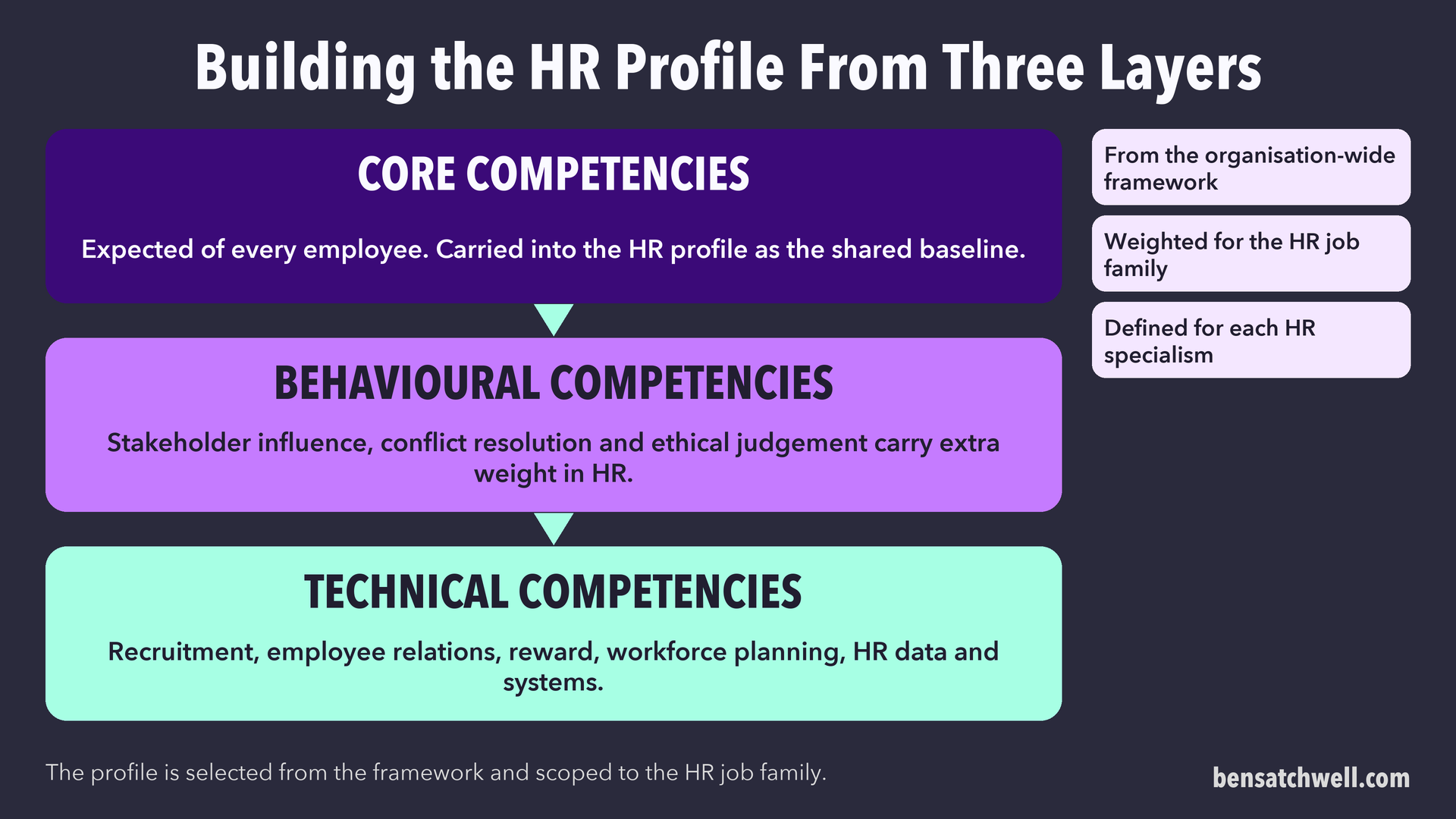
The profile is selected from the framework and scoped to the HR job family.
A note on terminology. A competency framework is also called a competency model, especially in the United States. I use competency profile for the competencies and required levels for one role, and competency matrix for the grid of required against current proficiency. Usage varies by region, and I explain the differences in this competency model definition.
Why HR Needs Its Own Profile
HR is unusual among functions. It is a discipline with its own technical competencies, in employee relations, reward, talent acquisition and workforce planning, and it is also expected to model the behavioural standard for everyone else. An organisation-wide framework rarely captures that dual demand with enough precision for HR-specific decisions such as capability gap analysis, succession inside the function or HR career paths.
The profile translates broad organisational competencies into something specific enough to assess, develop and recruit against inside HR. Occupational classification systems describe typical work, but they are not built to express your own standard. The US Department of Labor's O*NET summary for human resources specialists catalogues the knowledge, skills and work activities typical of the occupation across the labour market. It is useful workforce data, but it is not calibrated to any one organisation's proficiency expectations.
How to Build It: Three Layers
Core competencies
These are the competencies every employee is expected to demonstrate. They are not unique to HR, but they sit inside the profile because HR professionals are assessed against them like everyone else. For the wider definition, see my guide to competency.
Behavioural competencies
HR work is relationship-heavy by design, so this layer carries more weight than it would in a purely technical function. Stakeholder influence, conflict resolution and ethical judgement typically sit here.
Technical competencies
This is where the profile becomes specifically HR: recruitment and selection, employee relations, remuneration and benefits, workforce planning, HR systems and data and, increasingly, the use of AI tools in people decisions.
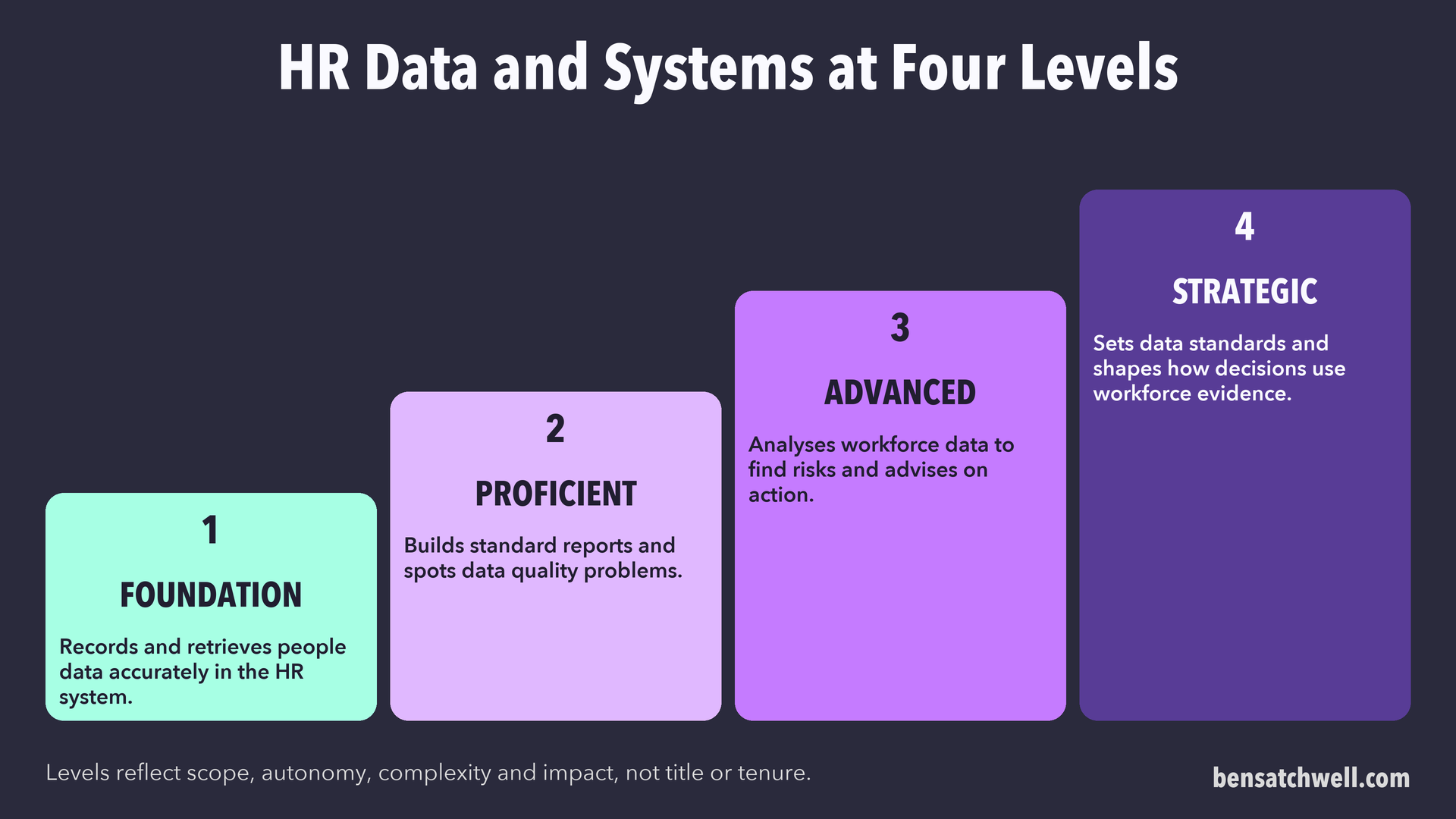
Levels reflect scope, autonomy, complexity and impact, not title or tenure.
Then set each competency against proficiency levels, usually four to six, defined by scope, autonomy, complexity and impact. An HR coordinator and a business partner can both be assessed on employee relations, but the indicator at each level describes a materially different standard of judgement and independence. See the human resources competencies guide for the underlying definitions.
What the HR Profile Is Not
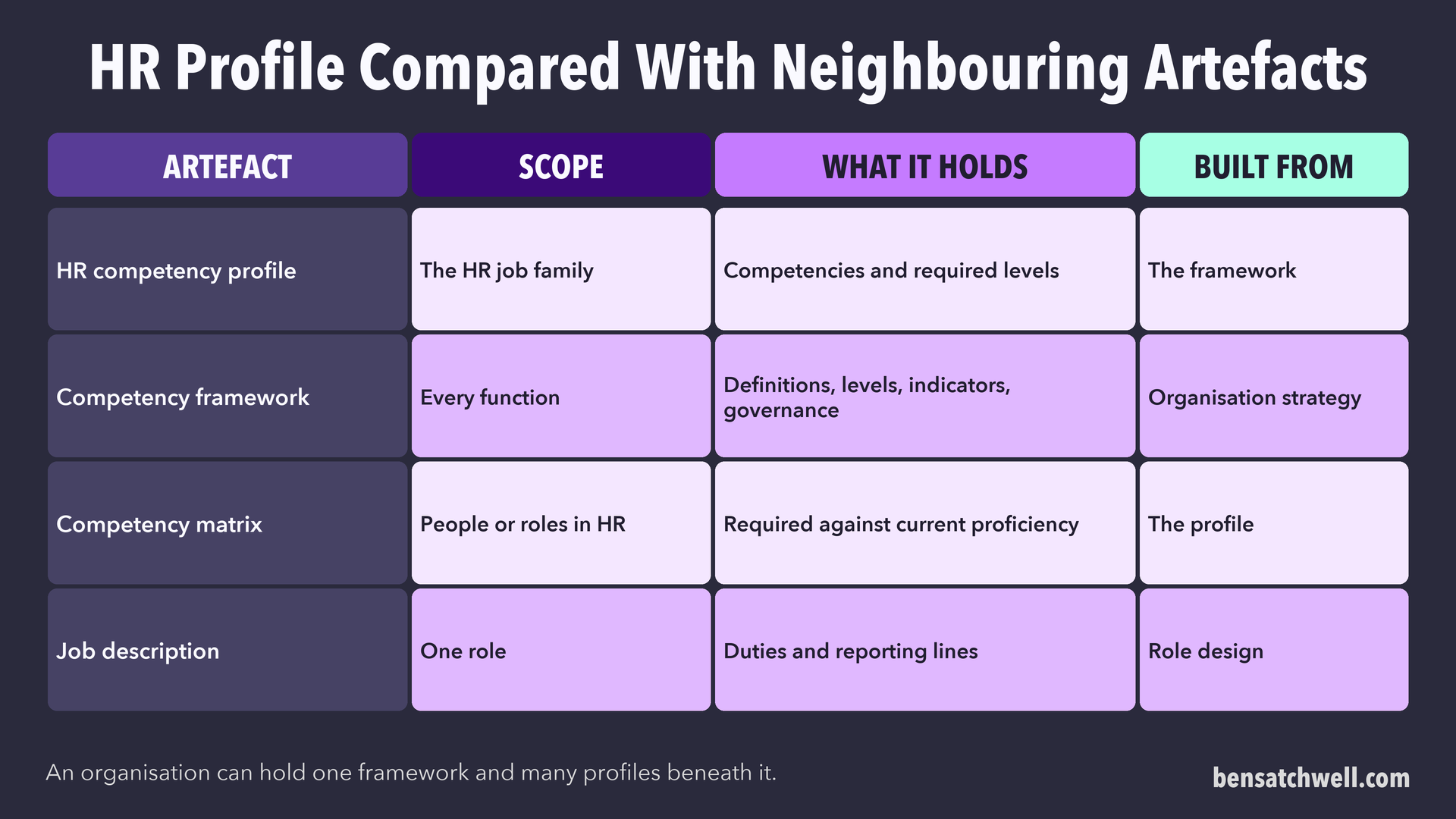
An organisation can hold one framework and many profiles beneath it.
- Not a job description. A job description lists duties and reporting lines. The profile describes the standard of performance behind them, independent of any role title.
- Not the framework. The framework is the organisation-wide governing system. The HR profile draws on it but is scoped to one job family.
- Not a competency matrix. A matrix plots people or roles against required and current proficiency. It is built from the profile. Building the matrix first is a common ordering mistake.
- Not an occupational skills taxonomy. Classifications describe what HR work generally involves. The profile describes good performance in your organisation.
Calibrating Against Professional Standards
Two reference points dominate. The SHRM Body of Applied Skills and Knowledge sets out behavioural competencies alongside a technical HR knowledge domain, and it underpins SHRM's certification, so it is calibrated for individual credentialing rather than organisational performance management. The CIPD Profession Map sets out core knowledge and core behaviours for every people professional with specialist knowledge layered on top. It is closer to a true framework-and-profile structure, because it separates the universal layer from the specialist layer. Neither replaces building your own. Both help calibrate level descriptors and check that your technical list has not missed an established domain.
Common Failure Modes
- Built before the framework. With no shared definitions or scale, the profile becomes an island, and islands get abandoned at the next HR system change.
- A duties checklist. Competencies written as tasks, such as processes payroll, collapse the profile back into a job description.
- No technical calibration. A purely behavioural profile cannot tell a strong employee relations specialist from a weak one.
- Gone stale. HR's technical domain moves quickly, especially around systems and data. Review within two to three years.
Trade-Offs and Constraints
It is worth building when the organisation has, or is building, a governing framework, when HR has enough role variation to justify levels and when the output will drive real decisions such as recruitment criteria, development planning or succession inside the function. It is not worth building in isolation if there is no framework at all. In that case a narrower reference such as the five-domain HR framework is a more realistic start, with the framework-anchored profile following once the organisation-wide structure exists. Hold on to scope discipline. The profile describes the HR function, not the whole workforce, and making it double as the organisation's whole framework is how these projects lose precision.
FAQ
What is the difference between an HR competency model and an HR competency framework?
There is no difference in structure. Competency model is the usual US name for the organisation-wide system and competency framework is more common in the UK and Australia. The selection scoped to HR roles is a competency profile.
How many competencies should the HR profile include?
Most usable profiles hold eight to fifteen across core, behavioural and technical layers. Beyond that, consistent assessment gets difficult.
Is the SHRM BASK the same as an organisation's HR profile?
No. SHRM's is built for individual credentialing across the profession. Your own profile is calibrated to your proficiency standards and career structure, though it can reference SHRM's domains.
Can an HR profile exist without a framework?
It can be drafted, but it will lack a consistent scale and shared definitions, which limits how reliably it can be assessed or maintained.
How often should it be reviewed?
Every two to three years at minimum, and sooner if HR systems or decision tools change materially.
Does it apply to all HR roles equally?
The competencies are shared across the job family, but the required level differs by role. A coordinator and a head of HR are assessed on the same set at different scope, autonomy and complexity.