
The SHRM competency model gets misread constantly. People use it as a generic HR skills checklist, an assessment rubric for HR generalists, or a vague list of things HR should be good at. It is none of these. It is a structured framework that defines what effective HR practice looks like, from technical HR knowledge to leadership behaviour, and it directly underpins the SHRM-CP and SHRM-SCP certifications offered by the Society for Human Resource Management.
It has also changed. Everything below is based on the current edition, the 2026 SHRM Body of Applied Skills and Knowledge (SHRM BASK), which introduced a new competency called Inclusive Mindset and brought the behavioural count back to eight.
What Is the SHRM Competency Model?
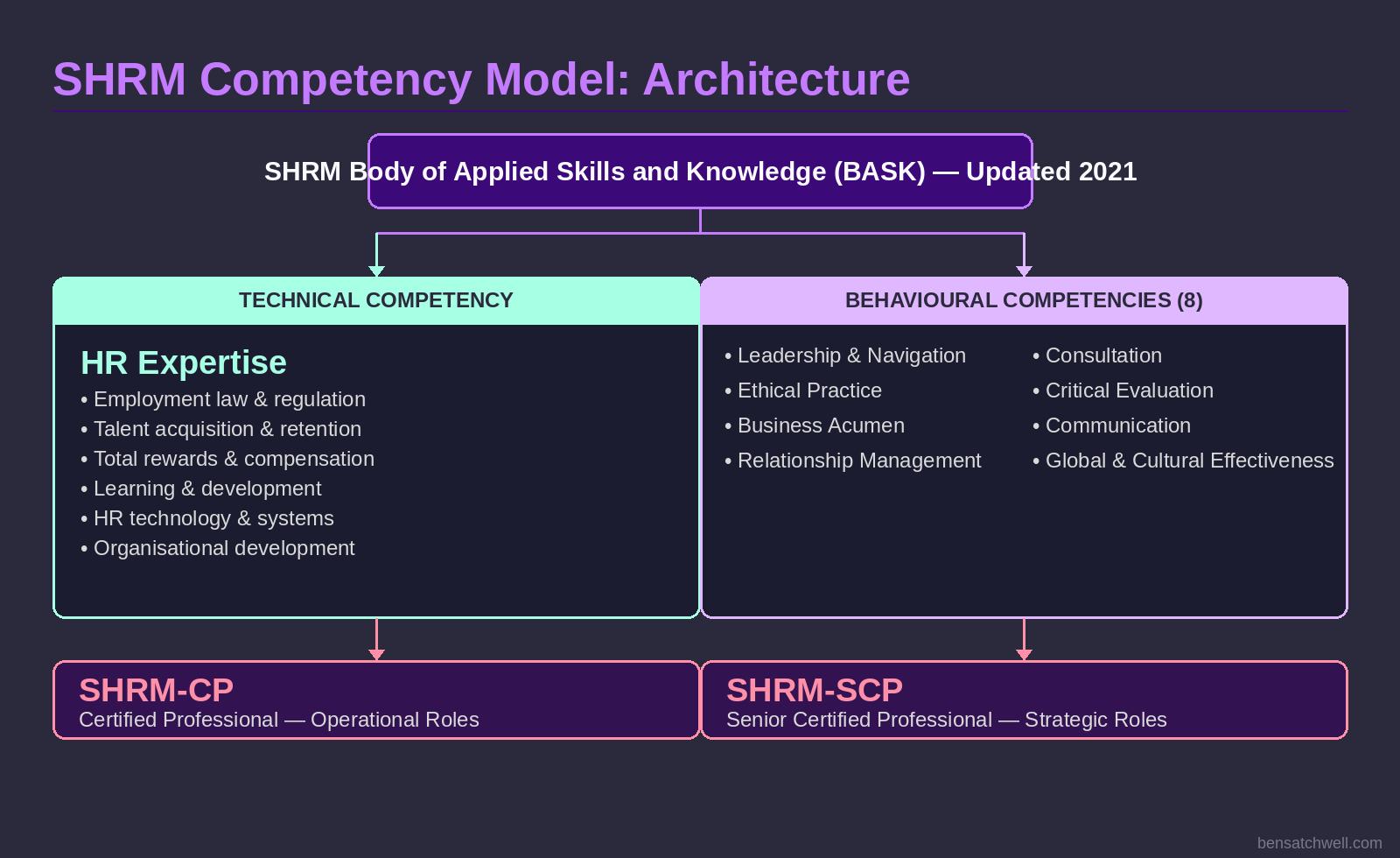
The SHRM competency model is a framework of nine competencies that define effective performance for HR professionals: eight behavioural competencies, grouped into Leadership, Interpersonal and Business clusters, and one technical competency called HR Expertise. SHRM publishes it as the SHRM Body of Applied Skills and Knowledge (SHRM BASK), and the 2026 edition is the current version. It is the content blueprint for the SHRM-CP and SHRM-SCP exams.
The model was unveiled as the SHRM Competency Model in June 2012, built from focus groups with nearly 1,200 HR practitioners in 33 countries and validated through a survey of more than 32,000 HR professionals. It was then published as the SHRM Body of Competency and Knowledge (BoCK), and is now the SHRM BASK. BASK stands for Body of Applied Skills and Knowledge, not "behavioural competencies and knowledge", a common misreading.
SHRM defines a competency as a cluster of closely related knowledge, skills, abilities and other characteristics (KSAOs) that produce the behaviour needed to perform a job effectively. SHRM calls its structure the SHRM Competency Model, which follows the North American use of competency model for the whole system. In the terms I use here, it is a competency framework for the whole HR profession, and a competency profile is what you build when you apply it to a specific HR role or level.
A note on terminology. A competency framework is also called a competency model, especially in the United States. I use competency profile for the competencies and required levels for one role, and competency matrix for the grid of required against current proficiency. Usage varies by region, and I explain the differences in this competency model definition.
Why the SHRM Competency Model Exists
HR has long had a professional visibility problem. Law, accounting and medicine have longstanding certification systems that signal competence to employers. HR did not, at least not with the same rigour. The SHRM competency model was developed to close that gap, a case Debra Cohen also made in Human Resource Management Review when she called for consistent HR practices and a sharper focus on competencies.
It gives HR professionals a shared language and a testable standard, and gives organisations a recognised reference point for hiring and developing HR talent.
What Changed in the 2026 SHRM BASK?
SHRM revises the BASK through periodic practice analyses. The 2026 SHRM BASK draws on research from 2019 to 2025 and makes four changes that matter:
- Inclusive Mindset replaces two competencies. Inclusion & Diversity and Global Mindset were merged to remove overlap, taking the behavioural count from nine back to eight.
- The Interpersonal cluster shrinks. It now holds only Relationship Management and Communication. Inclusive Mindset sits in the Leadership cluster.
- AI is written into the standard. Sub-competencies, proficiency indicators and key concepts now reflect the use of artificial intelligence in HR practice.
- HR Expertise indicators were expanded. The 14 functional areas are unchanged, but their indicators and key concepts were updated.
The naming history explains most of the confusion online. The 2012 model included Global & Cultural Effectiveness and Critical Evaluation. By the 2022 edition these were Global Mindset and Analytical Aptitude, and diversity, equity and inclusion had become a ninth behavioural competency, renamed Inclusion & Diversity in 2025. If a source lists Critical Evaluation, it describes the 2012 model. If it lists nine behavioural competencies, it describes the 2022 to 2025 editions.
What Are the SHRM Competencies? All 9 Explained
The nine SHRM competencies are Leadership & Navigation, Ethical Practice, Inclusive Mindset, Relationship Management, Communication, Business Acumen, Consultation, Analytical Aptitude and HR Expertise. The definitions below are my plain-English summaries of the 2026 BASK, followed by the sub-competencies SHRM lists under each (in SHRM's US spelling).
Leadership Cluster
- Leadership & Navigation: setting a vision for HR that fits the organisation's strategy and culture, then delivering HR initiatives and change through its formal and informal structures. Sub-competencies: Navigating the Organization, Vision, Managing HR Initiatives, Influence.
- Ethical Practice: maintaining personal and professional integrity, and acting as the ethical agent who promotes core values and accountability across the organisation. Sub-competencies: Personal Integrity, Professional Integrity, Ethical Agent.
- Inclusive Mindset (new in 2026): creating a workplace where people are treated fairly, have equal access to opportunities and feel they belong, and where collaboration works across cultural and geographic boundaries. Sub-competencies: Connecting I&D to Organizational Performance, Building the Infrastructure for an Inclusive and Diverse Culture, Ensuring Impartiality & Fairness, Cultivating an Inclusive and Diverse Culture, Operating in a Global Environment.
Interpersonal Cluster
- Relationship Management: building professional networks inside and outside the organisation, working as an effective team member and managing conflict in the organisation's interest. Sub-competencies: Networking, Relationship Building, Teamwork, Negotiation, Conflict Management.
- Communication: crafting clear, concise messages, listening to and addressing concerns, and translating information between levels and units of the organisation. Sub-competencies: Delivering Messages, Exchanging Organizational Information, Listening.
Business Cluster
- Business Acumen: understanding how the organisation operates and competes, and using business tools and analysis so HR initiatives support its strategic direction. Sub-competencies: Business and Competitive Awareness, Business Analysis, Strategic Alignment.
- Consultation: working with stakeholders to diagnose business challenges, design and implement HR solutions and change, and sustain support for those solutions as needs shift. Sub-competencies: Evaluating Business Challenges, Designing HR Solutions, Advising on HR Solutions, Change Management, Service Excellence.
- Analytical Aptitude: collecting and analysing qualitative and quantitative data, then interpreting and promoting findings that evaluate HR initiatives and inform business decisions. Sub-competencies: Data Advocate, Data Gathering, Data Analysis, Evidence-Based Decision-Making.
SHRM's Business cluster maps directly onto HR business partner competencies: business acumen, consulting and analytics sit at the core of the HRBP role.
HR Expertise: The Technical Competency
HR Expertise covers the principles, practices and functions of effective HR management. It is the single technical competency, organised into three knowledge domains and 14 functional areas:
- People: HR Strategy, Talent Acquisition, Employee Engagement & Retention, Learning & Development, Total Rewards.
- Organization: Structure of the HR Function, Organizational Effectiveness & Development, Workforce Management, Employee & Labor Relations, Technology Management.
- Workplace: Managing a Global Workforce, Risk Management, Corporate Social Responsibility, U.S. Employment Law & Regulations.
For a broader list that is not tied to SHRM, my guide to human resources competencies compares the domains most professional bodies share.
SHRM Behavioural Competencies vs HR Expertise
HR Expertise describes what an HR professional knows. The behavioural competencies describe how they apply it. SHRM's validation research found that knowledge and behaviour each relate to HR job performance in their own right, and neither is sufficient alone.
The exam design reflects the split. According to the 2026 SHRM Certification Handbook, roughly half of each exam tests the behavioural clusters (Leadership 19%, Business 17.5%, Interpersonal 13.5%), mostly through situational judgement scenarios. The other half tests HR Expertise across People (19%), Organization (18%) and Workplace (13%).
In my experience, this is the most useful idea in the model and the one organisations most often lose. Internal HR frameworks over-describe technical knowledge, because it is easy to write down, and under-describe the judgement that separates an effective HR business partner from a merely well-informed one.
How the SHRM Competency Model Applies From Early Career to Executive
The BASK does not use a numbered proficiency scale. Each sub-competency and functional area carries two sets of proficiency indicators:
- Indicators for all HR professionals, which apply from early career through to executive level.
- Indicators for advanced HR professionals, which apply mainly at senior and executive level and add strategic scope.
The 2012 model was more granular, describing proficiency standards at four career levels: entry, mid, senior and executive. The BASK compresses these into two tiers that line up with the certifications. The SHRM-CP targets operational HR work, such as implementing policy and running day-to-day HR functions, and needs no degree or prior HR experience. The SHRM-SCP targets strategic HR work and requires at least three years of strategic-level HR experience, or three years holding the SHRM-CP while moving into a strategic role.
The progression is easiest to see inside one sub-competency. Under Vision, the indicators for all HR professionals cover supporting the organisation's mission, setting actionable goals for HR programmes and spotting improvements that fit the strategy. The advanced indicators shift to envisioning the future state of the HR function, setting HR's long-term direction and pivoting HR strategy when conditions change.

Two tiers is enough for an exam but rarely enough inside an organisation, where you need to distinguish an HR coordinator from an advisor, a business partner and a head of HR. When I adapt the SHRM model internally, I rebuild the scale as four or five competency framework levels defined by scope, autonomy, complexity and impact rather than job title.
How Organisations Use the SHRM Competency Model Beyond Certification
Most people meet the SHRM competency model through exam preparation, but it is used well beyond certification. The most common uses I see are:
- HR role profiles: selecting the sub-competencies that matter for each HR role and setting a target proficiency for each.
- Hiring HR staff: building behavioural interview questions around specific sub-competencies, such as Conflict Management or Evidence-Based Decision-Making.
- HR capability gap analysis: assessing the HR team against the model, for example to find strong HR Expertise but thin Analytical Aptitude.
- Career pathways: using the gap between the all-professionals and advanced indicators as the development plan for moving from operational into strategic HR roles.
- HR leadership succession: using the advanced Leadership and Business indicators as the benchmark for heads of HR.
Each of these needs translation work: rewriting indicators in local language, replacing U.S. Employment Law & Regulations with the law you actually operate under, and deciding which competencies are core to every HR role. That translation is where most of the value sits, and it is the step most often skipped. A 2021 Sage Open study on competency framework development for HR management makes a related observation: competency-based hiring, development and evaluation are widely discussed but far less common in practice.
If you are doing that translation for a specific HR audience, I work through it in separate guides to the competency framework for HR, the competency framework for HR professionals, the competency framework for an HR department, the competency model in HRM and the competency framework for talent management.
If you need a framework for your own HR function rather than a certification benchmark, my guide to HR competency frameworks covers how to design one, with SHRM as one of several inputs.
What the SHRM Competency Model Is NOT
It is not a skills checklist. The SHRM competencies describe integrated performance patterns, not discrete technical skills to tick off. Knowing benefits administration does not make someone competent in benefits. Competence shows in how they apply that knowledge to competing interests, ambiguous regulations and real organisational constraints.
It is not a generic HR job description. The model does not define what HR professionals do day to day. It describes what effective performance looks like in the doing of it.
It is not a substitute for a bespoke organisational competency framework. Organisations that adopt the SHRM model wholesale, without tailoring it to sector, culture and strategy, are using a professional standard where they need a competency framework aligned to their own organisation. The two serve different purposes.
SHRM Competency Model vs CIPD Profession Map
The CIPD Profession Map is the closest equivalent to the SHRM competency model outside North America. Both define effective practice for people professionals and underpin a professional credential, but they are built differently.
- Structure: SHRM uses eight behavioural competencies in three clusters plus one technical competency with 14 functional areas. The CIPD puts purpose at the centre, with three professional values (principles-led, evidence-based, outcomes-driven), six core knowledge areas, eight core behaviours and optional specialist knowledge areas.
- Behaviours: SHRM frames behaviour around HR's business contribution, with a whole Business cluster. CIPD's core behaviours put more weight on ethics and judgement, including Professional Courage and Influence and Situational Decision-Making.
- Technical knowledge: SHRM treats HR knowledge as one broad competency every candidate is tested on. CIPD separates core knowledge from role-dependent specialist knowledge such as reward, resourcing or people analytics.
- Levels: SHRM has two indicator sets tied to the SHRM-CP and SHRM-SCP. CIPD has four levels, Foundation, Associate, Chartered Member and Chartered Fellow, each equivalent to a membership grade.
- Credential and updates: SHRM certifies by exam, with recertification every three years, and last revised the BASK for 2026. CIPD links levels to qualifications and membership, and reviews the map regularly; its 2025 review added a workforce planning specialist area.
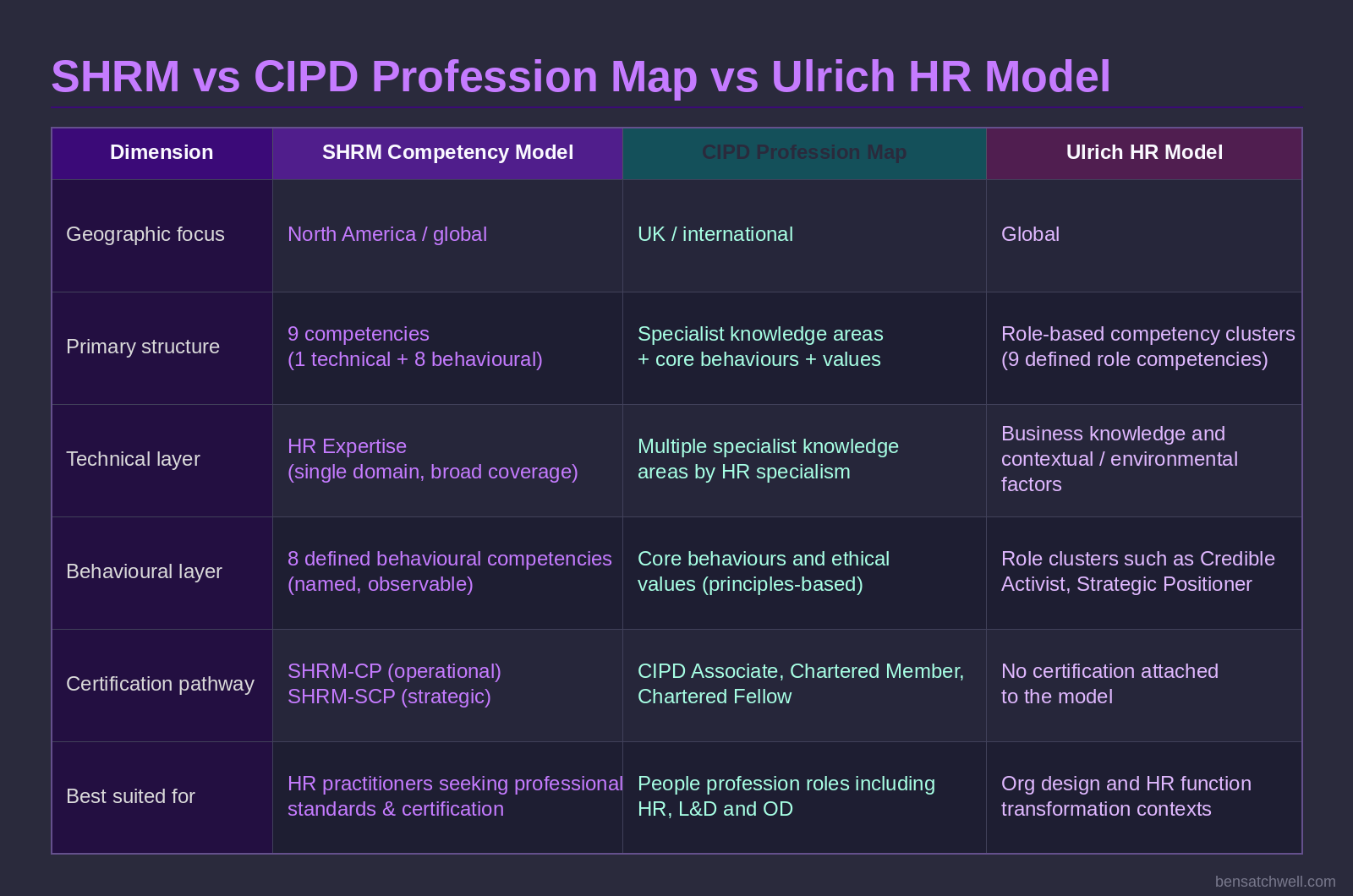
My rule of thumb: use SHRM when you need a clear, testable standard with a business-partner orientation, or your HR team works mainly in North America. Use the CIPD Profession Map when you want specialist pathways and a heavier emphasis on evidence and ethics. For HR teams in Australia, the AHRI competency framework is usually the more natural reference point, with SHRM as a cross-check.
Common Failure Modes
The most common failure mode I see is using the SHRM competency model as a generic HR capability assessment tool without asking what it was designed to measure. It was built for certification, not workforce planning, so applied without calibration it produces data that looks useful but is not actionable. A financial services organisation expects different things of its HR business partners than an aged care provider, and the SHRM model does not make that distinction.
A second failure mode is treating the behavioural competencies as soft skills. Ethical Practice requires specific judgement in high-stakes situations. Analytical Aptitude requires the discipline to challenge prevailing assumptions with evidence. These are developed competencies, not personality traits.
A third is working from an outdated version. I regularly see internal frameworks built on the 2012 names or the nine behavioural competencies of 2022 to 2025. If you reference SHRM, record which edition you used and check it when SHRM publishes a new BASK.
Trade-Offs and Constraints
The SHRM competency model's strength is also its main constraint. As a certification standard, it prioritises breadth and generalisability over contextual precision. That makes it portable and well recognised, but insufficient on its own for organisations with distinctive workforce challenges.
It is also primarily American. SHRM's research drew on HR professionals from many countries, but one of its 14 functional areas is explicitly U.S. Employment Law & Regulations. Practitioners in Australia, the UK or Asia Pacific should treat it as a reference point rather than a blueprint.
The same adaptation problem applies outside HR. I cover it for IT professionals, administrative staff, Industrie 4.0 employees and training and development teams. The building blocks behind any of them are in my guides to competency framework design, what a competency framework means, competency model job analysis and communication competencies.
Frequently Asked Questions
What are the 9 SHRM competencies?
In the 2026 SHRM BASK, the nine SHRM competencies are eight behavioural competencies and one technical competency. The behavioural competencies are Leadership & Navigation, Ethical Practice and Inclusive Mindset (Leadership cluster), Relationship Management and Communication (Interpersonal cluster), and Business Acumen, Consultation and Analytical Aptitude (Business cluster). The technical competency is HR Expertise, covering 14 functional areas across the People, Organization and Workplace domains.
Which competencies are in the SHRM Interpersonal cluster?
Since the 2026 SHRM BASK, the Interpersonal cluster contains Relationship Management and Communication. It previously also included Global Mindset (originally Global & Cultural Effectiveness), which was merged with Inclusion & Diversity into Inclusive Mindset in the Leadership cluster.
What changed in the 2026 SHRM BASK?
The 2026 SHRM BASK merged Inclusion & Diversity and Global Mindset into a new behavioural competency, Inclusive Mindset, reducing the behavioural competencies from nine to eight. It also added artificial intelligence content throughout and expanded the proficiency indicators for the HR Expertise functional areas.
What does SHRM BASK stand for?
SHRM BASK stands for SHRM Body of Applied Skills and Knowledge. It replaced the SHRM Body of Competency and Knowledge (BoCK) and defines what the SHRM-CP and SHRM-SCP exams assess.
What is the difference between SHRM-CP and SHRM-SCP?
The SHRM-CP is for operational HR work, such as implementing policies and running day-to-day HR functions, and has no degree or HR experience requirement. The SHRM-SCP is for strategic HR work and requires at least three years of strategic-level HR experience. Both cover the same competencies, but the SHRM-SCP also draws on the indicators for advanced HR professionals.
Can organisations use the SHRM competency model for internal capability assessment?
Yes, with caveats. The SHRM model was designed for professional certification, not internal capability planning. Internal use needs calibration to your context, role-specific expectations, local employment law and a proficiency scale with more than two levels. Without that, the assessment data is too broad to act on.