
The HRBP role is one of the most contested in HR, and the competency models built for it are often part of the problem. I keep seeing generic HR competency lists with business partnering bolted on as a flavour. That does not work. A usable HRBP profile has to account for what makes the role distinct: commercial fluency, strategic advisory skill and the ability to influence senior leaders without formal authority. This article is about the content of that profile: what to select, how to weight it for your context and what to require. The underlying system, with all eight competencies and level indicators, is in my guide to the HR business partner competency framework.
What Is an HRBP Competency Model?
An HRBP competency model is a role-level selection of competencies from an HR competency framework that defines what effective performance looks like for a person in an HR business partner role. I call that selection a competency profile. It states the knowledge, judgement and observable behaviour expected at each proficiency level, so the individual and the organisation share a picture of what good looks like.
It draws on the organisation-wide HR framework but is scoped to the business partnering context. If you want to be sure what a competency is before designing a profile, my guide to what a competency is and how it works covers it.

The profile selects and weights. It does not rewrite the framework.
A note on terminology. A competency framework is also called a competency model, especially in the United States. I use competency profile for the competencies and required levels for one role, and competency matrix for the grid of required against current proficiency. Usage varies by region, and I explain the differences in this competency model definition.
Why the Role Needs Its Own Profile
The role sits at an unusual intersection. It needs enough technical HR knowledge to be credible, but the main value is not technical execution. What marks out an effective HRBP is translating business problems into workforce solutions, advising leaders on people decisions and driving outcomes through others. That is a materially different profile from an HR generalist or specialist, and a single HR-wide set will not bring out the difference with enough precision. A role-specific profile makes it explicit, which is what makes it useful in hiring, development and performance conversations. For the HR-wide standards the profile is built on, see HR competency models.
The Four Domains
Business and commercial acumen
Understanding how the organisation creates value, how the business operates financially and how the part of the organisation you support turns strategy into work. It includes financial literacy, industry awareness and connecting commercial data to people decisions.
Strategic advisory and consulting
The domain that most separates the HRBP from other HR roles. It covers diagnosis, problem framing, stakeholder influence and shaping people strategy with leaders instead of only implementing it for them.
HR expertise and evidence use
An HRBP need not be a deep specialist in every discipline, but must draw on knowledge across talent, capability, workforce planning and employee relations to make sound recommendations. This domain captures breadth at practitioner level, not specialist level.
Leadership and relationship capability
An HRBP works through influence, not authority. This domain covers building relationships with senior leaders, managing complex stakeholder dynamics and working across organisational lines. The same behaviours are examined in a leadership competency model for senior individual contributors.
Weighting for Context

An illustration of my own. Weighting is a judgement for each organisation to make.
The same title means different work in different places. An HRBP in a 200-person scale-up needs a different profile from one in a 10,000-person financial services firm. A unionised operation lifts the weight on employee relations judgement, and a restructure lifts the weight on workforce planning. Treating all competencies as equal misrepresents what the role needs. Anchor the profile to what effective partnering requires in your context, not to a universal ideal that may not match the conditions the role actually faces.
Levels and Targets
For each selected competency, set a required level from four to six. Four is enough for most HRBP profiles, because entry-level practitioners sit alongside experienced strategic advisors and more granularity adds complexity without improving assessment. Behavioural indicators at each level should describe what the person does in a given situation, not what they are like. Personality traits, styles and dispositions are not competencies. If a quality such as curiosity or resilience belongs in the profile at all, express it as observable behaviour in a specific context.
Where the Standards Help
The SHRM Body of Applied Skills and Knowledge and Dave Ulrich's HR competency research, summarised by the University of Michigan HR Community of Practice, are the most influential references. The CIPD has also published work on the evolving role of the HR business partner. None is a ready-made profile. They give structure to calibrate against.
HRBP, Generalist and Director Compared
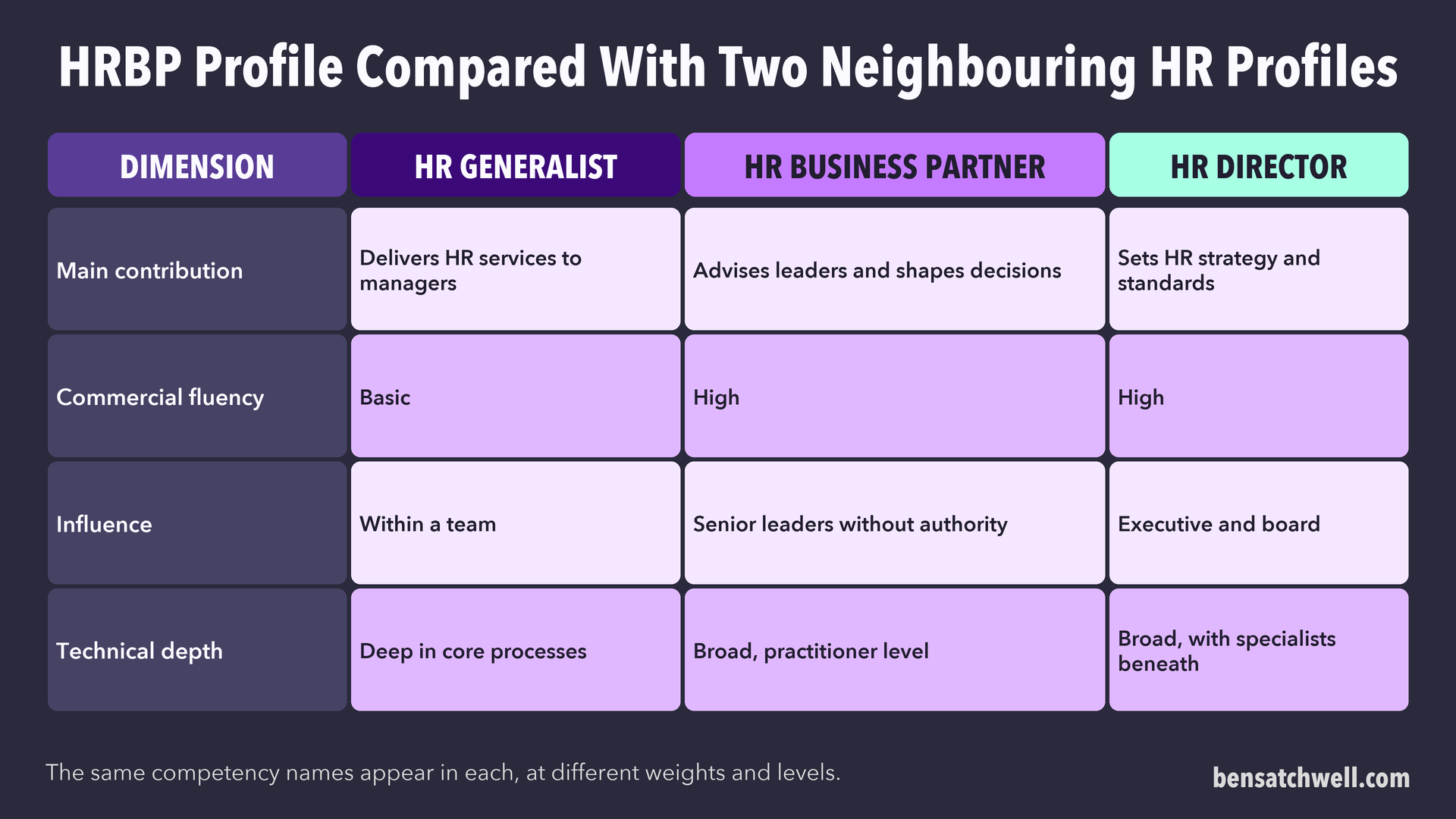
The same competency names appear in each, at different weights and levels.
For another role-specific profile built on the same logic, see my guide to the product manager competency framework.
Common Failure Modes
- A generic HR set with partnering added. If the profile leans on HR process expertise, it will attract and develop the wrong people. Deep employment law or learning design knowledge is not what separates HRBP performance. The defining competencies are advisory, relational and commercial.
- Written for the role you wish you had. Aspirational competencies in digital fluency or workforce analytics that current systems do not support create a gap that reflects the organisation, not the person, and weaken the profile's credibility with those assessed against it.
- One profile for every context. Without adjusting weights, the profile fits no organisation well.
Trade-Offs and Constraints
A role-specific profile takes design effort: time, substantive input from HR leaders and the business leaders HRBPs partner with, and rigour in defining observable behaviour at each level. It also needs revisiting as the organisation changes, because the profile is anchored to your operating conditions and not to a universal ideal.
FAQ
What is an HRBP competency model?
A role-level selection of competencies from an HR framework, with required levels and behavioural indicators, defining effective performance for an HR business partner.
How does it differ from a general HR competency model?
A general HR set applies to every HR role. The HRBP profile gives more weight to commercial fluency, strategic advisory skill and senior stakeholder influence.
Which domains should it include?
Business and commercial acumen, strategic advisory and consulting, HR expertise and evidence use, and leadership and relationship capability, each with levels and role-specific indicators.
Which sources are used to develop HRBP profiles?
The SHRM Body of Applied Skills and Knowledge and Dave Ulrich's HR competency research are the most influential, with CIPD work on the business partner role.
How many proficiency levels should it have?
Four to six. Four usually suffices for a role that spans emerging to expert practitioners.
What is the difference between a competency model and a competency framework?
There is no difference in structure. Competency model is the usual US name and competency framework is more common in the UK and Australia. The selection for one role is a competency profile.