

People use "competency based training framework" to mean a corporate learning catalogue with a competency label stuck on the front. It is not that. A competency based training framework is a specific, defined training model, most fully developed in vocational education and training systems, where what gets delivered, assessed and certified is built entirely around demonstrated units of competency rather than hours attended, content covered or an exam score. Confuse the two and you either under-deliver a compliance obligation or over-build a corporate learning system nobody asked for.
What Is a Competency Based Training Framework
A competency based training framework is the governing structure that defines how training is designed, delivered and assessed against fixed units of competency, so that a person is judged competent or not yet competent against a workplace standard, rather than ranked, graded or credited for time spent in a room.
A competency based training framework specifies the units of competency to be trained against, the training package or curriculum they sit within, the delivery modes permitted, and the assessment requirements that decide whether competence has actually been demonstrated. Time served and content covered are incidental. The only thing that counts is the evidence.
In Australia this is not a loose metaphor. Competency-based training (CBT) is the named training approach that underpins the entire vocational education and training sector, built on nationally endorsed training packages and regulated by the Australian Skills Quality Authority. Similar national systems exist elsewhere, from the UK's National Vocational Qualifications heritage to Germany's dual apprenticeship model, but the logic is consistent: training is structured around a defined competency standard, not a syllabus.
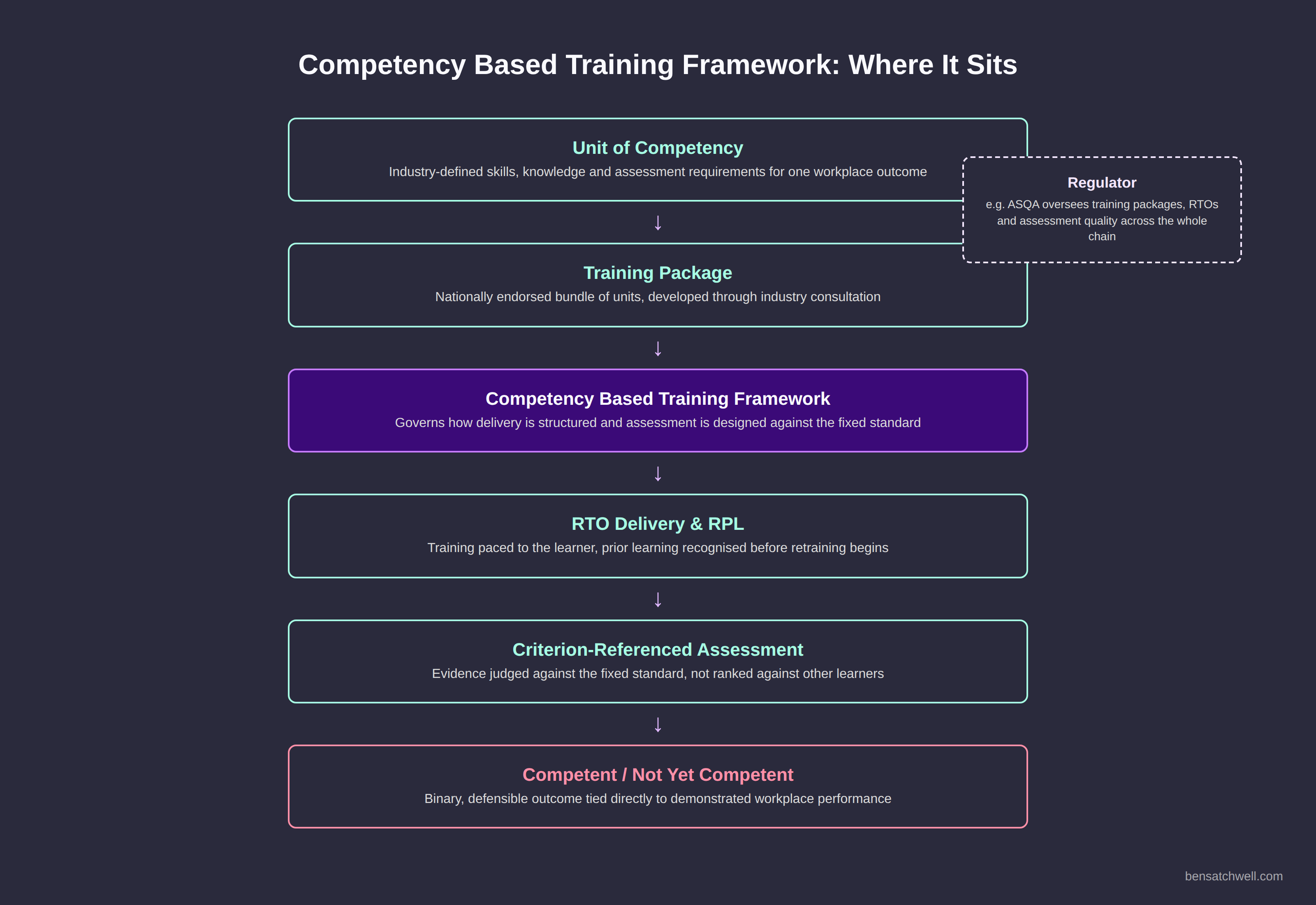
Where a competency based training framework sits between the unit of competency and the competent / not yet competent outcome.
Why Does a Competency Based Training Framework Exist
Traditional training measures inputs: hours attended, modules completed, marks scored on a written test. None of those reliably predict whether a person can actually perform the task in a live workplace, unsupervised, to a required standard. For a forklift licence, an aged care certificate, or an electrical trade qualification, that gap is not academic. It is a safety and liability problem.
A competency based training framework exists to close it. Instead of asking "did this person sit through the content", it asks "can this person do the job, evidenced against a fixed, industry-set standard". NCVER's review of the competency-based training literature traces this shift back to a deliberate move away from norm-referenced, seat-time education toward criterion-referenced training tied directly to industry-defined outcomes.
It also solves a portability problem. A unit of competency completed at one registered training organisation is meant to mean the same thing at another, because the standard, not the trainer's own judgement, is what training and assessment are built against.
How Does a Competency Based Training Framework Work in Practice
Units of Competency as the Building Block
The framework starts with the unit of competency: a defined statement of the skills and knowledge required to perform effectively in the workplace, along with the assessment requirements attached to it. In Australia these units sit inside nationally endorsed training packages, developed through industry consultation, so a unit means the same thing in Perth as it does in Hobart.
Training Is Structured Around the Standard, Not a Syllabus
Delivery is sequenced and paced around what the learner can already do and what the unit requires, not a fixed timetable. Recognition of prior learning is built into the framework as standard practice, not an exception, because if someone can already demonstrate the competency, retraining them against content they have already mastered wastes everyone's time and undermines the entire premise of the model.
Assessment Produces a Binary, Criterion-Referenced Decision
Assessment against the framework does not produce a grade. It produces one of two outcomes: competent, or not yet competent, based on evidence that is valid, sufficient, authentic and current. There is no partial credit and no ranking against other learners in the same cohort, because the standard is fixed and does not move depending on who else was assessed that year.
Regulation Holds the System Together
None of this works without external quality assurance. In Australia, the Australian Skills Quality Authority regulates training packages and the registered training organisations delivering them, so that a competency based training framework cannot quietly drift back into seat-time delivery dressed up in competency language.
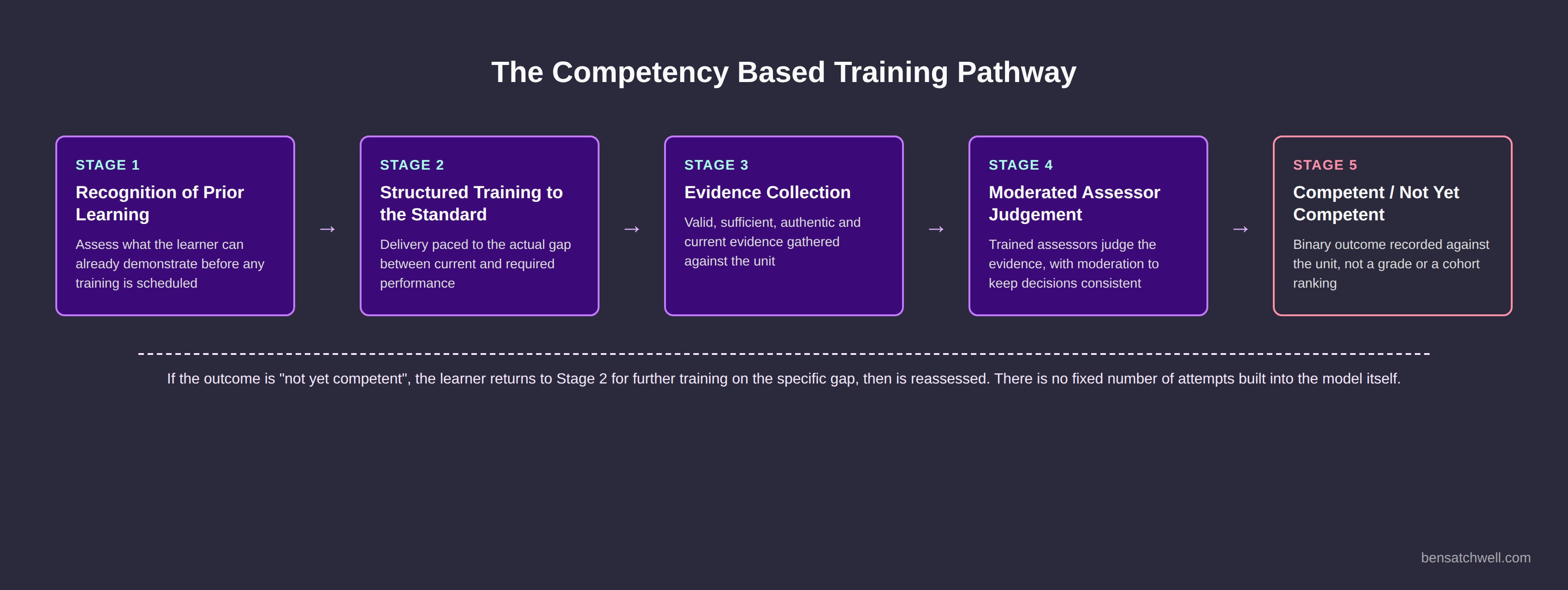
The competency based training framework pathway, from recognition of prior learning through to a moderated competent or not yet competent decision.
What a Competency Based Training Framework Is NOT
It is not a competency framework. A competency framework is an organisation-wide structure that defines and organises competencies, proficiency levels and behavioural indicators for reuse across roles. A competency based training framework is one specific application of that logic: a training and assessment model built around a fixed unit of competency, usually inside a regulated qualification, not a corporate-wide reference structure.
It is not the same as a competency based framework in the broader corporate sense either. That term covers any process, hiring, pay, performance, built around competencies as the organising unit. A competency based training framework is the training-and-assessment-specific instance of that same design logic, with a narrower and more codified form: named units, training packages, and a regulator.
It is not a competency based assessment framework by itself, though the two are inseparable in practice. The assessment framework is the machinery that judges whether the competency has been demonstrated. The training framework is what structures how a person builds toward that standard in the first place. One without the other is either training with no defensible proof of outcome, or assessment with no structured pathway to get someone ready for it.
It is also not the same problem a competency development framework solves. Development frameworks are typically built for internal capability growth across a career, often for behavioural or leadership competencies with no external regulator involved. A competency based training framework is far more likely to sit inside a regulated qualification, with an external body such as ASQA holding the standard, not an internal HR or L&D function.
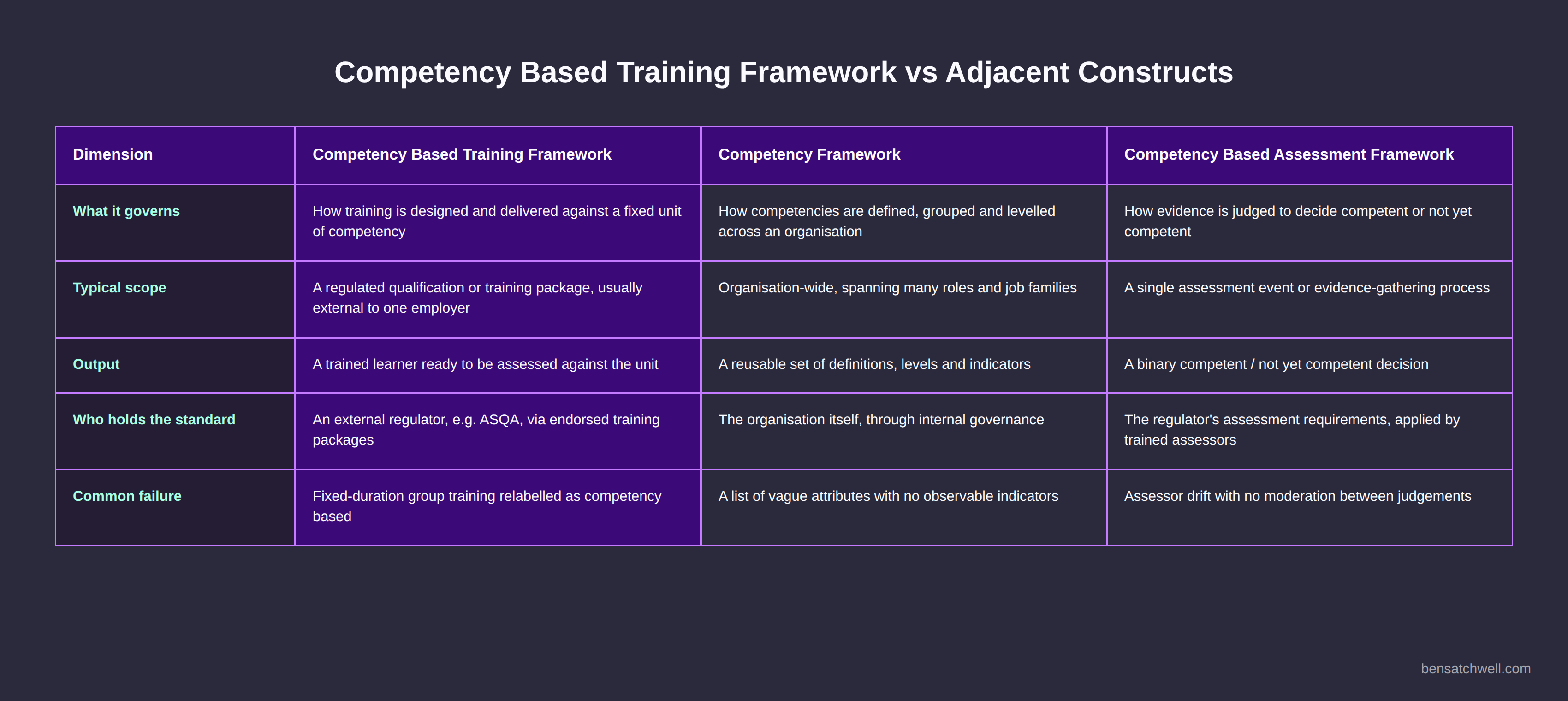
A competency based training framework, a competency framework and a competency based assessment framework govern different things.
Named Frameworks and Standards
Australia's National Training System is the clearest working example: nationally endorsed training packages, units of competency, and RTOs regulated against the Standards for Registered Training Organisations. The UNESCO-UNEVOC TVETipedia glossary confirms this is not an Australian idiosyncrasy. Competency-based training is recognised internationally as a distinct approach within technical and vocational education and training, built around demonstrated mastery rather than programme completion. SFIA operates on adjacent logic in the technology sector, defining skills against levels of responsibility, though SFIA is a professional skills framework rather than a regulated training-and-assessment system in its own right.
Common Failure Modes
The most common failure is delivering the same fixed-duration, group-paced training regardless of what individual learners already know, then calling it competency based because a unit of competency sits behind it on paper. If pacing, recognition of prior learning and individualised assessment are not actually happening, the "competency based" label is decoration.
A second failure is assessor inconsistency. Without moderation, two assessors reviewing similar evidence can reach different competent or not yet competent decisions, which quietly breaks the entire promise that a unit means the same thing regardless of where or by whom it was assessed.
A third failure is treating "competent" as permanent. Skills decay and standards get updated. A framework with no re-assessment or currency requirement lets people carry a competent status long after the underlying skill, or the standard itself, has moved on.
A fourth is under-resourcing the assessment side while over-investing in content delivery. Genuine competency based assessment, gathering sufficient, authentic, current evidence, takes real time and trained assessors. Cutting that corner produces a framework that looks competency based on a compliance document and functions as seat-time training underneath.
Trade-offs and Constraints
A competency based training framework earns its cost where the required skill is well-defined, observable and stable enough to codify into a unit of competency, and where the consequence of a false "competent" call is serious: licensed trades, safety-critical operations, regulated care work. The infrastructure of training packages, endorsed units and external regulation is heavy, and it should be, because the alternative is unverified competence in exactly the settings where that is least acceptable.
It is a poorer fit for fast-changing, ambiguous or judgement-heavy work, where the skill cannot be pinned down into a stable, codified unit long enough to be worth training and assessing against a fixed national standard. That is the territory of broader capability development, not competency based training, and treating the two as interchangeable is where a lot of otherwise sound programmes go wrong.
Frequently Asked Questions
What is the difference between a competency based training framework and a competency framework?
A competency framework is an organisation-wide structure defining competencies, proficiency levels and indicators for reuse across roles. A competency based training framework is a specific training and assessment model, usually inside a regulated qualification, built around demonstrating fixed units of competency.
Is competency based training the same as competency based assessment?
No. Training is the structured pathway that builds a person toward a standard. Assessment is the separate process that judges whether the standard has actually been met. A competency based training framework needs both, but they are distinct functions.
Who regulates competency based training in Australia?
The Australian Skills Quality Authority regulates training packages and the registered training organisations that deliver them, ensuring nationally endorsed units of competency are trained and assessed consistently.
Does competency based training use grades?
No. Assessment produces a binary outcome, competent or not yet competent, based on evidence against a fixed standard, rather than a grade or a rank against other learners.
Can competency based training be used outside vocational education?
The same logic can be applied inside organisations for structured, regulated or safety-critical skills, but most corporate capability and leadership development is better served by a broader competency or capability framework rather than a training model built for codified, stable units of competency.
What is recognition of prior learning in this context?
It is the built-in process for assessing whether a person can already demonstrate a unit of competency before training begins, so they are not required to sit through content covering a skill they already hold.