
Most descriptions of human resources competencies list qualities like strong communication skills and a strategic mindset beside things like HRIS proficiency and employment law knowledge. That mix of attributes, skills and technical knowledge, bundled as if they were equivalent, is the problem. Defined properly, human resources competencies have a specific meaning and structure. They are not a list of things HR practitioners should be good at.
What Are Human Resources Competencies?
Human resources competencies are the defined behaviours and capabilities expected of HR professionals, expressed at proficiency levels that reflect the growing complexity and strategic scope of the work across a career. They describe how HR professionals are expected to work, in a way that is observable and assessable rather than aspirational.
The critical distinction is between a competency and a trait. Builds trust with stakeholders is a trait. Engages with stakeholders to understand their business priorities, gives well-reasoned HR advice that is heard and acted on, and constructively challenges decisions where HR considerations warrant it is closer to a competency, because it describes behaviour that can be observed. A good set should let two assessors watch the same practitioner and reach similar conclusions.
When these competencies are selected and levelled for a particular HR role, the result is a competency profile for that role. The competencies below are the raw material, and the profile is the function-specific selection built from them. The role-level build is covered in my guide to the human resources competency model.
A note on terminology. A competency framework is also called a competency model, especially in the United States. I use competency profile for the competencies and required levels for one role, and competency matrix for the grid of required against current proficiency. Usage varies by region, and I explain the differences in this competency model definition.
Why They Exist
The HR function spans workforce planning, talent acquisition, employee relations, organisation design, learning and development, remuneration and HR operations, among other work. Without defined competencies, an organisation has no consistent basis for assessing practitioners across those areas, identifying development needs or saying what good practice looks like in its context.
A study of HR professionals' competencies reports that clearly defined and consistently applied HR competencies are associated with better HR function effectiveness, particularly where organisational support for applying them is strong. It is one study and it shows association, not cause. The point it supports is that the competencies need to be specific to HR and applied with enough detail to inform real workforce decisions.
Core Human Resources Competencies
The most widely used professional frameworks share several domains, though they express them differently. The SHRM Body of Applied Skills and Knowledge in its 2026 edition defines eight behavioural competencies for HR professionals:
- Leadership and navigation: guiding people, processes and change toward organisational goals.
- Ethical practice: integrating values, integrity and accountability into HR decisions.
- Inclusive mindset: valuing diverse perspectives and supporting an inclusive culture.
- Relationship management: building networks and managing conflict.
- Communication: exchanging information clearly and persuasively.
- Business acumen: understanding the business well enough to align HR with strategy.
- Consultation: giving guidance and coaching to stakeholders on HR matters.
- Analytical aptitude: interpreting workforce data to inform decisions.
It also defines one technical domain covering HR-specific knowledge. Inclusive mindset merged the earlier global mindset and diversity competencies, as I explain in my guide to the SHRM competency model.
The CIPD Profession Map takes an integrated approach, with core behaviours for all practitioners beside specialist knowledge areas and professional values. The core behaviours are ethical practice, professional courage and influence, valuing people, working inclusively, passion for learning, insights focused, situational decision making and commercial drive. The CIPD also publishes a factsheet on competency and competency frameworks.
Shared Core, Role Overlays

A single flat list cannot serve a director and an administrator.
Both frameworks separate competencies that apply to every HR role from those specific to a part of HR practice. That layered structure reflects the reality that HR is a collection of disciplines with a shared behavioural foundation, not a single profession with one competency set.
What changes by role is the behavioural indicators, the weight given to each competency and the technical knowledge required. A business partner role weights business acumen, advisory ability and influence more heavily than an HR generalist or operations specialist does. The behaviours that define business acumen for a business partner differ from those for an HR coordinator even though the label is the same. A talent acquisition specialist needs further competencies in sourcing, candidate assessment and employer brand. The same is true in remuneration, employee relations and organisational development.

The competency label stays the same. The scope and complexity change.
The design implication is that HR competencies cannot be a single flat list. A sound design uses the competency model framework structure: a shared behavioural core with role-specific overlays.
What Human Resources Competencies Are Not
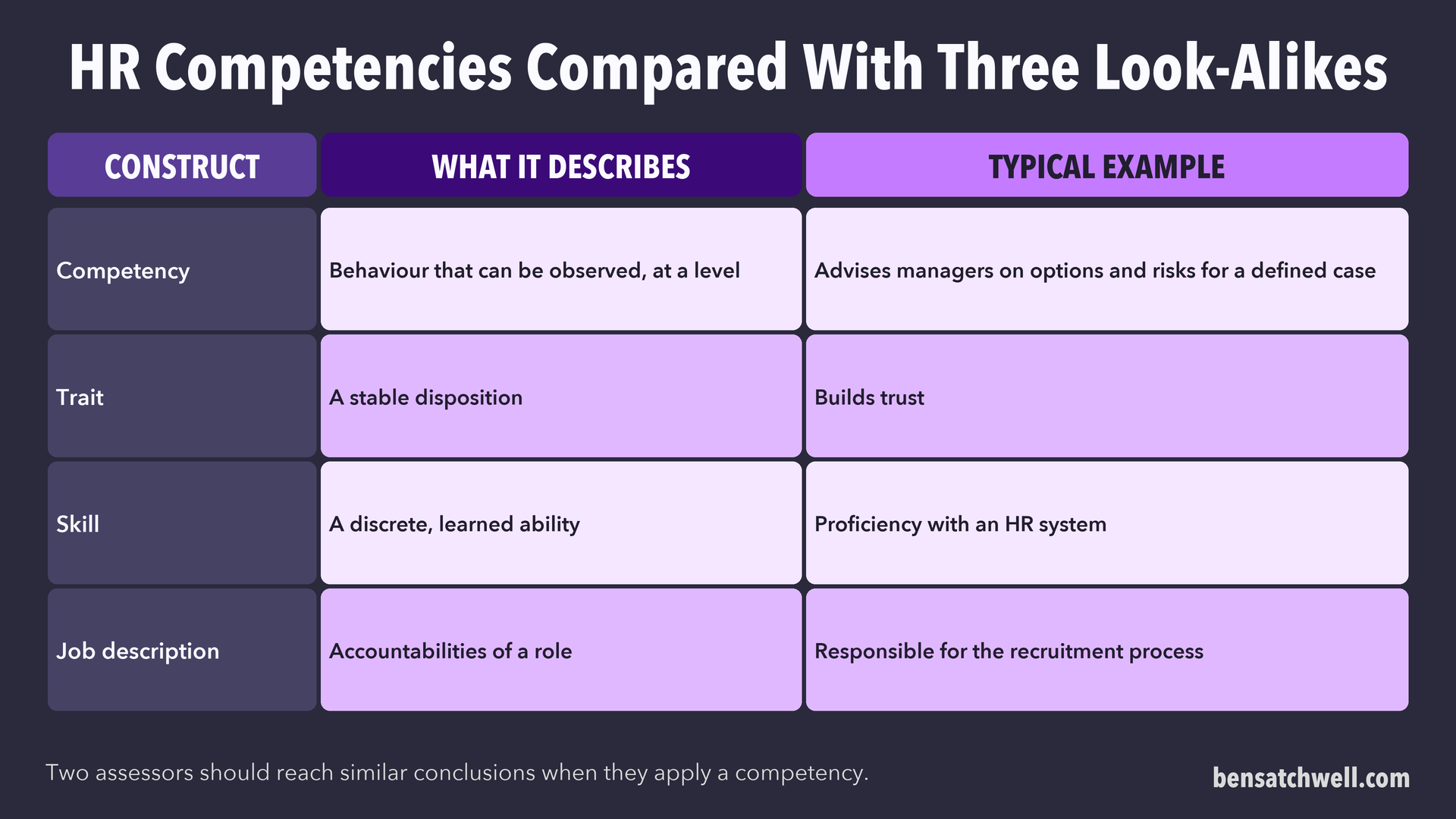
Two assessors should reach similar conclusions when they apply a competency.
- Not a job description. A job description defines what a practitioner is accountable for. Competencies define what is needed to do it well. Both are needed, and they are not interchangeable.
- Not a skills list. Skills such as employment legislation, HRIS proficiency or benchmarking method are specific abilities. Competencies describe the behaviours that draw on them in real work. A skills list says what someone knows. A competency says how they apply it.
- Not a performance rating. Competencies describe performance at defined levels. They do not produce a score on their own, and reducing them to met or not met removes the developmental information they exist to give.
Common Failure Modes
- One framework for the whole function. A set that must apply to an HR director, a business partner and an operations administrator ends up too abstract for any of them.
- Competencies that read as values. Acts with integrity is not a competency until it is described in behaviour, including where integrity is difficult or costly.
- Built without practitioners. Competencies written by HR leadership alone rarely reflect how the work is done across functions and seniority levels.
Trade-Offs and Constraints
A whole-of-function set is easier to maintain and communicate than a suite of role-specific profiles, but less precise for any one role. A shared core with role-specific indicators is more useful for assessment and development and takes more design effort and upkeep. Adopting an external framework such as the SHRM Body of Applied Skills and Knowledge or the CIPD Profession Map cuts design effort and gives external legitimacy, but both are built for HR practitioners broadly and need adapting for role-level assessment. The same starting-architecture approach used in a sales competency framework applies equally to HR.
FAQ
What are human resources competencies?
The behaviours and capabilities expected of HR professionals, expressed at proficiency levels, so they can be assessed and developed over time.
What are the core competencies of an HR professional?
The 2026 SHRM Body of Applied Skills and Knowledge defines eight behavioural competencies, listed above, plus a technical domain. The CIPD Profession Map defines a comparable set of core behaviours.
How do HR competencies differ from HR skills?
Skills are specific technical abilities. Competencies describe how practitioners apply them in real work and how that application changes with seniority and complexity.
Can one competency framework cover the whole HR function?
A shared behavioural core can, but it needs role-specific indicators to support assessment and development in specialist or senior roles.
What is the difference between the SHRM and CIPD frameworks?
Both define core behaviours for HR practitioners with similar domains. SHRM is more often used as a reference in North America and the CIPD map in the UK and internationally. Both need adapting for use inside one organisation.
How are proficiency levels used?
They show what each competency looks like at different career stages, so one framework can support development decisions across the whole career and not only at recruitment.