
Competency, capability, skill, behaviour and knowledge are used interchangeably in most HR functions and precisely in almost none. An HR competency model is among the constructs most often misunderstood, built badly and then shelved. This article looks at the content of one: how it is structured, how the two main professional standards compare and how to adapt them. For the organisation-specific build, see my guide to the human resources competency model.
What Is an HR Competency Model?
An HR competency model is a structured definition of the behaviours, knowledge and skills HR professionals need to perform to an agreed standard across the roles and levels of the HR function. It answers a single question: what does good look like for an HR practitioner, and how does that change with seniority and specialisation? For one HR role, the competencies and required levels together are a competency profile.
Two professional bodies have produced the most referenced standards. The SHRM Body of Applied Skills and Knowledge defines eight behavioural competencies in its 2026 edition, including business acumen, ethical practice and analytical aptitude, plus a technical domain covering HR expertise. The CIPD Profession Map separates core behaviours, specialist knowledge and professional values across four levels. Both reflect a basic truth about the profession: effective HR work takes more than technical knowledge of employment law, benefits or learning design. It takes judgement, ethical grounding, business fluency and the ability to influence senior decisions.

Each layer needs the one before it. Labels alone are not indicators.
A note on terminology. A competency framework is also called a competency model, especially in the United States. I use competency profile for the competencies and required levels for one role, and competency matrix for the grid of required against current proficiency. Usage varies by region, and I explain the differences in this competency model definition.
Why HR Needs a Defined Standard
The HR profession has struggled with credibility and definition for decades. What HR is for, whether administrative processing, strategic partnering or organisational development, has never been fully settled, and the answer varies by organisation, sector and level. That ambiguity has costs. Organisations struggle to hire HR professionals to a consistent standard, to evaluate their performance fairly and to offer career pathways that are credible to the people in them. Salary benchmarking is hard because the same job title covers different work.
A defined standard gives HR a common language and a common bar. It does not need to be identical in every organisation, but it needs to exist and to be specific enough to inform the decisions it is meant to support.
Domains, Indicators and Levels
Domains
These are the broad areas of HR performance. Drawing on SHRM and CIPD, the domains commonly found include HR technical expertise across employment relations, workforce planning, learning, reward and talent; business acumen; ethical practice; relationship management and stakeholder influence; use of evidence and analytics; communication; leadership and navigation; and cultural and global effectiveness. Their number and weighting vary with whether the function is built around generalists, centres of expertise or business partners. A shorter, synthesised version is in my five-domain HR framework.
Behavioural indicators
Within each domain, the profile states observable behaviour. This is where most HR profiles fail. Acts ethically and demonstrates business acumen are labels. A useful indicator says what the practitioner does: uses workforce data to identify patterns and risks and presents a clear recommendation with supporting evidence to senior leaders. Analyses HR data is not an indicator.
Proficiency levels
A scale of three to five levels shows what the same competency looks like at different stages, which is what lets it support career architecture and promotion decisions.

The change across levels is complexity and autonomy, not years of service.
The shift across levels is about complexity, autonomy, scope of influence and the consequences of decisions. That qualitative difference is what makes a scale useful in a career conversation and not just a compliance checkbox.
Comparing the Standards With a Build of Your Own
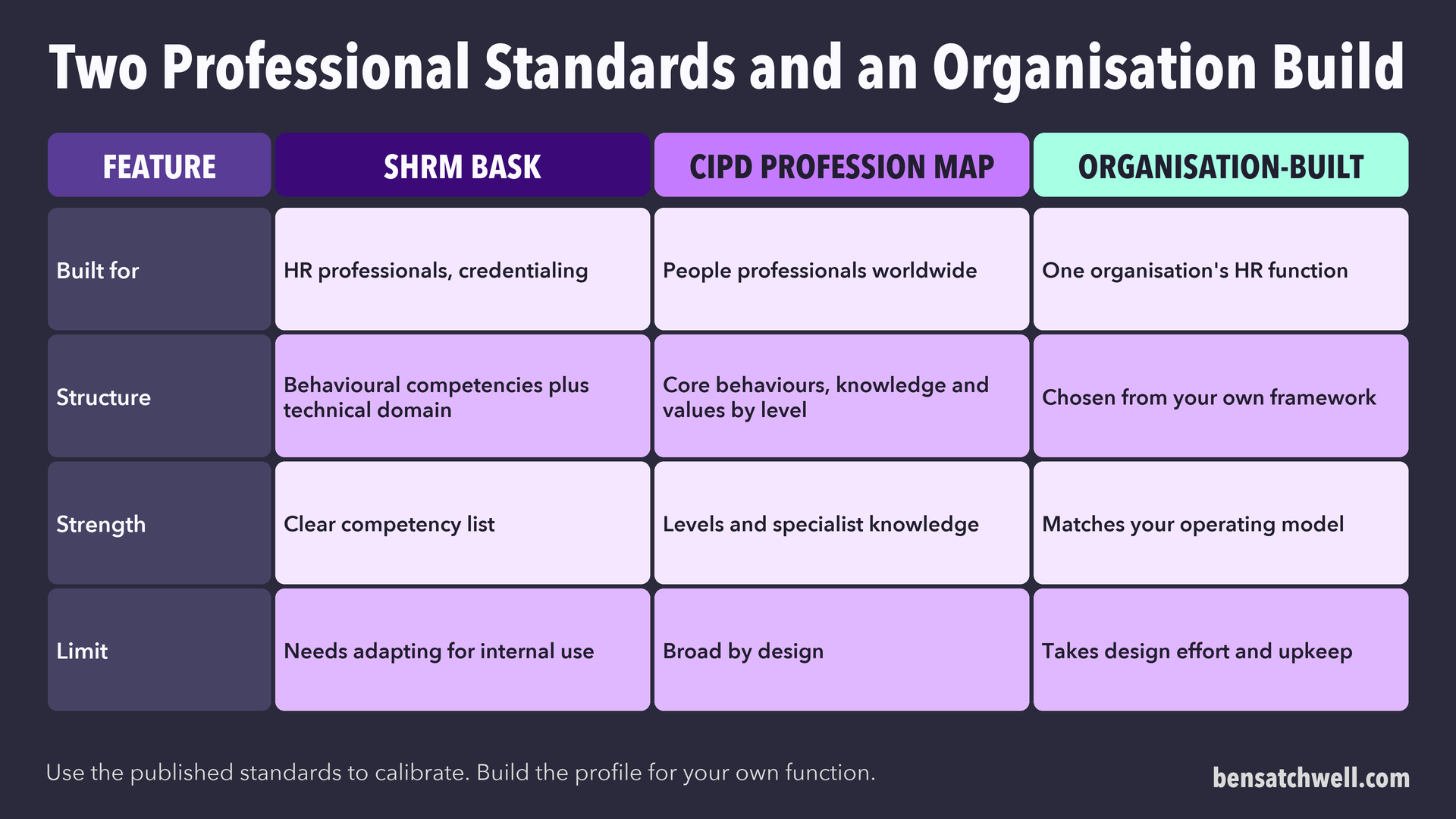
Use the published standards to calibrate. Build the profile for your own function.
SHRM's work underpins its certification, so it is calibrated for individual credentialing and not for managing performance inside one organisation. The CIPD map is the most comprehensive HR standard from a professional body, with core behaviours that apply to every role and specialist knowledge by domain. For role-specific needs, such as HR business partners who support product teams or HR specialists in sales, these standards are a structural starting point that needs adaptation. My guide to the SHRM competency model breaks down each competency, and the human resources competencies article sets out the underlying definitions.
What an HR Competency Model Is Not
- Not a job description. A job description defines responsibilities. The profile defines the behavioural standard for fulfilling them.
- Not a capability framework. Capabilities are broad, durable human abilities that travel with a person across roles. Competencies are tied to performance in a role. Merging them gives a structure that does both jobs badly. See my guide to capability framework design.
- Not a learning pathway. The profile says what good looks like. A learning pathway says how to get there.
Careless use of these terms has consequences, a theme I develop in my article on the semantic crisis in work design.
Common Failure Modes
- Written to make HR feel good. Aspirational, untestable language does not survive a promotion panel.
- Levels that do not differ. If senior business partner indicators are longer versions of graduate advisor indicators, the profile cannot support career architecture or calibration.
- Built apart from the HR operating model. A function organised around business partners and centres of expertise has different expectations from a shared services generalist model. The profile must reflect the real design.
- One-sided. Profiles that cover only technical knowledge, or only behaviour, underperform as management tools. The strongest combine strategic, relational and technical dimensions.
Trade-Offs and Constraints
A profile built from first principles for your organisation is more accurate and credible than one adopted whole, and it costs more time and stakeholder effort to build and keep current. For most organisations the pragmatic route is to start from the CIPD or SHRM standard and adapt the language, scale and domain emphasis to the operating model. The adaptation is where the design value sits. Maintenance matters too. HR roles change as tools take over administrative and analytical work, so review the profile at least every two years or sooner if the function is restructured. See also the HRBP competency model for the business partner role.
FAQ
What is an HR competency model?
A structured definition of the behaviours, knowledge and skills HR professionals need to perform to an agreed standard, at each level of the function. It is used for hiring, assessment and career development.
What is the difference between an HR competency model and an HR competency framework?
There is no difference in structure. Competency model is the usual US name and competency framework is more common in the UK and Australia. The competencies and levels for one HR role are a competency profile.
What are the main HR standards from professional bodies?
The CIPD Profession Map and the SHRM Body of Applied Skills and Knowledge. Both define behavioural competencies and technical knowledge, with SHRM structured by competency and CIPD by level.
Should we build our own or adapt an existing standard?
Most organisations do better adapting a published standard than starting from nothing. Aligning the domains, indicators and levels to your operating model is where the value is created.
How many domains should it have?
Six to ten works for most functions. Too few cannot separate different areas of performance, and too many are impractical for everyday conversations.
How often should it be reviewed?
At least every two years, and sooner if the HR operating model or the way HR work is done changes.