

Most organisations that say they have competency models in HRM actually have a list of desirable traits pasted into a performance form. I want to be precise about what a competency model is, what it does inside human resource management, and why so many of them never get used for anything.
What Are Competency Models in HRM?
A competency model in HRM is an applied selection of competencies, drawn from an organisation-wide competency framework and tailored to a specific role, level, function or job family, that defines what effective performance looks like in observable terms.
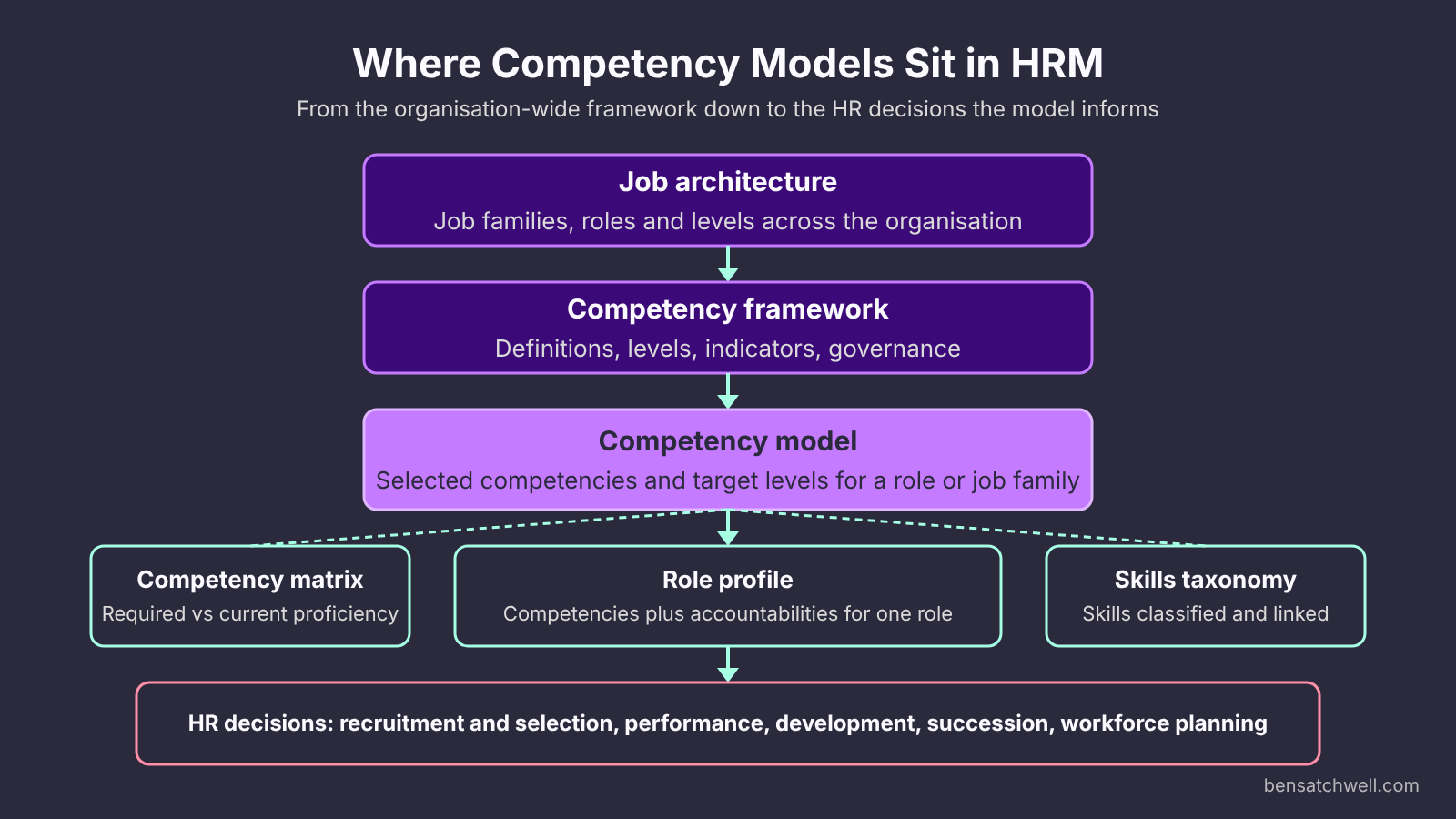
A competency is the integration of skills, knowledge, judgement and behaviour applied effectively in the context of a role. It is not a task and it is not a single skill. If the competency framework is the governing system, the model is one instance of it. A competency matrix, the grid that shows required versus current proficiency, is a third thing again.
Why Do Competency Models Exist in Human Resource Management?
HR makes the same decisions repeatedly: who to hire, who to promote, what to develop, how to pay, how to assess performance. Without a shared definition of good performance, each decision is made on a different basis by a different person.
A competency model gives those decisions a common reference. It states, in the same language, what a role requires and at what level. That is the functional reason it exists. It is not there to describe culture or to decorate a careers page.
The United States Office of Personnel Management is a clear public example. Its Human Resources Management Competency Model covers all GS-0201 positions and was validated through an environmental scan, focus groups and a job analysis survey. OPM states the model can be used for workforce planning, performance management, recruitment and selection, but agencies must still confirm applicability to their own positions through job analysis.
How Do Competency Models Work in Practice?
A working model is built from a small number of parts, each of which has to be present.
- Competencies drawn from the framework, grouped into competency domains such as technical, behavioural and leadership.
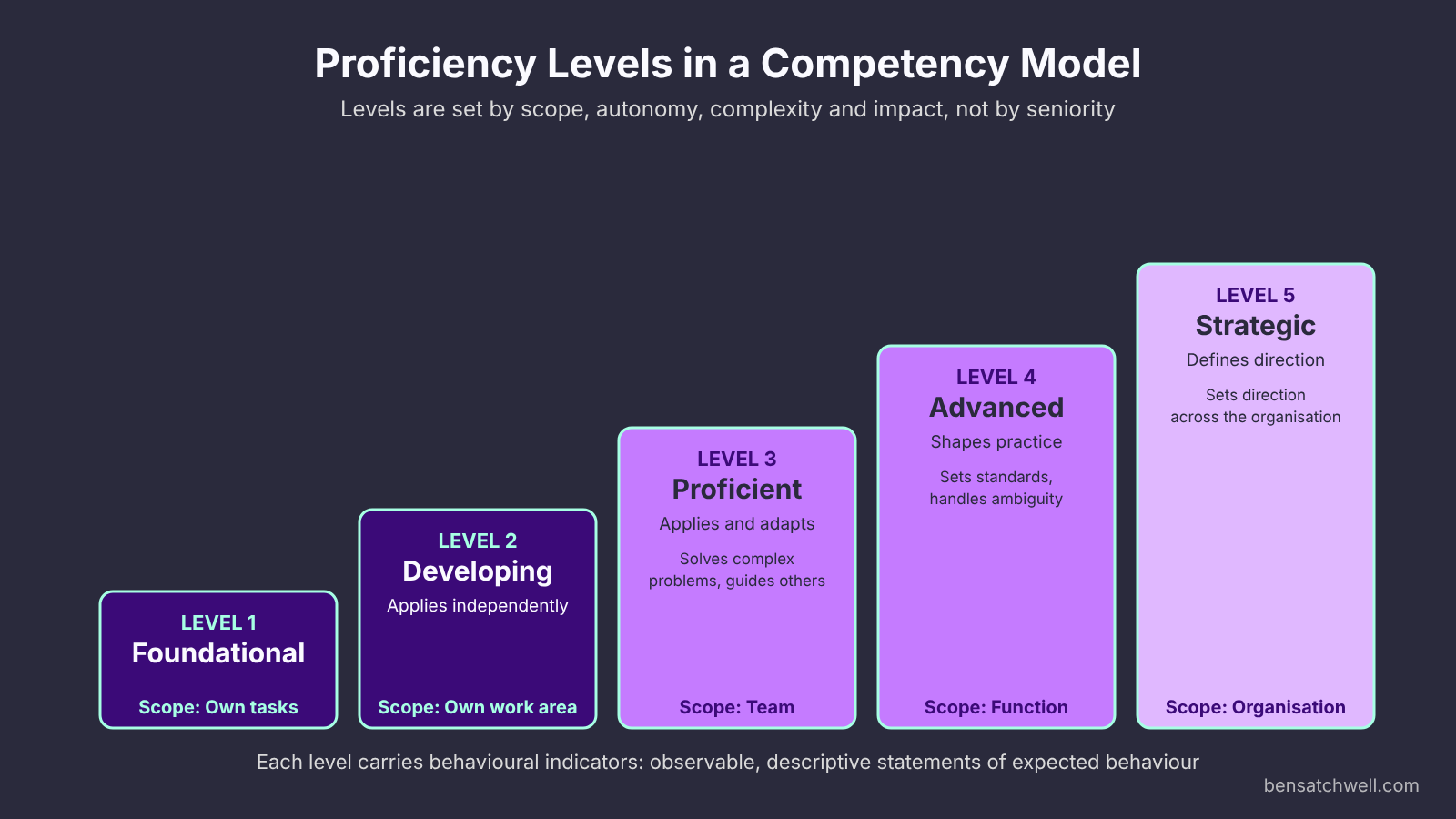
- Proficiency levels, usually four to six, set by scope, autonomy, complexity and impact rather than seniority or years of service.
- Behavioural indicators at each level, written as observable, descriptive statements that assessment can be conducted against.
- Target levels for the role, level or job family the model is built for.
How are proficiency levels set in a competency model?
Levels describe a change in the nature of the work, not a change in title. A person at a higher level handles greater complexity, works with more autonomy and affects a wider area. If a level descriptor only says "does more of the same, better", it is not a level.
Which HR processes use the model?
The same model can sit behind recruitment and selection, performance conversations, development planning, succession and workforce planning. This reuse is the whole value of building a model rather than writing a fresh list for each process. For a worked set of HR-specific examples, see my breakdown of an HR competency model.
What Is the Difference Between a Competency Model, a Framework and a Matrix?
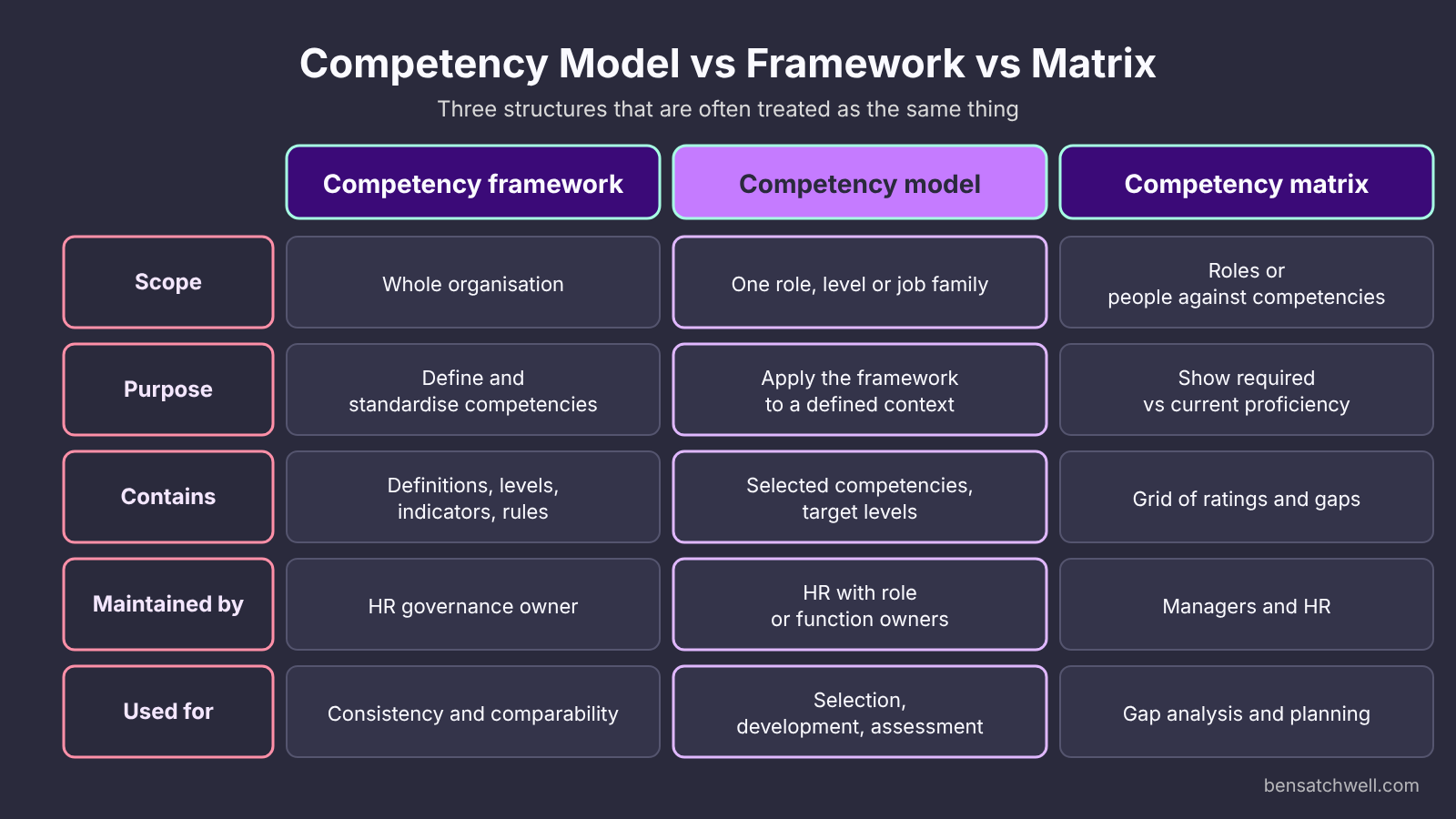
These three terms are conflated constantly, and the confusion causes real design errors. I use them this way, and I flag that this is a stipulative convention. North American practice often uses "competency model" as the broadest term.
- A framework is the organisation-wide system with definitions, levels, indicators and governance.
- A model is an applied selection from that framework for a role, level, function or job family.
- A matrix is a grid that shows holdings or gaps. It is a display artefact, not the governing structure.
What a competency model is not
A competency model is not a job description. A job description lists responsibilities, and a role defines what someone is accountable for. The model describes what a person needs to do that role well.
It is not a skills list. Skills are discrete, learned abilities that change as tools change. It is not a capability framework either. Capabilities are broad, durable and held by the person across roles, while a competency is applied in the context of a role.
Which Named Competency Models Are Used in HRM?
Three models for the HR profession itself are worth knowing, because they show three different design choices.
SHRM publishes its Body of Applied Skills and Knowledge. It organises behavioural competencies into Leadership, Interpersonal and Business clusters, and separates them from knowledge across People, Organization and Workplace domains. I cover the earlier version in more detail in my SHRM competency model article.
The CIPD Profession Map takes a different structure. It has core knowledge, eight core behaviours and specialist knowledge, set across four impact levels. The levelling is by the impact of the work, which is the correct basis.
OPM's model, covered above, is built for a single occupational series and extended with parenthetical models for specialty areas such as classification and employee benefits. That is a good example of a base model with specialist models layered on it.
For a broader comparison that includes Korn Ferry and others, see these competency model examples.
Why Do Competency Models in HRM Fail?
They are built without a framework
When each model is written from scratch, the same competency gets a different name and a different definition in every function. Comparison across roles becomes impossible, and the HR team spends its time reconciling language instead of making decisions.
They are too long
Models with thirty or forty competencies per role cannot be assessed honestly. Managers rate everything the same and the model stops informing anything.
Indicators describe traits, not behaviour
"Is a strong communicator" cannot be observed. "Adjusts the message and format to the audience's level of detail" can. If the indicator is evaluative rather than descriptive, assessment becomes opinion.
They sit outside the HR processes
A model that is published but not connected to selection, performance or development decisions is documentation, not a working tool.
What Are the Trade-offs and Constraints?
Use a competency model when you need consistent, comparable expectations for a role family and you can maintain the underlying framework. A model is well suited to stable roles where the required behaviour is reasonably well understood.
Be cautious when roles change quickly. Competencies are tied to the context of a role, so a model for a role that is being redesigned will date fast. In that case, anchor the work in capabilities, which are broader and more durable, and derive the role-level models once the role has settled.
There is also a maintenance cost. Every model adds to what must be reviewed when the framework changes. Fewer, well-built models almost always outperform many thin ones.
Frequently Asked Questions
What is a competency model in HRM?
It is a defined set of competencies, with proficiency levels and behavioural indicators, tailored to a particular role, level or job family and used to guide HR decisions such as selection, development and performance assessment.
What is the difference between a competency model and a competency framework?
The framework is the organisation-wide system that defines and governs competencies. The model is an applied selection from that framework for a specific role or cohort. One framework supports many models.
How many competencies should a competency model include?
Enough to describe effective performance in the role, and few enough to be assessed honestly. In practice that usually means a small set per role, drawn from core, technical and leadership domains, rather than a long list.
How many proficiency levels should a competency model have?
Four to six is workable. Fewer than four does not distinguish progression well, and more than six produces levels that cannot be told apart in practice.
What are examples of competency models in HRM?
The SHRM Body of Applied Skills and Knowledge, the CIPD Profession Map and the US OPM Human Resources Management Competency Model are three published examples built for HR professionals.
Is a competency model the same as a skills framework?
No. A competency integrates skills, knowledge, judgement and behaviour in the context of a role. A skills framework defines discrete skills and their proficiency levels, and sits alongside a skills taxonomy and ontology.