
The phrase competency model framework appears in academic papers, vendor software, HR documents and search results. It is also one of the least precise terms in work design. This article resolves the ambiguity: what the phrase means, why it reads strangely, and which term to use in its place.
What Is a Competency Model Framework?
A competency model framework is not a separate construct. The two main words are names for the same thing. Competency modelling research uses model for the organisation-wide system of competencies, levels and indicators, and the UK and Australia call that same system a framework. Putting both words together names the structure twice.
In practice, when someone says competency model framework they usually mean one of three things:
- a competency framework, the organisation-wide system
- a competency model, the same system under its US name
- a framework together with the role-level profiles built from it
None of these needs the compound phrase. The compound adds length without adding precision, and it hides the one distinction that does matter, which is between the system and the role-level selection drawn from it.
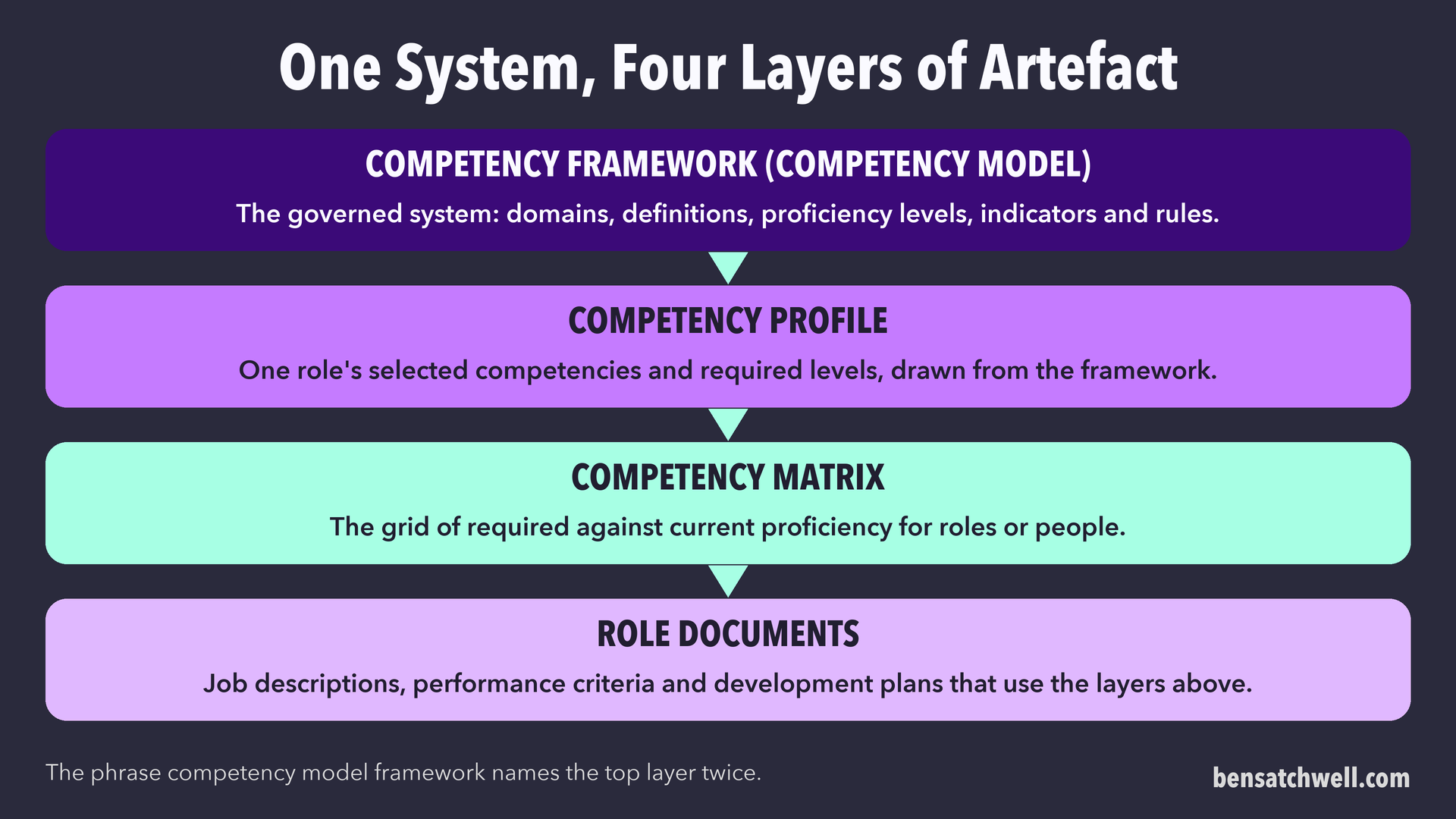
The phrase names the top layer twice. The layers beneath it are where the real distinctions sit.
A note on terminology. A competency framework is also called a competency model, especially in the United States. I use competency profile for the competencies and required levels for one role, and competency matrix for the grid of required against current proficiency. Usage varies by region, and I explain the differences in this competency model definition.
Where the Phrase Appears
The phrase turns up wherever people combine the US and UK or Australian names without choosing between them.
- Academic writing. Authors often use model and framework loosely for both the theory and its application, and the competency models literature shows how widely the usage ranges.
- HR software. A catch-all label for a competency library plus role profiles.
- Documents written for mixed audiences. A US head office and an Australian or UK team each use their own name, and the document carries both.
- Search. People type the phrase because they have seen both words, not because it is precise.
Why the Phrase Causes Confusion
The confusion is practical. When one phrase covers the system, the role selection and the documents that use them, nobody can answer basic governance questions cleanly: who owns the definitions, who approves changes, what can a role customise, and what must stay consistent.
That is how competency systems degrade quietly. Local teams edit definitions because they cannot tell which layer they are allowed to change. The result is duplicated competencies, inconsistent proficiency levels and assessment disputes, and almost none of it is a content problem. It is a structure and language problem.
Think in Layers Instead
Layer 1: the competency framework
The governed system. It holds the domains, competency definitions, proficiency levels, behavioural indicators and rules for use. It is organisation-wide and changes infrequently. The competency framework page covers it in full.
Layer 2: competency profiles
One role's selection from the framework, with the required level for each competency and a few role-specific examples. The competency model page shows how one is built.
Layer 3: competency matrices
The grid of required against current proficiency across roles or people, used for gap analysis and planning.
Layer 4: role documents
Job descriptions, performance criteria and development plans. These use the layers above but are not part of them.
Each layer has a different purpose and a different owner. Mixing them blurs accountability.
The Constructs Behind the Phrase
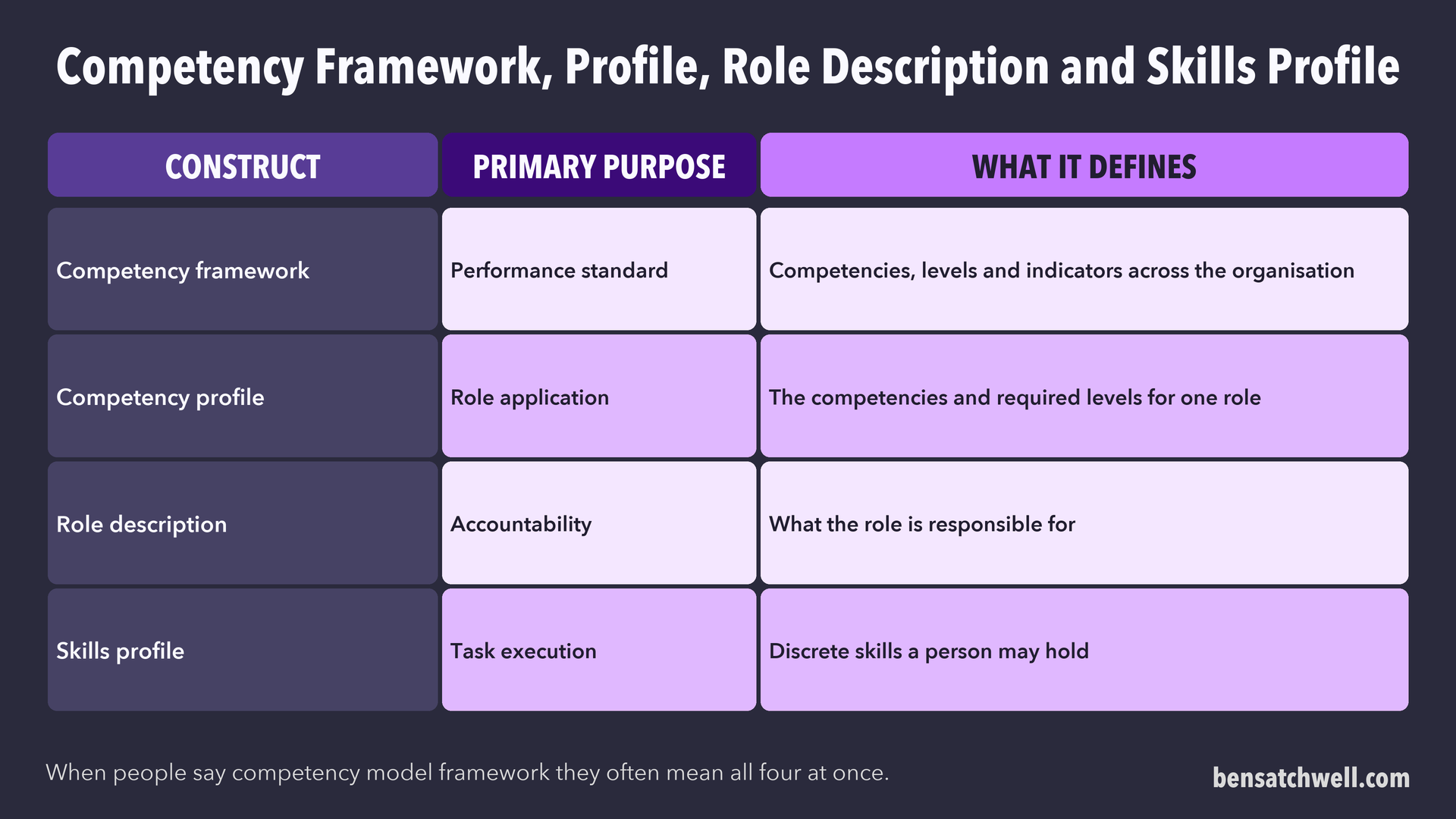
When people say competency model framework they often mean all four at once.
Four different things get folded into the phrase: a performance standard, a role application, an accountability statement and a list of discrete skills. Bundled into one artefact they are hard to govern and impossible to reuse.
Which Term to Use
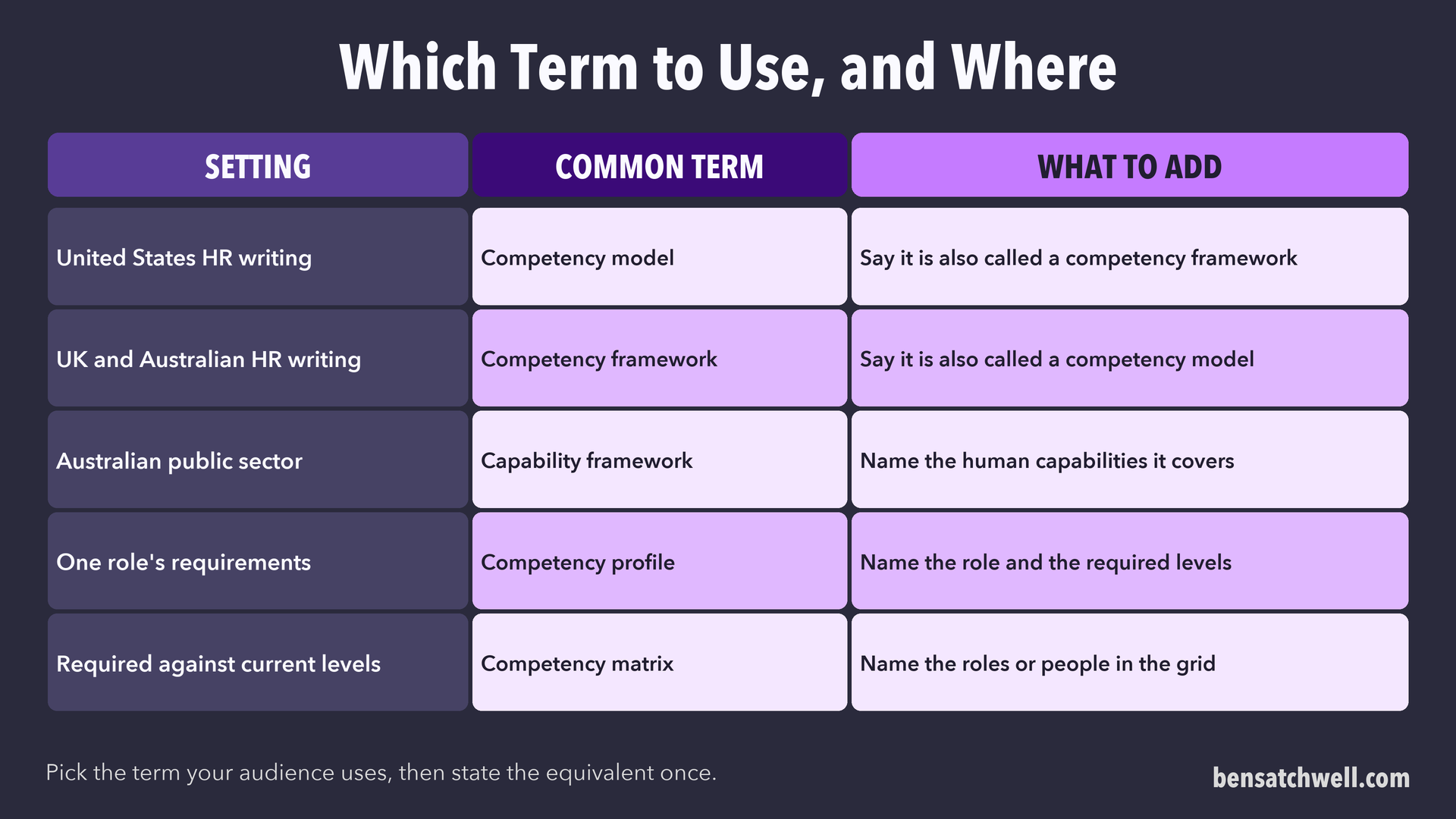
Pick the term your audience uses, then state the equivalent once.
If you want precision, use the name your audience already uses for the system and state the other name once. Use competency profile for one role and competency matrix for the grid. If you need to refer to the system and its role-level selections together, write competency framework and its competency profiles. It is longer, and it is correct.
When the Combined Phrase Is Acceptable
There are limited cases where it is tolerable: informal conversation, marketing copy that defines the terms straight away, and headings that immediately explain the phrase. Even then it should be unpacked quickly.
A Worked Example of the Right Separation
Framework: 30 competencies across five domains, four proficiency levels, owned centrally. Profile for a senior account executive: six competencies selected from the framework, a required level for each and role-specific examples. Matrix: the account executive team set against that profile.
Calling the first of these a competency model framework adds nothing. Calling it a competency framework, and the second a competency profile, tells the reader exactly what is governed and what is applied.
Common Mistakes
- Treating the framework as role-specific. The framework should not change per role.
- Letting profiles redefine competencies. A profile selects and sets levels. It does not rewrite definitions.
- Bundling everything into one artefact. This kills governance and reuse.
- Assuming the terminology does not matter. Structure follows language.
FAQ
What is a competency model framework?
It is a commonly used but imprecise phrase that combines the US and UK or Australian names for the same structure. Most people mean a competency framework, possibly with the role-level profiles drawn from it.
Is a competency model framework different from a competency framework?
No. Competency model and competency framework name the same system, so the compound repeats itself.
Should I use the term competency model framework?
Choose the name your audience uses, either competency framework or competency model, and state the other once. Use competency profile for one role.
Why does the phrase appear so often online?
Because writers and software vendors combine both regional names, and people search for the phrase they have seen.
What is the difference between a framework and a profile?
The framework is the organisation-wide system. A profile is one role's selection of competencies and required levels drawn from it.