
A role profile is the single record of one role: the job description that says what the role is accountable for, joined to the competency profile that says what standard is needed to do it. Most organisations keep the two in separate documents, written at different times by different people, and the documents drift apart. In Australia the job description is usually called a position description, and the same logic applies.
I treat the role profile as a bridge between two parts of this site. A job description records the role. A competency profile records the standard. The role profile is what you get when both are written against the same role and kept in step with the competency framework they draw from.
What is a role profile?
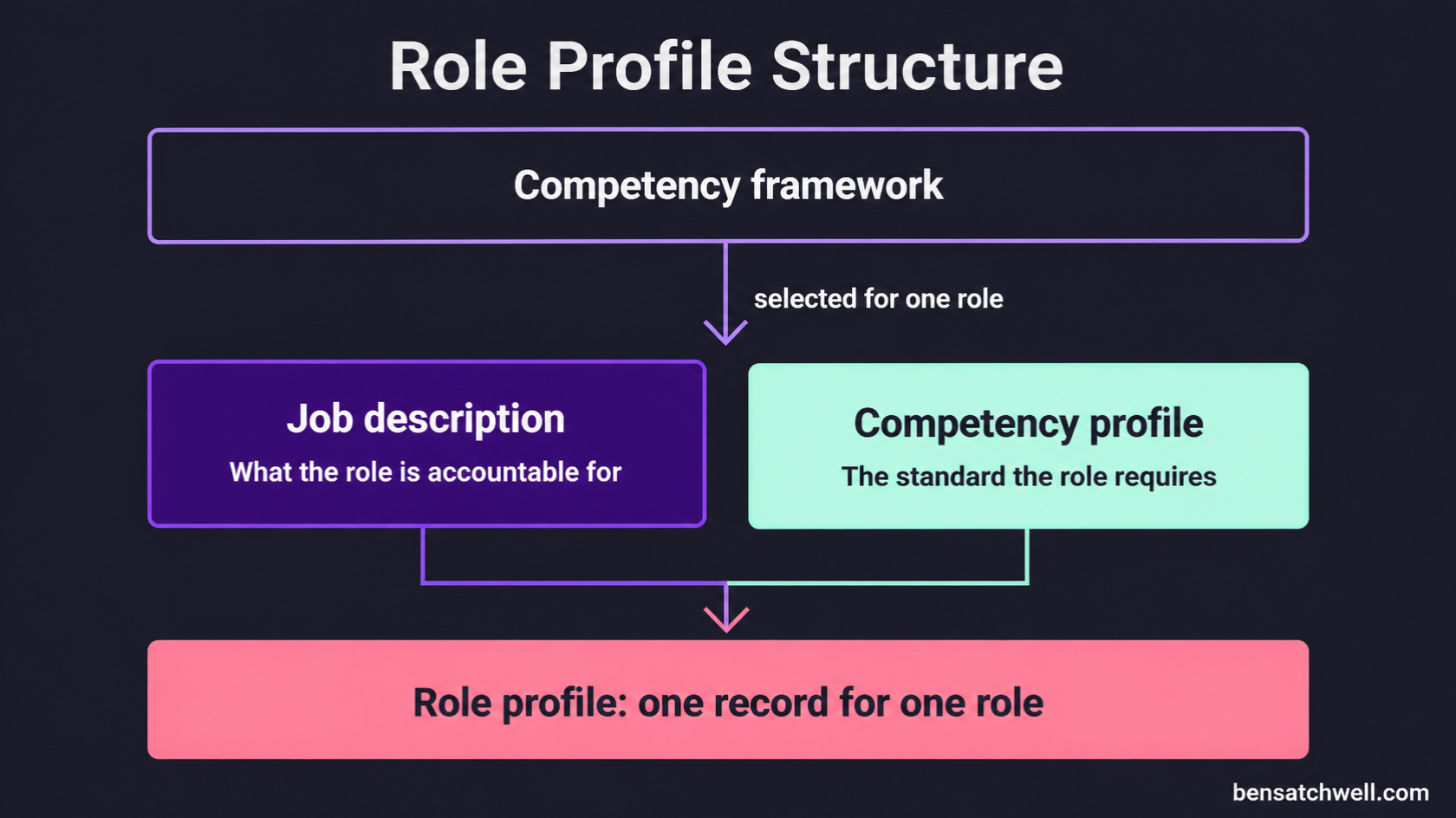
A role profile is a role's job description and competency profile held together as one record, so that what the role does and the standard it requires are written against the same role.
It is written at the level of a single role. The International Labour Organization defines a job in ISCO-08 as a set of tasks and duties performed, or meant to be performed, by one person. A role profile sits at that level. It is not written for an occupation, a job family or a whole function.
The SFIA Foundation uses the same idea in its own terms. Its guidance describes a skills profile as a set of SFIA skills and skill levels mapped to a position, job or role, and says it is not an assessment of an individual's skills. A basic SFIA-based role profile then adds the role purpose, an overall SFIA level and relevant generic attributes to that skills profile, as set out in its guidance on building skills profiles. That is a role profile in everything but name: a statement of the role plus a statement of the standard.
A note on terminology. A competency framework is also called a competency model, especially in the United States. I use competency profile for the competencies and required levels for one role, and competency matrix for the grid of required against current proficiency. Usage varies by region, and I explain the differences in this competency model definition.
What does a job description record and what does a competency profile record?
The two documents answer different questions, and the role profile only works if each stays in its lane. The NSW Government puts the combined purpose plainly: role descriptions explain the purpose of a role, where it fits in the organisation, and what capabilities are needed. The first two parts belong to the job description. The third belongs to the competency profile.
| Dimension | Job description | Competency profile |
|---|---|---|
| Question answered | What is this role accountable for? | What standard does the role require? |
| Unit | One role | One role, selected from the framework |
| Content | Purpose, accountabilities written as outcomes, reporting lines, essential requirements | Competencies, the required proficiency level for each, and the behavioural indicators at that level |
| Changes when | The work or the structure changes | The framework changes, or the scope and complexity of the role change |
| Main uses | Advertising, grading, contracts | Selection, assessment, development, career moves |
If you are still deciding how to write the left-hand column, my guides to how to write a job description and to job description vs position description cover it in full.
How do a job description and a competency profile fit together?
Use a decision rule first, then four design rules.
- Use a job description alone when the aim is to advertise a vacancy or document a contract, and nobody will assess or develop against the role.
- Add a competency profile when people will be selected, assessed or developed against the role.
- Hold them as a role profile when the same role is used for more than one of those purposes, so that one record serves all of them.
Rule 1: write both against the same purpose
The role purpose is the anchor. If the purpose in the job description and the competencies in the profile cannot be traced to each other, one of them is wrong.
Rule 2: trace each accountability to a competency
Every accountability should lean on at least one competency, and every competency should be needed by at least one accountability. Gaps in either direction are the quickest way to find a weak profile.
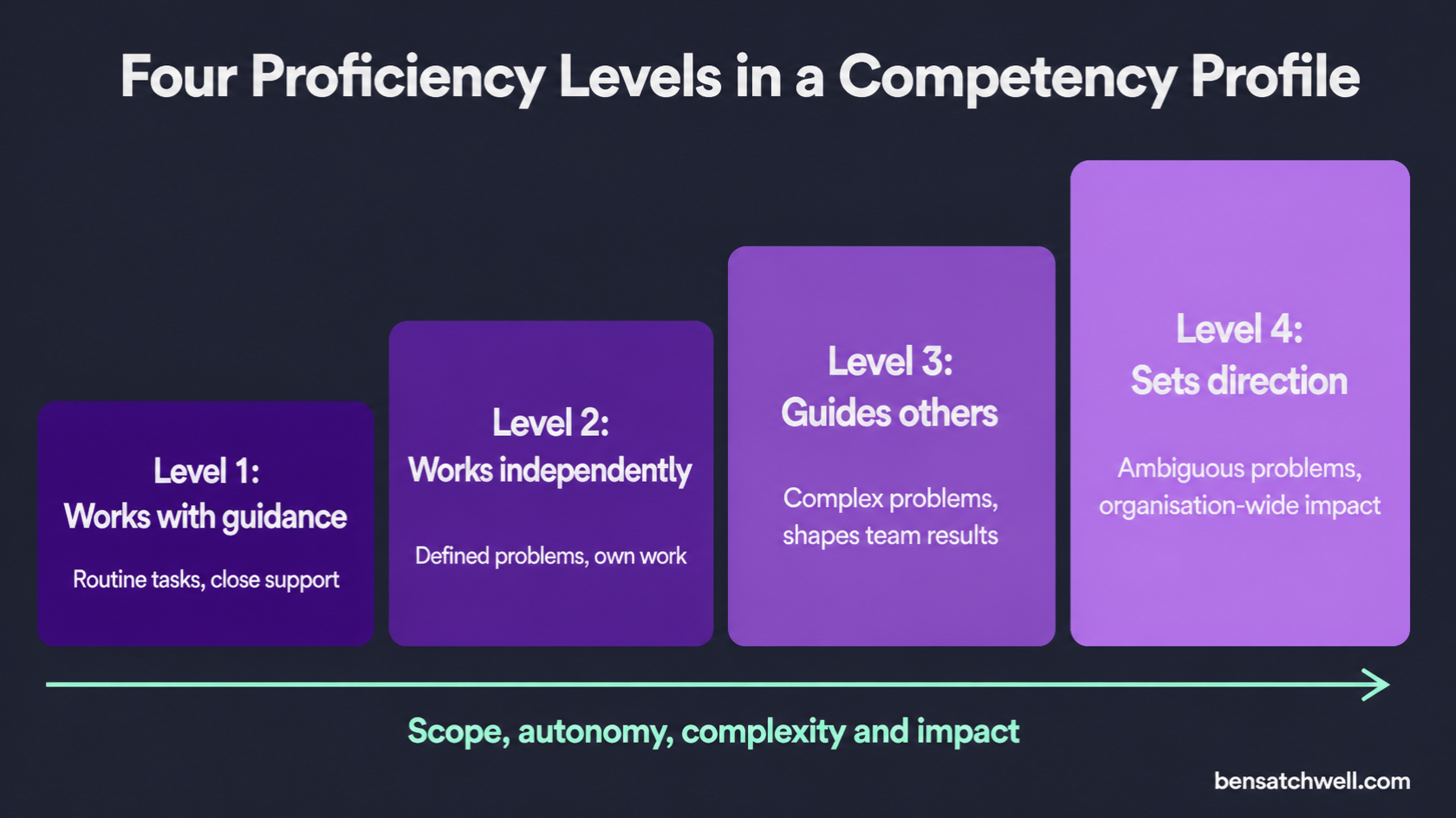
Rule 3: set levels by scope, not seniority
A proficiency level reflects the scope, autonomy, complexity and impact of the role, not the grade or years of service. My explanation of competency framework levels covers how to define them.
Rule 4: select from one framework
The competency profile is a selection from the organisation's framework, never a fresh list written for each role. When every profile draws on one framework, you can aggregate them into a competency matrix and compare roles on the same terms.
What does a role profile look like for a finance analyst?
This example is illustrative. It uses a four-level scale, where Level 1 is working with guidance and Level 4 is setting direction for others.
Job description part
- Purpose: Provide accurate analysis that lets budget holders make spending decisions.
- Accountability A: Monthly management reports are accurate and issued by the fifth working day.
- Accountability B: Forecasts are updated each quarter and reconciled to actual results.
- Accountability C: Budget holders understand their variances and know what to do about them.
Competency profile part
| Competency | Required level | Behavioural indicator at that level | Supports |
|---|---|---|---|
| Financial modelling (technical) | 3 | Builds and checks models that others rely on, and documents the assumptions | A, B |
| Analytical thinking | 3 | Separates cause from symptom in a variance and tests more than one explanation | A, B, C |
| Stakeholder communication | 3 | Explains results to non-finance leaders in terms of the decision they face | C |
| Commercial awareness | 2 | Links a result to what is happening in the business unit | C |
| Planning and organising | 2 | Sequences own work to hit the close calendar without reminders | A |
Each accountability is supported by at least one competency, and each competency supports at least one accountability. That two-way trace is the test of a sound role profile.
What is a role profile not?
- Not a job description with competencies pasted at the end. A pasted list has no levels, no indicators and no link to the accountabilities.
- Not an assessment of a person. It describes the role. The SFIA guidance is explicit that a profile is not an assessment of an individual's skills.
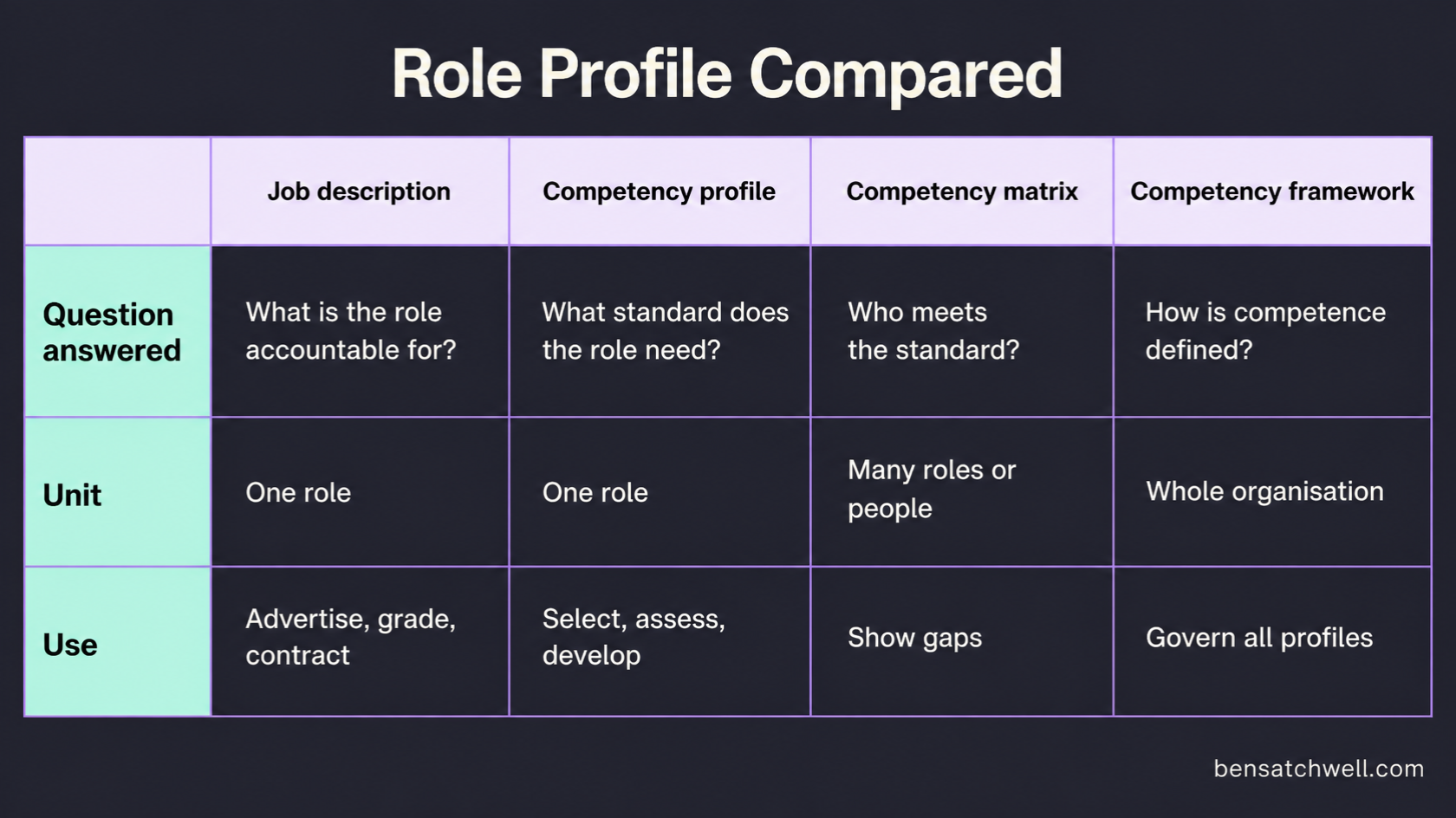
- Not a competency framework. The framework is the governing system. The profile is a selection from it for one role.
- Not a competency matrix. The matrix is a grid built from many profiles, showing required against current proficiency.
- Not a job architecture. Job architecture organises roles, levels and job families. A role profile describes one role inside it.
Where do role profiles go wrong?
- Copied competency lists. The same ten generic competencies appear in every profile, so the profile says nothing about this role.
- Levels set by grade. A senior title gets Level 4 across the board, whatever the role does.
- Two owners. Recruitment owns the job description and learning owns the competencies, and they edit separately.
- No source framework. Each profile invents its own competency names, so nothing can be compared.
- Duties instead of outcomes. Accountabilities written as tasks cannot be traced to a competency.
When is a role profile worth the effort?
A role profile costs more to maintain than a job description because two parts must stay aligned. It earns that cost in organisations that select, assess and develop against the same roles, and that already have a framework to draw from. It is poor value for one-off roles, for very small organisations, and wherever no competency framework exists yet. In those cases write a sound job description and build the framework first.
FAQ
What is a role profile?
A role profile is the job description and the competency profile for one role, held together as a single record. It states what the role is accountable for and the standard needed to do it.
Is a role profile the same as a job description?
No. A job description records the purpose, accountabilities and requirements of a role. A role profile includes the job description and adds the competency profile.
What is the difference between a role profile and a competency profile?
A competency profile lists the competencies and required levels for a role. A role profile is wider: it holds the competency profile together with the job description.
How many competencies should a role profile include?
I keep it to between five and eight. That is enough to tell roles apart and few enough to assess properly. A longer list usually means the profile describes a person rather than a role.
Who should own a role profile?
One accountable owner, usually in HR or the function that owns job architecture. The hiring manager contributes the content, but a single owner keeps the job description and competency profile in step.