

A job description is a written record of one role: why it exists, what it is accountable for and what it takes to do well. Most organisations hold hundreds of them and use almost none after the hire. They are written once to fill a vacancy, filed, and then drift away from the work they describe. In Australia, and across the public sector, the same document is usually called a position description. I use job description in this guide and position description where Australian readers would expect it. Usage of these terms varies by region, and I explain how I use them in this competency model definition.
What is a job description?
A job description is a written statement of the purpose, accountabilities and requirements of a single role.
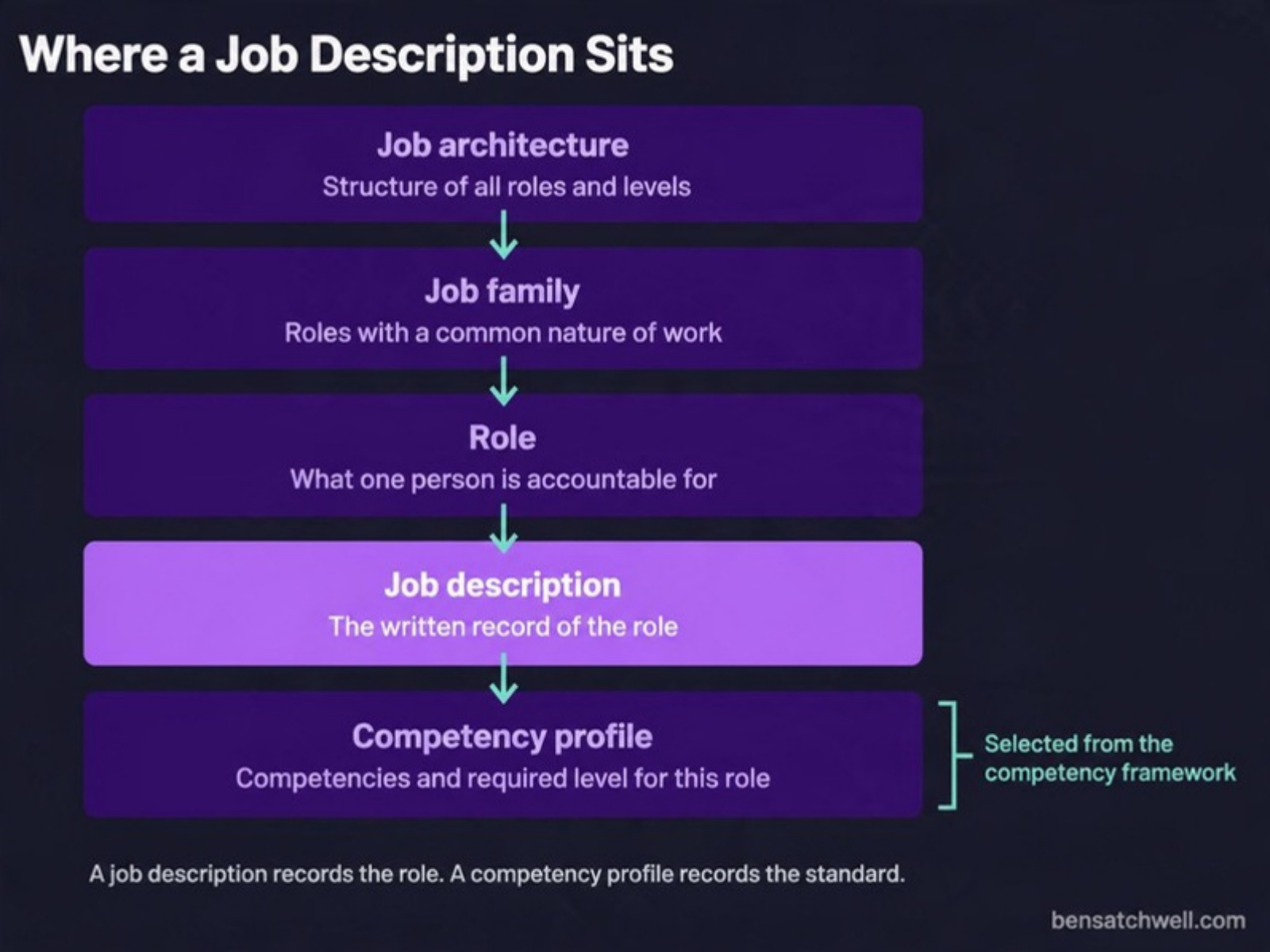
It tells an employer, a manager and a candidate what the role is for and what the person in it is answerable for. Three neighbouring words get mixed up, so I keep them apart.
- Job. The International Labour Organization defines a job as the set of tasks and duties done, or meant to be done, by one person (ILO, ISCO-08).
- Role. What a person is accountable for in a given context. One person can hold one job and play more than one role.
- Position. One post in the organisation's structure that one person fills. Several positions can share a single job description, such as three analyst posts in one team.
The job description is the document that records the role. A competency profile records the standard the role requires.
Why does a job description exist?
It exists because work has to be agreed before it can be hired for, paid for or assessed. Without a written record, each manager carries a private version of the role, and the version a candidate hears at interview differs from the one the manager expects six months later. A job description gives everyone one shared reference, and four decisions draw on it.
- Recruitment. What to advertise and what to assess candidates against.
- Classification and pay. Where the role sits relative to other roles.
- Performance. Which accountabilities the person is measured against.
- Development. The gap between the capabilities the role requires and those the person holds today.
What should a job description include?
The NSW Government describes a role description as a short summary of a job that covers why the role exists, the outcomes it delivers and where and how it operates. It advises focusing on outcomes rather than tasks, and including only information that applies to all applicants and will stay stable over time (NSW Government, creating a role description). That gives a workable structure, and this is the one I use as a template.
| Section | What it contains | Test it should pass |
|---|---|---|
| Job title and classification | The title, the grade or band and the job family | A reader can place the role in the structure without asking. |
| Role purpose | One or two sentences on why the role exists and the outcome it delivers | The person holding the role recognises their job in it. |
| Key accountabilities | Five to eight outcome statements | Each says what is achieved, not only what is done. |
| Relationships and reporting | Who the role reports to, works with and manages | No part of the role depends on an unwritten assumption. |
| Scope and authority | Budget, people, systems and the decisions the role can take alone | A manager can say what needs approval and what does not. |
| Essential requirements | Qualifications, licences, registrations and experience the person cannot do the job without | Each item is genuinely essential. Everything else is desirable. |
| Capabilities or competencies | The profile: which capabilities or competencies the role needs and the required level of each | Every item has a defined level taken from a framework. |
How do you write a job description?
1. Start with the work, not the person
Talk to the manager and, where there is one, the current holder. Ask what the role must achieve in the next twelve months and which decisions it makes. A description written around a favourite candidate inherits that person's strengths and blind spots.
2. Write the purpose in one or two sentences
If you cannot, the role is probably two roles.
3. Write accountabilities as outcomes
Name what is achieved and for whom. A weak statement reads "Answers phones and manages the diary." A stronger one reads "Keeps the executive team's commitments organised so that decisions are made on time with the right people present." The second survives a change of phone system.
4. Separate essential from desirable
Every essential requirement removes candidates, so test each one: could a capable person do the job without it? Many requirements survive only because they were in the previous version.
5. Attach the profile
Select capabilities or competencies from your organisation's framework and state the required level of each. Do not invent new wording for the job description. The next sections cover how.
6. Review it with the people who will use it
The manager, HR and the current holder should each read it. A good test is whether you can remove any sentence without losing the meaning of the role.

What is the difference between a job description, a position description and a role description?
In most organisations the three terms name the same document, and the choice follows convention rather than substance.
| Term | Where it is common | How I use it |
|---|---|---|
| Job description | The default in the United States and United Kingdom and in most global HR content | The general term in this guide |
| Position description | Australia, including the public sector | The same document, used on Australian pages |
| Role description | Some public bodies and charities, and the NSW Government for its own documents | The same document |
Some organisations use duty statement or job specification for a narrower document that lists only duties or only the requirements of the person. If yours does, define each term once in policy and use it consistently. The difference that matters is not the label but whether the document describes the work or the person.
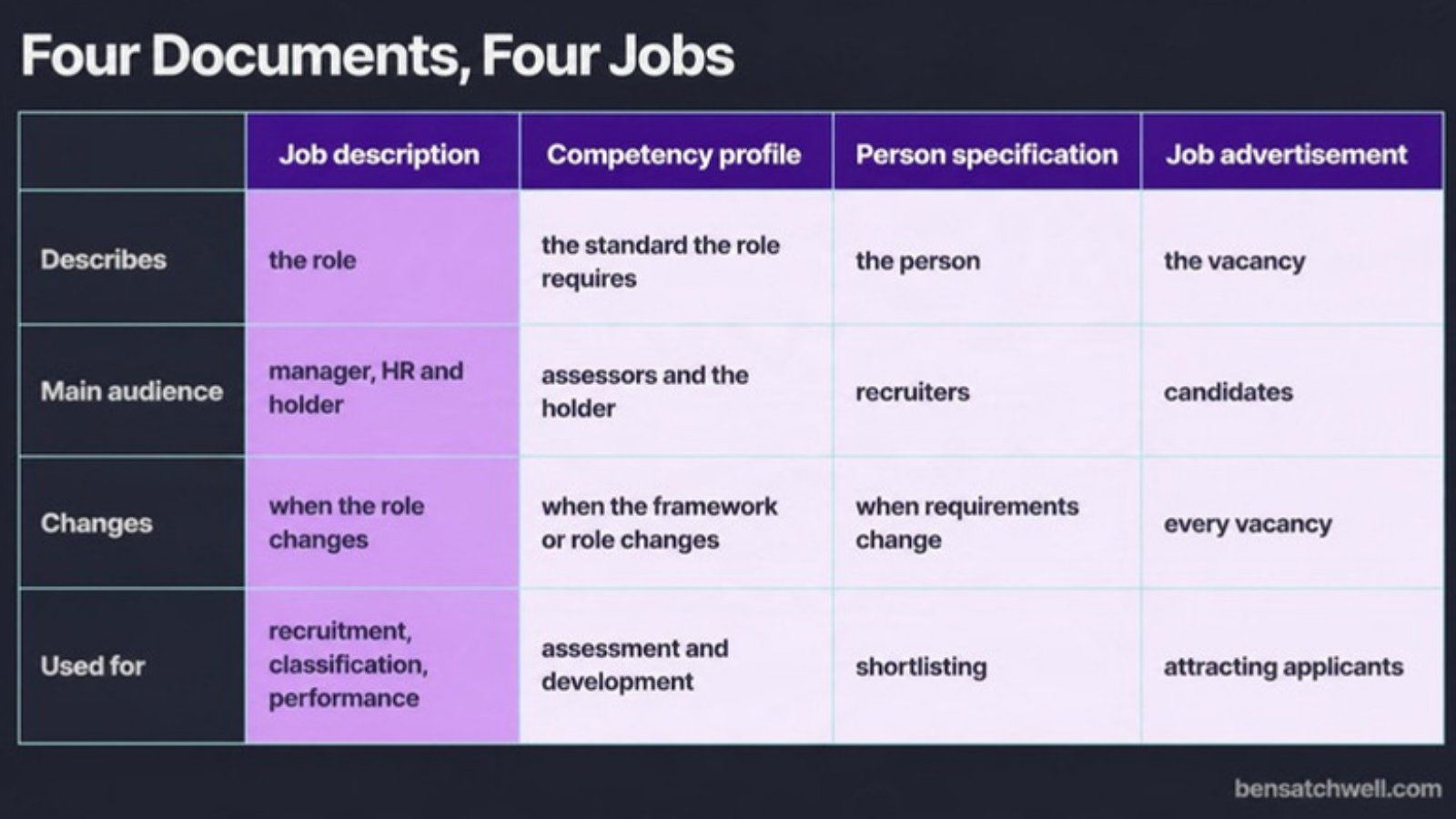
What a job description is not
- Not a task list. Tasks change often. Accountabilities and outcomes change slowly.
- Not a person specification. It describes the role. The requirements section describes only what the role demands of any holder.
- Not a performance review. It states what the role is accountable for, not how well one person is doing it.
- Not a job advertisement. The advertisement is written to attract candidates and changes with each vacancy. The job description stays stable.
- Not a competency profile. A job description records the role. A competency profile records the standard.
The profile is the set of competencies a role needs and the required proficiency level of each, selected from a competency framework. When the profile lives in a separate file, the two documents drift apart. A job competency matrix shows the same content as a grid, which is useful for comparing roles, but the job description is still where the role is written down.
How does a job description connect to competency, capability and skills frameworks?
The strongest job descriptions carry a profile instead of a list of adjectives. "Strong communicator" tells a candidate nothing. "Communication at level 3, defined by these behaviours" tells everyone the same thing. Use a competency framework or a capability framework, whichever your organisation has adopted. The structure is the same.
The SFIA Foundation shows the pattern for skills. It defines a skills profile as the set of SFIA skills and levels mapped to a position, job or role, and a SFIA-based role profile as that skills profile together with the role purpose, the overall SFIA level and the relevant generic attributes. Its guidance suggests that a profile typically carries five to seven professional skills (SFIA Foundation, building SFIA-based profiles).
Public sector frameworks apply the same logic. The NSW Government points role description writers to the NSW Public Sector Capability Framework to choose capabilities, and to its Capability Comparison Guide to choose the level (NSW Government). I cover the structure of those frameworks in my guides to public sector capability frameworks and the VPS Capability Framework.
Where I have a framework for the role itself, take the capability list from it. The administrative staff, HR, CFO and product manager frameworks already state the competencies and levels, so the job description needs only the selection.
Where do job descriptions commonly fail?
- Copied from the last version. The previous holder's job becomes the next holder's job, including duties that no longer exist.
- A list of tasks. It dates quickly and says nothing about what good looks like.
- Inflated essential requirements. Qualifications and years of experience are added as a proxy for judgement and narrow the field without improving it.
- Adjectives instead of levels. "Excellent communicator" cannot be assessed. A level with behavioural indicators can.
- No owner or review date. A document nobody owns is the one that drifts.
- Inconsistent terms across the organisation. When role, job and position mean different things in different departments, descriptions cannot be compared. I cover the wider problem in The Semantic Crisis in Work Design.
What are the trade-offs when writing a job description?
Outcomes against tasks. Outcome statements keep the document stable but leave gaps when a dispute turns on a specific duty. Keep outcomes in the job description and put task detail in a separate working document that the manager owns.
One description per position, or one per job family. Use an individual job description when the role is unique, senior or high risk. Use a shared description for a job family, with a short local schedule, when many people do similar work. The shared version is cheaper to maintain and easier to compare, but it hides differences that matter at the margins.
Detail against shelf life. The more specific the document, the sooner it goes out of date. Write at the level you are willing to review.
FAQ
What is the difference between a job description and a position description?
In most organisations there is no difference in substance. Job description is the common term in the United States and United Kingdom, and position description is the common term in Australia, including the public sector. Some organisations reserve one term for a shorter document, so check how your own policy defines them.
What should a job description include?
A job title and classification, the role purpose, key accountabilities, relationships and reporting, scope and authority, essential requirements, and the capabilities or competencies required with a level for each.
How long should a job description be?
As a guide, one to two pages. The NSW Government describes a role description as a short summary of a job. A much longer document is usually listing tasks or repeating a framework that should be referenced instead.
Is a job description the same as a job advertisement?
No. A job description records the role for the organisation and stays stable. An advertisement is written to attract candidates, carries pay, location and application details, and changes with each vacancy. Draw the advertisement from the job description, not the other way round.
Should a job description include competencies?
Yes, as a profile selected from the organisation's framework with a required level for each. Listing adjectives without levels gives candidates and assessors nothing to test against.
How often should a job description be reviewed?
Whenever the role changes materially, at every recruitment round, and at least once a year for roles with no turnover. Give each document an owner and a review date.