

A CEO job description records what the chief executive is accountable for across the whole organisation, not every decision the executive team makes in a week. Most are a list of duties copied from somewhere else. This page sets out what to put in one, using the structure from my guide to the job description and the standard described in the CEO competency framework.
I use the US term job description here. In Australia the same document is usually called a position description, and everything below applies unchanged. The job description vs position description page covers the wording differences.
What is a CEO job description?
A CEO job description is a short written record of why the chief executive role exists, the outcomes it is accountable for to the board, and the essential requirements of doing it well.
The Australian Bureau of Statistics classifies the occupation as Chief Executives and Managing Directors, who determine, formulate and review the general policy programs and the overall direction of organisations within the framework established by boards of directors and similar governing bodies. The role operates inside a framework the board sets, so the document has to say where the board's authority ends.
O*NET lists CEO first among the reported job titles for chief executives. Its task list includes directing financial and budget activities, conferring with board members, and appointing department heads.
That list describes activities. A job description needs the outcomes behind them, because the activities change with every strategy and board.
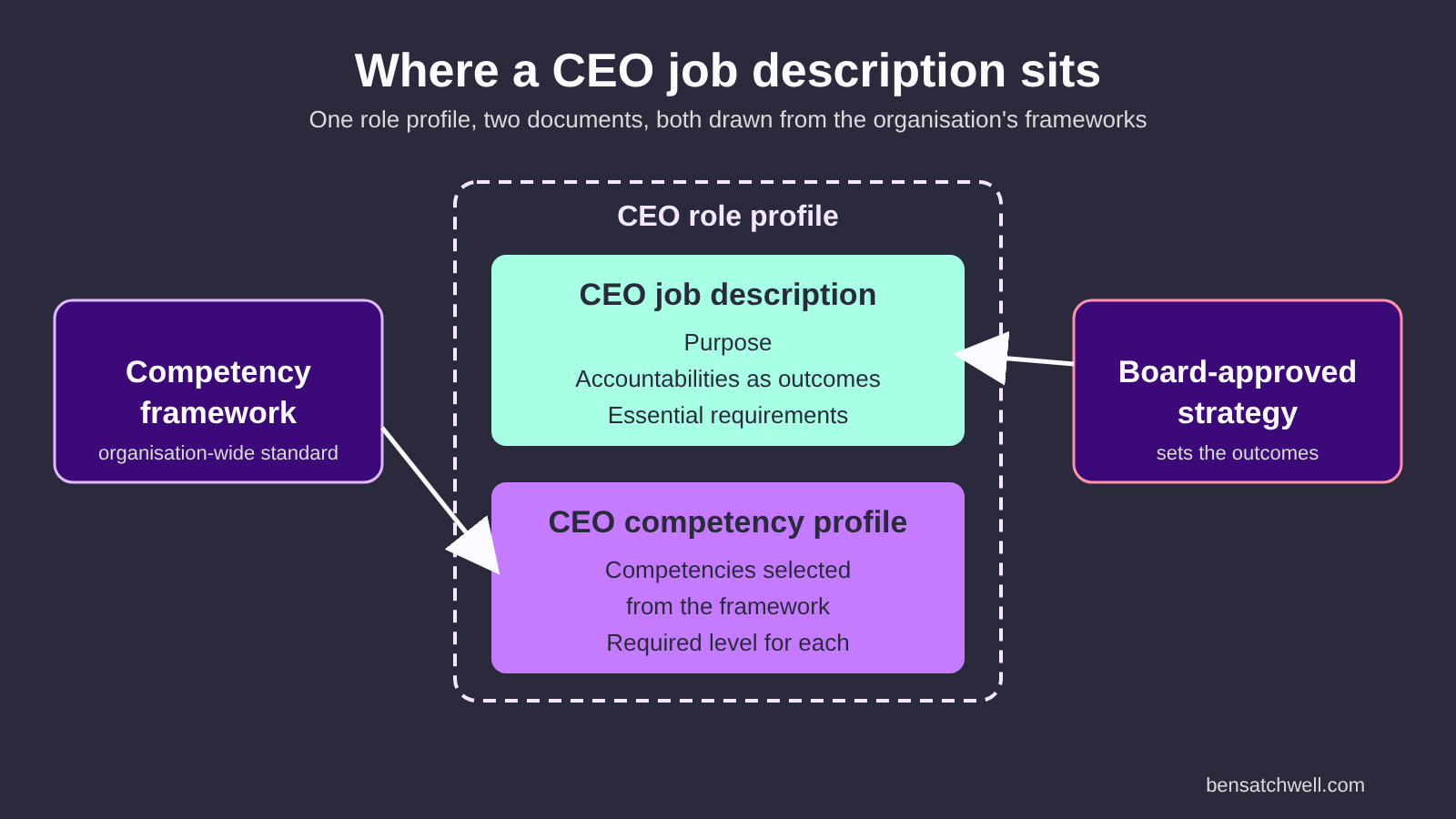
A note on terminology. A competency framework is also called a competency model, especially in the United States. I use competency profile for the competencies and required levels for one role, and competency matrix for the grid of required against current proficiency. Usage varies by region, and I explain the differences in this competency model definition.
What is the purpose of a CEO role?
The purpose statement is one or two sentences that say why the role exists. The NSW Government describes a role description as a short summary of a job that explains why the role exists and what outcomes it delivers, and its guidance on creating a new role description starts from the purpose of the role rather than a list of tasks.
A workable purpose for a CEO reads like this:
To lead the organisation in delivering the strategy the board has approved, and to give the board an accurate account of performance, risk and capability so that it can govern with confidence.
What accountabilities should a CEO job description include?
Five to seven accountabilities is enough. Each one is written as an outcome that someone could check, not as a duty. The table shows how common CEO tasks convert.
| Task people usually list | Accountability written as an outcome |
|---|---|
| Sets strategy | The board approves a strategy and plan that the executive can fund and deliver, and progress against it is reported honestly |
| Oversees operations | The organisation delivers its services or products to the agreed standard, cost and timeframe |
| Manages the budget | Resources are allocated to strategic priorities and results stay inside the approved financial limits |
| Reports to the board | The board receives timely, accurate information on performance, risk and compliance, including bad news |
| Builds the executive team | Executive roles are filled with people who can do them, and succession for each is understood |
| Represents the organisation | Regulators, partners, owners and the public have a credible and consistent point of contact |
The how to write a job description page walks through the steps and the review checklist for this part.
What essential requirements should it list?
O*NET asked incumbents how much education a new hire needs in the chief executive occupation. Of the respondents, 46% said a master's degree was required and 32% a bachelor's degree. ANZSCO describes a skill level commensurate with a bachelor degree or higher. The data shows a range, not a single required qualification.
Keep the essential list short and separate from the desirable list. List a credential as essential only if the organisation or its regulator needs it.
- Essential: senior experience leading an organisation or a major business unit, a record of delivering against a board-approved plan, and experience reporting to a board or governing body.
- Desirable: experience in the organisation's sector, or in a transaction such as a merger, a turnaround or a large system replacement.
What competency profile fits a CEO?
The job description says what the role is accountable for. The competency profile says what standard the role needs, and it selects from the organisation's framework rather than inventing new competencies. Written together they form a role profile. The levels below are illustrative, and the CEO competency framework shows how the competencies are defined and levelled for the role.
| Competency | Required level | What it looks like in this role |
|---|---|---|
| Strategic direction | Level 4 | Sets the direction that the rest of the organisation's plans depend on, and changes it when the evidence changes |
| Board and stakeholder relationships | Level 4 | Earns the trust of the board, regulators and owners, including when the message is unwelcome |
| Judgement under uncertainty | Level 4 | Makes decisions on novel problems with incomplete information and accepts accountability for them |
| Leading executives | Level 4 | Builds an executive team that works as a team, and holds its members to the standard |
| Financial and risk literacy | Level 3 | Reads financial and risk reports well enough to challenge them, and relies on specialists for the detail |
What a CEO job description is not
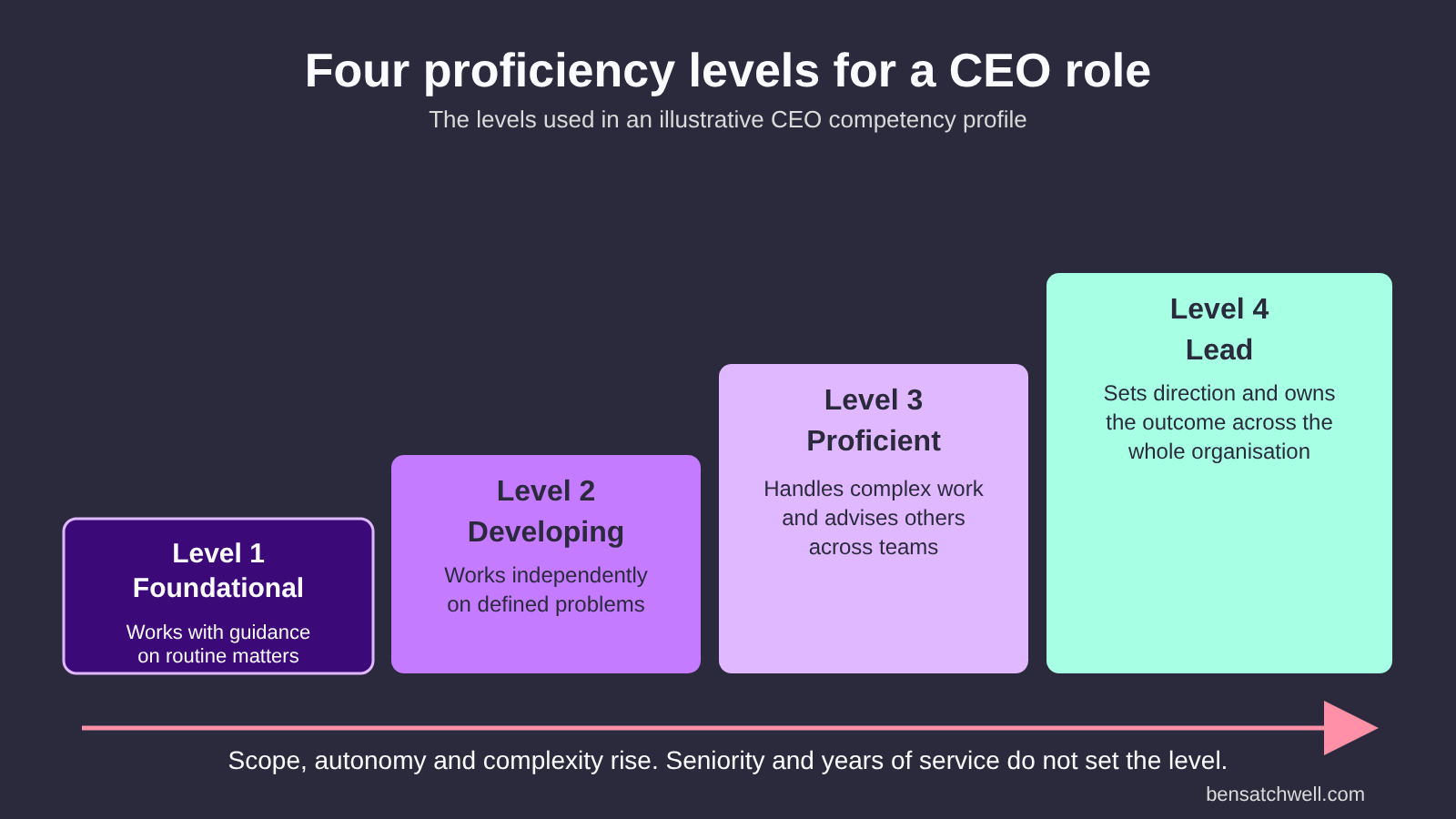
It is not a task list, a job advertisement, a performance agreement or a competency profile. Each of those answers a different question, and mixing them is the main reason these documents become unusable.
Where do CEO job descriptions go wrong?
- Task inventories. The list grows every year and never shrinks, until nobody can tell what the role is for.
- Board and CEO blurred. The document gives the chief executive duties that belong to the board, or the reverse, with no sense of where authority sits.
- Superhero requirements. The essential list describes a person no one could hire, so the board ends up compromising without saying what it traded away.
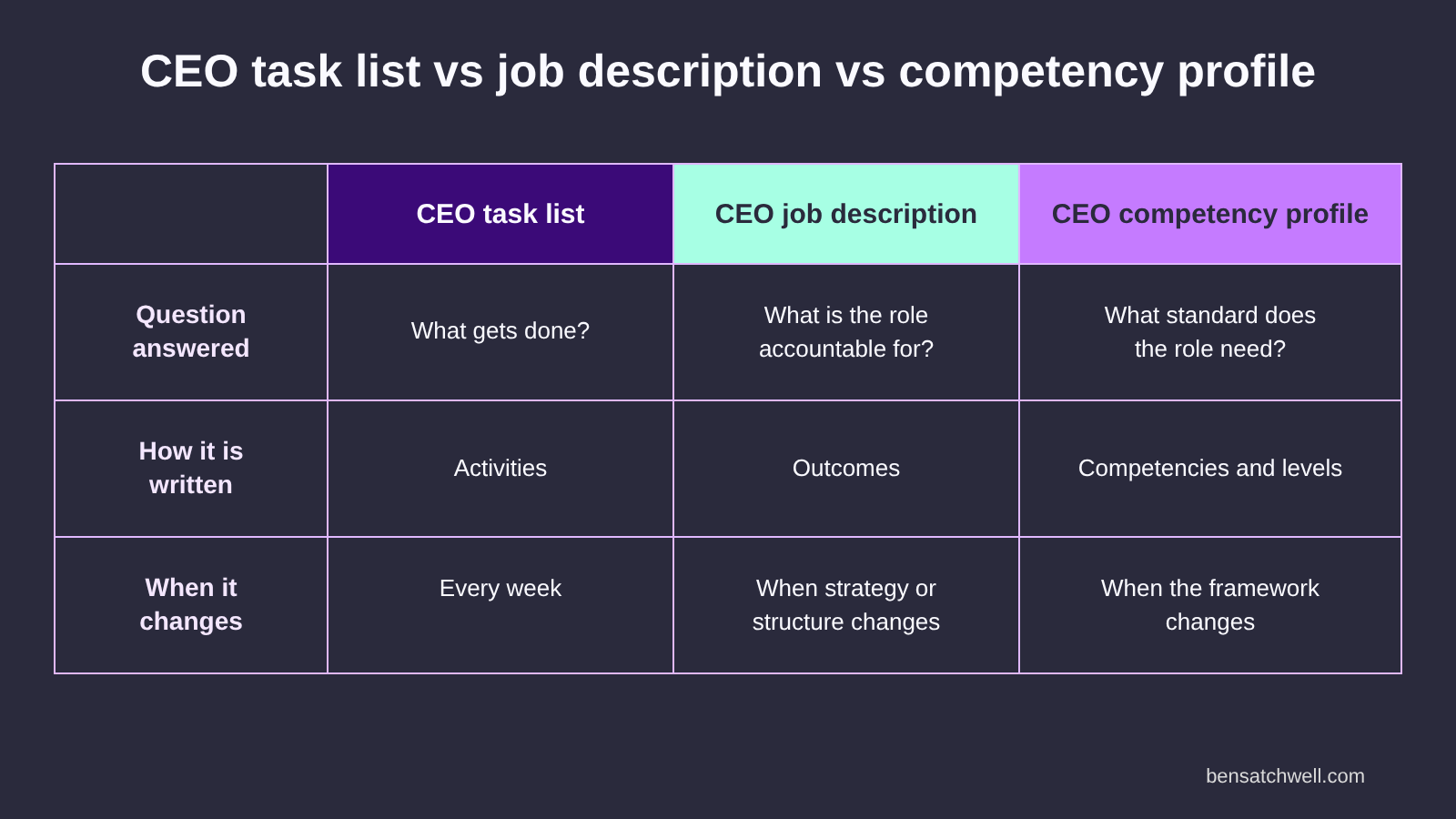
- Levels set by seniority. Every competency is set at the top level because the role is the top role, instead of being set by scope, autonomy and complexity.
Starting from the job description template avoids the first and second, and the job description examples show the same structure applied to other roles, such as the CFO job description.
What are the trade-offs when writing one?
Outcome wording takes longer to write than a task list, and it is harder to get agreement on. It pays back at review time, because outcomes survive a change of strategy and board composition.
A CEO description also has to fit a specific organisation. A listed company, a government agency and a family business all use the title, but the accountabilities to shareholders, ministers or owners differ. Write for the organisation you have, and use the competency profile to hold the common standard.
FAQ
What is the difference between a CEO and a managing director job description?
The titles overlap and usage varies by country and organisation. ANZSCO groups both under one occupation. The accountabilities are what matter, so use whichever title your organisation uses and write the same outcomes.
How long should a CEO job description be?
One to two pages. A purpose statement, five to seven accountabilities, a short essential and desirable list, and a pointer to the competency profile is enough.
What qualifications does a CEO need?
O*NET respondents for the chief executive occupation most often reported a master's degree, with a bachelor's degree next. Only list a degree as essential if the work or the regulator requires it.
Is a CEO job description the same as a position description?
Yes. Position description is the common term in Australia and job description is the common term in the United States. The content and structure are the same.