
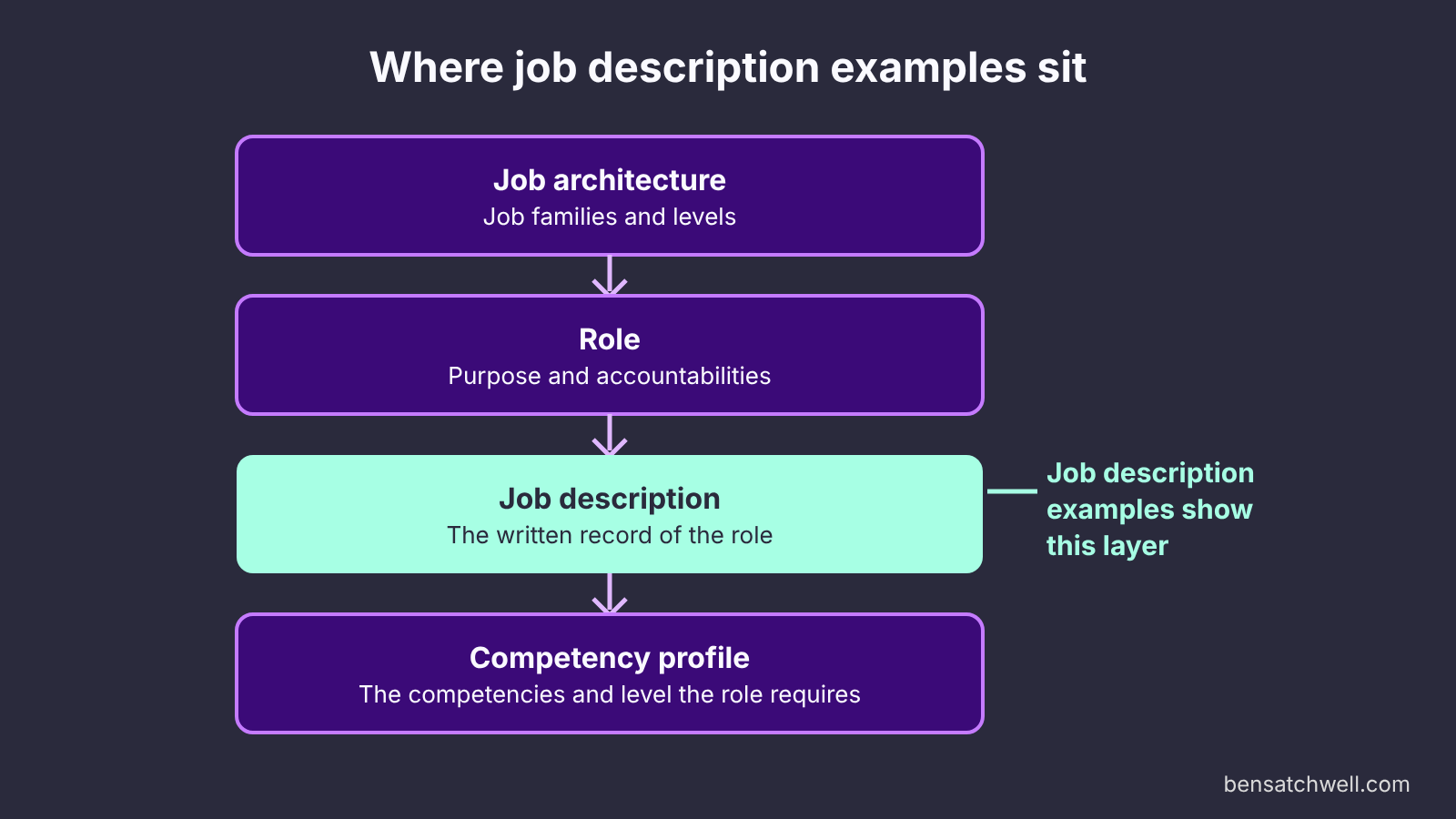
Job description examples are only useful if you can see why each one works. A job description records the role: its purpose, its accountabilities and what a person needs to do it. This page sets out what a good example contains, shows three short worked examples, and explains where examples mislead. The full method sits in my guide to the job description (position description). Usage of these terms varies by region, and I explain how I use them in this competency model definition.
What are job description examples?
Job description examples are completed job descriptions for real roles, used as a reference when you write or review your own. They show structure, level of detail and tone. They do not show what your role should contain, because your role has its own purpose and context.
It helps to be exact about what is being described. The International Labour Organization's ISCO-08 classification defines a job as a set of tasks and duties performed, or meant to be performed, by one person. An occupation is a set of jobs whose main tasks and duties are very similar. A job description example describes one job, so it can be borrowed from another organisation only where the tasks and duties genuinely match.
What does a good job description example contain?
Every example worth copying has the same five elements. The table shows each element and what it looks like for an administrative assistant.
| Element | What it records | Administrative assistant example |
|---|---|---|
| Role purpose | Why the role exists, in one or two sentences | Keeps the team's day running so leaders spend their time on work only they can do |
| Accountabilities | Outcomes the role answers for, not tasks | Meetings are coordinated with no avoidable clashes |
| Essential requirements | What the person must have on day one | Accurate written communication and proficiency with calendar and document tools |
| Role dimensions | Reporting line, scope and decision limits | Reports to the team leader, with no budget authority |
| Competency profile | The competencies and level required for the role | Organising work: level 2 of 4 |
Accountabilities written as outcomes are the feature that separates a useful example from a task list. A task list tells the reader what to do on Monday. An outcome tells them what must be true by Friday.
What do job description examples look like for different roles?
The three short examples below show the same structure on three very different roles. Each is an extract, not a complete job description.
Administrative assistant
Purpose: Keep the team's day running so that leaders and colleagues spend their time on the work only they can do.
- Calendars and meetings are coordinated with no avoidable clashes.
- Records are filed and findable within the agreed time.
- Correspondence is drafted accurately and issued on time.
The US Department of Labor's O*NET summary for secretaries and administrative assistants lists tasks such as answering telephones and giving information to callers. It also lists knowledge, skills and abilities for the occupation, which is a useful check on whether your requirements are complete.
HR generalist
Purpose: Give managers accurate advice on employment matters so that people decisions are lawful, consistent and timely.
- Employee relations cases are resolved within the agreed turnaround.
- Policy changes are communicated and recorded.
- HR data in the system is accurate at each month end.
Project coordinator
Purpose: Keep project information current so the project manager can see progress, risk and cost without chasing.
- The plan, risk log and decision log are updated every week.
- The status report is issued by the agreed time.
- Meeting actions are tracked to closure.
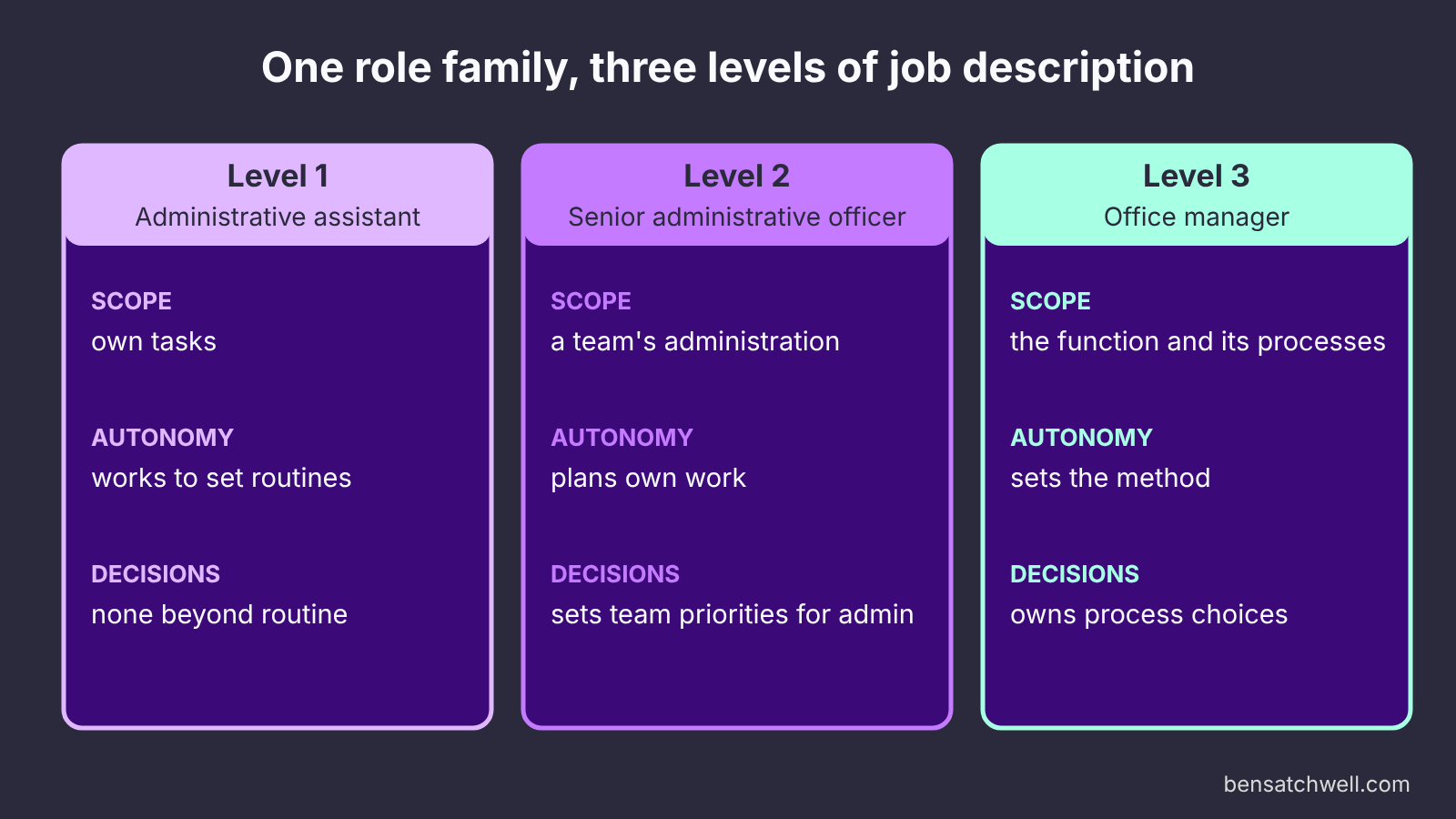
How should I use a job description example?
Use an example to check structure, not to supply content. Start with the purpose of your own role, write the accountabilities as outcomes, then compare your draft with the example to see what you have missed.
My guide on how to write a job description gives six steps and a review checklist for that process. If you want a blank structure to fill in, use the job description template.
Where do job description examples go wrong?
Examples fail in four ways.
- Copied wholesale. The result describes someone else's role, and the first performance conversation exposes it.
- Written as task lists. The reader cannot tell what good performance looks like.
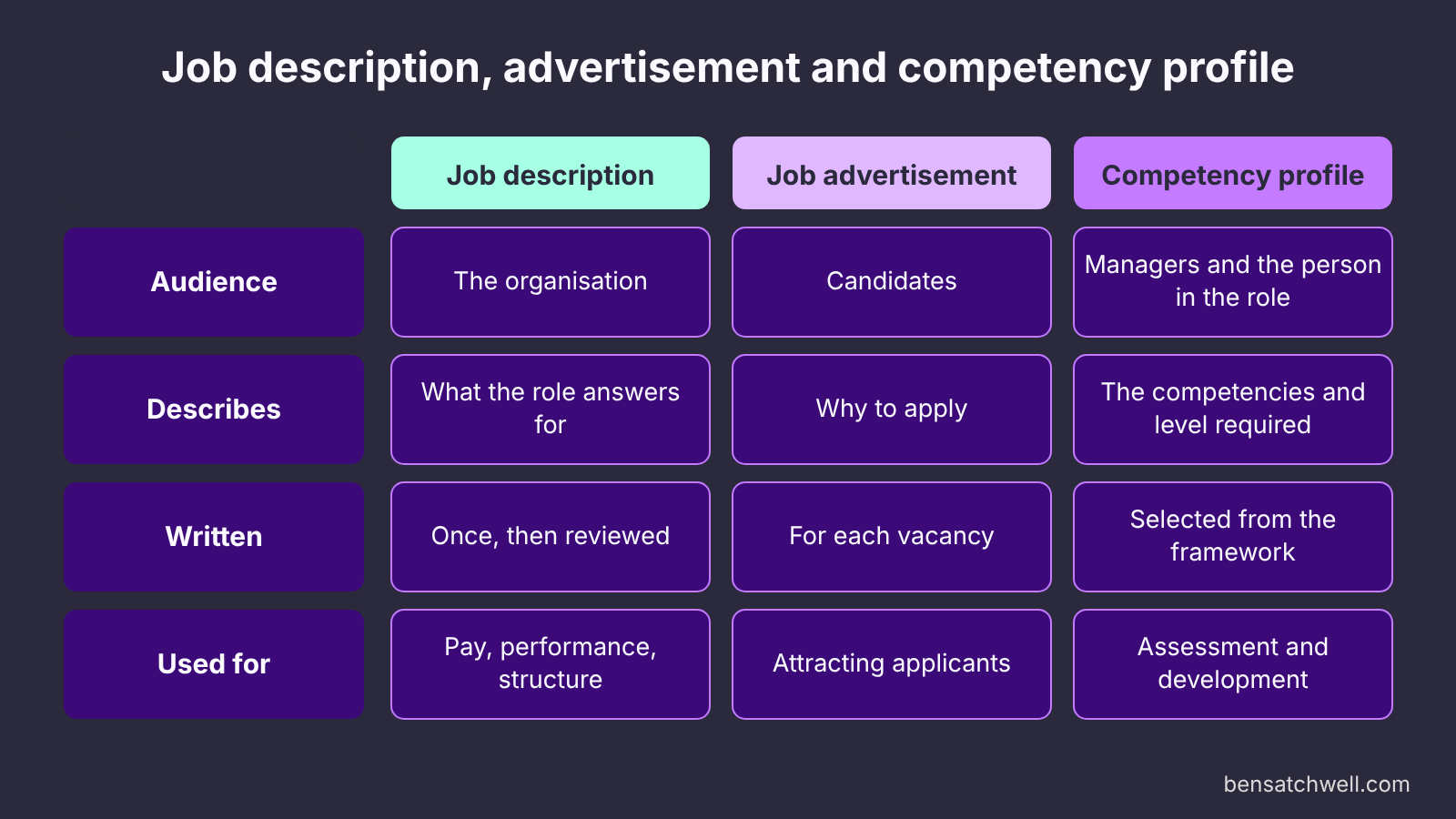
- Confused with a job advertisement. An advertisement sells the role to candidates. A job description records the role for the organisation.
- Missing the standard. A job description records the role, and a competency profile records the standard. Without the profile, two managers will read the same accountability and expect different levels. Your competency framework is where those levels are defined.
Should I use a job description or a position description?
They are the same document under two names. Australian readers usually say position description, and US readers say job description. The NSW Government publishes a sector role description library for roles common across the public sector. It describes the library as a way to save time and keep role descriptions consistent across agencies, and it notes that details such as role dimensions must still be added to complete each one. That is the right way to treat any example: a starting structure that you complete.
FAQ
What is a good example of a job description?
A good example has a one or two sentence purpose, three to six accountabilities written as outcomes, essential requirements, role dimensions and a competency profile. It is short enough to read in two minutes and specific enough that two managers would expect the same performance.
How long should a job description be?
Most are one to two pages. Length is not the test. The test is whether the purpose, accountabilities and requirements are each clear without needing a verbal explanation.
Can I copy a job description example from another organisation?
You can copy the structure. Do not copy the content, because the accountabilities describe that organisation's work, reporting lines and decision limits. Check any borrowed wording against the tasks and duties your role actually has.
What is the difference between a job description and a job advertisement?
A job description records the role for the organisation and stays in use while the role exists. A job advertisement is written once to attract candidates and leaves out detail that a job description must carry, such as decision limits.
What is the difference between a job description and a competency profile?
A job description records what the role is accountable for. A competency profile records the competencies and level required to do it. The two are used together.