
The job description vs position description question has a short answer. In most workplaces they are the same document under two names, and the confusion comes from a third term, the job specification, which is a different thing. This article separates the three, shows where they overlap and says which one to use in your market. If you want the wider picture first, start with the job description pillar page. Usage of these terms varies by region, and I explain how I use them in this competency model definition.
I treat the three terms as answers to two questions. A job description or position description answers "what is this role for and what is the person accountable for?" A job specification answers "what must the person bring to it?" Most of the mess comes from organisations that blend the two answers into one document without saying so.
Job description vs position description: which term should I use?
Use the term your readers already use. The document is the same either way.
- Use position description when you write for Australian employers and candidates. It is often shortened to PD.
- Use role description when you work in the NSW public sector, where the Public Service Commission uses that name for the same document.
- Use job description for the United States and for global audiences. It is also the dominant search term, which matters if you publish the document.
- Use job specification only for the list of requirements a person must meet, and say so in the heading.
What is the difference between a job description and a position description?
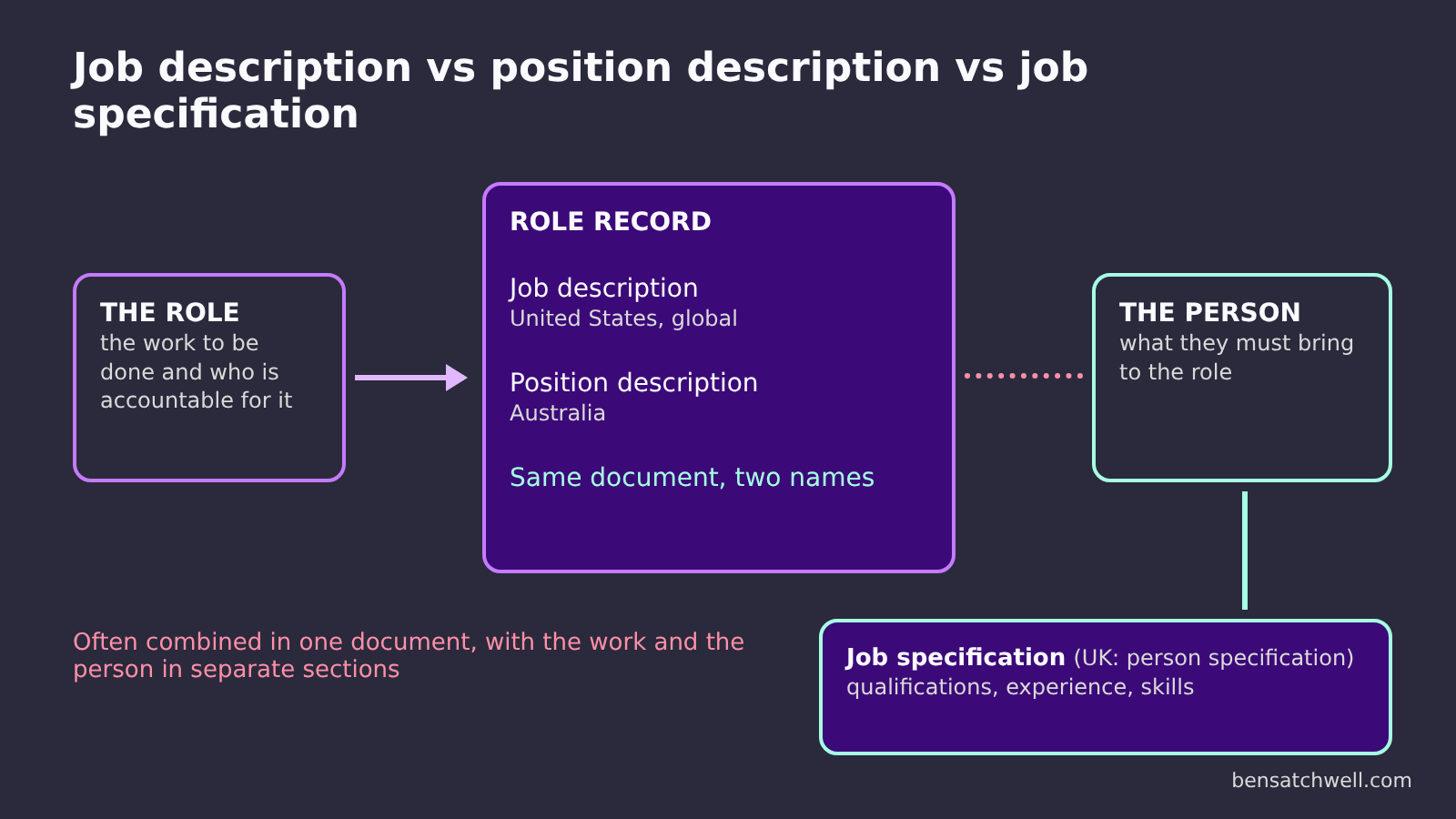
In everyday use, none. A position description is the Australian name for a job description. The two terms point at the same record of purpose, accountabilities and requirements for one role.
There is a finer distinction that some organisations keep in their HR systems. The International Labour Organization defines a job in ISCO-08 as "a set of tasks and duties performed, or meant to be performed, by one person", and an occupation as a set of jobs whose main tasks and duties are highly similar. Neither definition describes a document. They describe the work. Some organisations therefore separate a job, a type of work shared by many people, from a position, one funded seat in the structure. Where they do, a job description is shared and a position description is specific to the seat. Check which convention your organisation uses before you rely on the difference.
What is the difference between a job description and a job specification?
This is the real difference. The job description is about the work. The job specification is about the person.
- Job description: the purpose of the role, its accountabilities, its context and its relationships.
- Job specification: the qualifications, experience, knowledge and skills a person needs to be appointed.
In the United Kingdom the second part is often called a person specification. In practice many organisations publish one document that holds both, and call the whole thing a job description or a job specification. That is why the terms look interchangeable on job boards.
The NSW Public Service Commission shows the combined approach. Its role description guidelines list the primary purpose of the role, key accountabilities, key challenges, key relationships and role dimensions, then key knowledge and experience, essential requirements and capabilities for the role. The work and the person sit in one document, in separate sections.
How do the three terms compare?
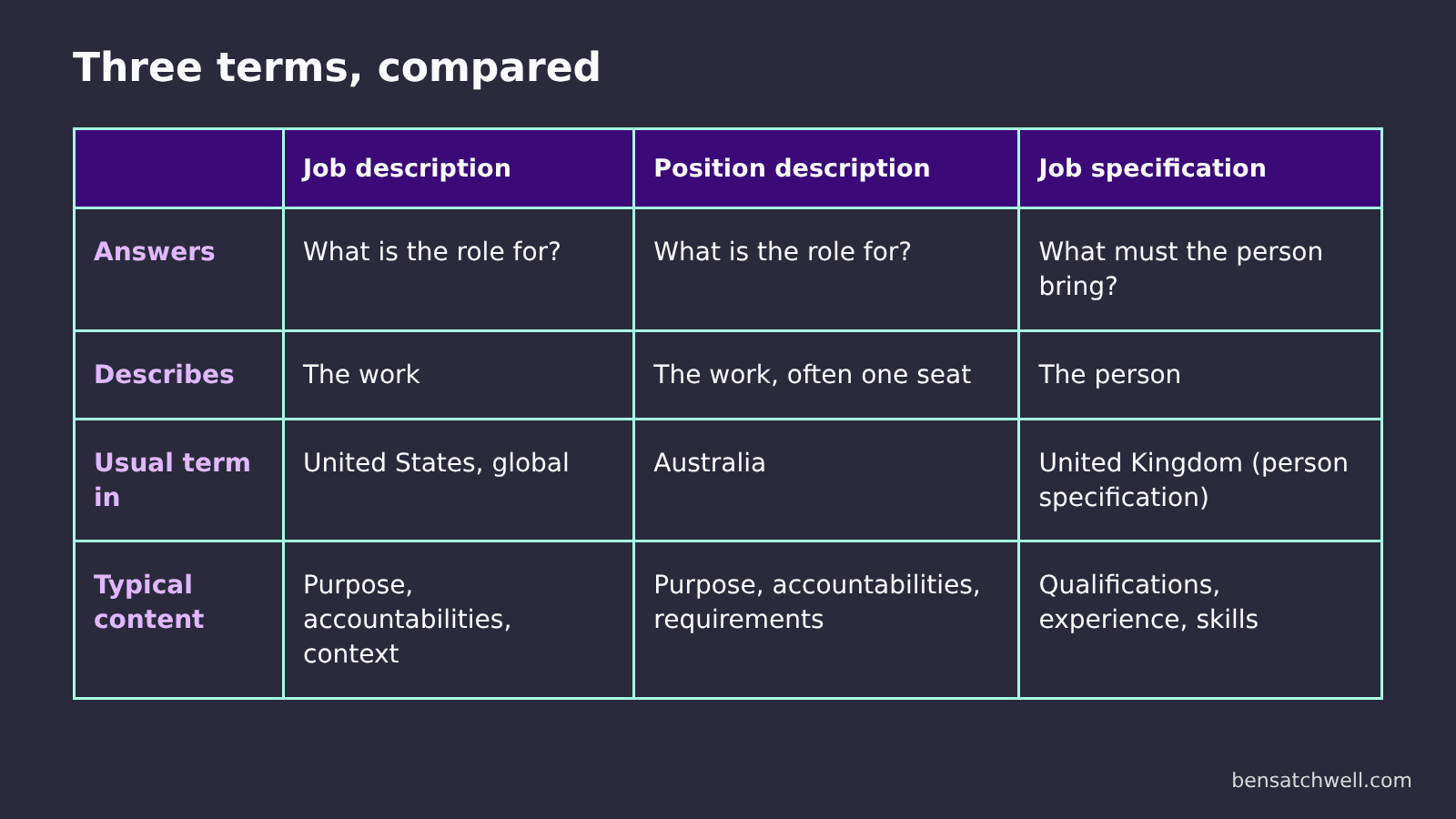
| Dimension | Job description | Position description | Job specification |
|---|---|---|---|
| Question it answers | What is the role for? | What is the role for? | What must the person bring? |
| Describes | The work | The work, often for one seat | The person |
| Typical content | Purpose, accountabilities, context | Purpose, accountabilities, context, requirements | Qualifications, experience, skills, knowledge |
| Where it is the usual term | United States, global | Australia | United Kingdom, often as a person specification |
| Changes when | The role changes | The role or reporting line changes | The standard for appointment changes |
What is a job description used for?
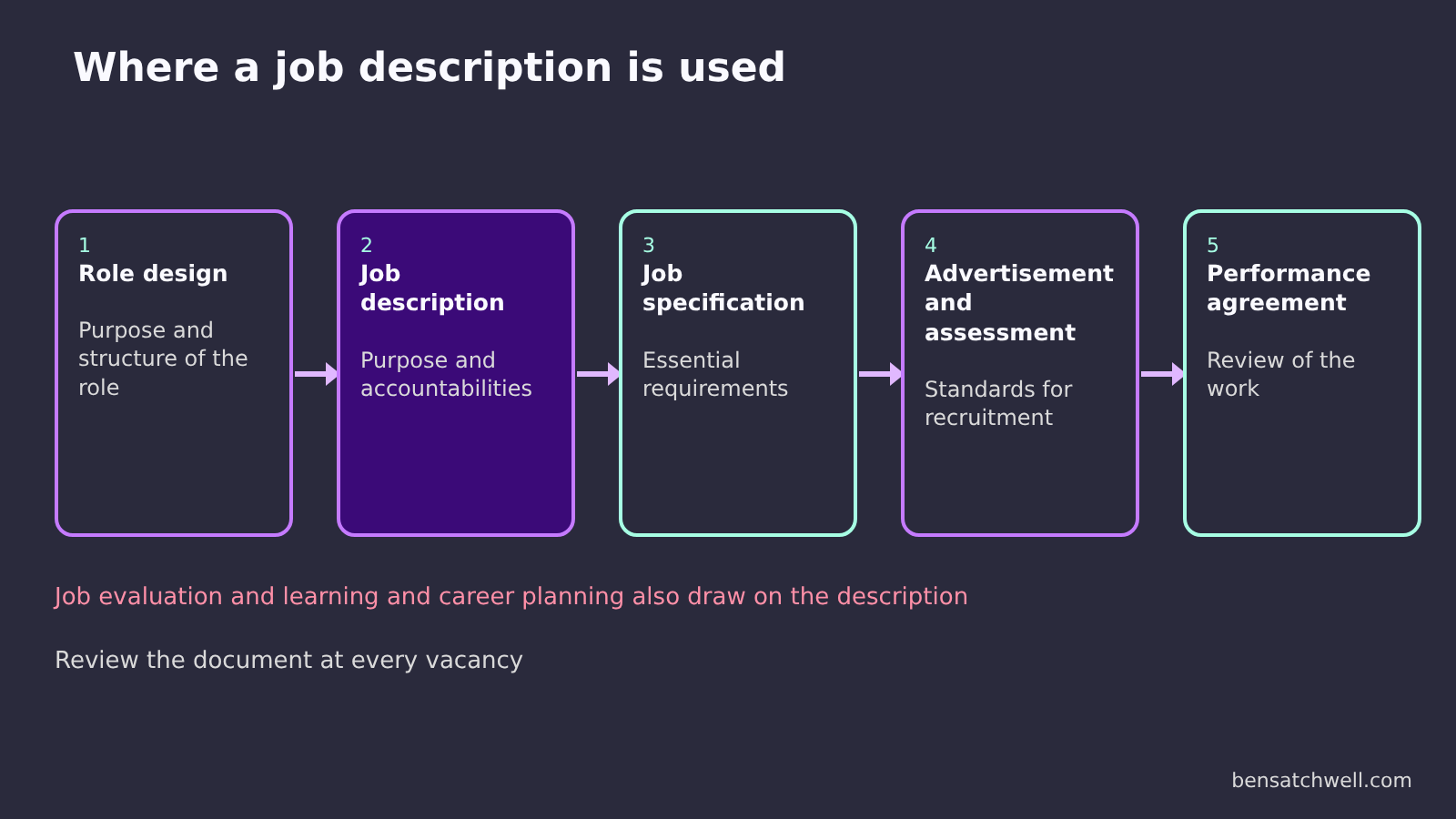
The NSW guidelines say the role description is the basis for job evaluation, for explaining the role to employees, managers and applicants, for setting assessment standards in recruitment and mobility, for performance agreements and reviews, for identifying learning and development needs, and for planning career development. A document that serves that many decisions needs a clear owner and a review date.
In the United States the document also has a legal use. The regulation at 29 CFR 1630.2(n) lists written job descriptions prepared before advertising or interviewing applicants as one kind of evidence of whether a function is essential. It sits alongside the employer's judgment, the time spent on the function and the consequences of not requiring it. A description is evidence, not proof.
What a job description is NOT
Four documents get mistaken for it.
- It is not a job specification. A specification lists what a person needs. A description lists what the role is for. Mixing the two produces a document that is half duties and half wish list.
- It is not a performance agreement. The NSW guidelines say short-term projects and goals belong in performance agreements, because they date quickly.
- It is not a competency profile. A job description records the role. A competency framework holds the standard, and a competency profile selects from it the competencies and levels one role needs. The description can reference the profile without repeating it.
- It is not the advertisement. The advertisement sells the role to candidates. The description is the record the organisation manages against.
Where do job descriptions and job specifications fail?
- Two documents, two answers. The description says one thing, the advertisement another, and the specification a third. Candidates and managers read different versions of the same role.
- Task lists with no purpose. A page of duties with no statement of purpose cannot be evaluated or levelled.
- Requirements as wish lists. If every item is "essential", none is. Essential requirements should be the few things without which the person cannot do the work.
- No review date. The document describes the role as it was when the last person left. The NSW guidelines treat a vacancy as the moment to check whether the role is still structured the right way.
- Copying titles instead of work. Borrowing a description from another organisation imports its structure and its assumptions.
One combined document or two separate ones?
Keep one document when the role is stable and the requirements are short. This is the usual choice in the Australian public sector, as the NSW example shows. Split the specification out when the same role is filled often, when requirements change faster than the work, or when you need the standard for appointment to be reviewed separately.
Whichever you choose, state in the document which sections describe the work and which describe the person. If you are ready to write one, the guide on how to write a job description gives six steps and a review checklist. The job description template sets out the structure with a worked example, and the job description examples page shows what good looks like.
Frequently asked questions
Is a position description the same as a job description?
Yes, in everyday use. Position description is the Australian term for the document most other countries call a job description. Some organisations reserve the term for a description of one specific seat, so check their convention.
What is a job specification?
A job specification lists what a person must bring to a role: qualifications, experience, knowledge and skills. In the United Kingdom it is often called a person specification. It describes the person, where a job description describes the work.
Is a role description the same as a position description?
For practical purposes, yes. The NSW Public Service Commission uses role description for the document that Australian employers elsewhere call a position description.
Which term should I use in my country?
Use position description for Australian audiences, role description inside the NSW public sector, and job description for the United States and global audiences. Use job specification or person specification only for the requirements section.
Does a job description have legal weight?
In the United States, the regulation at 29 CFR 1630.2(n) names a written job description prepared before advertising or interviewing as evidence of whether a function is essential. It is one piece of evidence among several. Outside the United States, check the local rules.
Should the job description and the job specification be one document?
One document is simpler when the role and its requirements are stable. Split them when the same role is filled often or when the requirements change faster than the work. Label which sections describe the work and which describe the person.