

To write a job description, you work out what the role must achieve, state that as a short purpose and a handful of outcomes, separate what is essential from what is merely wanted, and attach the capabilities the role needs at a stated level. This guide takes you through those steps in order, with a worked example and a checklist for review. It sits inside my wider guide to the job description, which covers what the document is and where it fits. In Australia and across the public sector the same document is called a position description, so everything here applies to writing a position description too. Usage of these terms varies by region, and I explain how I use them in this competency model definition.
What does it mean to write a job description?
Writing a job description means producing a written record of one role: why it exists, what it is accountable for and what it takes to do well. It is not a list of everything the current holder happens to do, and it is not a vacancy advertisement. The NSW Government describes a role description as a short summary of a job that explains why the role exists, the outcomes it delivers, and where and how the role works (NSW Government, creating a new role description).
The document needs to be written well because four decisions draw on it: who to recruit, how to classify and pay the role, what to measure the person against, and what to develop. A weak description makes all four harder.
How do you write a job description step by step?
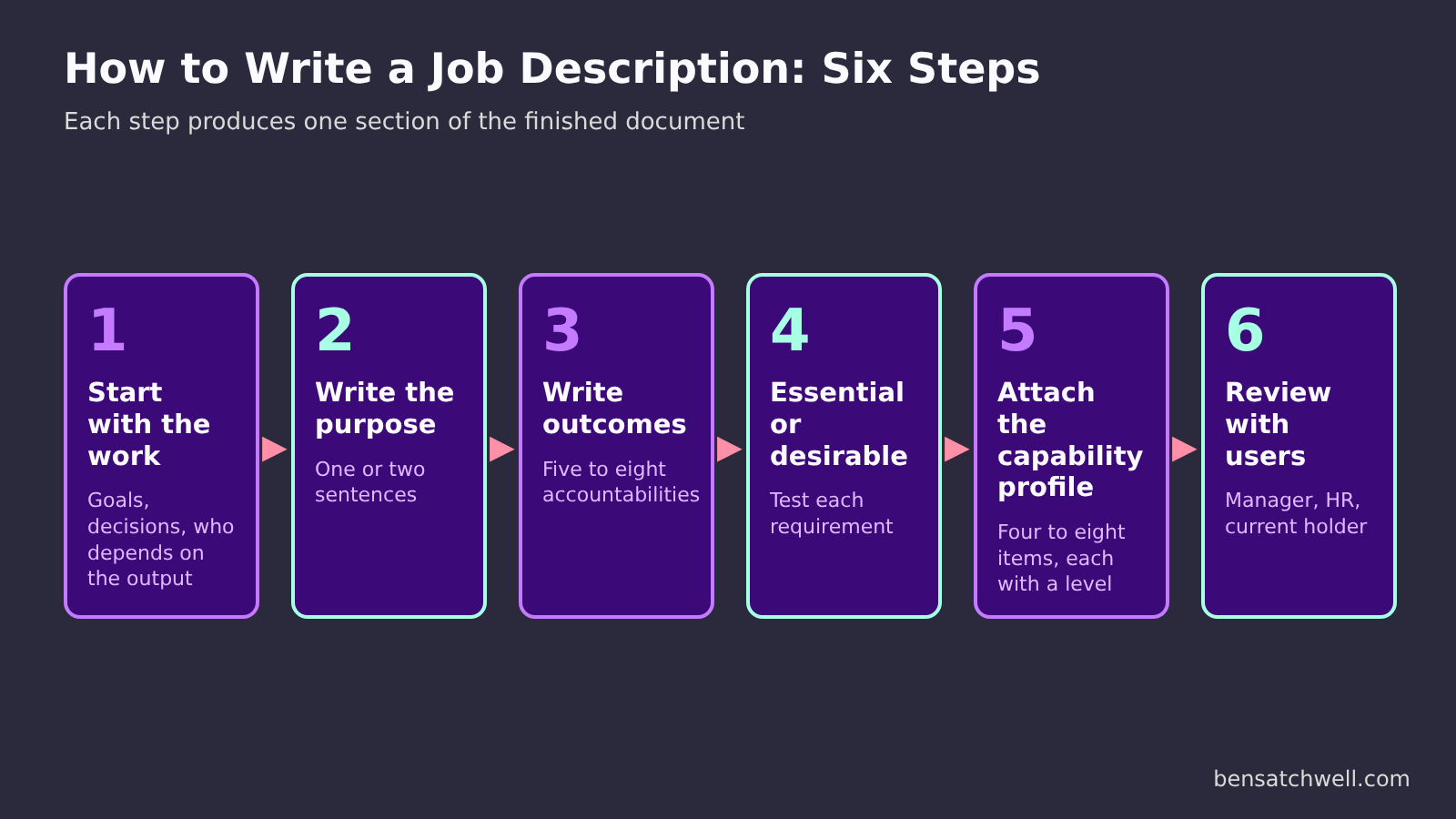
Work through the six steps in order. Each one produces a piece of the finished document, set out in the sections of my job description template.
Step 1: Start with the work, not the person
Ask the manager, and the current holder if there is one, what the role must achieve in the next twelve months and which decisions it makes alone. Note who depends on the output. If you start from a favourite candidate or the previous version, you inherit their strengths and blind spots along with the task list.
Step 2: Write the role purpose in one or two sentences
The purpose says why the role exists and what changes because it does. If you cannot say it in two sentences, the role is probably two roles. Test it by asking whether the holder would recognise their job in it.
Step 3: Write accountabilities as outcomes
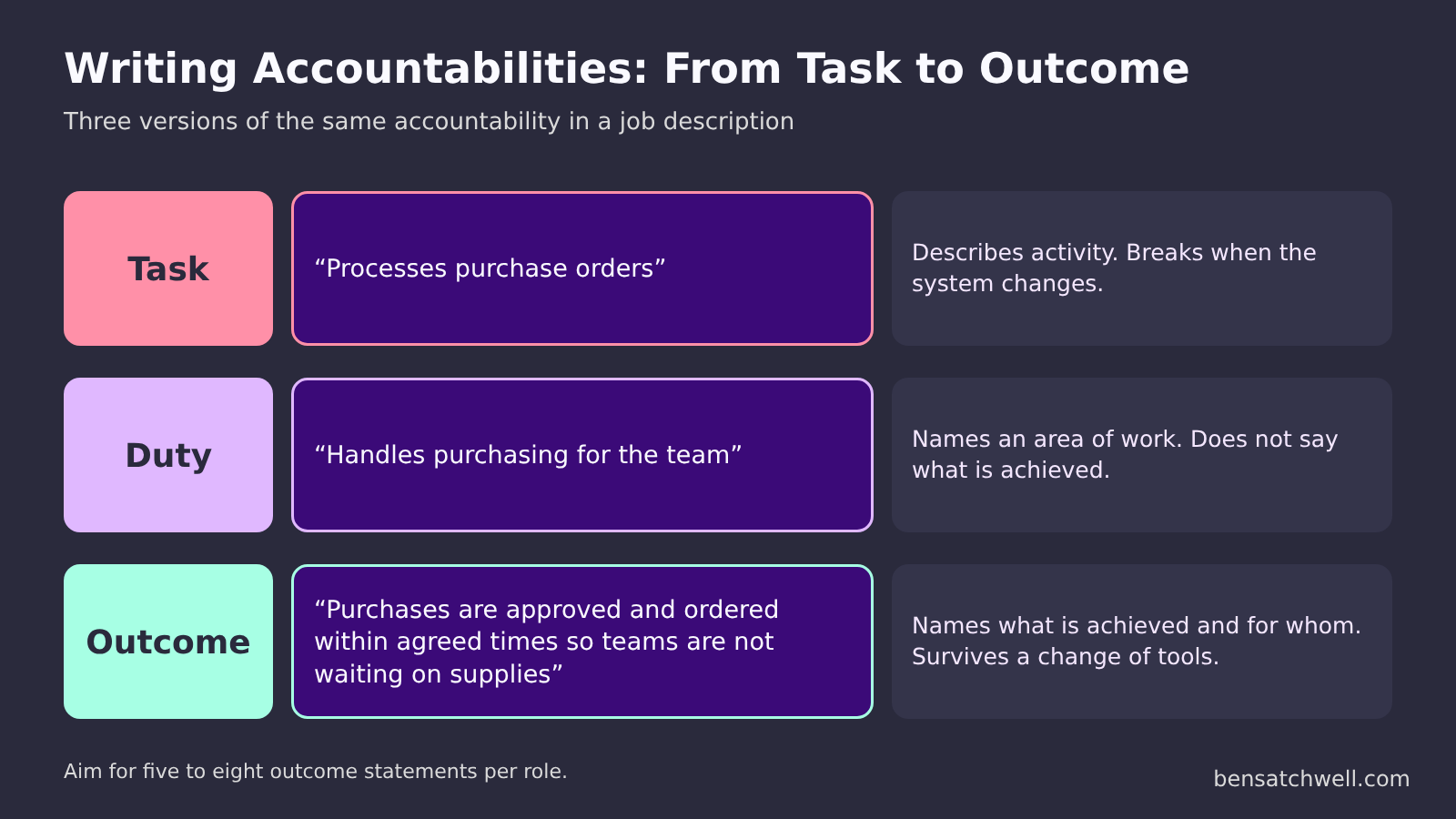
Aim for five to eight statements. Each names what is achieved and, where it helps, who benefits. The NSW guidance is blunt on this point: focus on outcomes, not tasks or processes. A task such as "processes purchase orders" breaks the moment the system changes. An outcome such as "purchases are approved and ordered within agreed times so teams are not waiting on supplies" survives the change.
Step 4: Separate essential from desirable requirements
Every essential requirement removes candidates, so test each one. Could a capable person do the job without it? Many requirements survive only because they were in the last version. In the United States this carries legal weight as well. The regulation implementing the Americans with Disabilities Act lists written job descriptions prepared before advertising or interviewing applicants as one piece of evidence of which functions of a job are essential (29 CFR 1630.2(n)(3)). It is one factor among several, alongside the employer's judgment and the time spent on the function, so write the list honestly and keep it short.
Step 5: Attach the capability or competency profile
Select the capabilities or competencies the role needs from your organisation's framework and state the required level of each. Do not invent new wording inside the job description. The NSW guidance does the same, directing writers to choose capabilities from the NSW Public Sector Capability Framework and then set the level. If you have no framework yet, start with the guides to the competency framework and the capability framework, which explain the two structures.
The SFIA Foundation follows the same pattern. Its role profile combines a role purpose, an overall level and a skills profile of the selected skills and levels, and it advises keeping the skills to five to seven (SFIA Foundation, building SFIA-based skills profiles). Four to eight items is a sound range for most roles.
Step 6: Review it with the people who will use it
The manager, HR and the current holder should each read the draft. A good test is whether you can remove any sentence without losing the meaning of the role. If you can, remove it.
Job description worked example: Procurement Analyst
Here are the steps applied to a procurement analyst in a mid-sized organisation.
| Section | Completed example |
|---|---|
| Title and classification | Procurement Analyst, Band 4, Finance and Procurement |
| Role purpose | Keeps purchasing visible and within budget, so that teams get what they need at an agreed price and the finance team can see commitments before they become costs. |
| Key accountabilities | Purchase requests are assessed and approved within agreed times. Spend against budget is reported to cost centre owners each month. Supplier prices are compared at each renewal and the result recorded. Recurring delays are traced to a cause and reported with a proposed fix. |
| Relationships and reporting | Reports to the Procurement Manager. Works with cost centre owners and Accounts Payable. Manages no staff. |
| Scope and authority | Approves purchases up to a set limit. Escalates anything above it and any single-supplier purchase. |
| Essential requirements | Two years in a purchasing, finance or supply role. Working knowledge of spreadsheets and a purchasing system. |
| Desirable | A recognised procurement qualification. |
| Capability profile | Analysis and judgement, level 3. Communication, level 2. Planning and organising, level 2. Working with others, level 2. |
Notice what is missing. There is no list of software and no "other duties as required". The qualification sits under desirable because a capable analyst could do the job without it.
Job description review checklist
Run through these checks before the description is released. If one fails, fix it and read the document again.
- The purpose is one or two sentences and the holder recognises their job in it.
- There are five to eight accountabilities and each states an outcome.
- Each essential requirement passes the test of whether a capable person could do the job without it.
- The capability profile uses wording and levels from your framework, with four to eight items.
- Reporting lines, scope and authority are stated, with nothing left to assumption.
- The description names no person, and the wording would suit anyone who holds the role.
- The manager, HR and the current holder have each read it.
- The title and classification match the rest of your job architecture.
What a job description is not
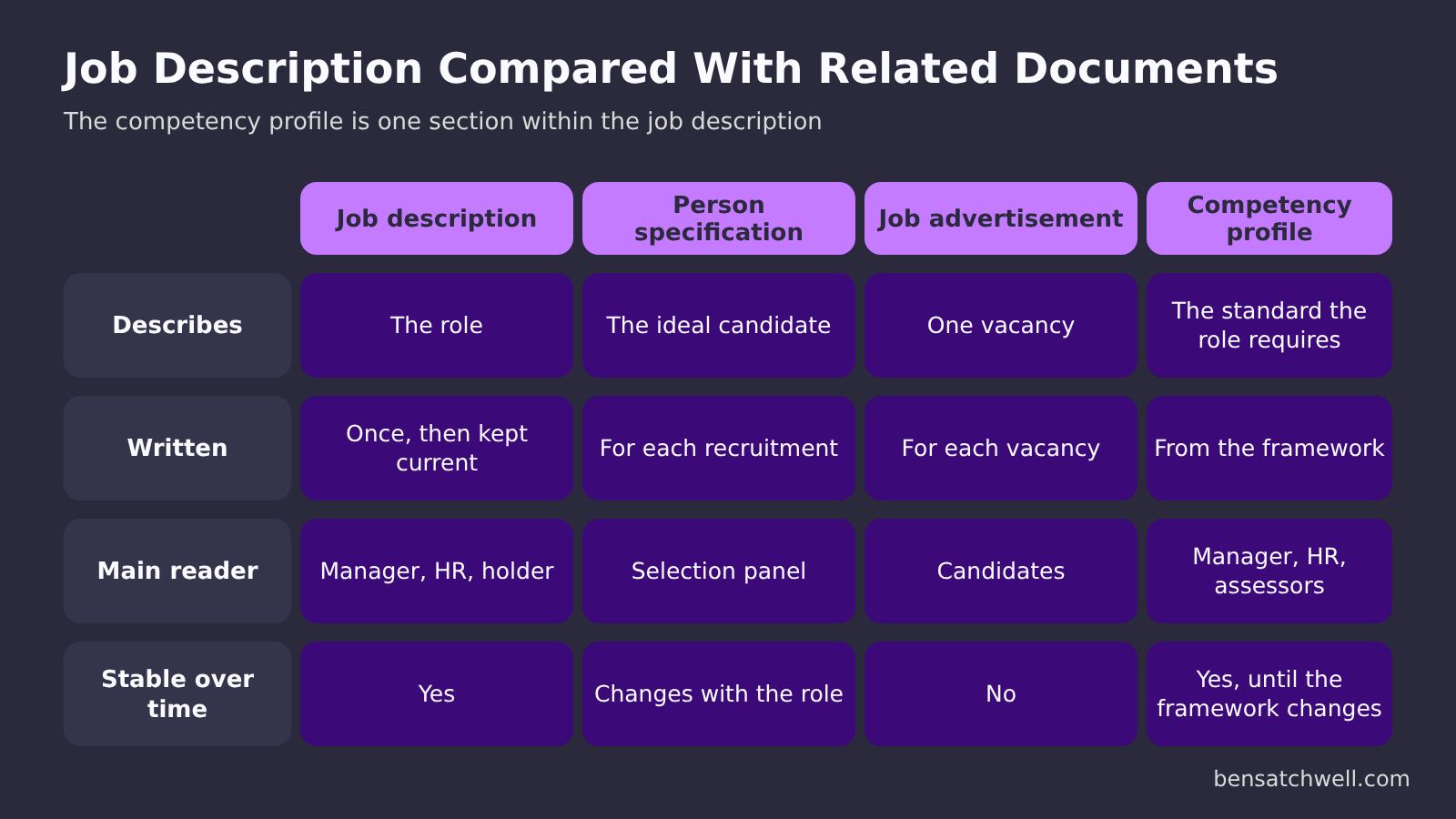
Writers often mix a job description with the documents around it, which is why the result becomes too long.
- Not a person specification. The description covers the role. The specification covers the ideal candidate.
- Not a job advertisement. An advertisement is written for one vacancy and one audience. The description stays stable.
- Not a performance review. It states what the role is accountable for, not how well one person is doing it.
- Not a competency profile. The job description records the role. The profile records the standard the role requires and forms one section of the description. A competency matrix then shows the required levels for many roles in one grid.
Where do job descriptions go wrong?
- Tasks instead of outcomes. A list of duties is out of date as soon as the tools change.
- Copying the last version. Requirements and wording carry over without anyone testing them.
- Everything marked essential. Capable candidates, often from a different background, rule themselves out.
- Invented capability wording. Each manager writes their own, so no two roles can be compared.
- Writing around a person. The role is shaped to fit a favourite candidate or the current holder.
- No owner. Without a named reviewer, descriptions drift away from the work they describe.
What are the trade-offs of a short job description?
A short description is easier to keep accurate, but it leaves out detail that some readers need. Public sector and regulated roles often need more, such as legislated duties or licence conditions. My rule is to state in the description only what applies to everyone in the role and stays stable, and to put changing detail in a work plan. The NSW guidance makes the same point, advising that only information that applies to all applicants and will stay the same over time belongs in the description.
FAQ
How long should a job description be?
One to two pages. A purpose of one or two sentences and five to eight accountabilities are enough for most roles.
What is the difference between how to write a job description and how to write a position description?
Nothing in method. Position description is the Australian and public sector name for the same document, so the same six steps apply.
Who should write a job description?
The hiring manager should draft it with input from the current holder, and HR should check it against the framework and the job architecture. A single named owner should keep it current.
Should a job description list skills or competencies?
List competencies or capabilities with a required level, taken from your framework. Name specific tools or methods only where the role cannot function without them.
How often should a job description be reviewed?
Review it when the role changes and at least once a year with the manager. Review the role itself at the same time, including whether it is still needed.
Can I use a template to write a job description?
Yes. A template fixes the headings so every role is described the same way, and it speeds up the first draft. The content still has to come from the work.