

A job description template is a fixed set of headings that makes every role in an organisation get described the same way. This page gives the template in full, a worked example for one role and the checks I run before a description is released. It is a companion to my guide to the job description, and it works unchanged as a position description template, because in Australia and across the public sector the same document goes by that name.
What is a job description template?
A job description template is a reusable document structure listing the sections every job description must contain, with a prompt and a test for each section. It standardises the form, not the content. The content for each role still has to come from the work.
The template describes a job and the role in it. The International Labour Organization defines a job as "a set of tasks and duties performed, or meant to be performed, by one person" (ILO, ISCO-08). A template keeps that description consistent, so a recruiter, a manager and a candidate read the same seven sections in the same order.
A note on terminology. A competency framework is also called a competency model, especially in the United States. I use competency profile for the competencies and required levels for one role, and competency matrix for the grid of required against current proficiency. Usage varies by region, and I explain the differences in this competency model definition.
What sections should a job description template include?
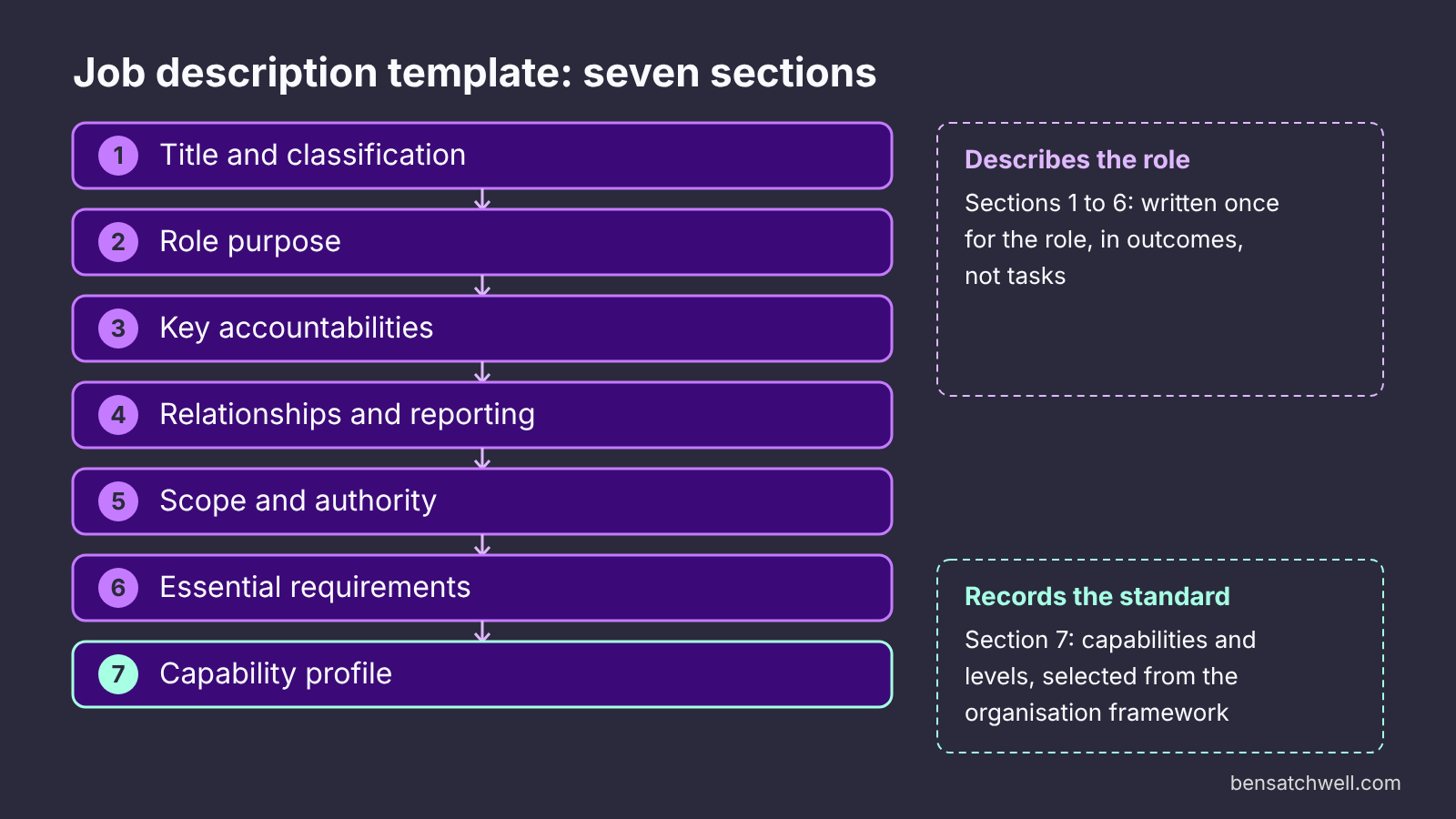
Seven sections cover what a hiring decision, a pay decision and a performance conversation need. Each has a prompt to complete it and a test it must pass.
| Section | Prompt | Test it should pass |
|---|---|---|
| Title and classification | Job title, grade or band, job family | A reader can place the role in the structure without asking. |
| Role purpose | Why the role exists, in one or two sentences | The holder recognises their job in it. |
| Key accountabilities | Five to eight outcome statements | Each says what is achieved, not only what is done. |
| Relationships and reporting | Who the role reports to, works with and manages | No part of the role depends on an unwritten assumption. |
| Scope and authority | Budget, people, systems and decisions the role can take alone | A manager can say what needs approval and what does not. |
| Essential requirements | Qualifications, licences, registrations and experience the role cannot do without | A capable person could not do the job without each item. |
| Capability profile | The capabilities or competencies the role needs, each with a required level | Every item and level comes from a framework, not from new wording. |
The essential requirements section carries legal weight in some places. In the United States, the regulation that implements the Americans with Disabilities Act lists written job descriptions prepared before advertising or interviewing as evidence of which functions of a job are essential (29 CFR 1630.2(n)(3)). That is a practical reason to keep the list short and honest.
Job description template to copy
Copy the headings below into your own document and replace each bracket.
- Job title: [title]. Grade or band: [grade]. Job family: [family].
- Role purpose: [One or two sentences on why the role exists and the outcome it delivers.]
- Key accountabilities: [Five to eight statements, each naming an outcome and who benefits.]
- Relationships and reporting: Reports to [role]. Works with [roles]. Manages [roles or none].
- Scope and authority: [Budget, headcount, systems, decisions the role can take alone.]
- Essential requirements: [Qualifications, licences, registrations, experience.]
- Capability profile: [Capability or competency from the framework, required level.]
Job description template worked example
Here is the template completed for a customer service team leader.
| Section | Completed example |
|---|---|
| Title and classification | Customer Service Team Leader, Band 5, Customer Operations |
| Role purpose | Keeps a team of eight advisers resolving customer contacts accurately and on time, so customers do not have to repeat themselves. |
| Key accountabilities | Customer issues are resolved at first contact in most cases. Advisers receive coaching every fortnight. Rosters cover forecast demand. Recurring complaints are reported to the service manager with a proposed fix. |
| Relationships and reporting | Reports to the Customer Service Manager. Works with Billing and Product. Manages eight advisers. |
| Scope and authority | Approves credits up to a set limit, approves leave and sets the weekly roster. Escalates refunds above the limit. |
| Essential requirements | Two years in a customer contact role. Experience leading others, formal or informal. |
| Capability profile | Communication, level 3. Coaching others, level 3. Problem solving, level 2. Planning and organising, level 2. |
Notice that the accountabilities are outcomes. "Answers calls" would describe a task, and tasks change whenever the phone system does.
How do you complete the capability profile section?
Select from the competencies or capabilities your organisation already defines, and state the required level of each. Do not write new descriptions inside the job description. If no framework exists yet, my competency framework template shows how the levels and behavioural indicators are laid out, and the competency framework and capability framework guides explain the two structures.
The SFIA Foundation uses the same pattern. Its role profile is a skills profile, meaning the selected skills and levels, together with the role purpose and an overall level, and an extended profile adds organisation-specific items such as qualifications and experience (SFIA Foundation, building SFIA-based role profiles).

The levels above are an example. Use the scale from your own framework, and keep the number of capabilities to what the role really needs, usually four to eight. A competency matrix then shows the required levels for many roles in one grid.
What a job description template is not
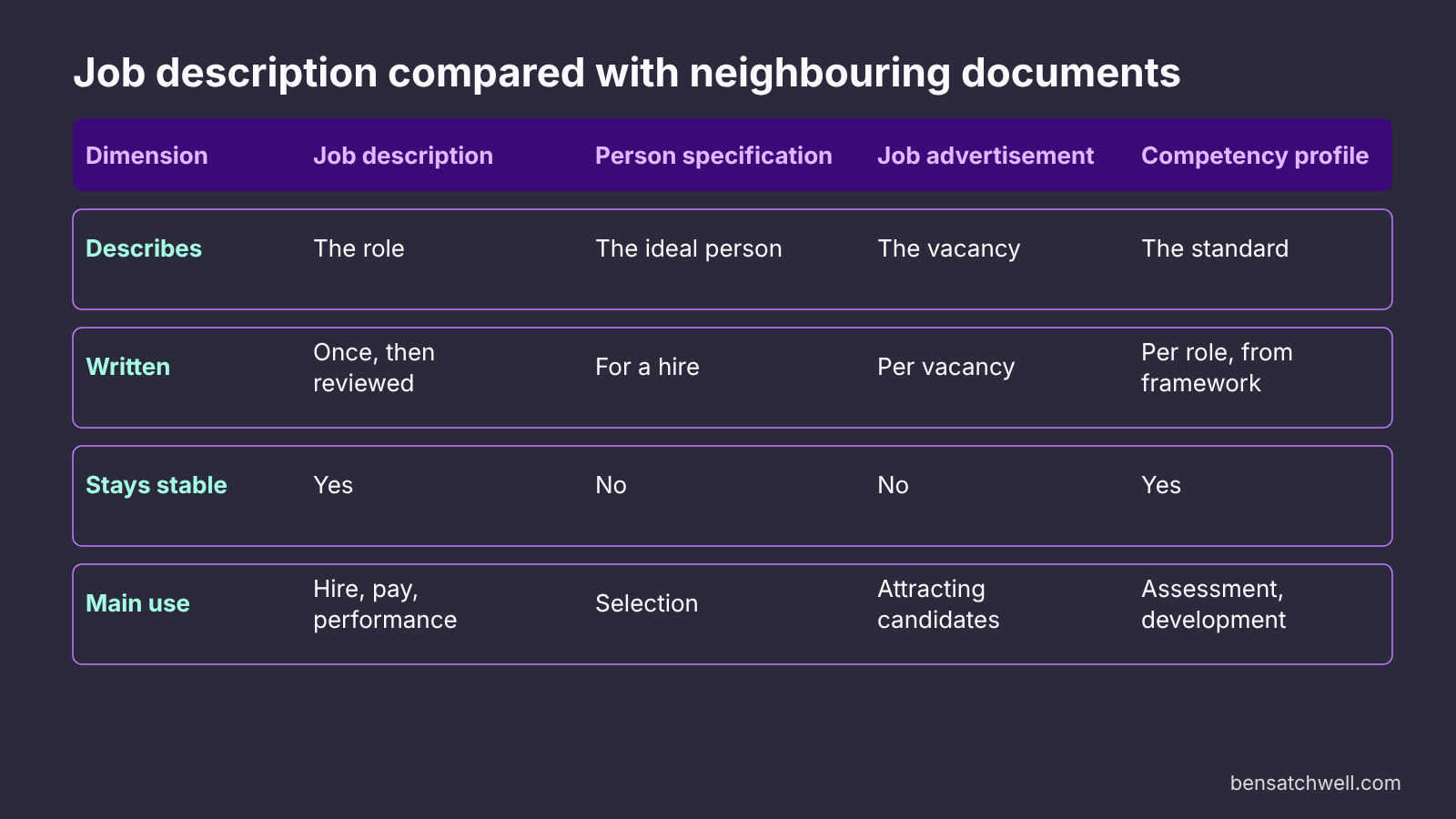
A template is easily mistaken for the documents around it.
- Not a person specification. It describes the role, not the ideal candidate.
- Not a job advertisement. The advertisement is written for a vacancy. The description stays stable.
- Not a performance review. It states what the role is accountable for, not how well one person is doing it.
- Not a competency profile. The job description records the role. The profile records the standard the role requires, and is one section within it.
Where do job description templates fail?
- Too many fields. A template with fifteen headings gets filled in badly. Seven is enough.
- Tasks instead of outcomes. A list of duties is out of date within a year.
- Requirements that were never tested. Items copied from the previous version remove capable candidates for no reason.
- Invented capability wording. Each manager writes their own, and no two roles can be compared.
- No owner. Without a named reviewer, descriptions drift from the work.
FAQ
What is the difference between a job description template and a position description template?
Nothing in structure. Position description is the Australian and public sector name for the same document, so the same template serves both.
How long should a job description be?
One to two pages. The purpose is one or two sentences, and five to eight accountabilities are enough for most roles.
Should a job description list skills or competencies?
List competencies or capabilities with a required level, taken from a framework. Specific tools and methods belong in the essential requirements only where the role cannot function without them.
How often should a job description be reviewed?
Review it when the role changes and at least once a year with the manager. A named owner for each description makes this happen.