


Competency Framework Meaning
Ask five people in HR what a competency framework means and you will get five different answers, and at least two of them will actually be describing a capability framework or a skills matrix. Competency framework meaning is not a minor semantic quibble. Getting it wrong is the reason so many frameworks get built, sit on a shared drive for eighteen months, and then quietly get replaced.
Competency Framework Meaning: A Precise Definition
A competency framework is an organisation-wide system that defines, groups and standardises competencies so they can be reused consistently across roles and levels. It sets out the competencies expected across the workforce, the proficiency levels at which they are demonstrated, and the observable behavioural indicators that show what each level looks like in practice.
The word doing the real work here is competency. A competency is the integration of skills, knowledge, judgement and behaviour applied effectively in the context of a role. It describes what good performance looks like, not a single skill and not a task. A competency framework is the governing structure that organises many of these competencies, sets the rules for how they are levelled, and lets an organisation apply them consistently instead of reinventing performance language for every role.
This is a stipulative distinction, and worth naming as such. The North American tradition often uses "competency model" as the broadest, catch-all term for this whole area. In the convention used here, a framework is the organisation-wide governing system, a model is an applied instance of it for a specific role or cohort, and a matrix is the grid that shows who holds what against what is required. If your organisation uses these words interchangeably, you are not wrong by some universal standard. You are just using a different convention, and it is worth being explicit about which one you have chosen.
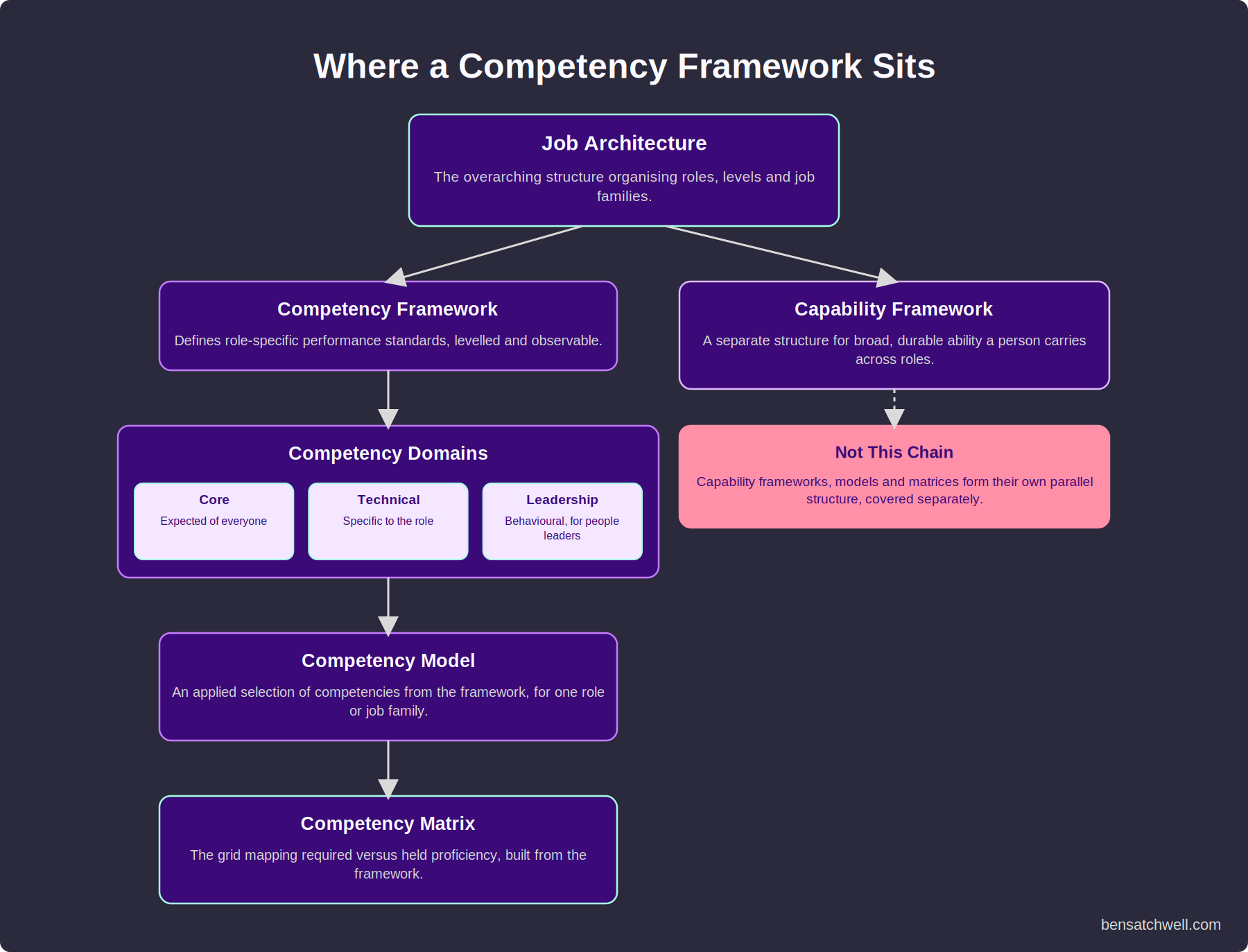
Where a competency framework sits: from job architecture down through competency domains, models and matrices.
Why the Term Exists
A competency framework was not built to describe potential, career pathways or workforce transformation. It exists to answer a narrower question: what does effective performance look like in this role, right now, and how do we know when someone is meeting the standard?
That question matters most where consistency and defensibility are non-negotiable. Recruitment panels need a shared basis for comparing candidates. Performance reviews need a standard that does not shift depending on which manager is running them. Promotion decisions need criteria that survive an appeal. A competency framework exists to give all of these processes a common, observable reference point, rather than leaving performance expectations to individual judgement.
This is also why the CIPD's factsheet on competency and competency frameworks draws such a careful line between competency, the behavioural and technical inputs a person brings, and competence, the broader, demonstrable outcome of applying those inputs well. A framework that only measures inputs without ever checking outcomes has missed half of what it was built to do.
How a Competency Framework Works in Practice
A working competency framework has three moving parts, and most of the frameworks that fail are missing at least one of them.
Competency domains
Related competencies are grouped into domains, typically core (expected of everyone), technical or functional (specific to a role or discipline), and leadership or behavioural. This is different from a competency model, which is the applied selection of competencies from the framework for a specific role. The framework holds the full library. The model draws from it.
Proficiency levels
Competencies are meaningless without levels. A framework typically defines four to six proficiency levels, set by scope, autonomy, complexity and impact, never by seniority or years of service alone. A junior analyst and a director can both be assessed against "stakeholder communication," just at different levels.
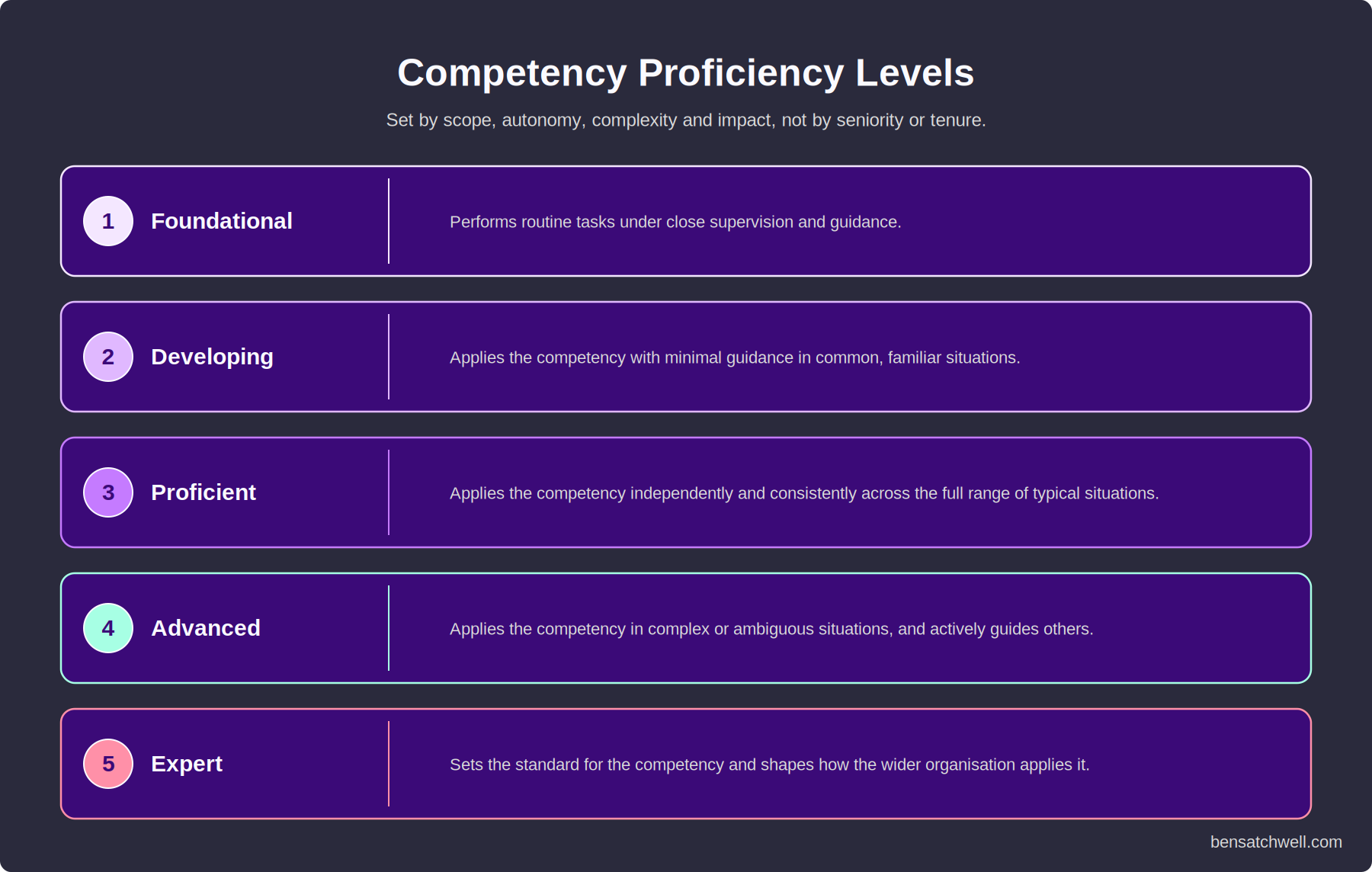
Proficiency levels in a competency framework, set by scope, autonomy, complexity and impact rather than seniority.
Behavioural indicators
Each level needs a written, observable statement describing what that level looks like in practice. Indicators are descriptive, not evaluative. "Adapts communication style to the audience" is a usable indicator. "Communicates well" is not, because there is nothing to observe or dispute.
Governments and large public institutions tend to be the most disciplined users of this structure, because their processes have to hold up to scrutiny. The OECD's work on public sector competency frameworks treats them as structured reference models that connect individual capability with institutional objectives, not as a motivational document. That is the correct posture for any organisation building one, public or private.
Competency Framework vs Related Constructs
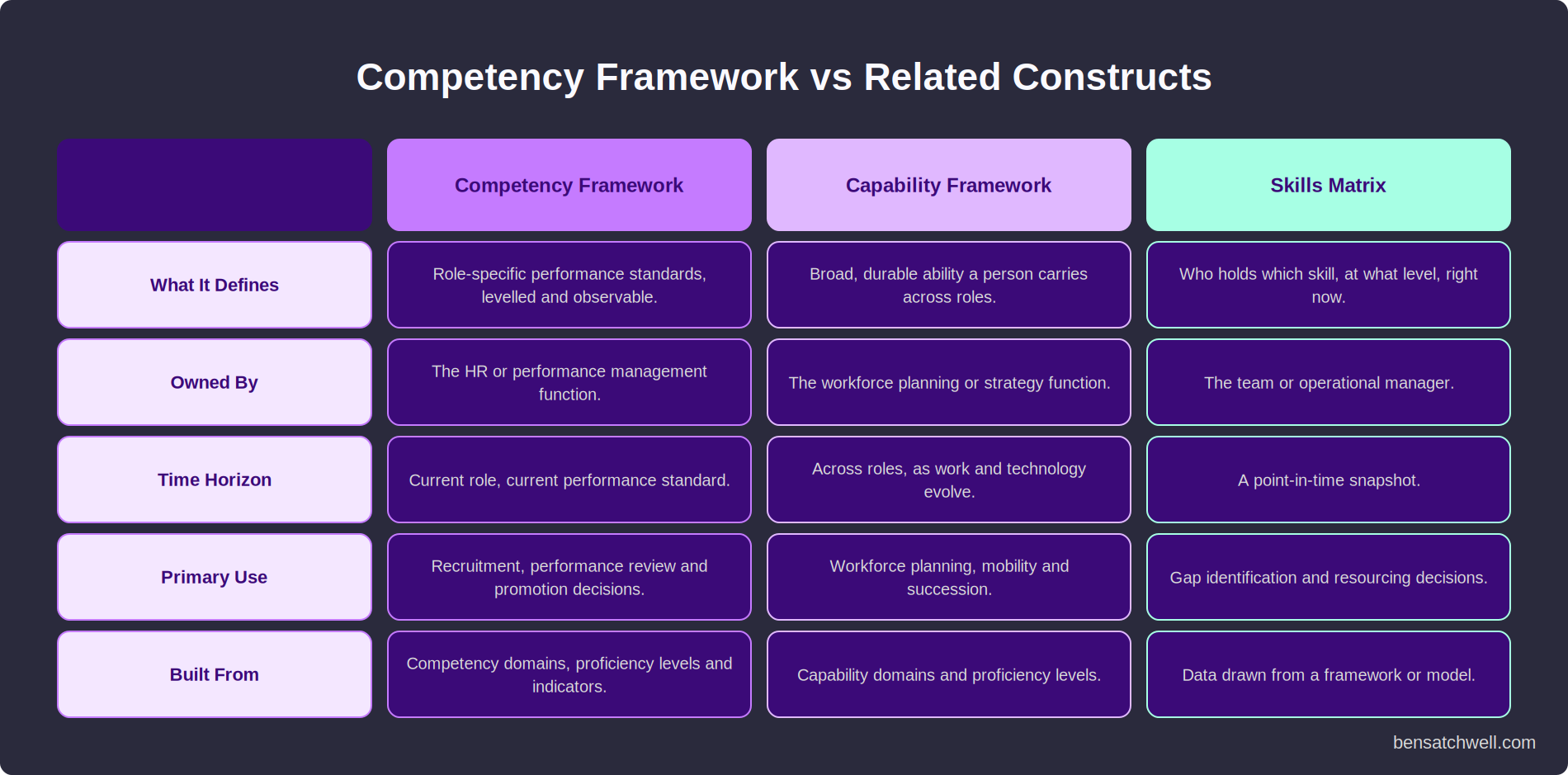
Competency framework meaning contrasted with capability framework and skills matrix, across five dimensions.
Named Frameworks and Standards Worth Knowing
Several established models illustrate how the underlying meaning gets applied differently depending on context. Korn Ferry's leadership competency work and the older Lominger library both treat competencies as observable, coachable behaviours tied to leadership levels. SHRM's competency model for the HR profession applies the same logic to a single function rather than an entire workforce. SFIA takes a related but distinct approach for the technology profession, defining skills with levelled responsibility statements rather than competencies in the strict sense used here, which is itself a useful illustration of how the same underlying idea gets relabelled across disciplines.
Academic literature adds a further layer of precision. Stan Lester's peer-reviewed analysis of professional standards, competence and capability makes the point that a purely competence-based approach struggles to represent complex professional judgement, and that frameworks benefit from incorporating capability thinking alongside competency thinking rather than treating them as competitors.
Common Failure Modes
Most competency frameworks fail for one of three predictable reasons.
The first is indicator inflation, where behavioural indicators are written as aspirational statements rather than observable ones. If two assessors cannot independently agree on whether someone met an indicator, the indicator has failed at its only job.
The second is scope creep, where a framework built to standardise performance assessment gets pressed into service for succession planning, career pathing and workforce strategy, none of which it was designed for. That is capability work, and stretching a competency framework to cover it usually produces something too rigid for either purpose.
The third is neglect after launch. A framework is a living reference, not a project deliverable. Roles change, technology changes, and a framework that is not periodically reviewed against actual work drifts out of relevance within a few years, at which point people stop trusting it and stop using it.
Trade-Offs and Constraints
A competency framework is the right tool when an organisation needs consistent, defensible performance standards across many roles, particularly for recruitment, performance management and promotion decisions. It is the wrong tool when the actual problem is workforce planning, identifying future skill gaps, or describing what people are capable of beyond their current role. Those problems belong to capability frameworks and skills taxonomies respectively, and trying to solve them with competency language usually produces a document that satisfies neither need.
Frameworks also carry a genuine cost in governance. Someone has to own the definitions, review the levels periodically and arbitrate disputes about whether an indicator has been met. An organisation that cannot commit to that ongoing governance is often better served by a smaller, role-specific competency model than a full organisation-wide framework it will not maintain.
Frequently Asked Questions About Competency Framework Meaning
What is the competency framework meaning in simple terms?
It is a structured system that defines what good performance looks like for different competencies, at different proficiency levels, across an organisation, so performance can be assessed consistently rather than subjectively.
What is the difference between competency framework and competency model?
The framework is the organisation-wide governing system, including definitions, levels and rules. A model is an applied selection of competencies from that framework, tailored to one role or job family.
Is a competency framework the same as a capability framework?
No. Competency frameworks describe role-specific performance standards. Capability frameworks describe broad, durable abilities a person carries across roles, and are built for workforce evolution rather than performance assessment.
What is the difference between competency and competence?
A competency is a defined unit, the integration of skills, knowledge and behaviour required for a role. Competence is the broader, overall condition of being able to perform to the required standard, what Lester calls fitness for purpose.
Why do organisations build competency frameworks?
To create a consistent, observable and defensible basis for recruitment, performance management and promotion decisions, so these processes do not rely purely on individual manager judgement.
How many proficiency levels should a competency framework have?
Most workable frameworks use between four and six levels, set by scope, autonomy, complexity and impact rather than by seniority or tenure.