
The market uses “skills and competency framework” in two completely different ways. Some organisations mean a competency framework that has been extended to include a skills taxonomy underneath it. Others mean a skills framework, like SFIA, that levels professional skills against behavioural indicators. These are not the same design, and the distinction matters when you are deciding what to build. Getting clear on which structure you actually need saves a significant amount of framework redesign later.
What Is a Skills and Competency Framework?
A skills and competency framework is a governing structure that defines both skills and competencies within a single integrated system, using consistent proficiency levels to connect them.
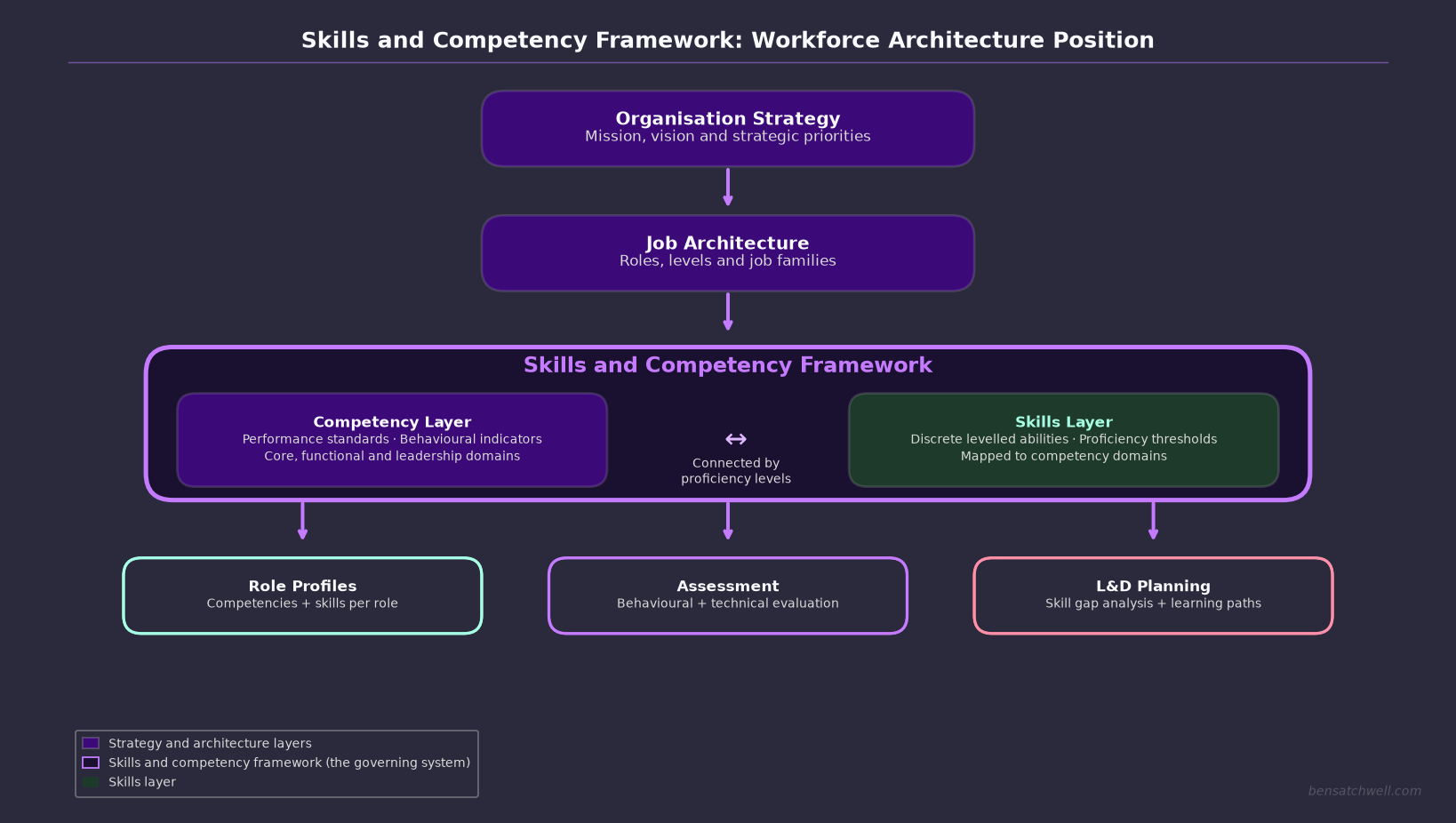
The word “and” is doing real work in that phrase. A skills and competency framework does not simply list skills alongside competencies. It governs the relationship between them: how skills sit underneath competencies, how both are levelled, and how both are applied in role definitions, assessment tools, and development planning.
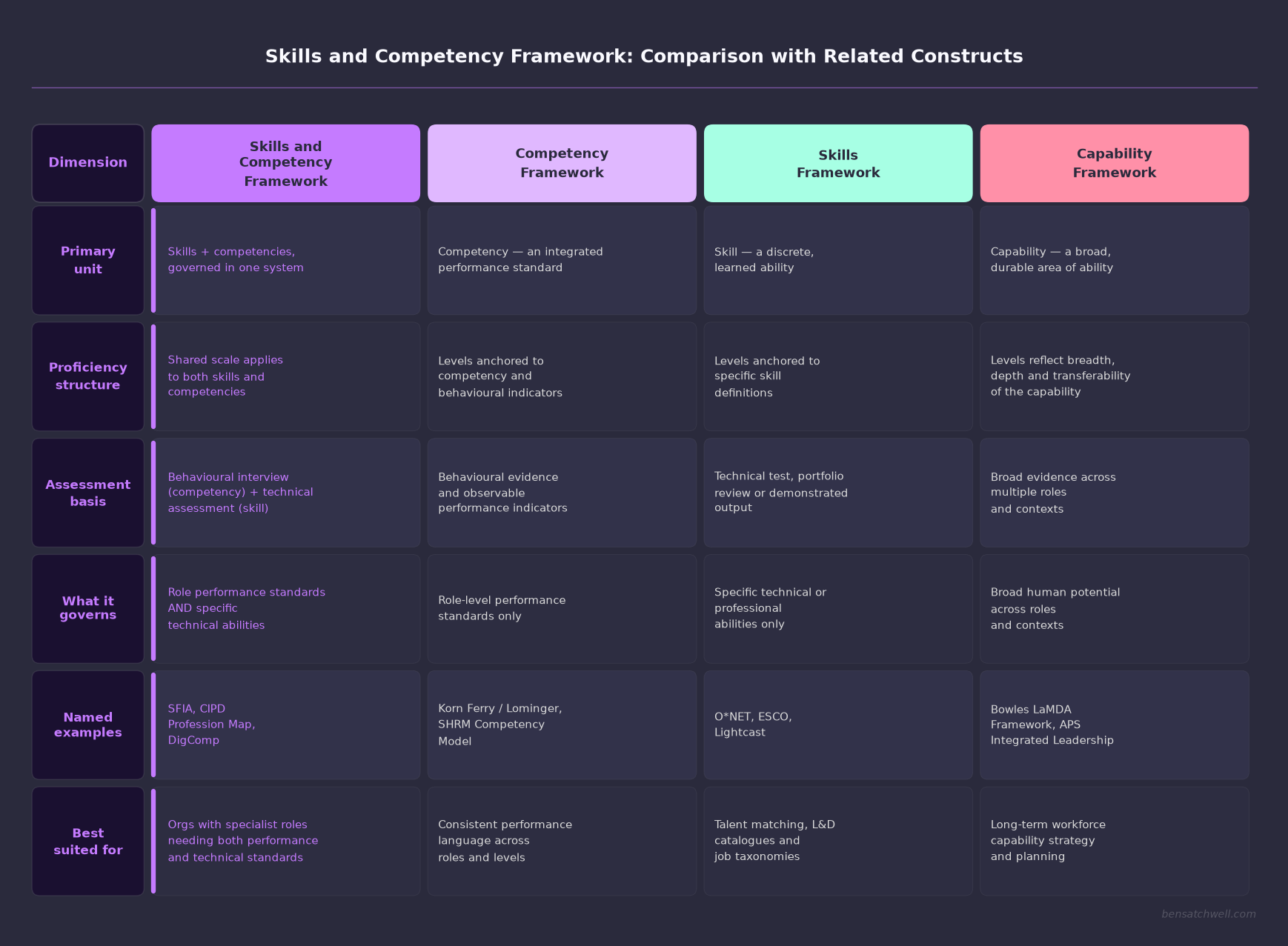
Where a competency framework defines integrated performance standards, what good looks like in a role, and a skills framework defines discrete levelled abilities, specific things a person can do, a skills and competency framework manages both layers explicitly within one structure.
The SFIA Foundation describes SFIA as “the global skills and competency framework for the digital world” because it integrates professional skills with generic attributes, including behavioural factors, business skills, and knowledge, across seven responsibility levels. According to the SFIA Foundation, “professional skills and generic attributes work together to define overall competence.” That integration is what makes it a skills and competency framework rather than a pure skills list.
A note on terminology. A competency framework is also called a competency model, especially in the United States. I use competency profile for the competencies and required levels for one role, and competency matrix for the grid of required against current proficiency. Usage varies by region, and I explain the differences in this competency model definition.
Why Does a Skills and Competency Framework Exist?
The underlying problem is structural. Organisations running a competency framework often struggle to connect it to specific technical ability. The competencies are broad and transferable but do not tell you whether a software engineer can write production-grade code, or whether a data analyst can work with unstructured data sets. That granularity lives in skills, not in competencies.
At the same time, organisations running a skills framework can map what people know how to do but often cannot connect that to the expected standard of performance at a role level. Skills inventories answer “can this person do X?” but not “are they performing at the right level for this role?”
A skills and competency framework closes that gap. It governs both layers in one structure so that role expectations can be expressed as competencies with behavioural indicators, specific skills can be mapped to competency domains with their own proficiency thresholds, and assessment can draw on both layers without needing to reconcile two separate systems.
The OECD demonstrates this integration at an institutional level. The OECD Competency Framework defines fifteen core competencies grouped into three clusters, each with behavioural indicators that describe performance across multiple levels of complexity, scope, and responsibility. It is a useful reference point for how skills and competency integration can be applied at scale.
How Does a Skills and Competency Framework Work in Practice?
A skills and competency framework typically operates across three structural layers.
The competency layer defines performance standards: what effective behaviour looks like in a role at a given level. These are grouped into competency domains, typically functional or technical, behavioural or interpersonal, and leadership or professional. Each competency carries a definition and a set of behavioural indicators at each proficiency level.
The skills layer sits underneath the technical competency domain. Individual skills are defined at granular level with their own proficiency thresholds. A financial analyst role might carry a competency called “Financial Modelling and Analysis” that contains specific skills: building discounted cash flow models, stress-testing assumptions, interpreting variance reports. Each skill is defined and levelled separately from the competency it supports.
The proficiency architecture connects the two. Proficiency levels, typically four to six in a workable framework, describe increasing autonomy, complexity, and scope of impact. Both competencies and skills are anchored to the same proficiency scale so that role design, assessment, and development planning draw on a consistent set of level descriptors.
In day-to-day application, this means a hiring panel can assess a candidate against both the competencies for a role (through structured behavioural interviews) and against the specific skills required (through technical assessment or portfolio review), using one coherent framework rather than two disconnected tools.
What a Skills and Competency Framework Is Not
It is not a skills inventory or skills taxonomy alone. A taxonomy classifies skills into a navigable hierarchy. It does not define performance standards, does not carry behavioural indicators, and is not sufficient to govern hiring, promotion, or performance assessment on its own.
It is not a competency profile. A profile is the selection of competencies and required levels configured for a specific role, level, or cohort. A framework is the governing system the profile draws from. The framework defines the architecture; the profile is one use of it.
It is not a capability framework. Capabilities are broader and more durable than either skills or competencies. Where a skill is specific and a competency is role-anchored, a capability belongs to the person and transfers across roles and contexts. A capability framework governs a different layer of the workforce architecture.
It is not SFIA by definition. The SFIA framework is one well-known example of a skills and competency framework, built specifically for digital and technology work. When an organisation says it has implemented a skills and competency framework, it may or may not be using SFIA. SFIA is an instance of this type of structure, not the only one.
Named Framework and Standard References
SFIA (Skills Framework for the Information Age) is the best-known publicly available skills and competency framework. It covers digital, data, and technology roles across seven responsibility levels. The SFIA Foundation makes it available under a free-to-use licence, which is why it has been adopted in over 200 countries. Its architecture, separating professional skills from generic attributes and connecting both to a responsibility-level scale, is the reference design for this type of structure in the technology sector.
The CIPD Profession Map operates similarly for HR and people professionals. As the CIPD notes, well-designed competency frameworks “increase clarity around performance expectations and establish a clear link between individual and organisational performance.” The Profession Map integrates professional knowledge and practice areas alongside core behaviours and values, connected through a common career progression architecture.
DigComp, the European Commission’s digital competence framework for citizens, structures digital skills into five competence areas with proficiency levels from foundation through to highly specialised. It is more competency-focused than SFIA but operates across a shared architecture governing both skills and competence.
Common Failure Modes
Running parallel systems that do not connect. Many organisations build a competency framework for HR and a skills framework for L&D without ever aligning the two. Assessment data sits in separate systems, role design uses different vocabulary, and employees receive conflicting signals about what “good” means. The result is low framework adoption and poor data quality.
Treating skills and competencies as interchangeable. A skill is discrete and specific. A competency integrates multiple skills alongside knowledge, judgement, and behaviour. Using the terms interchangeably collapses an important architectural distinction and usually produces a framework that is neither precise enough to guide technical assessment nor broad enough to describe performance standards meaningfully.
Over-specifying the skills layer. Technology skills particularly become outdated quickly. A framework that attempts to catalogue every specific tool or platform creates significant maintenance burden. The skills layer should be specific enough to be useful for role design and assessment, but not so granular that it requires revision every quarter.
Copying a public framework without adaptation. SFIA, CIPD, or any other publicly available framework represents a general architecture, not a finished product. Implementing one without mapping it to your organisation’s roles, levels, and strategic priorities produces a framework that looks complete but cannot be operationalised.
Trade-offs and Constraints
A skills and competency framework is appropriate when an organisation needs to govern both technical ability and performance expectations within a single system, and when the workforce has enough specialisation that a competency framework alone is too broad to support technical assessment.
It is not appropriate as a starting point for small organisations or those without significant specialist roles. For most workplaces, a well-designed competency framework is sufficient. Adding a skills layer adds design complexity, governance overhead, and system integration requirements that are difficult to justify unless the organisation’s scale and technical diversity warrant it.
The most effective implementations are sector-specific. SFIA works because the digital and technology domain has a clear, shared vocabulary of professional skills that translates across organisations and borders. Organisations in engineering, finance, health, or other specialist domains can apply the same architectural logic using their own domain vocabulary. The architecture transfers; the content does not.
FAQ
What is the difference between a skills framework and a competency framework?
A skills framework defines discrete, levelled professional abilities, specific things a person can do, using proficiency thresholds. A competency framework defines integrated performance standards, what good looks like in a role, expressed as observable behaviour. A skills and competency framework governs both layers in one structure.
Is SFIA a skills framework or a competency framework?
SFIA explicitly describes itself as a skills and competency framework. It integrates professional skills with generic attributes, including behavioural factors, business skills, and knowledge, across seven responsibility levels. The combination of skills and behavioural attributes is what makes it a skills and competency framework rather than a skills list.
Can a competency framework include skills?
Yes. A competency framework can incorporate a skills layer within its functional or technical competency domain. Many do. When a framework defines individual skills within a competency and levels them separately, it is functioning as a skills and competency framework even if it is not labelled as such.
How many proficiency levels should a skills and competency framework use?
Four to six levels is the workable range for most organisations. Fewer than four does not provide enough granularity to distinguish meaningful performance differences. More than six creates calibration problems and assessment fatigue. SFIA uses seven, which works at scale across a very large and diverse workforce.
What comes first, the skills layer or the competency layer?
The competency layer should be designed first. It sets the performance standards and domains that give the skills layer its context. Skills without a competency architecture to sit inside are just a list. Design the framework structure first, then populate the skills underneath each competency domain.
How is a skills and competency framework different from a capability framework?
A capability framework governs broad, durable areas of human ability that transfer across roles and contexts. A skills and competency framework governs role-anchored performance standards (competencies) and specific technical abilities (skills). The constructs operate at different levels of the workforce architecture and serve different purposes.