

Ask three people in the same organisation what a company competency framework is and you will get three different answers: a values poster, a performance review template, and "the thing HR built three years ago that nobody uses". None of those are quite right. A company competency framework is not a document, a poster or a one-off project. It is the organisation-wide system that defines every competency a business relies on, groups those competencies logically, and sets the rules for applying them consistently from the graduate hire through to the executive team.
What Is a Company Competency Framework?
A company competency framework is an organisation-wide system that defines, groups and standardises competencies so they can be reused consistently across every role and level in the business, rather than being reinvented each time a job description gets written. It includes the competency definitions themselves, the proficiency levels each one is assessed against, the behavioural indicators that describe what each level looks like in practice, and the governance rules for how role-specific models draw from it.
The word "company" in front of "competency framework" is doing descriptive work, not definitional work. It signals scope, the framework covers the whole company rather than a single team or project, but the underlying construct is the same as what I mean anywhere else on this site by a competency framework. The CIPD describes a competency framework in similar terms, as the complete collection of competencies an organisation needs, together with the behavioural indicators that make each one assessable across acquisition, development, performance and reward decisions.
Why Does a Company Need a Competency Framework?
Without a company-wide framework, competencies get defined ad hoc. One manager writes "stakeholder management" for their team, another writes "relationship building" for a functionally identical expectation, and a third does not write anything down at all. None of it is comparable. Hiring panels use different language for the same standard, performance conversations reference expectations nobody agreed on, and promotion decisions cannot be defended consistently because there is no shared reference point underneath them.
A company competency framework exists to solve that coordination problem. Define each competency once, set the proficiency levels once, and let every role model, job description and assessment tool draw from the same source. The goal is not compliance for its own sake. It is comparability: the ability to say with confidence that "proficient" means the same thing in finance as it does in operations.
How a Company Competency Framework Works in Practice
A working framework is built from a small number of parts that repeat consistently across roles.
Core competencies sit at the top. These are the competencies every person in the organisation is expected to demonstrate regardless of role or level, things like communication or judgement, and they carry the shared expectations and culture that every other layer of the framework builds on. Beneath them sit technical or functional competencies, which are specific to a discipline, function or role and populate the framework's technical domains. A core competency framework is effectively this top layer isolated and examined on its own, which is a useful way to see the distinction before the technical layer gets added underneath it.
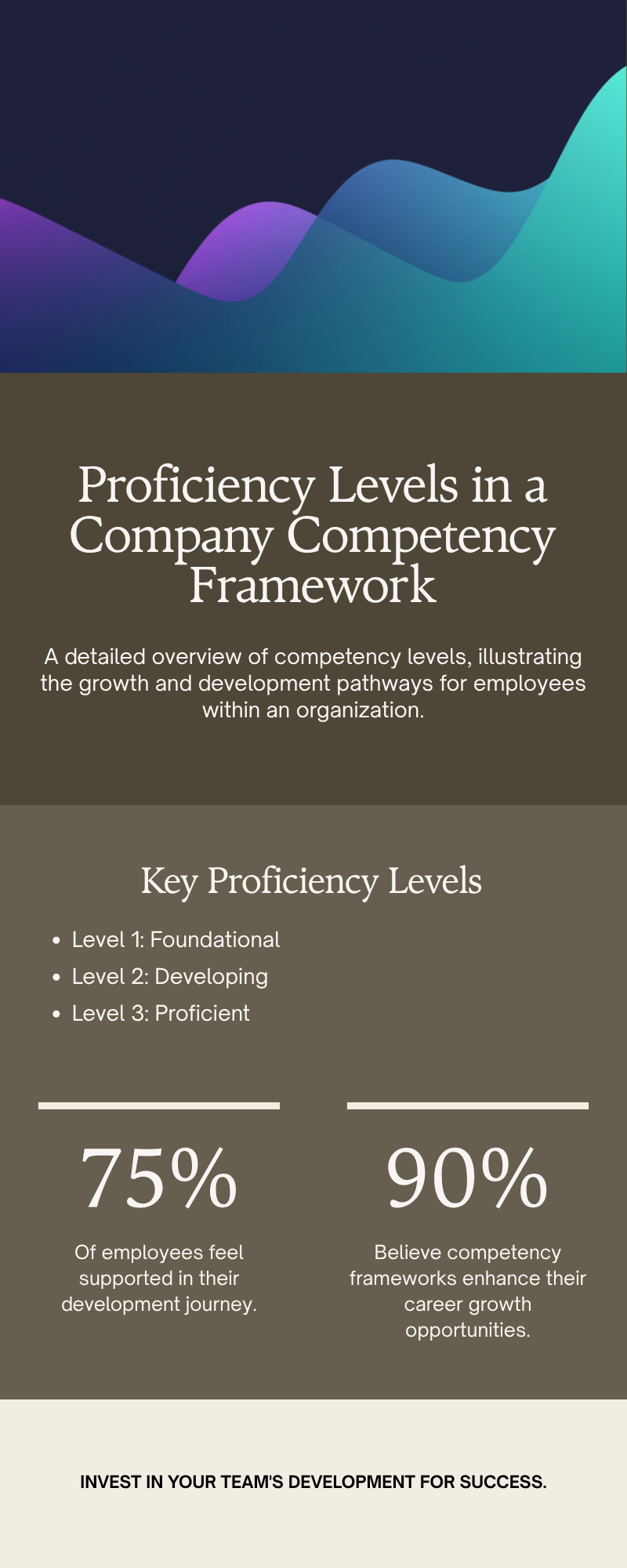
Competencies are organised into domains, typically functional or technical, behavioural or interpersonal, leadership, and professional or ethical, so related competencies sit together rather than appearing as a flat, undifferentiated list. Each competency is set against four to six proficiency levels, and each level carries a written behavioural indicator describing what that standard of performance actually looks like, not what it should feel like. This is what turns the framework from a values statement into an assessable structure.
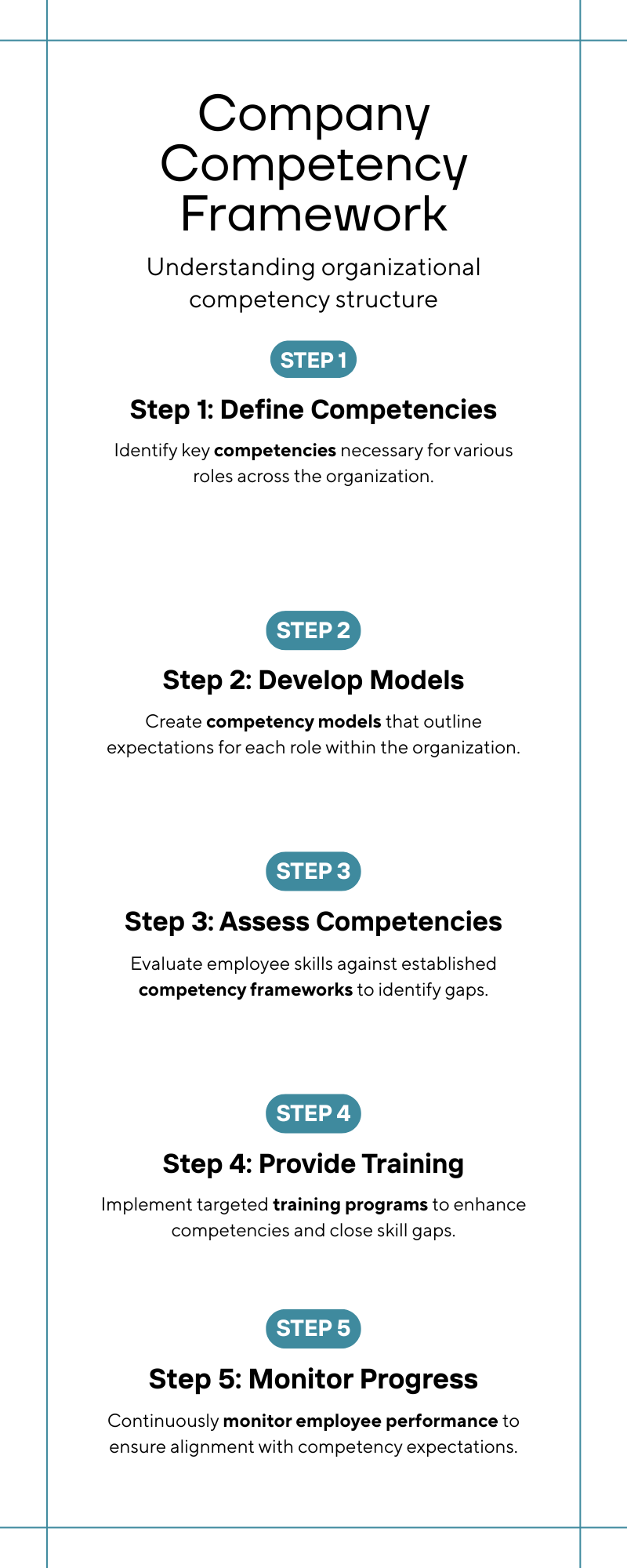
Governance is the part organisations underinvest in. Someone has to own updates to the framework, decide when a new technical domain is needed, and control how role-specific competency models are drawn down from it. The OECD publishes its own competency framework for exactly this reason, so every part of the organisation is working from one governed reference point rather than parallel, locally invented versions.
What a Company Competency Framework Is Not
This is where most of the conflation happens, and it is worth being precise.
It is not a competency model. A model is an applied selection of competencies drawn from the framework and tailored to a specific role, level, function or job family. If the framework is the governing system, the model is one instance of it. A company has one competency framework and dozens, sometimes hundreds, of competency models sitting underneath it.
It is not a competency matrix either. A matrix is the grid that maps required proficiency against current proficiency for a role or a person, useful as a display and assessment tool, but it is built from the framework and the models, not the structure that governs them.
It is not a capability framework. A capability framework organises broad, durable, transferable human capabilities that a person carries across roles and contexts. A competency framework defines what good performance looks like inside a specific role or level. Capability signals potential to move into new work; competency describes the current standard expected in a role that already exists.

And despite the near-identical name, it is not "core competence" in the strategic management sense. Prahalad and Hamel's 1990 concept of core competence describes the organisation's distinctive collective advantage, the deep, hard-to-imitate combination of skills and technologies that gives a company access to markets its competitors cannot reach. That is an organisational-level construct. The competencies inside a company competency framework belong to people, not to the business as a whole, and the two should never be used interchangeably even though the vocabulary overlaps.
Named Models and Standards Behind Company Competency Frameworks
Few companies build a framework entirely from a blank page. Professional bodies publish their own competency models as reference points, even though these are built for a profession rather than a specific employer. SHRM's Body of Applied Skills and Knowledge defines nine behavioural competencies plus a technical competency for HR professionals specifically, and it is a useful structural example of core versus technical separation, but it is a profession-wide model, not a company-wide framework, and should not be adopted wholesale as one.
Korn Ferry and Lominger's competency libraries are commonly licensed as a starting inventory that companies then adapt and level for their own context. DDI's approach leans on behavioural competencies for leadership assessment and succession specifically. None of these replace the work of building a company-specific framework; they shorten the drafting process and give a company a tested vocabulary to adapt rather than invent from nothing.
Common Failure Modes in Company Competency Frameworks
The same mistakes show up repeatedly.
- Treated as a project, not an asset. A framework gets built, launched, and then never reviewed. Roles change, technology changes, and the framework quietly stops matching the work it was meant to describe.
- Too many competencies. Frameworks with thirty or forty competencies dilute the distinction between core and technical until everything looks equally important, which functionally means nothing is prioritised.
- Vague behavioural indicators. Indicators written as aspirational statements rather than observable behaviour cannot actually be assessed against, which pushes every rating back to manager opinion.
- No governance owner. Nobody is accountable for updating the framework as the organisation changes, so it decays the way most badly governed frameworks do, a pattern I've written about in more detail in why most capability frameworks fail.
- Never connected to real decisions. A framework that does not feed hiring, performance or promotion decisions exists on paper and changes nothing in practice.
When a Company Competency Framework Is (and Is Not) Worth Building
A full company competency framework earns its governance overhead at real scale, where a business has enough roles and job families that comparability across them actually changes hiring, pay and promotion decisions. That is usually somewhere north of a few hundred employees spread across multiple functions.
Below that scale, the overhead often is not worth it. A twenty-person company does not need domains, four proficiency levels and a governance charter. A small, shared set of role expectations and a common language for what good performance looks like will do the same job without the bureaucracy. Building the full structure prematurely creates a framework with no users, which is its own kind of failure mode.
FAQ
What is the difference between a company competency framework and a competency model?
The framework is the organisation-wide governing system that defines and standardises every competency. A competency model is an applied selection from that framework, tailored to one role, level or job family.
Does every company need a competency framework?
No. It earns its cost at scale, where consistency across many roles and functions genuinely changes hiring, pay and promotion outcomes. Small organisations are usually better served by a simpler, shared set of role expectations.
How many competencies should a company competency framework include?
There is no fixed number, but frameworks with more than roughly twenty to twenty-five competencies typically dilute the distinction between core and technical competencies rather than adding useful precision.
Who owns a company competency framework?
It needs a single accountable owner, usually within HR or organisational design, responsible for reviewing and updating it as roles and technology change. Without an owner, frameworks decay quietly.
Is a company competency framework the same as a capability framework?
No. A competency framework defines the standard of performance expected inside existing roles. A capability framework defines the broad, transferable human capabilities a person carries across roles as work changes.
How often should a company competency framework be reviewed?
Most organisations review the full framework every two to three years, with individual competency definitions updated sooner if a function or role changes materially in the interim.