

Competency Framework for IT Professionals
Most organisations building a "competency framework for IT professionals" are actually building three different things at once and calling them one thing: a skills list lifted from SFIA, a set of role descriptions, and a handful of behavioural values statements. None of that is a competency framework. A competency framework for IT professionals is a specific, structured artefact, and conflating it with a skills taxonomy or a job description is exactly why so many technology competency initiatives stall after the first working session.
What Is a Competency Framework for IT Professionals?
A competency framework for IT professionals is an organisation-wide system that defines, groups and standardises the competencies required across technology roles, so they can be applied consistently from a junior support analyst to a principal architect. It is built from three parts: competency definitions, proficiency levels, and behavioural indicators that describe what each level looks like in observable terms.
A competency is the integration of skills, knowledge, judgement and behaviour applied effectively in the context of a role. A competency framework is the governing system that defines and standardises those competencies across the organisation.
For IT specifically, this usually means two domains sitting side by side: a technical or functional domain (cloud architecture, secure coding, infrastructure management, data engineering) and a core domain that every technology employee is expected to hold regardless of specialism (stakeholder communication, problem-solving under ambiguity, collaborative delivery). The technical domain is what most people mean when they say "IT competency framework," but a framework without the core layer underneath it is only half built.
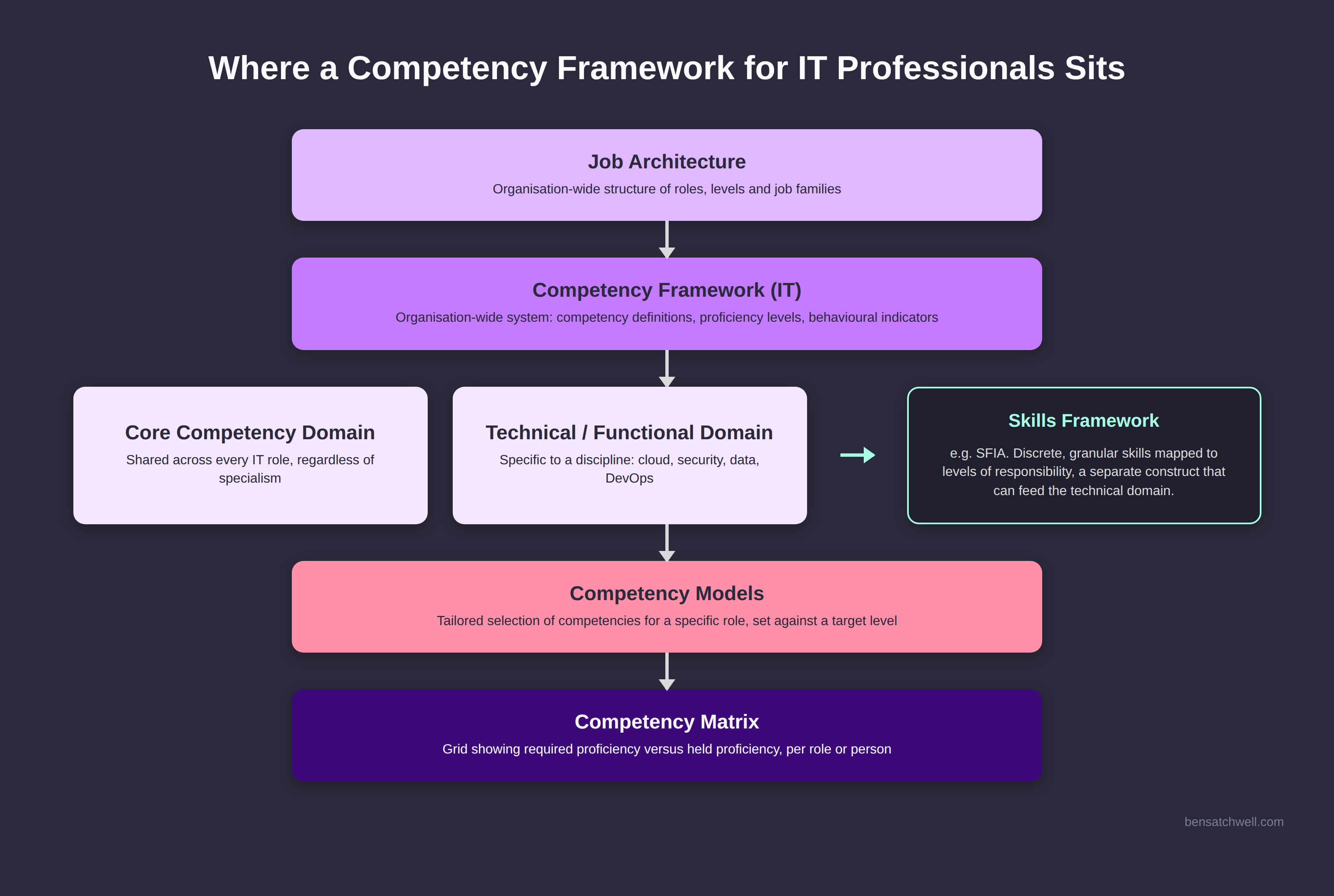
Where a competency framework for IT professionals sits within the broader job architecture and skills framework system.
Why It Exists
Technology functions have a specific version of a problem every large workforce eventually hits: skills and roles proliferate faster than any single manager can track. A cloud engineer in one business unit and a cloud engineer in another may hold wildly different capabilities and be assessed against different, informal standards, if they are assessed at all.
A competency framework exists to solve that inconsistency directly. It gives hiring managers a shared standard to interview against, gives career pathways a defined ladder instead of a vague sense of "senior enough," and gives L&D a target to design against rather than reacting to whatever the loudest team lead asks for. For IT specifically, there is an added driver: the underlying skills shift faster than almost any other function, so the framework has to be built to be revised, not signed off once and left alone.
How It Works in Practice
A working competency framework for IT professionals is built in a defined sequence, not assembled ad hoc from a template.
1. Define the domains. Separate core competencies (shared across all IT roles) from technical or functional competencies (specific to a discipline such as network engineering, DevOps, or data platforms).
2. Set proficiency levels. Most functional frameworks use four to six levels, defined by scope, autonomy, complexity and impact rather than years of experience or job title. A level 2 security analyst and a level 5 security architect are separated by the complexity of the problems they are trusted to solve independently, not by tenure.
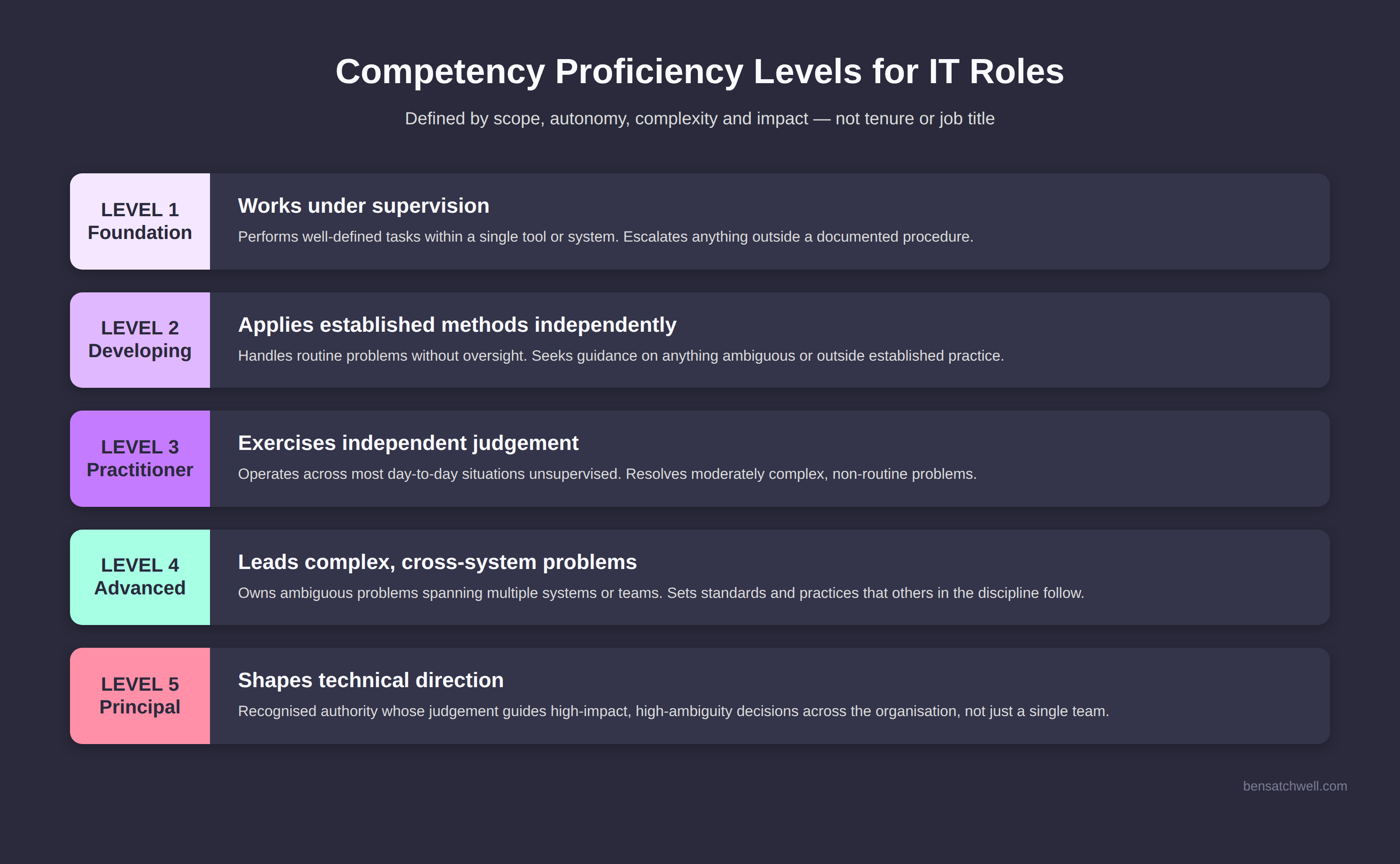
Proficiency levels in an IT competency framework, defined by scope and complexity rather than tenure.
3. Write behavioural indicators. Each competency, at each level, needs an observable statement of what that level looks like in practice. "Understands secure coding principles" is not an indicator. "Identifies and remediates OWASP Top 10 vulnerabilities in code reviews without escalation" is.
4. Build role-specific models. The framework itself stays organisation-wide. Individual roles draw a tailored selection from it, set against a target level, which is where the framework becomes usable day to day rather than a document nobody opens. I go through exactly this layering logic, from governing structure down to the artefacts people actually touch, in the four layers that any capability or competency system needs to function.
The UK Government's Digital, Data and Technology Profession Capability Framework is a useful real-world reference here. It sets out defined role types across six job families, from software developer to cyber security, mapped against described skill levels and maintained centrally rather than left to individual departments to reinvent. Whatever it is named, the mechanics are the same: domains, levels, and observable descriptions of performance, built for a workforce where the underlying technology changes constantly (GOV.UK Digital, Data and Technology Capability Framework).
What a Competency Framework for IT Professionals Is NOT
This is where most of the confusion in technology teams actually sits, and it is worth being precise about each distinction.
It is not a skills framework. SFIA, the Skills Framework for the Information Age, is the clearest comparison. SFIA maps discrete, granular skills against seven levels of responsibility, and it is explicitly a skills framework, not a competency framework. Skills are specific, transient, and shift as tools and methods change. A competency integrates a cluster of skills with knowledge, judgement and behaviour into something you assess as demonstrated performance in a role, not a checklist of tools someone has used. Organisations frequently import SFIA wholesale and call the result a competency framework. It is not one until the skills are integrated into role-contextualised, levelled, observable competencies (SFIA: the global skills and competency framework for the digital world).
It is not a capability framework. A capability is broad, durable and transferable across roles, tasks and contexts, unlike a competency, which is defined and assessed within a specific role. "Adaptability" or "systems thinking" are capabilities an engineer carries with them as they move roles. "Configures CI/CD pipelines to enterprise security standards" is a technical competency tied to a specific job. I have written at length about why capability frameworks fail when this distinction gets flattened, and the same failure pattern shows up in competency work.
It is not a job description. A job description defines accountabilities: what someone is responsible for. A competency framework defines the standard of performance expected while carrying out those accountabilities. Two people can share a job title and job description and sit at completely different competency levels.
It is not a certification list. Holding an AWS certification or a CISSP is evidence toward a competency, not the competency itself. Certifications test knowledge at a point in time; competencies are assessed as demonstrated, ongoing performance in the role.
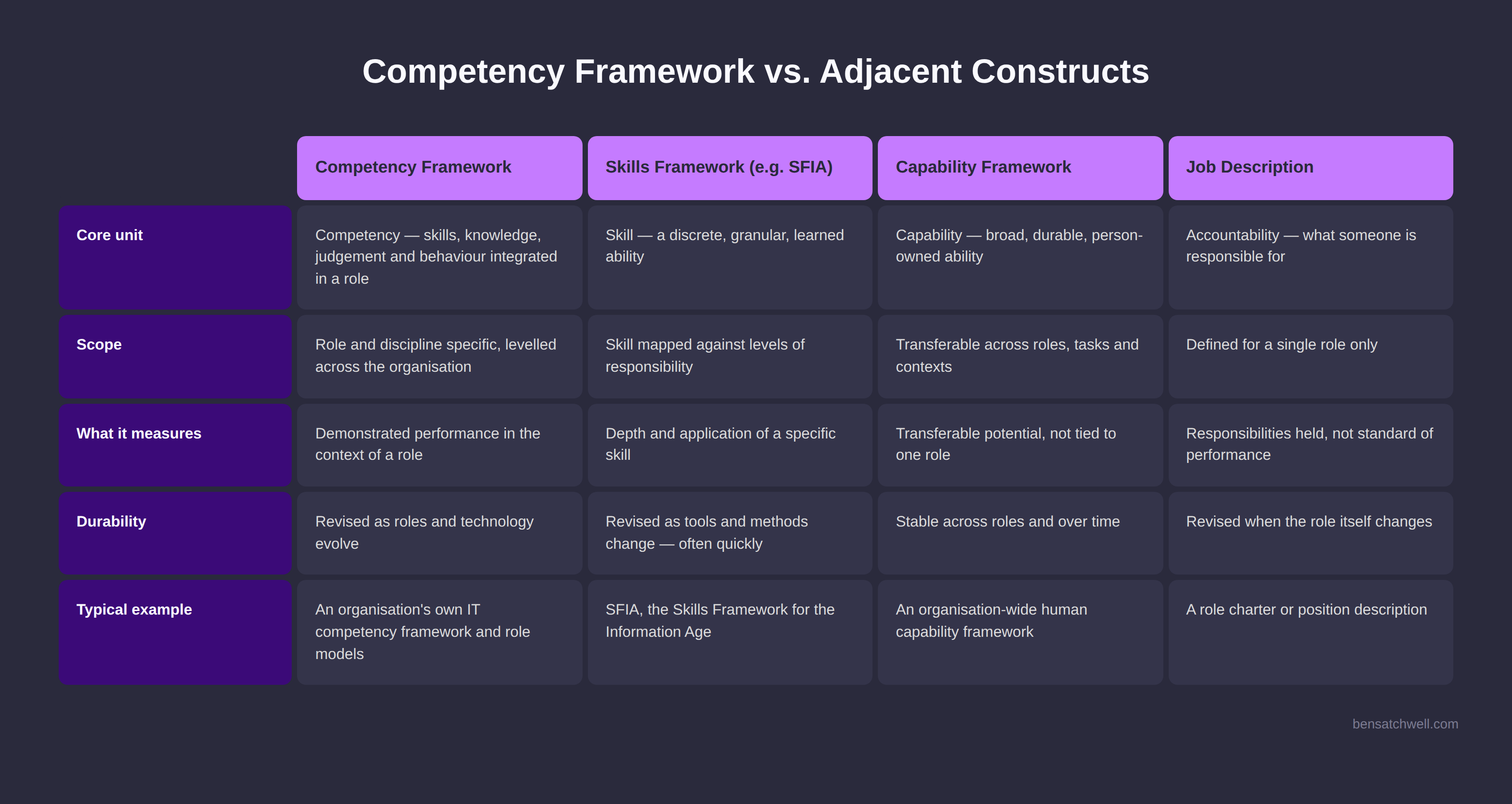
A competency framework for IT professionals compared against the skills framework, capability framework and job description.
Named Frameworks and Standards Worth Knowing
Beyond SFIA and the UK's DDaT framework, a handful of other reference points shape how IT competency work gets built. The NIST NICE Workforce Framework for Cybersecurity, developed by the US National Institute of Standards and Technology, organises cybersecurity work around Task, Knowledge and Skill statements rather than broad competency clusters, which makes it a strong source for granular technical detail even where an organisation's overarching framework is competency-based (NIST NICE Framework Resource Center).
Korn Ferry and Lominger's general leadership and behavioural competency libraries are commonly used for the core domain layer shared across all IT roles, even where the technical domain is built specifically for the organisation's own stack.
Common Failure Modes
Copying a skills taxonomy and calling it done. The most common failure in IT competency work specifically. A list of technologies someone has touched is not a levelled, behavioural description of how well they apply them.
Levels defined by tenure. "Senior" should describe the complexity and ambiguity of what someone is trusted to own, not years in the role. Tenure-based levelling produces title inflation and breaks the framework's usefulness for hiring and pay decisions.
No maintenance cycle. Technology competency frameworks decay faster than almost any other type. A framework built around on-premises infrastructure skills in a cloud-native organisation is actively misleading within two or three years if nobody owns its revision.
Behavioural indicators written as aspirations. "Champions innovation" is not observable. If an assessor cannot point to specific, witnessed behaviour that satisfies an indicator, the indicator is not doing its job, and the whole assessment process built on top of it becomes subjective.
Built in isolation from the People function. Technical leads often build these frameworks without connecting them to how the organisation structures roles and job families more broadly, which is one of the mechanical reasons well-intentioned frameworks fail to change hiring or development decisions even when the content is well written.
Trade-offs and Constraints
A competency framework for IT professionals is worth building once a technology function has grown past the point where informal, tribal knowledge about "who is good at what" scales, usually somewhere past 30 to 50 technical staff, or wherever hiring managers are already interviewing inconsistently against the same job title.
It is not worth building as a first move for a small, tightly-knit team where everyone already has direct visibility of everyone else's work. The overhead of maintaining levels and indicators only pays off once the organisation is too large for informal calibration to hold. It is also the wrong tool if the real problem is role clarity rather than performance standards. If nobody can agree what a "platform engineer" is accountable for, that is a job architecture problem to solve first. I unpack the broader system this needs to plug into in what a people capability system actually is.