
In my work with organisations reviewing performance systems, competency is often the most misunderstood term, not because it’s unclear, but because it’s routinely asked to do work it was never designed for. Competency frameworks are criticised for being rigid, backward-looking, or limiting growth, when in reality they’re being misapplied.
What I consistently see is this: competency frameworks work exceptionally well when they’re used for what they were built for, and poorly when they’re stretched into development, transformation, or future readiness.
This article clarifies what competency actually means, why it’s so often conflated with capability, and the specific jobs competency frameworks are designed to do.
How Competency Is Commonly Defined
Authoritative definitions of competency are remarkably consistent.
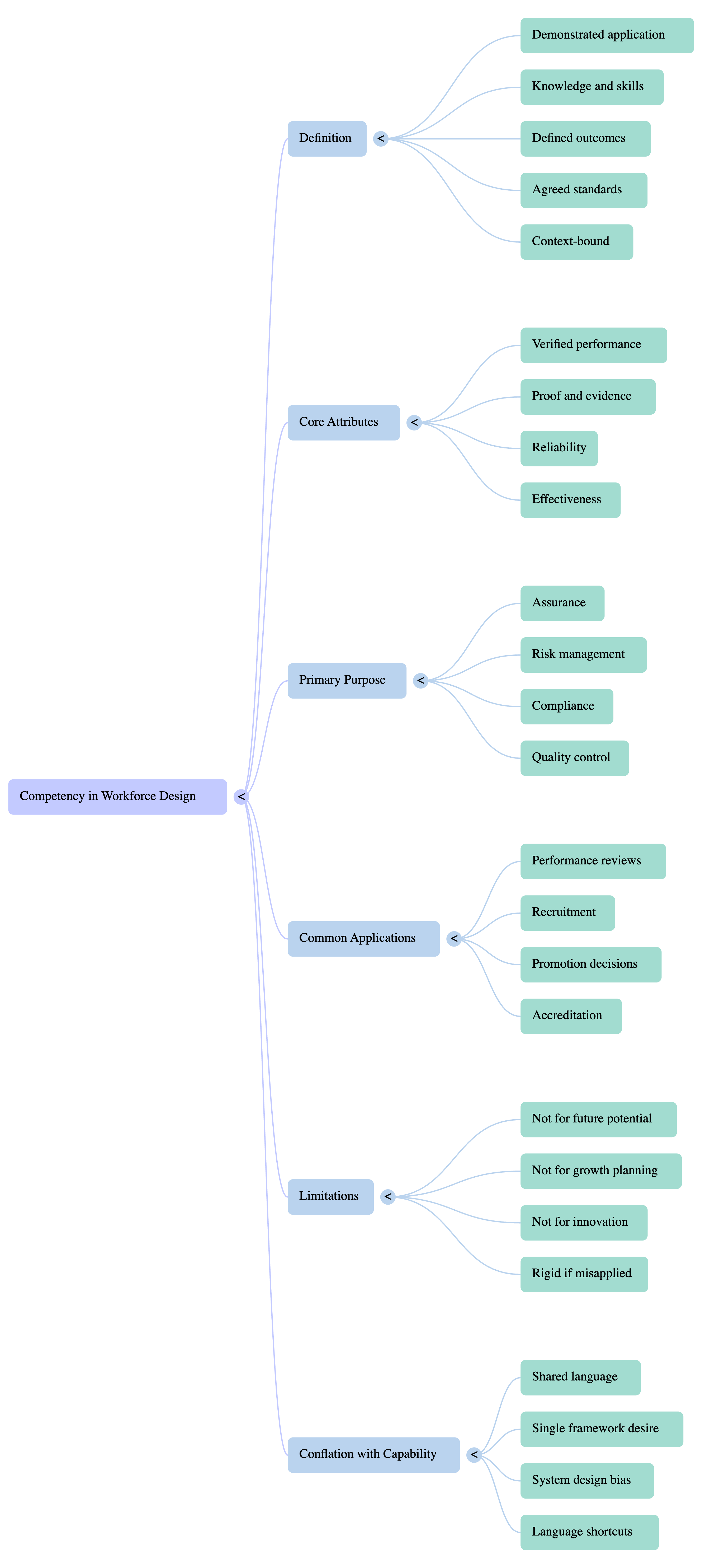
The ISO standard ISO/IEC 24773-1 defines competency as the ability to apply knowledge and skills to achieve intended results. The SFIA Foundation reinforces this, framing competency as demonstrated application in real-world contexts, under accountability for outcomes.
Across standards-aligned literature, competency implies:
- application, not possession,
- demonstration, not intention,
- reliability, not potential.
From what I see, competency is about proof.
A note on terminology. A competency framework is also called a competency model, especially in the United States. I use competency profile for the competencies and required levels for one role, and competency matrix for the grid of required against current proficiency. Usage varies by region, and I explain the differences in this competency model definition.
What the Dictionary Gets Right, and What It Misses
Dictionaries typically define competency as the ability to do something successfully or efficiently. That’s directionally correct, but insufficient for workforce systems.
What it gets right:
- Competency implies effectiveness.
- It suggests a standard has been met.
What it misses:
- Competency is always contextual.
- It requires evidence.
- It is assessed against defined expectations, not personal potential.
In practice, I see organisations treat competency as a general trait, when it is actually a context-bound judgement.
Why Competency Gets So Heavily Conflated in HR
Competency is most often conflated with capability, and that confusion is structural.
A few drivers show up repeatedly in my work:
- Shared language, different intent
Both competency and capability frameworks use behaviours and proficiency levels, which hides their distinct purposes. - Desire for a single framework
Organisations want one model to handle performance, development, and workforce planning. - Everyday language shortcuts
Saying someone is “competent” in plain English collapses demonstrated performance and future potential. - System design bias
Performance management systems are optimised for evaluation, so everything gets pulled into that logic.
The outcome is that competency frameworks are criticised for failing at development, a job they were never built to do.
The Problem Competency Was Originally Designed to Solve
Competency exists to solve assurance.
In my work, competency frameworks are at their best when organisations need to:
- define clear performance standards,
- ensure consistency across roles,
- verify readiness for practice,
- manage risk, compliance, and quality.
Competency answers the question:
Can this person reliably perform to the required standard in this role?
It does not answer:
- whether they can grow into something new,
- whether the organisation is future-ready,
- whether capability exists beyond the current context.
Those are different questions.
How Competency and Competency Frameworks Are Used in HR Today
Across organisations I work with, competency frameworks are commonly used for:
- performance reviews and appraisals,
- recruitment and selection,
- promotion and progression decisions,
- accreditation and certification.
This works well when competency frameworks are:
- role-specific,
- evidence-based,
- tied to observable outcomes.
It breaks down when they’re repurposed for development planning, leadership uplift, or transformation agendas. In those cases, competency becomes a ceiling rather than a foundation.
A Clear, Practical Definition of Competency (My Position)
From both standards and applied practice, this is the definition I work with:
Competency is the demonstrated ability to apply knowledge and skills to achieve defined outcomes to an agreed standard within a specific context.
Competency is verified performance, not latent ability.
It answers “has this been proven?”
It does not answer “what could be possible next?”
What This Definition Supports, and What It Doesn’t
Used properly, competency supports:
- performance assessment,
- role clarity and standards,
- assurance and compliance,
- fair and consistent evaluation.
It is poorly suited for:
- long-term development planning,
- capability building,
- innovation and adaptability,
- future workforce design.
When competency frameworks are stretched into these roles, they appear rigid, not because they are flawed, but because they’re misused.
Why Getting This Right Actually Matters
From what I see, organisations don’t fail because they measure performance, they fail when they confuse performance measurement with development strategy.
Competency frameworks provide evidence of mastery. Capability frameworks provide direction for growth. Skills and knowledge underpin both.
When each construct is allowed to do its proper job, the system works.
When they’re collapsed into one, everything becomes harder than it needs to be.
Related Frameworks and Models
- CEO Competency Model
- CIO Competency Framework
- CFA Competency Framework
- Career Competency Model
- Business Competency Model
- DEI Competency Model
- Customer Success Competency Model
- Customer Service Competencies Framework
- Customer Services Competencies Framework
- AHRI Competency Framework
- ADB Competency Framework
- Management Competency Model
- 9 Box Competency Model
- Project Management Competency Model
- Business Development Competency Framework
- Talent Acquisition Competency Framework
- PMO Competency Framework
- Innovation Competency Framework
- Learning and Development Competency Framework
- Best Leadership Competency Models
- Adaptive Leadership Competencies