
Most organisations build their competency framework in the wrong order. They start with what looks manageable: pulling together a list of competencies from a competitor's published document, adding a few values from the strategy deck, and calling the result a framework. What they end up with is a list masquerading as architecture. Creating a competency framework properly means working through a defined process, in sequence, with the right inputs at each stage.
What Is a Competency Framework?
A competency framework is an organisation-wide system that defines, groups, and standardises competencies so they can be reused consistently across roles and levels. It includes competency definitions, proficiency levels, and observable behavioural indicators, plus the governance rules for how role profiles apply them.
The goal is consistency and comparability in people decisions across the workforce. It is not a list of attributes and it is not a values poster. If your competency framework cannot tell you, at any given level, exactly what observable behaviour is expected of a person, it is not functioning as a framework.
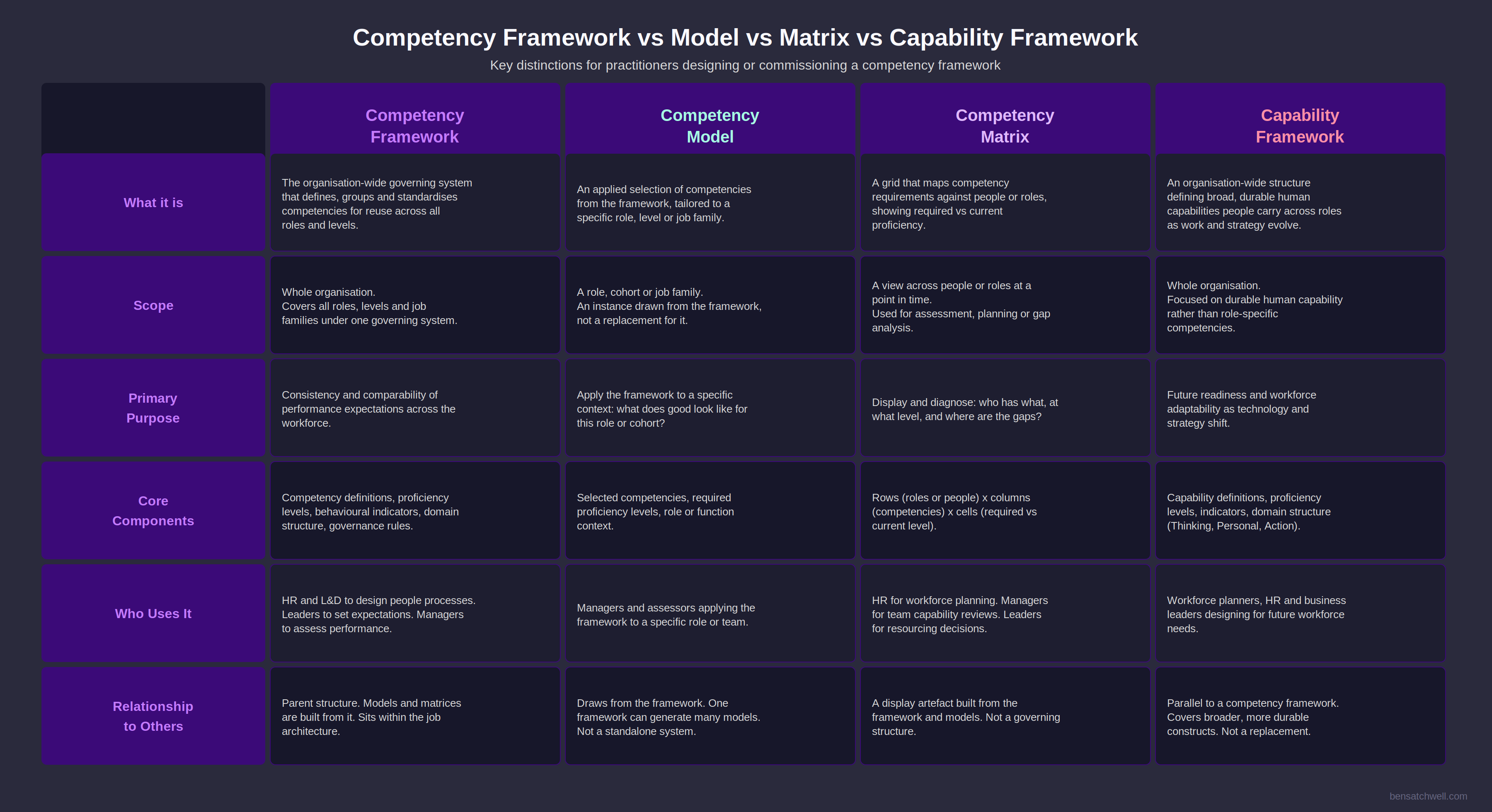
A note on terminology. A competency framework is also called a competency model, especially in the United States. I use competency profile for the competencies and required levels for one role, and competency matrix for the grid of required against current proficiency. Usage varies by region, and I explain the differences in this competency model definition.
Why Organisations Need a Process for Creating One
A competency framework is only useful if it reflects the real performance requirements of the organisation. Generic competencies drawn from external sources, or copied from a framework designed for a different industry, produce frameworks that no one trusts and assessors cannot apply reliably.
CIPD's research on competence and competency frameworks notes that the most common failure mode is frameworks designed without sufficient input from the people doing the work. The result is a document that HR owns and managers ignore.
The process matters because the framework has to survive contact with the organisation. That requires stakeholder ownership from the start, grounding in real work requirements, and governance for what happens when roles or strategies change.
How to Create a Competency Framework: The Core Steps
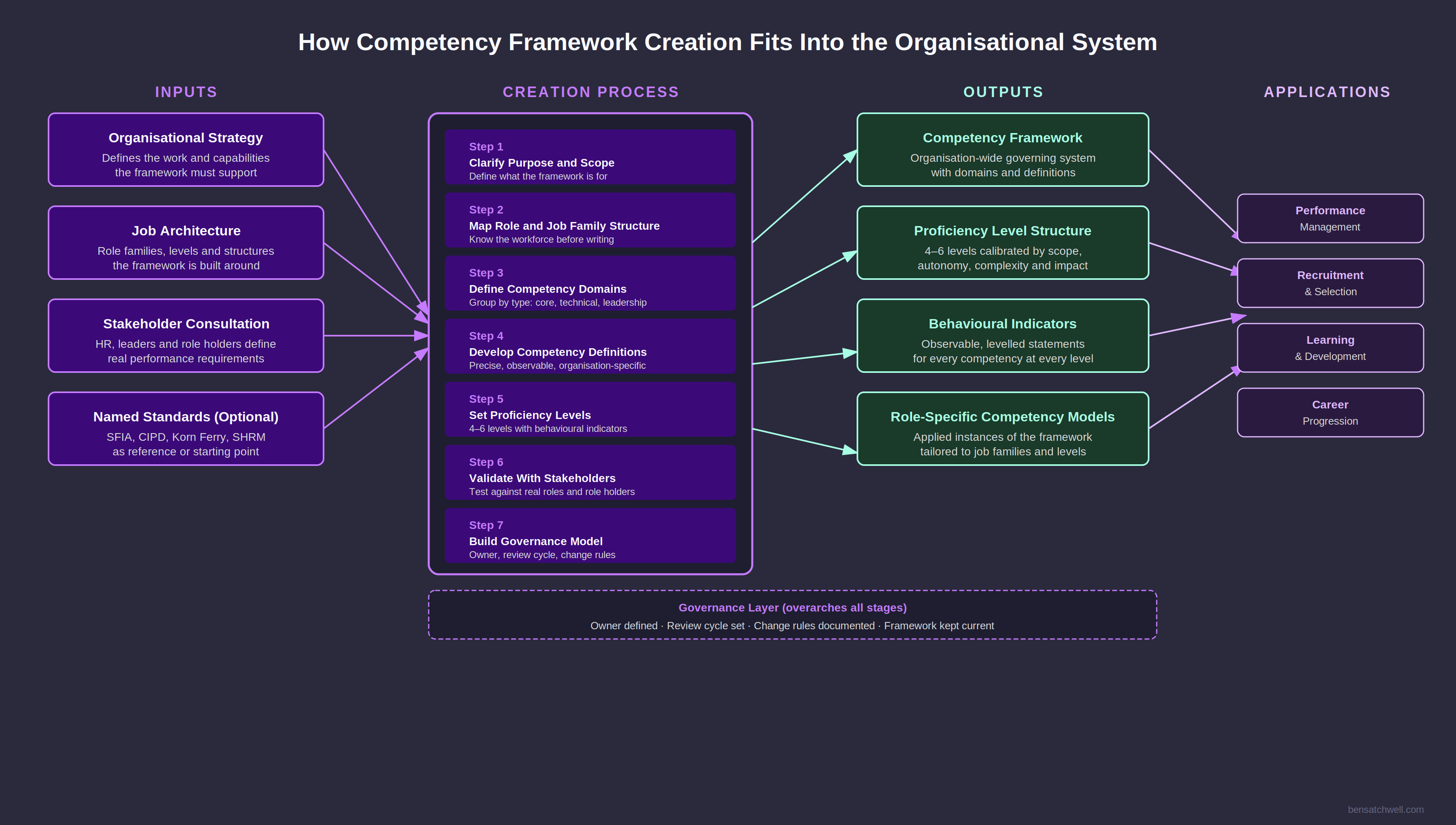
Step 1: Clarify Purpose and Scope
Before any content is developed, the design team needs to agree on what the framework is for. A competency framework used primarily for recruitment will be structured differently from one used for performance management, promotion decisions, or learning and development planning.
Scope decisions at this stage include: which parts of the workforce the framework will cover, whether it will address leadership separately from technical roles, and whether the framework will integrate with existing job architecture or be built from scratch.
Getting this right at the outset avoids the most common redesign cost: discovering halfway through that the framework does not fit the way roles are actually structured.
Step 2: Map the Role and Job Family Structure
Creating a competency framework that works at scale requires a clear understanding of the role architecture it will sit within. That means mapping job families, identifying the major role clusters, and understanding how the workforce is organised before a single competency is written.
This is where many organisations skip a critical step. They start writing competencies before they know which roles will use them. The result is a framework with inconsistent coverage: detailed for some roles, generic or absent for others.
If the job architecture does not exist, the framework process exposes that gap immediately. This is not a problem. It is an opportunity to build both in parallel, with the framework informing the role structure and the role structure informing the competency domains.
Step 3: Define the Competency Domains
A competency framework is organised into competency domains, groupings of related competencies organised by the type of performance they describe. Common domains include functional or technical competencies, behavioural or interpersonal competencies, leadership competencies, and professional or ethical competencies.
The right domain structure depends on the organisation's purpose and workforce. A professional services firm may need separate domains for client management, commercial acumen, and technical expertise. A public sector agency will typically weight leadership and ethics differently from a technology company.
Frameworks also commonly distinguish between core competencies (what every person in the organisation is expected to demonstrate, regardless of role) and technical or functional competencies (specific to a role, discipline, or job family). That distinction matters for how the framework is applied across different parts of the business. An HR competency framework, for example, carries a distinct technical domain alongside the core competencies shared across the organisation.
Step 4: Develop the Competency Definitions
Each competency needs a clear definition: what it means in this organisation, for this workforce. Not a one-line label, and not a paragraph of vague aspiration.
A well-defined competency names the integration of skills, knowledge, judgement, and behaviour applied effectively in a role context. It is grounded in observable performance, not in traits or intentions. Effective competency definitions also clarify what the competency is not, because adjacent competencies overlap and assessors need clear boundaries.
Research published in SAGE Open on competency framework development for human resource management confirms what practitioners already know: competency definitions developed through a participatory process, where role holders contribute alongside HR and leadership, produce more accurate and trusted frameworks than those developed by HR in isolation.
Step 5: Set Proficiency Levels
Proficiency levels are the defined stages at which a competency is held or required. A workable framework uses four to six levels, and they are calibrated by scope, autonomy, complexity, and impact, not by years of service or seniority.
The proficiency level structure is what makes the framework usable for performance calibration, career progression, and learning planning. Without levels, the framework can describe what good looks like but cannot differentiate between someone early in development and someone operating at senior or expert standard.
Each level needs behavioural indicators: observable, written statements describing the specific behaviour expected at that stage. This is the most labour-intensive part of the process and the part most often rushed or delegated to an external provider without adequate quality control.
Step 6: Validate With Stakeholders
Before the framework is finalised, it should be tested against real roles with real managers and role holders. This is not optional.
Validation surfaces the gaps: competencies that do not apply to any role, indicators that sound good but cannot be observed in practice, proficiency levels that do not correspond to any recognisable stage in the career path, and language that makes sense to HR but confuses the people being assessed.
A structured validation process typically involves focus groups or structured review sessions across representative job families, with specific questions: does this competency describe something that distinguishes high from average performance? Can you observe the behaviour described in the indicators? Does the language reflect how this work is actually done?
Step 7: Build the Governance Structure
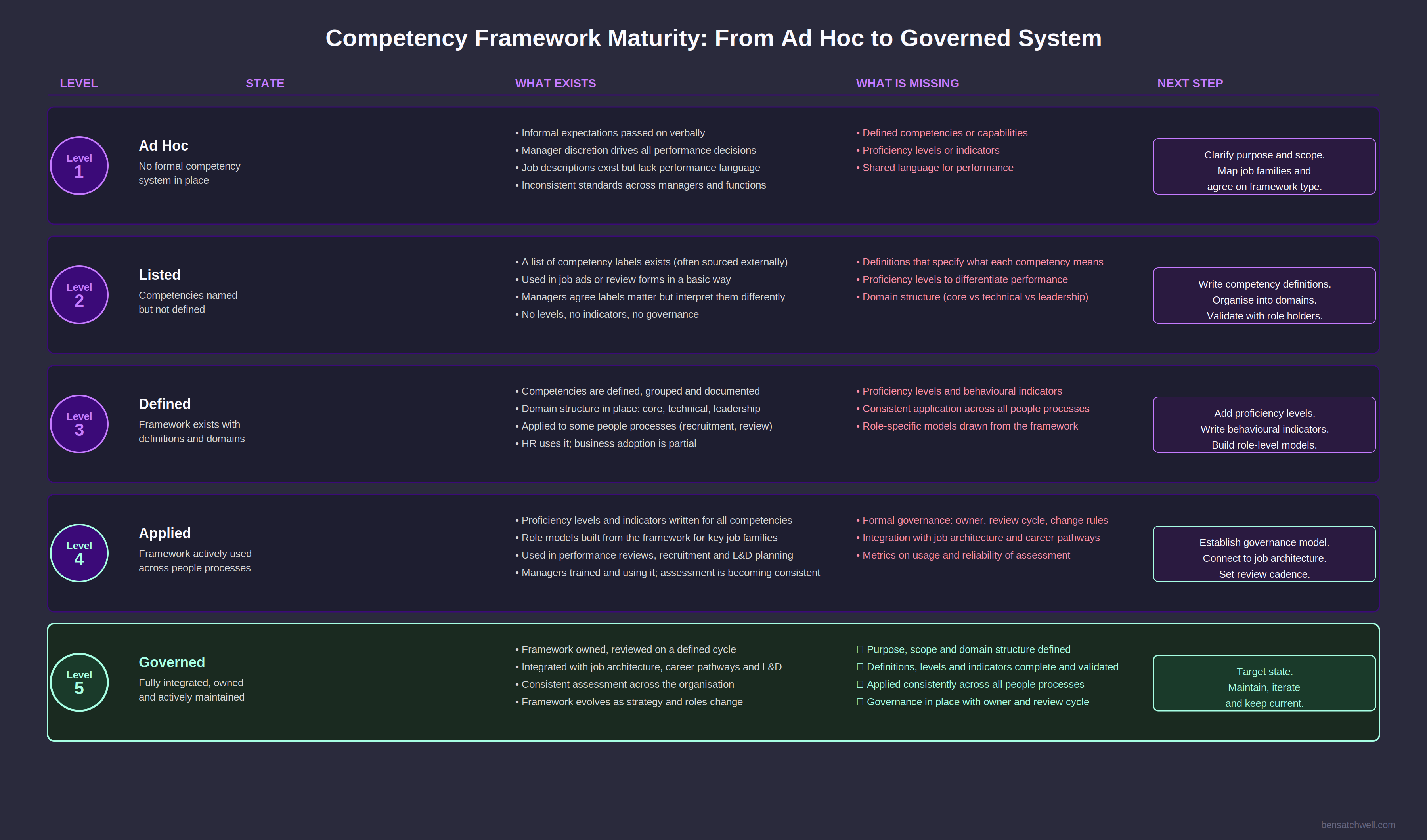
A competency framework without governance is not a framework, it is a document. Governance defines who owns the framework, who can add or remove competencies, how often it is reviewed, and what triggers a redesign.
Without an owner and a review cycle, the framework becomes outdated the moment the organisation restructures or strategy shifts. This is not a theoretical risk: most frameworks that fall out of use do so not because the original design was wrong, but because no one was responsible for keeping them current.
What Creating a Competency Framework Is Not
It is not writing a list of competencies and formatting it as a table. It is not copying SHRM's or Korn Ferry's framework and applying it wholesale. It is not a drafting-session output that becomes a policy document without validation.
It is also not the same as designing a capability framework, which organises broader, more durable human capabilities rather than role-specific performance expectations. The two serve different purposes and are structured differently. Conflating them at the design stage produces a framework that is unclear about what it is measuring.
Organisations also commonly confuse a competency profile with a competency framework. The framework is the governing system. The profile is the selection of competencies and required levels for a specific role or job family, such as the one set out in a CEO competency framework or for a specific technical job family. The profile draws from the framework. It is not a replacement for it.
Common Failure Modes When Creating a Competency Framework
Starting with the content before the purpose. Jumping to competency writing before agreeing on what the framework will be used for produces frameworks that are structurally sound but functionally useless. Purpose determines scope, domains, level count, and indicator style.
Skipping role architecture. A framework applied to a poorly defined role structure will never work well. If roles are inconsistently titled, scoped, or levelled, the framework cannot provide the consistency it is designed to deliver.
Neglecting the indicator layer. Frameworks that define competencies but do not write behavioural indicators at each proficiency level leave assessors to interpret expectations themselves. That defeats the purpose. Inconsistent assessment is exactly what the framework was supposed to prevent.
Outsourcing the whole thing. External consultants can facilitate and structure the process, but they cannot substitute for the internal knowledge of what good performance actually looks like in this organisation. Frameworks built entirely from outside the organisation rarely stick.
No governance. A framework without a review cycle is on a countdown to irrelevance. Every restructure, role redesign, or strategic shift is a reason the framework needs to be revisited.
Trade-offs and Constraints When Creating a Competency Framework
Creating a competency framework is an investment. A well-designed framework covering a workforce of any real complexity requires significant input from HR, business leaders, and frontline managers, over a period of months, not weeks. The depth of that investment correlates directly with the quality and shelf-life of the output.
Simpler, faster alternatives exist. Lightweight competency profiles built for a single function or role family can be developed in weeks. But for a complete, organisation-wide framework, depth and rigour are not optional extras. They are what make the framework worth having.
The right scope depends on where the organisation is in its maturity. An organisation with no prior framework may be better served starting with leadership competency framework examples and an initial framework for the leadership cohort, rather than attempting to cover the whole workforce in one pass.
A scoping review published on PubMed Central on developing competencies in professional environments found that phased implementation, beginning with the highest-impact role clusters, significantly improves adoption rates compared to whole-of-organisation launches.
Frequently Asked Questions
How long does it take to create a competency framework?
A complete framework for a medium-sized organisation typically takes three to six months from scoping to validated draft. Simple single-function profiles can be completed faster. Whole-of-organisation frameworks with deep stakeholder engagement take longer.
Who should be involved in creating a competency framework?
At minimum: HR, senior leadership, and representative role holders from each major job family. Frameworks designed without input from the people doing the work are consistently less trusted and less accurately applied.
What is the difference between a competency framework and a competency profile?
The framework is the governing, organisation-wide system. A competency profile is the selection of competencies and required levels drawn from it for a specific role, level, or job family. They are not interchangeable.
Do you need a job architecture before creating a competency framework?
Ideally yes. A clear role structure gives the framework a stable base to plug into. If the architecture does not exist, the framework design process will surface the need for it. Both can be developed in parallel, but the role structure decisions need to be made before the framework is finalised.
What proficiency levels should a competency framework use?
Four to six levels is the practical range. Levels should be calibrated by scope, autonomy, complexity, and impact. Generic labels like beginner, intermediate, advanced, and expert work as a starting point but need to be described with behavioural indicators specific to the competencies in the framework.
Can you adapt an existing framework like SHRM or Korn Ferry instead of building from scratch?
Yes, and it is a legitimate starting point. Published frameworks provide a validated domain structure and competency library to draw from. The adaptation still requires customisation, validation with role holders, and the addition of organisational language and context. Adopting a published framework wholesale, without adaptation, produces the same problems as any other externally sourced document applied internally without testing.