

Competency Framework for Talent Management
Most organisations run talent management off a competency framework they never actually built for that purpose. They inherit one from a performance review rollout, or a leadership development programme, and then stretch it to cover recruitment, succession planning and career pathing without checking whether it was designed to carry that weight. It usually wasn't, and the cracks show up first in succession planning, where nobody can agree what "ready now" actually means.
What Is a Competency Framework for Talent Management?
A competency framework for talent management is the organisation-wide system that defines, groups and standardises the competencies used to make talent decisions, recruitment, performance management, succession planning, career pathing and development, so that those decisions are made against a consistent, comparable standard rather than each function inventing its own criteria.
It is not a talent management competency model. A model is an applied selection of competencies from the framework, tailored to a specific role, level or job family, such as the set of competencies used to assess readiness for a general manager succession pool. The framework is the governing system; the model is one instance of it, built for one purpose.
A properly built competency framework for talent management includes three things: defined competencies with clear behavioural indicators, proficiency levels set by scope and complexity rather than seniority, and governance rules for how those competencies get applied consistently across every talent process that touches them.
Why It Exists
Talent management fails quietly when every function uses a different language for the same thing. Recruitment screens for "leadership potential." Performance reviews score "strategic thinking." Succession planning talks about "readiness." None of these are defined the same way, none of them are levelled the same way, and none of them are comparable across the organisation.
A competency framework for talent management exists to remove that translation problem. It gives recruitment, performance management, succession planning and development a shared set of definitions and levels, so a competency assessed in a performance review means the same thing when it turns up in a succession conversation eighteen months later. Without that shared structure, talent decisions are made on manager impression rather than evidence, which is exactly what Why Most Capability Frameworks Fail sets out in more detail for capability work generally, and the same logic applies directly to competency.
The functional reason this construct needs to exist is comparability. Without it, you cannot build a defensible succession pipeline, because "ready" for one manager means something different to "ready" for another.
How It Works in Practice
In practice, a competency framework for talent management sits above the individual talent processes and feeds into each of them.
Core competencies apply to everyone in the organisation regardless of role, and typically cover things like collaboration, communication and judgement. These give talent management a consistent baseline to assess against, no matter which process is running.
Technical or functional competencies are role and discipline specific. They populate the models used for role-specific talent decisions, such as assessing a finance manager against financial acumen and controls literacy, competencies that would be irrelevant in an engineering succession pool.
Proficiency levels, usually four to six of them, are set by scope, autonomy, complexity and impact. This is what makes cross-role comparison possible. A "level 3" in stakeholder management should represent the same actual scope of responsibility whether the person sits in HR, operations or finance, which is the entire point of building the framework centrally rather than letting each function set its own bar.
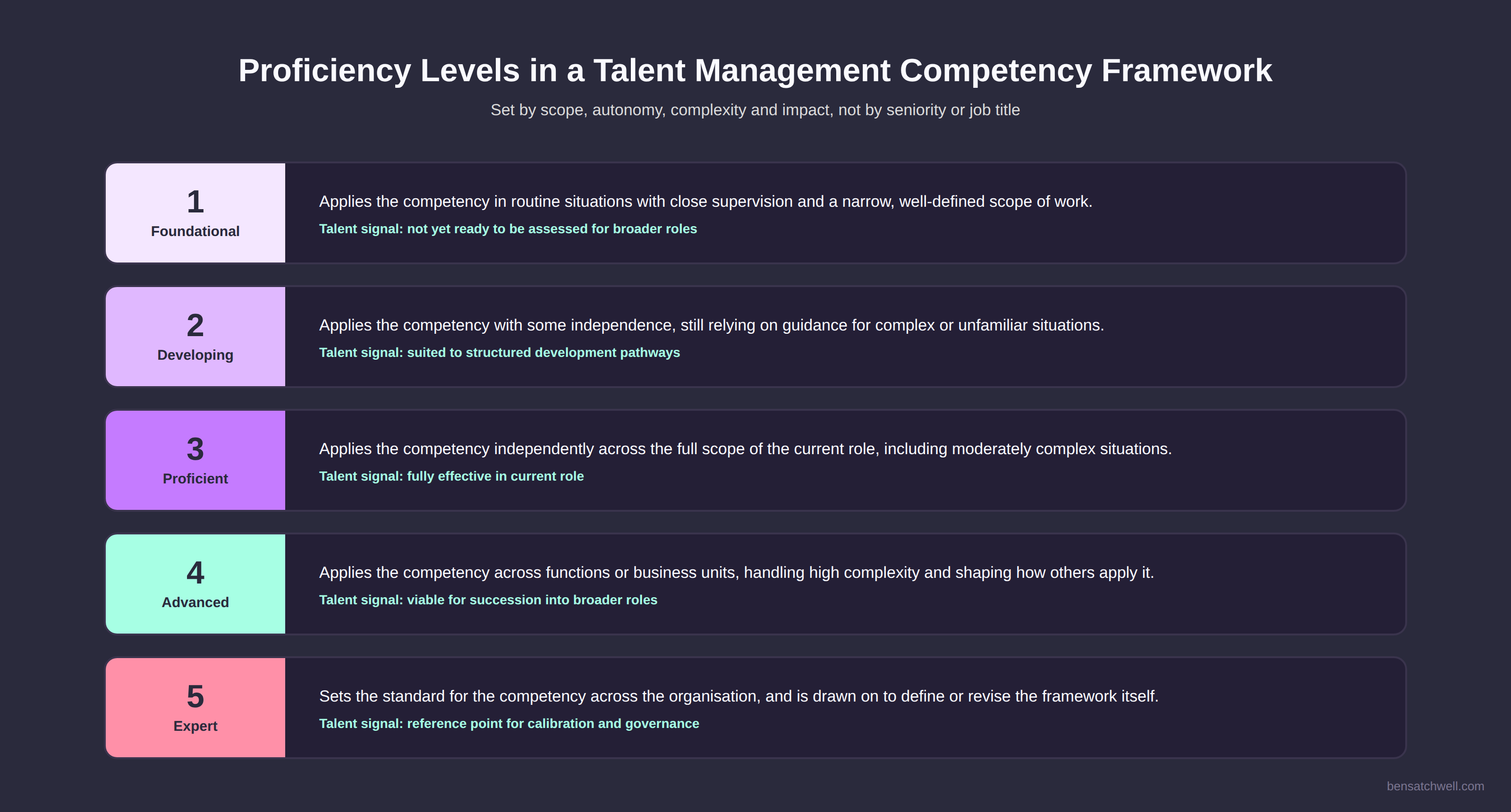
Proficiency levels in a competency framework for talent management are set by scope, autonomy, complexity and impact, not by seniority.
From there, talent management processes each draw a competency model, an applied selection from the framework, for their specific purpose: a recruitment model for a hiring panel, a succession model for a leadership pipeline, a development model tied to career pathing. Behind each model sits a competency matrix, the grid that shows current holding against required level for a person or role, which is the artefact recruiters, managers and succession panels actually work from day to day. This is broadly consistent with How the People Capability System Works, where framework, model and matrix are treated as three distinct layers rather than interchangeable terms.
Governance closes the loop. Someone has to own the framework centrally, control how new competencies get added, and audit whether models built from it are staying consistent with the original definitions. Without that governance, every function slowly drifts back to inventing its own version.
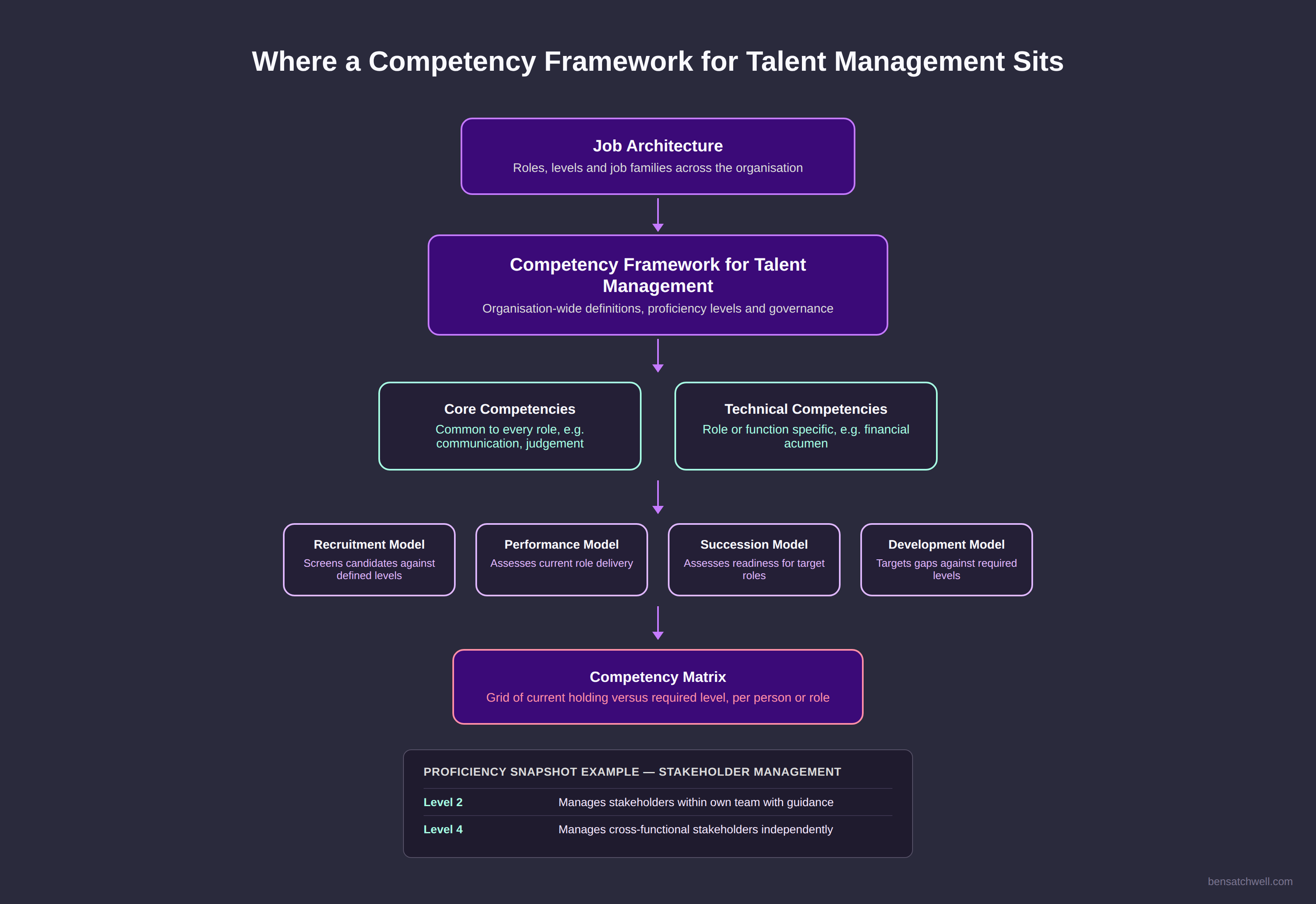
Where a competency framework for talent management sits: governed centrally, then drawn into recruitment, performance, succession and development models.
What It Is NOT
A competency framework for talent management is not a competency model. The framework is the organisation-wide governing structure; the model is a role-specific instance built from it. Confusing the two is why organisations end up with a dozen incompatible "competency frameworks," one per business unit, none of which talk to each other.
It is not a capability framework, and this is the distinction most commonly missed. A competency describes performance in a specific role, integrating skills, knowledge, judgement and behaviour applied in context. A capability is broader and durable, something a person owns and carries across roles as work changes, and signals their potential to move into work that does not exist yet. Talent management that only tracks competencies can tell you if someone is doing their current job well. It cannot tell you whether they are capable of doing a job that does not exist on the org chart yet, which is precisely the gap The Problem the People Capability System Solves is built around.
It is not a competency matrix. The matrix is a display and assessment artefact, the grid showing who holds what against what is required. It is built from the framework and the models, not the governing structure itself. A talent team that only maintains matrices, without the framework underneath, is maintaining a spreadsheet, not a system.
It is not a set of soft skills bolted onto a job description. Most of what gets labelled "soft skills," communication, adaptability, collaboration, are properly capabilities by this definition: broad, durable and transferable rather than role-specific. Treating them as narrow, discrete skills is a category error that shows up constantly in badly built talent frameworks.
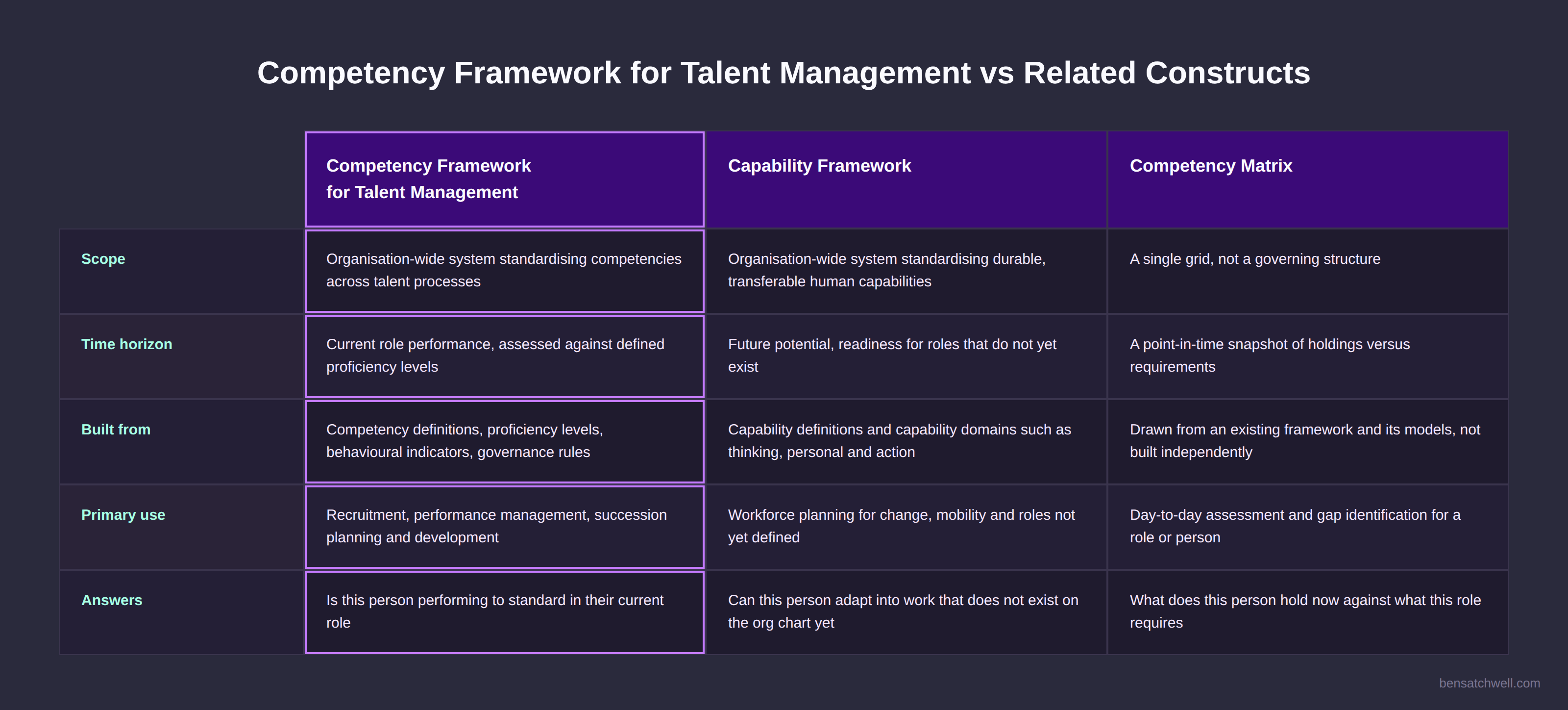
How a competency framework for talent management differs from a capability framework and a competency matrix, by scope, time horizon and use.
Named Frameworks and Standards
Several established models sit in this space and are worth knowing by name. The CIPD's work on competence and competency frameworks is a useful reference point for how competency-based approaches should be built and where they commonly go wrong in practice.
SHRM's competency model, built from research across thousands of HR professionals, defines core behavioural competencies used specifically to strengthen talent management, and SHRM's own analysis notes that organisations increasingly use competency modelling to underpin nearly every stage of the talent lifecycle, from recruitment through to succession planning.
Korn Ferry and Lominger built some of the most widely licensed competency libraries in the market, used heavily in leadership succession work. Public sector bodies have built their own variants for the same purpose; the OECD's framework for digital talent and skills in the public sector is a recent example of a competency-based approach purpose-built for one talent management problem, attracting and developing digital capability in government.
Common Failure Modes
The most common failure is building the framework backwards from a single talent process, usually performance reviews, then retrofitting it to recruitment and succession later. It was never designed to carry that weight, and the strain shows up as competencies too vague to assess consistently, or too specific to apply outside the original use case.
A second failure is proficiency levels set by seniority rather than scope. If "level 4" simply means "manager and above," the framework stops measuring anything real and starts measuring job title, defeating the purpose of building comparability in the first place.
A third is no governance. Without a clear owner controlling how competencies are added or changed, every business unit eventually builds its own version, and the organisation ends up back where it started, with incompatible language across recruitment, performance and succession.
A fourth, increasingly common, is conflating competency with capability across the whole talent system, then wondering why the framework cannot answer questions about future readiness. A competency framework tells you about current role performance. It was never built to answer questions about future potential, that is capability's job.
Trade-offs and Constraints
A competency framework for talent management earns its investment when an organisation runs talent decisions across multiple functions and needs those decisions to be comparable, particularly for succession planning, where inconsistent standards do the most damage.
It is not worth building for a small organisation running informal, single-manager talent decisions, where governance and maintenance overhead will exceed the value returned. There, a lighter competency model built for one specific purpose, without the full governing framework behind it, is the more sensible starting point.
The constraint to hold onto is scope. A competency framework answers how well someone performs in a defined role. If the real question is adaptability to roles that do not exist yet, that is a capability question, and no amount of competency framework rebuilding will answer it. Ben's People Capability System is built specifically to answer that broader question, alongside the competency framework rather than instead of it.