
Most organisations that say they have a competency development framework have something far narrower. They have a competency framework: a list of defined competencies. They may even have a learning catalogue attached to it. What they lack is the structural scaffolding that connects defined competencies to assessed capability gaps and systematic development pathways. That distinction matters more than most practitioners realise.
What Is a Competency Development Framework?
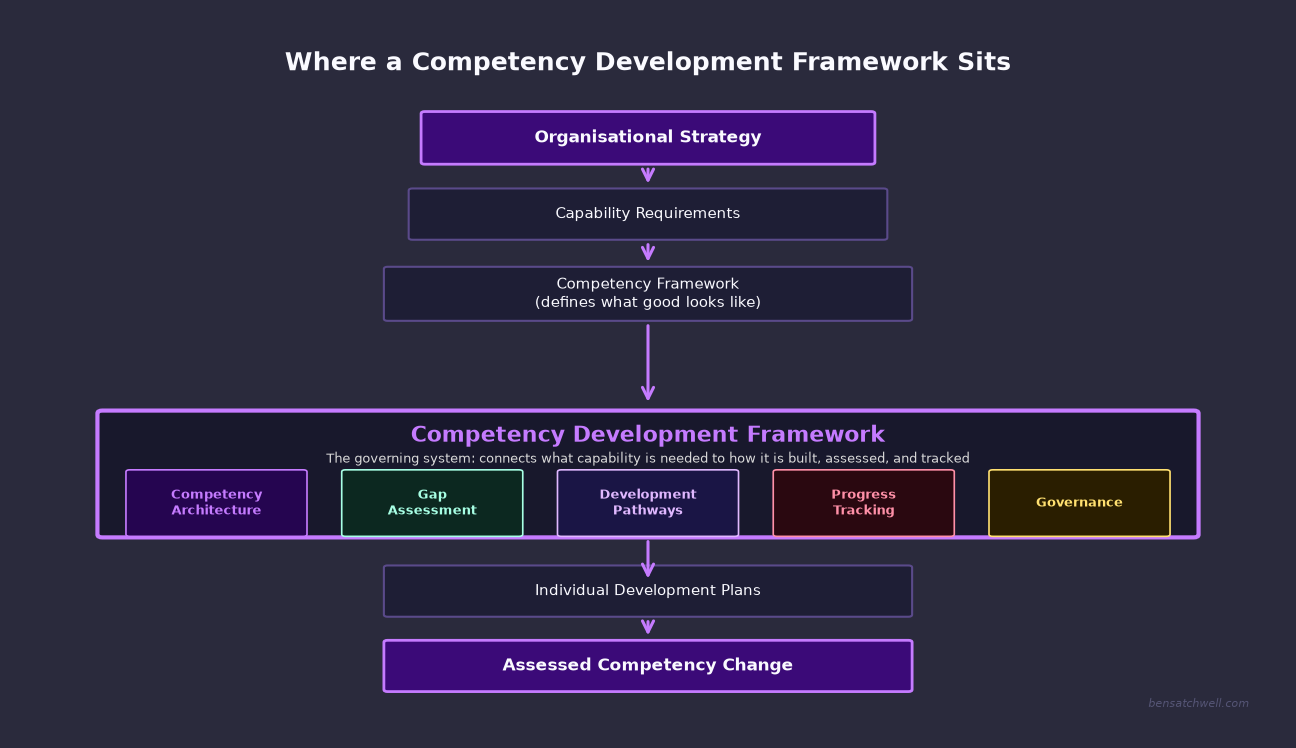
A competency development framework is a structured system that defines the competencies required across roles or functions, establishes how those competencies are assessed, and provides clear development pathways for closing gaps. It differs from a competency framework in that it is explicitly developmental rather than purely descriptive.
A competency framework defines what is required. A competency development framework goes further: it specifies how capability against those requirements is measured, what development activity is appropriate at each level, and how progress is tracked over time.
The structure typically encompasses five elements: the competency definitions themselves, proficiency level descriptors, gap assessment methodology, mapped development resources, and governance processes for monitoring capability change.
A note on terminology. A competency framework is also called a competency model, especially in the United States. I use competency profile for the competencies and required levels for one role, and competency matrix for the grid of required against current proficiency. Usage varies by region, and I explain the differences in this competency model definition.
Why Does a Competency Development Framework Exist?
The problem that a competency development framework solves is the disconnection between defined expectations and actual capability development in organisations. Most organisations invest significantly in defining what good looks like across their workforce. Far fewer invest in building systems that turn that definition into measurable development activity.
The CIPD competency factsheet is a useful general reference here. Many organisations struggle to translate competency definitions into genuine capability-building outcomes. The gap is usually structural: without a framework that connects competency definitions to development pathways, managers and employees are left to interpret what development should look like in practice.
A competency development framework is the mechanism that closes this gap. It answers the questions a competency framework alone cannot: how do we know where someone is, what do they need to do to move forward, and how do we track whether they have?
How Does a Competency Development Framework Work in Practice?
The operational logic of a competency development framework follows a sequence of five components, each dependent on the one before it.
Competency Definitions
The foundation is the competency definitions themselves. These must be precise enough to be assessable. Vague definitions like "communicates effectively" are not usable in a development context unless they include behavioural indicators at each proficiency level.
Proficiency Levels
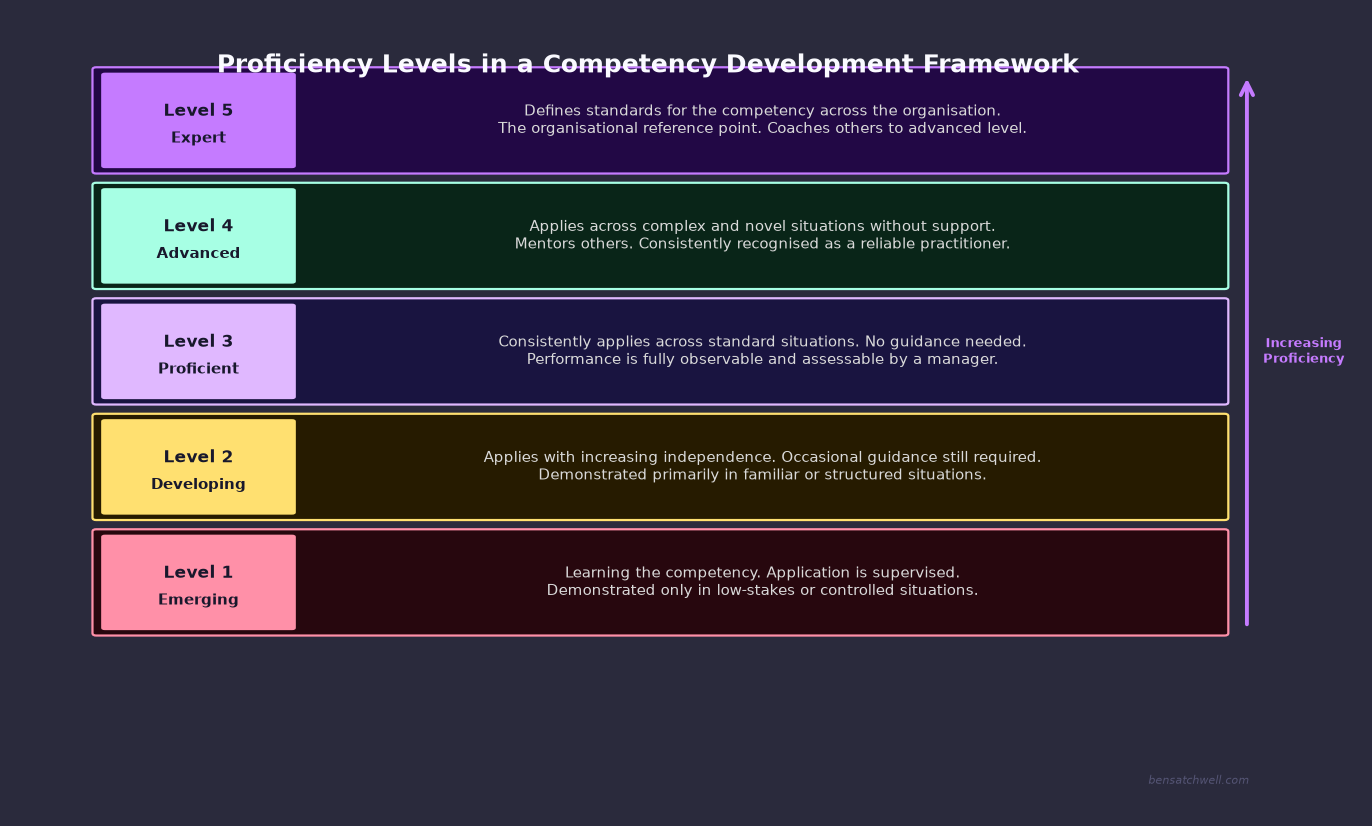
Each competency should be defined across a set of proficiency levels, typically three to five. These levels describe what the competency looks like at different stages of development, from emerging capability through to advanced or expert-level practice. The architecture for this is covered in my article on building a competency framework.
Gap Assessment
Before development can be mapped, organisations need to know where individuals and teams currently sit relative to the required proficiency levels. This assessment process should be structured, repeatable, and separate from performance evaluation wherever possible. I have written about the design of this in my article on competency assessment frameworks.
Development Pathways
Once gaps are identified, the framework maps appropriate development activities to each competency and level. These are not generic learning catalogues. They should specify what types of development activity are appropriate for moving from one level to the next for a specific competency. Stretch assignments, mentoring, peer feedback, and structured observation are often more effective than formal instruction at higher proficiency levels.
Progress Governance
The framework requires a governance mechanism to track whether capability is actually changing. This typically involves periodic reassessment, structured review conversations, and reporting at an organisational level. Without governance, a competency development framework becomes a static document rather than an active system.
What a Competency Development Framework Is NOT
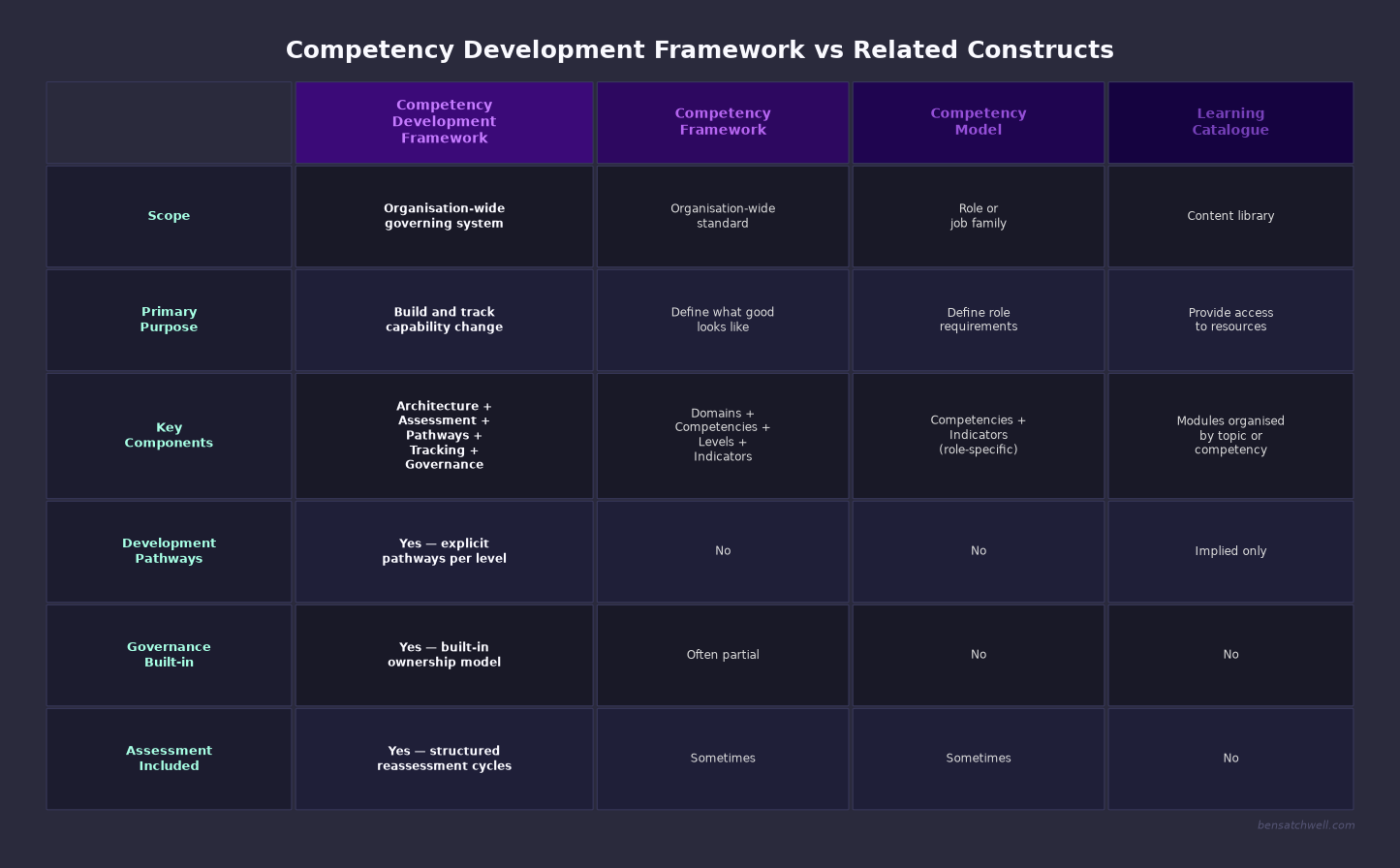
The most common conflation is between a competency development framework and a competency framework. A competency framework defines required competencies. A competency development framework adds the developmental architecture on top. If you do not have gap assessment, development pathways, and progress governance, you have a competency framework, not a competency development framework.
A competency development framework is also not a competency profile. A profile sets the competencies and required levels for a role. It describes the standard but does not move anyone towards it. A competency development framework is operational: it is built to drive and track actual capability change.
Nor is it a learning catalogue. A learning catalogue maps content to roles or topics. A competency development framework maps development activity to specific competency-level transitions, which is a more precise and more useful design.
Finally, a competency development framework is not a performance management framework. Performance management asks whether someone is meeting expectations. A competency development framework asks whether someone is growing toward them and beyond.
Named Standards and Referenced Frameworks
Several established frameworks provide structural inputs for competency development framework design.
SFIA (Skills Framework for the Information Age) offers one of the most mature examples of competency-level architecture in technology and digital roles. Its seven-level scale with defined generic attributes at each level provides a reusable reference for organisations designing proficiency descriptors.
The Korn Ferry Lominger library includes developmental suggestions mapped to each competency, an early example of integrating definition with development guidance at scale. The library has limitations in contemporary application, but its developmental scaffolding concept remains sound.
SHRM's Body of Applied Skills and Knowledge (BASK) provides both competency definitions and associated proficiency levels for HR practitioners, making it one of the more directly usable reference standards for a specific professional context.
CIPD's Profession Map pairs competency definitions with proficiency levels and connects them to professional development pathways. The intention is that practitioners can use the map to plan their own development over time.
Research continues to develop the evidence base for competency framework design and implementation. Recent work on competency-based framework development and implementation examines how organisations approach design choices and the factors that affect successful implementation across contexts.
Common Failure Modes
The most common reason a competency development framework fails to produce capability change is that it is designed once and then treated as complete. Competency definitions become stale. Proficiency descriptors lose relevance as role requirements shift. Development pathways no longer match what is actually available. Governance processes atrophy.
A second failure mode is disconnection from the performance system. When competency development is treated as a separate exercise from performance conversations and talent decisions, it tends to attract compliance behaviour rather than genuine engagement.
A third failure mode is over-engineering the competency definitions themselves. When behavioural indicators are so numerous and specific that no manager can reasonably use them in conversation, the framework collapses under its own weight. Precision is necessary, but usability is equally important.
A fourth failure mode is gap assessment that is not credible. If the assessment process is not structured or perceived as biased, individuals will disengage from the development pathways that follow. Research into competency definitions, development, and assessment identifies assessment credibility as a prerequisite for framework utility.
A fifth failure mode is treating development pathways as synonymous with formal instruction. For most competencies above an emerging level, the most effective development activity is experiential: stretch assignments, structured coaching, peer learning, and deliberate practice. Frameworks that default to formal instruction as the primary development vehicle systematically underestimate the richness of available options.
Trade-offs and Constraints
A competency development framework is appropriate when the organisation has the operational maturity and commitment to maintain it. Building one requires significant upfront investment in definition, assessment design, and pathway mapping. More importantly, it requires ongoing investment in governance and refresh.
Organisations that have not yet built a reliable competency framework should not attempt to skip to a development framework. The foundation has to be sound before the developmental layer adds value.
Smaller organisations may find that a lighter approach, using a small number of critical competencies with simple proficiency descriptors and informal development conversations, delivers better outcomes than a highly structured system that cannot be sustained with available resources.
FAQ
What is the difference between a competency framework and a competency development framework?
A competency framework defines what competencies are required and what proficiency looks like across levels. A competency development framework adds the developmental layer: how gaps are assessed, what development activity closes them, and how progress is tracked. The framework is the description; the development framework is the operating system.
How do you assess competencies in a development framework?
Competency assessment in a development framework typically uses a combination of manager observation, self-assessment, structured behavioural questioning, and work sample review. The method should be consistent, documented, and separate from performance evaluation to reduce conflation of development need with performance judgement.
How many competencies should a competency development framework include?
Most effective competency development frameworks use between eight and fifteen competencies at the organisational or functional level. Fewer than eight often fails to capture meaningful differences across roles. More than fifteen creates assessment and maintenance burden that most organisations cannot sustain.
Can a competency development framework be used for succession planning?
Yes. Because it identifies current proficiency levels against defined requirements, it produces structured data about who is at what level and what development is needed to reach the next. This makes it directly applicable to succession pipeline analysis and talent mobility decisions.
What is the role of a manager in a competency development framework?
Managers are the primary assessors and development conversation facilitators. The framework does not replace managerial judgement; it structures it. Managers assess current proficiency, identify priority development gaps, and support access to relevant development activity. Without active manager participation, the framework operates as a document rather than a system.
How often should a competency development framework be reviewed?
The competency definitions and proficiency descriptors should be reviewed every two to three years, or sooner if role requirements shift materially. Development pathways should be reviewed annually. Governance processes should be reviewed continuously, not on a fixed cycle.