

Competency Framework for HR Department
Every few months a client asks me to build them a competency framework for their HR department. What they actually want, in nearly every case, is a competency model: an applied set of competencies pulled from the organisation's existing competency framework and tailored to the roles that sit inside HR. The two get used interchangeably constantly, and the mix-up matters, because building an entire governance system for one function is a different job to selecting and levelling the right competencies for it.
What Is a Competency Framework for HR Department
A competency framework for HR department describes the set of competencies that define good performance across the roles inside the HR function, organised by domain and set against defined proficiency levels.
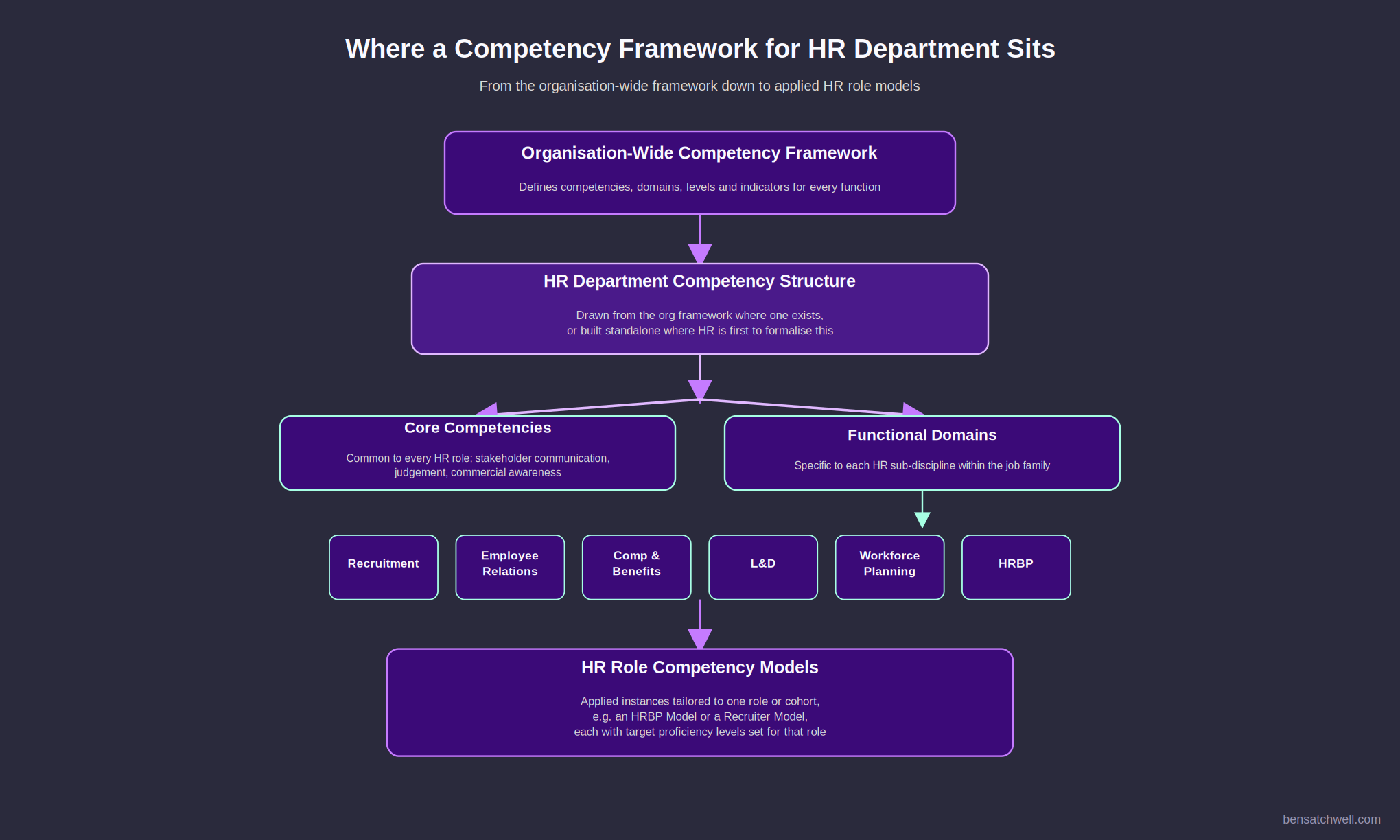
In most organisations, HR already sits inside a broader competency framework, and what the department actually needs is a competency model built from it, not a second framework running in parallel. Where no organisation-wide framework exists yet and HR is the first function to formalise this work, the departmental structure genuinely does function as its own framework, complete with domains, proficiency levels and behavioural indicators built specifically for HR's job family.
Either way, the content is the same. A workable structure names the competencies HR roles are assessed against, groups them into domains, defines what each looks like at every level, and states the observable behaviour expected at each level. Without those levelled, behavioural indicators, the whole exercise stays a list of aspirational words rather than something anyone can actually assess a person against.
Why a Competency Framework for HR Department Exists
HR is the function that tells the rest of the organisation to define capability requirements, assess proficiency and manage development on a defensible basis. It is a difficult position to hold credibly while running its own recruitment, employee relations and workforce planning off vague job descriptions and instinct.
A competency framework for HR department exists to close that gap. It gives the function the same discipline it asks of engineering, sales or operations: named competencies, set proficiency expectations and a basis for hiring, developing and succession planning that does not depend on any one manager's judgement of who is "good at HR."
It also exists because HR is not one job. It is a job family covering recruitment, employee relations, compensation and benefits, learning and development, workforce planning, HR business partnering and HR operations, each with a genuinely different mix of technical competencies. That is a different question to what belongs in a generic HR competency framework, which sets out the competencies expected of HR professionals in general; a departmental framework has to reflect this organisation's own job family and structure. A competency framework that treats HR as one undifferentiated role cannot do useful work across that spread.
How a Competency Framework for HR Department Works in Practice
In practice, the structure is built in layers. A small set of core competencies apply to every role in HR: things like stakeholder communication, sound judgement under confidentiality constraints and commercial awareness of the business HR supports.
Sitting alongside that core layer are the functional or technical domains specific to each HR sub-discipline. Recruitment competencies differ from employee relations competencies, which differ again from compensation and benefits. This is where a well-built HR business partner competency framework earns its keep. It shows exactly how one HR job family, HRBP work, is broken into competencies distinct from recruitment or L&D, each with its own proficiency levels and indicators.
Most organisations do not start from a blank page here. The SHRM Body of Applied Skills and Knowledge, developed from research across thousands of HR professionals globally, defines eight behavioural competencies (leadership and navigation, ethical practice, relationship management, communication, global and cultural effectiveness, business acumen, consultation, and critical evaluation) plus HR expertise as a technical competency (SHRM, Body of Applied Skills and Knowledge). Many HR departments adopt that core layer directly rather than drafting one from scratch, then add their own functional domains and proficiency levels on top.
CIPD's Profession Map takes a related but distinct approach in the UK and Commonwealth context, defining core knowledge every HR professional needs regardless of specialism, alongside specialist knowledge areas such as workforce planning or employee experience, each written at four levels of impact (CIPD, The Profession Map: Core Knowledge). Where SHRM's model is behavioural and US-centric, CIPD's is knowledge-based and impact-graded. Neither is wrong. They reflect different assumptions about what actually predicts good HR performance, and a department borrowing from either should understand which assumption it is inheriting.
What a Competency Framework for HR Department Is Not
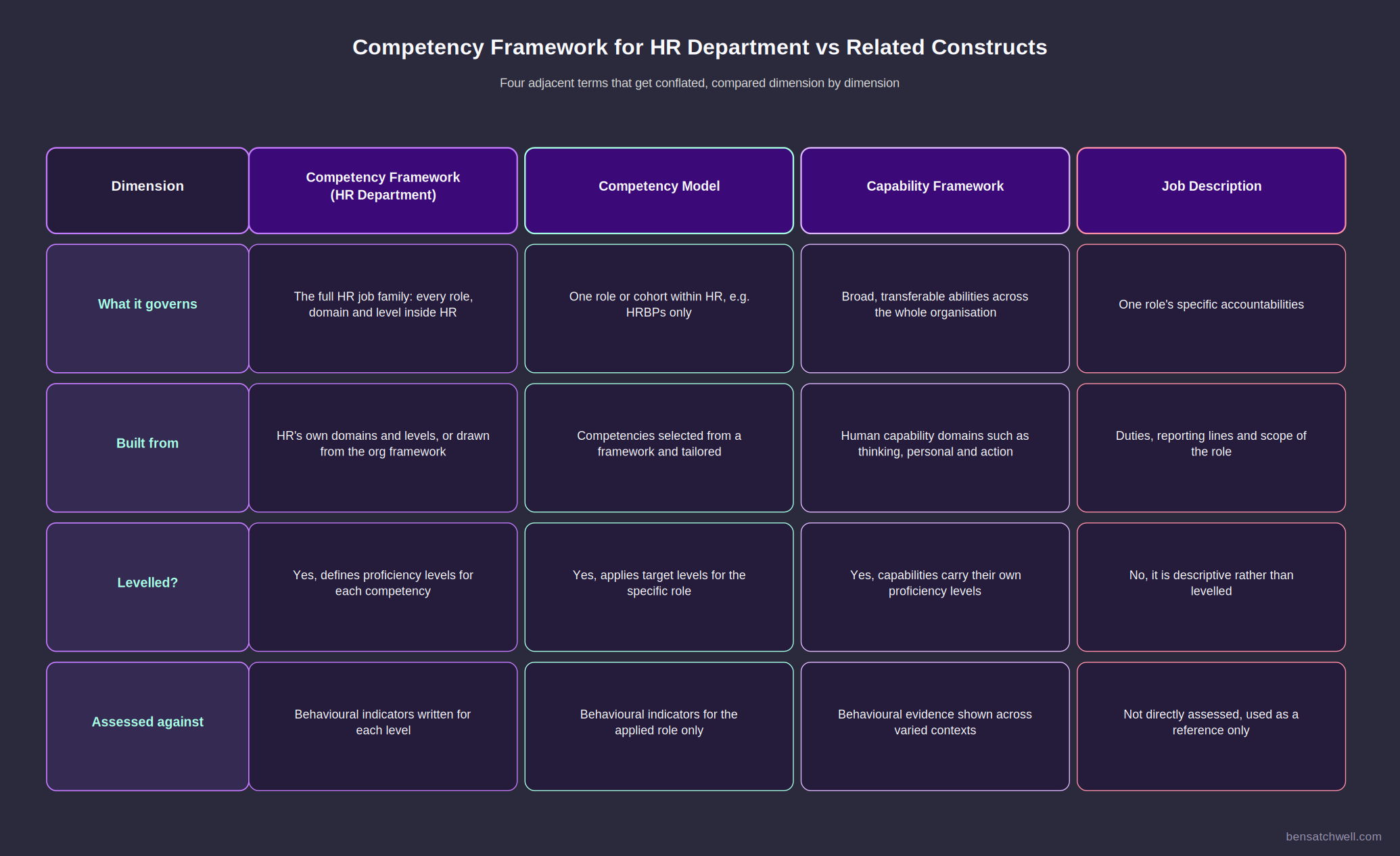
It is not a competency model. A model is the applied, tailored selection built for one role, level or cohort, such as a model just for HRBPs or just for recruitment. A framework is the governing structure the model draws from. Most requests for "a competency framework for HR" are really requests for a model.
It is not a capability and competency framework in the sense of covering broad, transferable capability alongside role-specific competency. A capability is something a person carries across roles and contexts, durable and transferable. A competency is defined against a specific role's requirements. An HR competency framework describes what good performance in HR roles looks like today; it does not describe the broader, portable capabilities an HR professional might carry into a completely different function.
It is also not a job description, and not a curriculum. A job description states what a role is accountable for. A competency framework states the standard of performance expected in doing it, and a levelled indicator is not the same thing as a course outline or a development plan built to close a gap against it.
Common Failure Modes
The most common failure is building the HR framework in isolation from whatever the rest of the organisation uses, or from nothing at all if no organisation-wide framework exists yet. The result is a structure that cannot be compared against anything else in the business and gets treated as HR's private artefact rather than infrastructure anyone else trusts.
The second is flattening the whole thing into one undifferentiated list instead of domains mapped to HR's actual job family. Research on competency framework development for HR management consistently finds that frameworks built through a genuine bottom-up process, combining research, data collection, focus groups and case interviews across the specific roles involved, hold up far better than ones drafted from a template (Ali et al., 2021, SAGE Open). A framework assembled from a generic list without that grounding tends to describe nobody's actual job.
The third is skipping behavioural indicators altogether. Naming "stakeholder management" as a competency without describing what it looks like at each proficiency level leaves assessors guessing, which defeats the entire purpose of having named competencies in the first place.
Trade-offs and Constraints
Building a dedicated competency framework for HR department is worth the effort when the function is large enough to have genuinely distinct job families, when workforce planning or succession inside HR itself is a live problem, or when the organisation is about to select an HR information system that needs competency data to run on.
It is usually not worth the effort for a small HR team of two or three generalists. In that case, adopting SHRM's or CIPD's existing model directly, with light adaptation to the organisation's own language, gets nearly all of the benefit without the governance overhead of maintaining a bespoke structure.
It is also premature if the organisation has no competency framework at all and has no near-term plan to build one. HR building its own structure first, in isolation, risks creating exactly the disconnected artefact described above, one more competency list nobody outside HR ever uses or trusts.
Frequently Asked Questions
Is a competency framework for HR department the same as an HR competency model?
Usually not. A framework is the governing structure; a model is the applied selection of competencies tailored to a specific HR role or cohort within it. Most requests described as a framework are actually asking for a model.
What competencies should a competency framework for HR department include?
A core layer common to every HR role, such as stakeholder communication and commercial awareness, plus functional domains specific to each HR sub-discipline: recruitment, employee relations, compensation and benefits, learning and development, workforce planning and HR business partnering.
How many proficiency levels should an HR competency framework use?
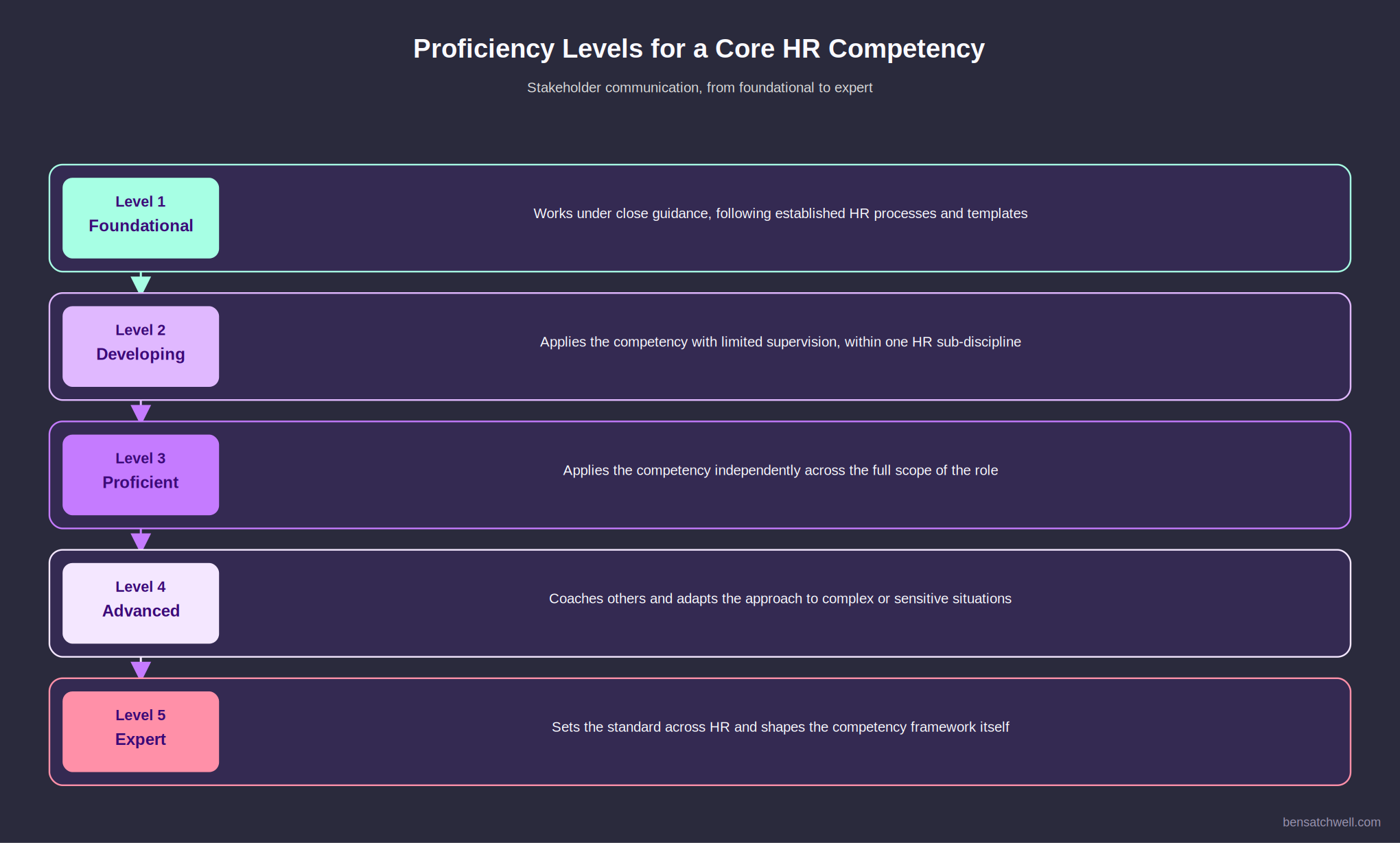
Between four and six, set by the scope, autonomy and complexity of the work at each level, not by job title or years of service.
Should HR build its own competency framework before the organisation has one?
Generally no. Building HR's structure in isolation from an organisation-wide framework tends to produce a disconnected artefact. It is better to build or contribute to the organisation-wide framework first, then derive HR's model from it.
What is the difference between a competency framework and a capability framework for HR?
A competency framework defines what good performance looks like in specific HR roles today. A capability framework describes broader, transferable abilities an HR professional carries across roles and contexts, independent of any single job.
Which named models do HR competency frameworks commonly draw from?
SHRM's Body of Applied Skills and Knowledge and CIPD's Profession Map are the two most widely adopted starting points, each reflecting a different view of what predicts strong HR performance.