
Most competency values framework examples you find online are lists of nice words. Integrity, respect, collaboration, excellence. None of them tell a manager what to look for on a Tuesday afternoon, and none of them can be assessed. In this post I show what a values competency looks like once it has a definition, levels and behavioural indicators, using worked examples you can adapt inside your own competency framework.
A values competency is a competency whose subject is a value. It takes a stated principle and describes it as observable behaviour at defined proficiency levels. If you want the wider picture of how competencies are grouped and levelled, start with the pillar page, then come back here for the examples.
What is a competency values framework?
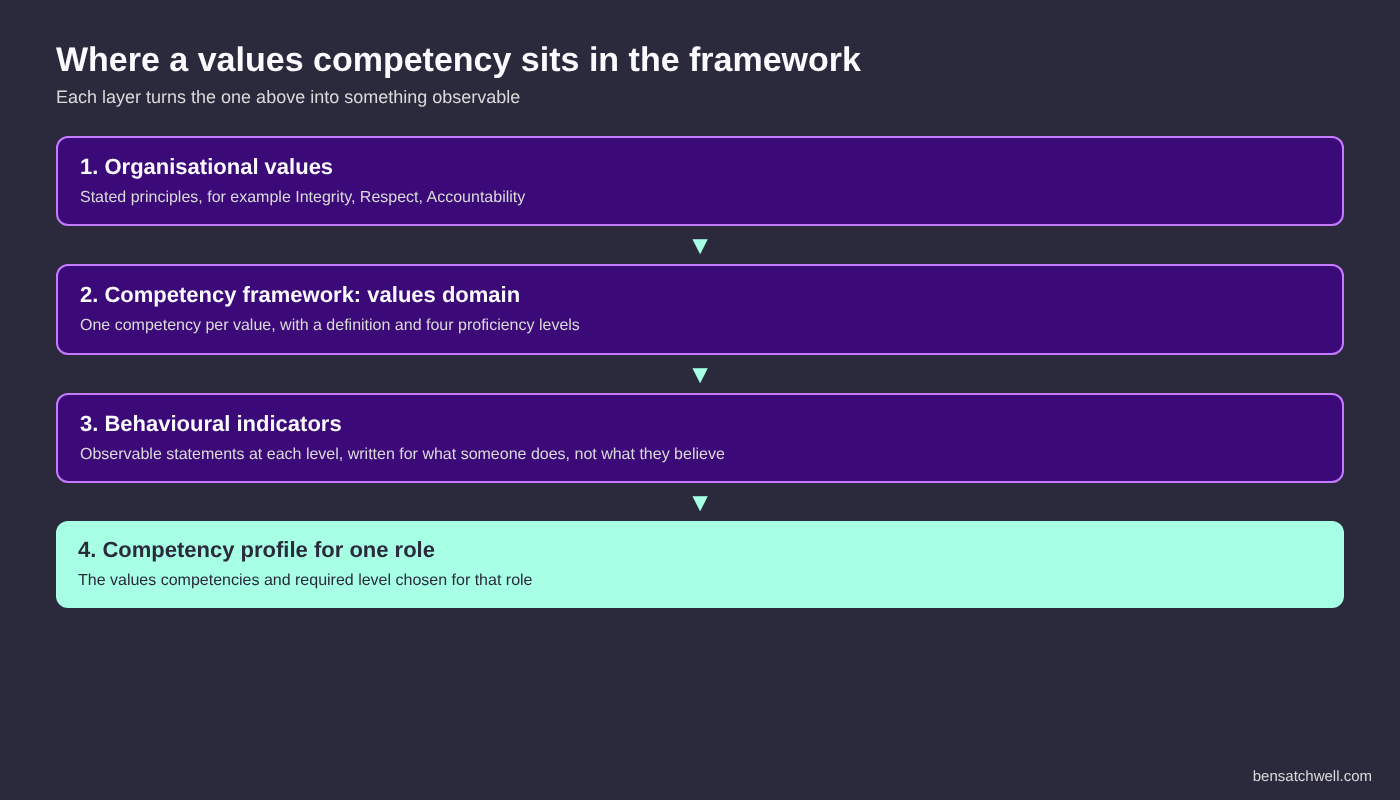
A competency values framework is a set of competencies built from an organisation's stated values, where each value has a definition, proficiency levels and behavioural indicators. It sits as a values domain inside the wider competency framework, next to technical and leadership domains.
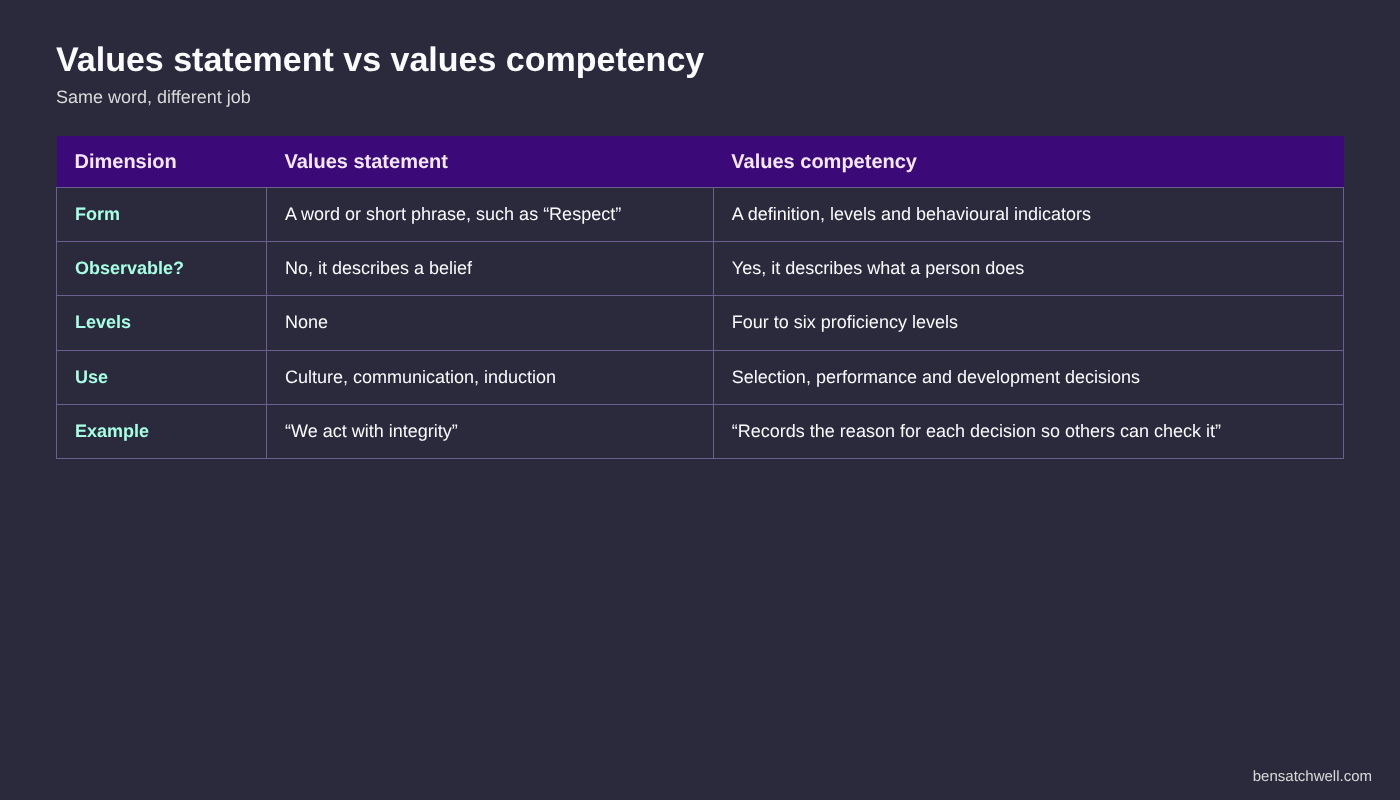
The test is simple. If a colleague can watch someone work and say whether the behaviour was shown, you have a competency. If the statement only describes what a person believes or feels, you have a values statement. Most organisations have the second and call it the first.
Public sector values are a good place to start, because they are published openly. The UK Civil Service Code names four core values (integrity, honesty, objectivity and impartiality) and defines each in a sentence. For example, it defines integrity as putting the obligations of public service above your own personal interests. That is a good definition. It is not yet a competency, because it carries no levels and no indicators.
Why do values need to become competencies?
Values exist to guide judgement where rules run out. The problem is that a value written as a single word cannot be used in a selection decision, a performance conversation or a development plan. People read it differently, and the strongest readings tend to be held by whoever is most senior.
The US Office of Personnel Management describes a competency as a measurable pattern of knowledge, skills, abilities, behaviours and other characteristics needed to perform work successfully, and notes that competencies specify the "how" of the work. Values are the "how" at its most basic. Turning them into competencies is what lets an organisation hire, assess and develop against them without relying on impressions.
A competencies and values framework does this on purpose. It keeps the values visible and attaches the evidence standard to them.
A note on terminology. A competency framework is also called a competency model, especially in the United States. I use competency profile for the competencies and required levels for one role, and competency matrix for the grid of required against current proficiency. Usage varies by region, and I explain the differences in this competency model definition.
How does a values competency work in practice?
Each values competency has the same five parts, and each part has a job.
- Name: the value, kept as the organisation already states it.
- Definition: one or two sentences on what the value means in work, not in life.
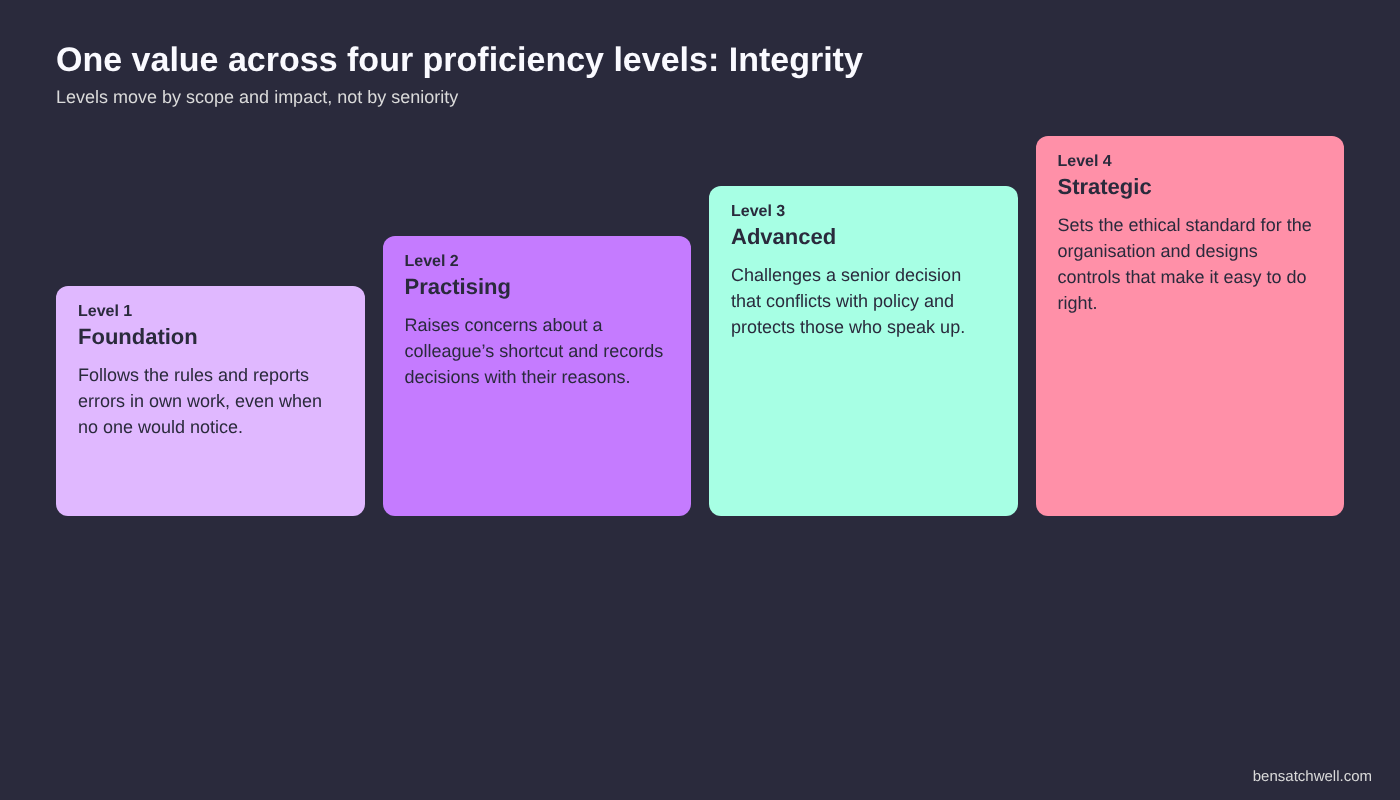
- Proficiency levels: usually four. Levels move by scope, autonomy and impact, not by seniority.
- Behavioural indicators: two to four observable statements for each level.
- Required level per role: set in the competency profile for that role.
The writing rule I hold to is that every indicator starts with a verb and describes something a person does. Words such as "believes", "values" or "cares about" are not behaviours. If you need help separating the two, my post on how to define behaviours sets out the method.
What are some competency values framework examples?
The examples below are my own draft wording, written to show the structure. Adapt the language to your organisation before you use any of it. Each shows the definition and the indicators at the lowest and highest levels, so the progression is visible.
Example 1: Integrity
Definition: Acting honestly and consistently, and putting the obligations of the role above personal interest.
- Level 1, Foundation: Follows policy and reports errors in own work, including when no one would notice.
- Level 4, Strategic: Sets the ethical standard for the organisation and designs controls that make it easy for others to do the right thing.
Example 2: Respect
Definition: Treating people fairly and listening to views that differ from your own.
- Level 1, Foundation: Listens without interrupting and responds to requests within agreed times.
- Level 4, Strategic: Shapes policies and practices so that people with different backgrounds and working patterns can contribute fully.
Example 3: Accountability
Definition: Taking ownership of outcomes, including the ones that go wrong.
- Level 1, Foundation: Completes assigned work to the agreed standard and says early when a deadline is at risk.
- Level 4, Strategic: Accepts accountability for results across the organisation and ensures decisions are recorded with their reasons.
Example 4: Collaboration
Definition: Working with others across boundaries to reach a shared result.
- Level 1, Foundation: Shares information with the team and asks for input before finalising work.
- Level 4, Strategic: Builds working arrangements between functions and resolves competing priorities at the executive level.
The same structure appears in published public sector frameworks. The NSW Public Sector Capability Framework, for instance, is described as a tool for designing roles, recruiting, supporting performance development and planning careers. That is the standard to aim for with values: a structure people can use to make decisions, not a poster.
What is a competency values framework not?
It is not a values statement. A values statement describes what an organisation stands for, and it works for culture and communication. A values competency describes what a person does, and it works for selection and performance decisions.
It is not a code of conduct. A code lists required and prohibited actions. A competency describes a range of proficiency, from meeting the minimum to shaping the standard for others.
It is not a behavioural competency framework in full. Values competencies are one domain within it, alongside communication, problem solving and the other behavioural areas. And it is not a personality test. The indicators describe behaviour at work, not traits.
Where do competency values frameworks fail?
Four failure modes come up repeatedly.
- Values copied from the website. The wording is aspirational, so the indicators end up describing an ideal person rather than observable work.
- Too many values. Seven values with four levels and four indicators each is 112 statements. Nobody will use them. Keep the set to what the organisation will actually assess.
- Levels that mean seniority. If Level 4 integrity only appears for executives, you have told everyone else that the value is optional. Levels should differ by scope and impact, and every role needs a defined level for every value.
- No assessment path. If the indicators never appear in selection, performance conversations or development plans, they stay on the page.
What are the trade-offs of building values into a competency framework?
Use values competencies when the organisation needs to make decisions about people against its values: recruitment, promotion, performance and development. Do not use them to police culture. Assessing someone against "respect" is only fair if the indicators are specific and the assessor has seen the behaviour.
There is a cost in maintenance and consistency. Values change less often than technical skills, but the examples that illustrate them date quickly. Review the indicators when the values are revised, and keep the number of indicators small enough that a manager can recall them without reading the document.
If you are building the full framework, my guide to competency framework examples shows the wider set of domains the values sit inside.
Frequently asked questions
What is an example of a values-based competency?
Integrity is a common one. Its definition is acting honestly and consistently, and its Level 1 indicator is that the person follows policy and reports errors in their own work, including when no one would notice. Higher levels describe challenging decisions and setting standards for others.
How many values should a competency framework include?
Between three and six. Each value needs a definition, four levels and several indicators, so every additional value adds substantial content that someone has to maintain and assess.
What is the difference between a value and a competency?
A value is a principle the organisation holds. A competency is a defined, levelled description of behaviour that can be observed and assessed. A values competency is the version of a value that has been written as a competency.
How do you write behavioural indicators for a value?
Start each indicator with a verb, describe something a colleague could observe, tie it to a proficiency level through scope and impact, and avoid words such as "believes" or "cares". Test each one by asking whether two managers would agree on whether it was shown.
Can values competencies be assessed fairly?
Yes, if assessment is based on observed behaviour against written indicators. It becomes unfair when assessors rely on impressions or when the indicators describe personality instead of work.