
In my work designing and reviewing capability and competency frameworks, behaviours are where things most often go wrong, not because they’re unimportant, but because they’re overloaded. Behaviours are routinely asked to explain performance, signal values, predict potential, and drive culture, all at once.
What I consistently see is this: behaviours are powerful when they’re used precisely, and deeply confusing when they’re used as proxies for outcomes. This article clarifies what behaviours actually are, why they’re so frequently conflated with other constructs, and where they add real value in workforce systems.
How Behaviours Are Commonly Defined
Authoritative frameworks tend to converge on a similar view of behaviour.
In workforce and learning literature, behaviours are described as observable actions that reflect how a person applies knowledge and skills in context. The European Commission’s DigComp framework frames closely related attitudes as dispositions or mindsets that influence how someone acts or reacts, which behaviours then make visible.
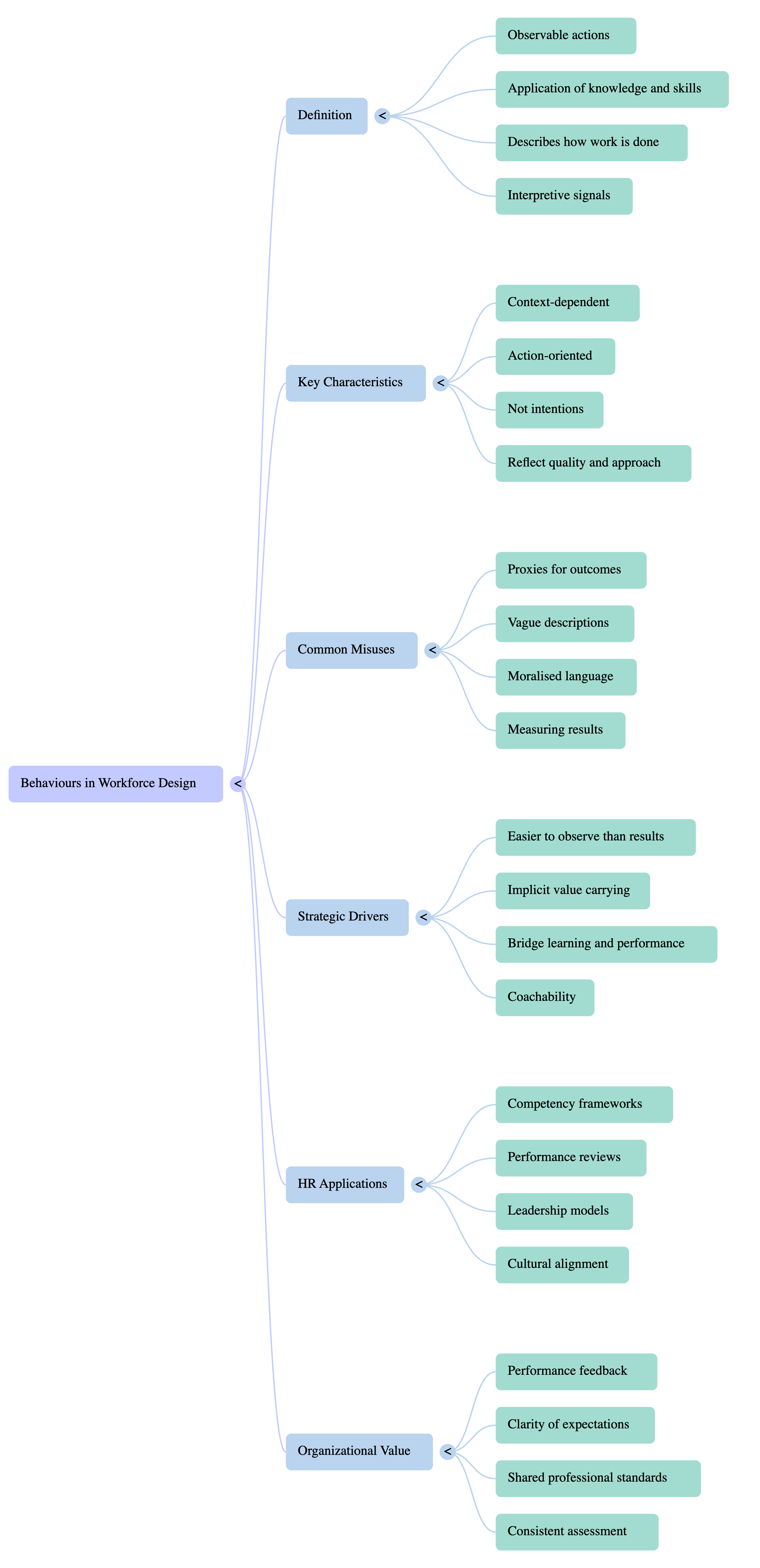
Across standards-aligned frameworks, behaviours:
- are observable,
- are expressed through action,
- describe how work is done rather than what is done.
From what I see, behaviours sit at the intersection of capability, competence, and culture, which is precisely why they’re so easy to misuse.
What the Dictionary Gets Right and What It Misses
Dictionary definitions usually describe behaviour as the way a person acts or conducts themselves. That’s broadly accurate, but incomplete for organisational use.
It gets the core right: behaviours are actions, not intentions.
What it misses is that, in HR systems, behaviours are rarely neutral. They are selected, framed, and interpreted against expectations. A behaviour only has meaning when it’s judged against a context, a standard, or a value set.
In practice, I see organisations treat behaviours as self-evident truths, when in fact they’re interpretive signals.
Why Behaviours Get So Heavily Conflated in HR
Behaviours are where multiple agendas collide.
Several structural forces drive their conflation:
- They’re easier to observe than outcomes
When results are delayed or diffuse, behaviours become a convenient stand-in. - They carry values implicitly
Many behavioural statements are value judgements in disguise, which gives them cultural weight. - They bridge learning and performance language
Behaviours appear in both competency and capability frameworks, often without clear distinction. - They feel coachable
Managers are more comfortable discussing behaviours than skills or systems.
The result is that behaviours get used as evidence, aspiration, and diagnosis, all at once.
The Problem Behaviours Were Originally Designed to Solve
Behaviours exist to solve quality of execution.
In my work, behaviours are most effective when they:
- describe how knowledge and skills are applied,
- make expectations explicit,
- enable consistent observation and feedback,
- support shared standards of professionalism.
Behaviours answer the question:
How is this work carried out?
They do not answer:
- whether the work achieved the right outcome,
- whether the person has the underlying skill,
- whether the system enabled success.
When behaviours are treated as outcomes rather than signals, assessment becomes distorted.
How Behaviours Are Used in the HR Profession Today
Across organisations I work with, behaviours show up in predictable places:
- Competency frameworks as behavioural indicators
- Performance reviews as feedback anchors
- Leadership models as value expressions
- Culture and engagement initiatives
This works well when behaviours are clearly anchored to:
- context,
- expectations,
- and observable examples.
It breaks down when behaviours are vague (“demonstrates leadership”), moralised (“shows commitment”), or detached from evidence. I often see people penalised or praised for behaviours without clarity on what success actually looked like.
A Clear, Practical Definition of Behaviours (My Position)
From both standards and applied practice, this is the definition I work with:
Behaviours are observable actions that describe how a person applies knowledge and skills in a given context.
They provide insight into quality, intent, and approach, but they are not outcomes in themselves.
Behaviours answer “how was the work done?”
They do not answer “did it work?”
What This Definition Supports and What It Doesn’t
Used well, behaviours support:
- performance feedback and coaching,
- clarity of expectations,
- cultural alignment,
- consistency in assessment conversations.
They are poorly suited for:
- measuring results or impact,
- inferring skill proficiency,
- predicting potential in isolation,
- standing in for system or process issues.
When behaviours are treated as proof rather than indicators, organisations end up managing impressions instead of performance.
Why Getting This Right Actually Matters
Behaviours shape how work feels and how it’s experienced, which matters deeply. But from what I see, they’re most valuable when they’re treated as signals, not verdicts.
Used precisely, behaviours improve feedback, fairness, and clarity. Used loosely, they become subjective, politicised, and exhausting.
Clarity here protects both people and systems.