


Most organisations that ask for a communication competency framework actually want a list of soft skills with better production values. That is not the same thing, and treating it as if it were is why so many of these frameworks get written, printed into a PDF, and never looked at again. A real communication competency framework does a specific job: it defines what effective communication looks like as observable behaviour, at defined levels, so it can be assessed and developed consistently across a workforce. Anything less is a poster.
What Is a Communication Competency Framework?
A communication competency framework is a structured definition of the communication behaviours a person needs to perform effectively in a role, set out across proficiency levels with observable indicators attached to each level. It is not a single skill and not a personality trait. It is the integration of knowledge (understanding your audience and context), skill (structuring and delivering a message), and judgement (knowing what to say, how, and when) into behaviour that can be watched and rated.
This puts a communication competency framework inside the broader family of a competency framework: an organisation-wide system that defines competencies, groups them into domains, and attaches levelled, observable indicators so the same competency means the same thing wherever it appears. Communication is almost always one of the behavioural or interpersonal competencies inside that wider system, sitting alongside things like collaboration, influencing, and stakeholder management.
Why Does a Communication Competency Framework Exist?
It exists because "communication skills" is one of the most inconsistently assessed things in most organisations. Ask ten managers what good communication looks like in a given role and you will get ten different answers, most of them about tone or likeability rather than performance. A communication competency framework exists to replace that subjectivity with a shared, levelled definition that can be applied the same way in recruitment, performance review, promotion decisions, and development planning.
There is also a structural reason. Communication is frequently treated as a core competency, meaning every person in the organisation is expected to demonstrate it regardless of role, rather than a technical competency specific to one job family. That makes it one of the few competencies that has to work equally well for a graduate analyst and a chief executive, just expressed at different levels of scope and complexity. Without a framework, "communicates effectively" ends up meaning something different at every level of the organisation, which defeats the purpose of calling it a shared expectation at all.

How Does a Communication Competency Framework Work in Practice?
In practice, a communication competency framework has three working parts.
A definition. A precise statement of what the competency covers: verbal and written communication, active listening, structuring information for an audience, and adjusting message and channel to context. This definition has to be specific enough that two assessors would rate the same behaviour the same way.
Proficiency levels. Most workable versions use four to six levels, set by scope, autonomy, and complexity, not by seniority or tenure. A junior team member might be expected to communicate clearly within their immediate team. A senior leader is expected to communicate through ambiguity, across functions, and under scrutiny. Same competency, different scope.
Behavioural indicators. Written, observable statements attached to each level, describing what someone actually does, not how they feel about doing it. "Adapts message and tone to different stakeholder groups" is a usable indicator. "Is a strong communicator" is not, because it cannot be independently observed or rated.
Once those three parts exist, the framework can be applied through a competency assessment framework: raters use the indicators as evidence prompts, comparing observed behaviour against the level descriptors rather than forming a general impression.

Communication competency is one of the clearest examples of why the SHRM Body of Applied Skills and Knowledge names Communication among its behavioural competencies for HR professionals, rather than folding it into technical knowledge, treating it as a distinct, assessable capacity rather than a background skill everyone is assumed to already have.
What a Communication Competency Framework Is Not
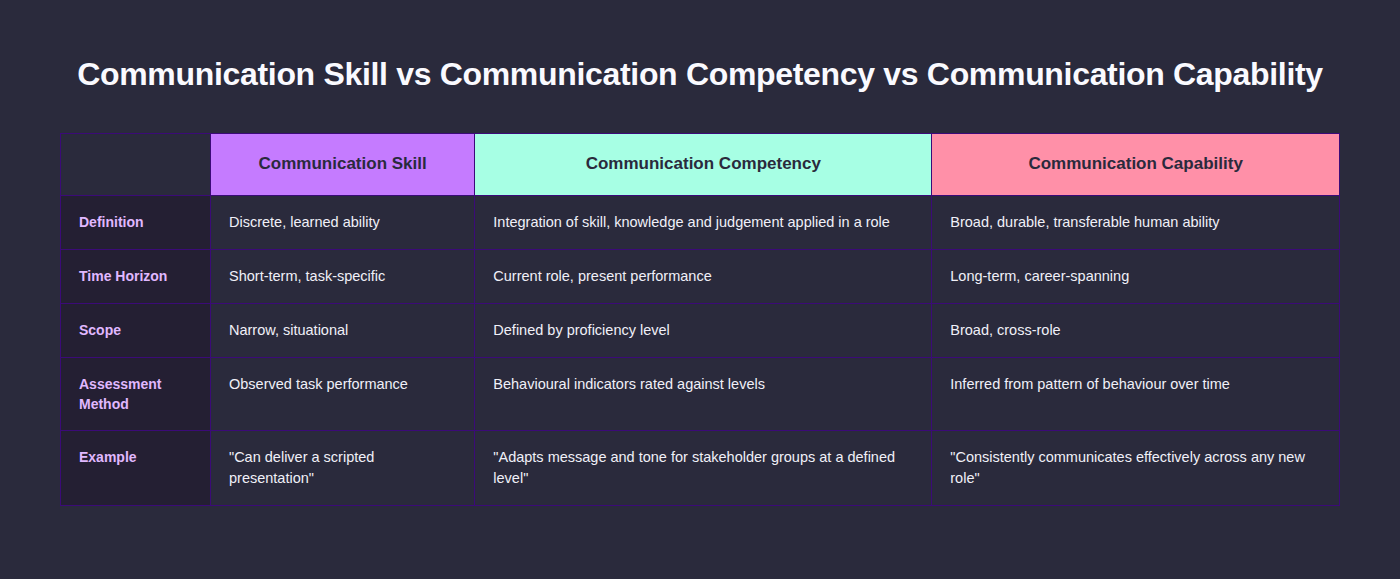
It is not a skills list. A skill is a discrete, learned ability, such as public speaking or facilitation. Communication competency is the integration of several skills with knowledge and judgement, applied in context. Listing "public speaking, active listening, written communication" as bullet points is a skills inventory, not a competency framework, because it has no proficiency levels and no behavioural indicators attached.
It is not a capability. This is the distinction people get wrong most often, and it matters. A capability is a broad, durable area of ability that a person carries across roles and contexts, and it signals potential for future roles rather than performance in the current one. Communication is frequently described in the market as a "soft skill," but by a stricter definition it behaves more like a capability than a discrete skill: broad, transferable, and not tied to one task. A communication competency framework narrows that broad human capability down to what "effective communication" specifically requires and looks like inside one role, at one level, right now. The capability is the raw material. The competency is the applied, levelled, role-specific version of it.
It is not a personality assessment. Communication competency frameworks describe behaviour, not disposition. Someone who is naturally quiet can still meet every indicator in a well-designed framework, because the indicators describe what is done, not how extroverted someone is while doing it.
Named Models and Standards That Reference Communication Competency
Communication rarely appears as a standalone framework. It shows up as a named competency inside larger, more established models. SHRM's competency model, used across HR certification and career development in the United States, names Communication as one of nine core behavioural competencies expected of HR professionals, defined around the ability to craft, deliver, and adapt information across organisational levels.
The academic foundation for most modern communication competency work traces back to Spitzberg and Cupach's relational model of communication competence, which frames competent communication as the product of knowledge (understanding what behaviour suits a situation), skill (the capacity to enact it), and motivation (the will to communicate appropriately). Most workplace competency frameworks compress this into observable behavioural indicators, but the underlying logic, that competence is an integration rather than a single trait, comes directly from that research line.
The CIPD's guidance on employee communication approaches the same territory from an organisational angle, treating effective internal communication as connected to employee voice and engagement rather than as an individual behavioural competency. That is a useful contrast: CIPD's material is largely about organisational communication systems, while a communication competency framework is about the individual behaviour that makes those systems work.
Common Failure Modes in Communication Competency Frameworks
The most common failure is writing indicators as adjectives instead of behaviours. "Excellent communicator" tells an assessor nothing they can act on. "Structures written updates so the recommendation appears in the first paragraph" does.
The second is collapsing all levels into one description and expecting managers to interpret seniority themselves. If the level 2 and level 5 indicators for communication read almost identically, the framework has not actually defined progression, it has defined a single bar and called it a scale.
The third is designing the framework around what is easy to write rather than what is actually observed. Communication is genuinely harder to assess consistently than a technical skill, because the evidence is behavioural and context-dependent. Frameworks that skip straight to a rating scale without real behavioural indicators tend to produce inconsistent, argument-prone assessment cycles, which is usually when the exercise gets quietly abandoned.
When a Communication Competency Framework Is (and Isn't) the Right Tool
A communication competency framework is the right tool when an organisation needs consistent, comparable assessment of communication across many roles and levels, particularly where communication sits inside performance reviews, promotion criteria, or leadership development decisions.
It is the wrong tool, or at least an incomplete one, when the actual problem is organisational: unclear reporting lines, absent internal communication channels, or a leadership team that does not share information downward. No amount of individual-level behavioural indicators fixes a structural communication failure. That is a systems and process problem, not a competency gap, and treating it as one just puts the accountability on individuals for a failure that belongs to the organisation.
It is also not the right first move for a small organisation without an existing competency framework. Building a standalone communication competency framework before the broader competency architecture exists usually produces something disconnected from proficiency levels, domains, and assessment processes used everywhere else, which undermines the consistency it was meant to create.
Frequently Asked Questions
Is communication a skill or a competency?
Communication itself functions more like a capability, broad and transferable across contexts. A communication competency framework narrows that capability down to specific, levelled, observable behaviours required in a defined role, which is what makes it a competency rather than a skill or a general trait.
What are examples of communication competency indicators?
Usable indicators are behavioural and specific, such as "presents complex information in plain language for non-specialist audiences" or "adjusts message and channel based on stakeholder urgency." Vague indicators like "communicates well" are not usable because they cannot be independently observed.
How many proficiency levels should a communication competency have?
Most workable frameworks use four to six levels, defined by scope, autonomy, and complexity of the communication required, not by job title or years of experience.
Is communication a core competency or a technical competency?
It is almost always treated as a core competency, meaning every person in the organisation is expected to demonstrate it at some level, expressed differently depending on seniority and role complexity.
Can a communication competency framework fix poor internal communication?
No. It can improve the consistency of individual assessment and development, but it cannot resolve organisational-level communication failures such as unclear reporting lines or absent communication channels. That requires structural change, not individual competency assessment.
Does SFIA or SHRM define communication competency the same way?
No single standard owns the definition. SHRM's competency model names Communication as one of nine core behavioural competencies for HR professionals. Broader skills frameworks like SFIA focus on technical and role-specific skills rather than behavioural competencies, so communication is more consistently addressed through behavioural competency models than through skills-based frameworks.